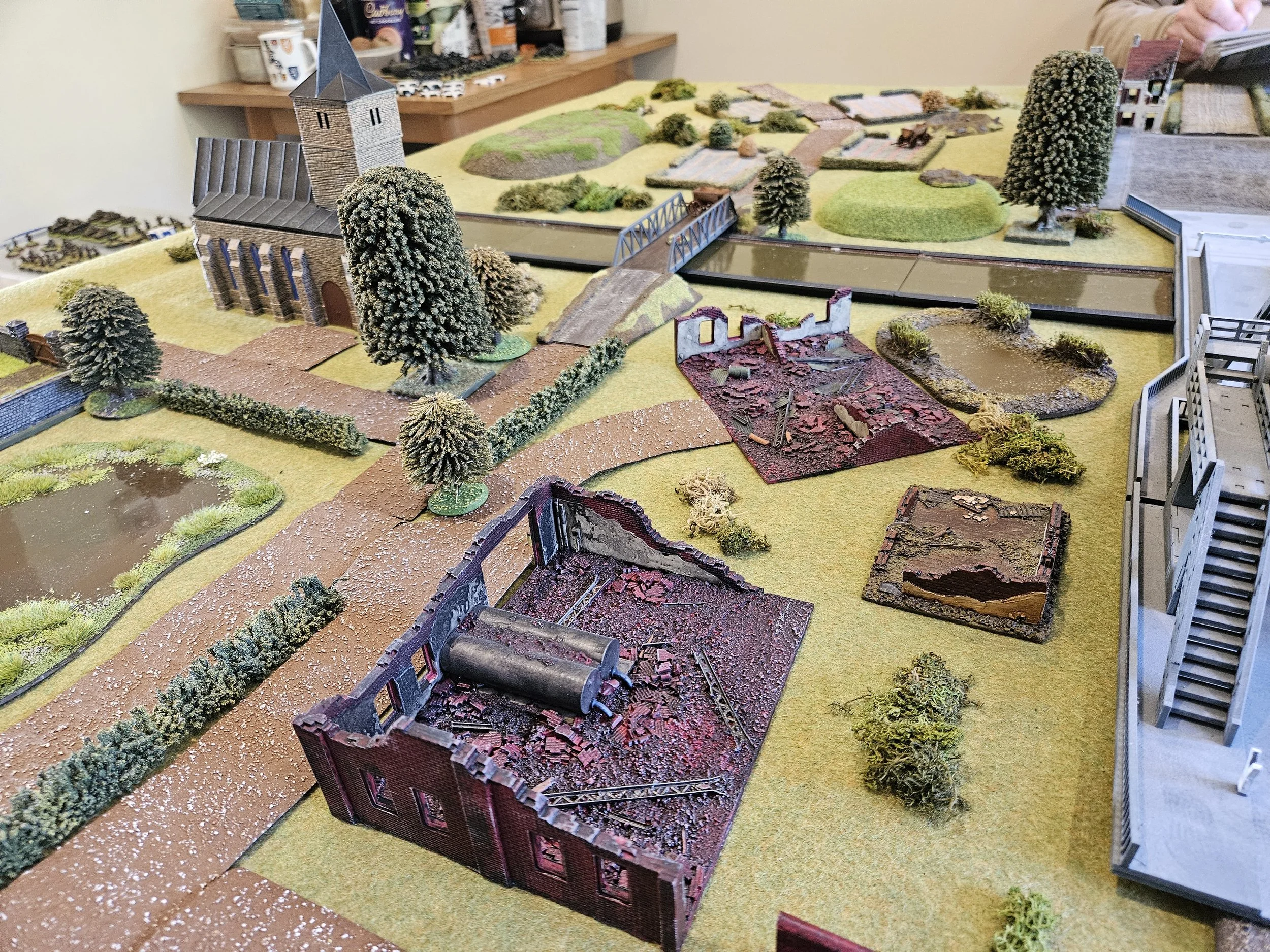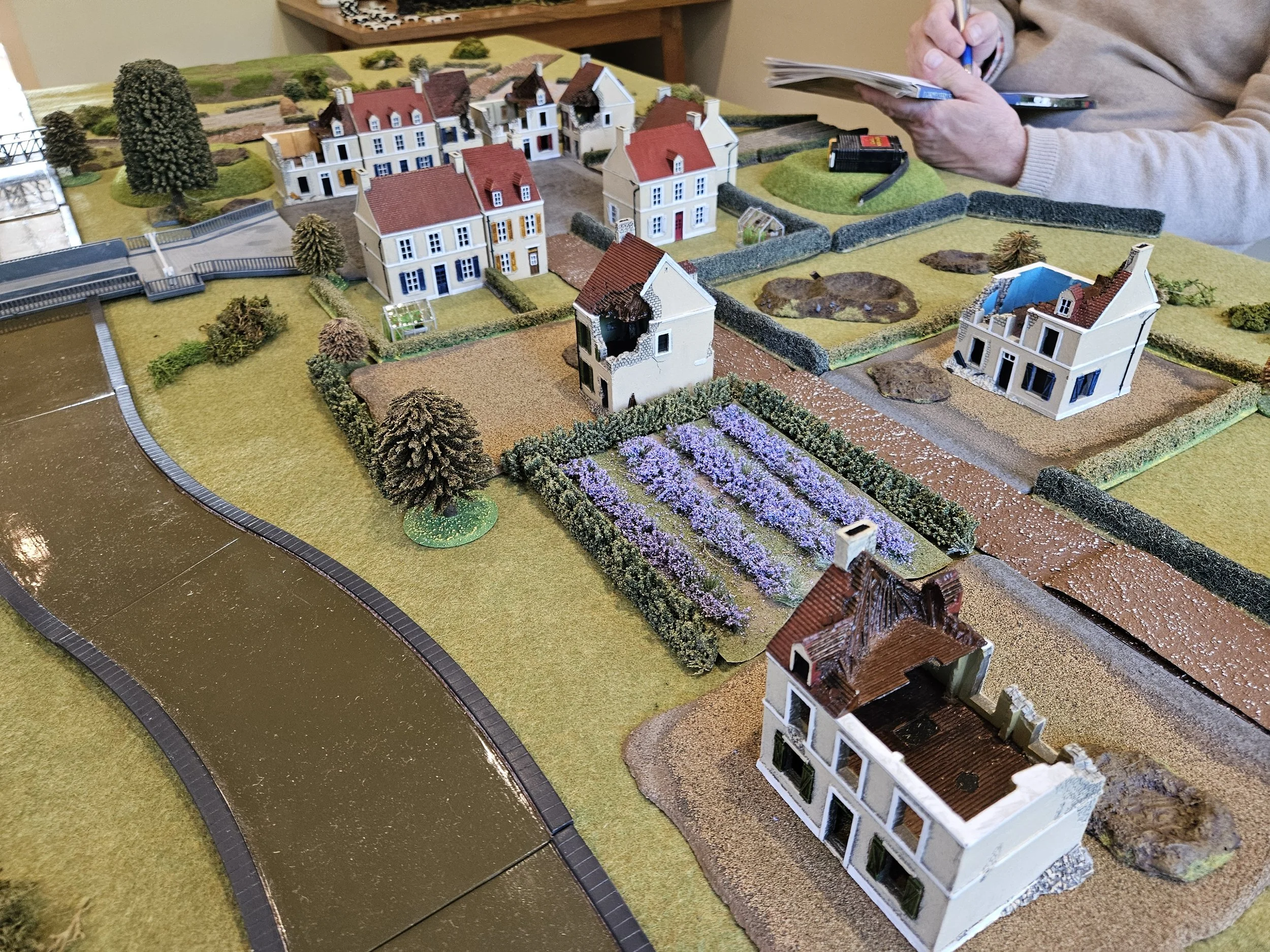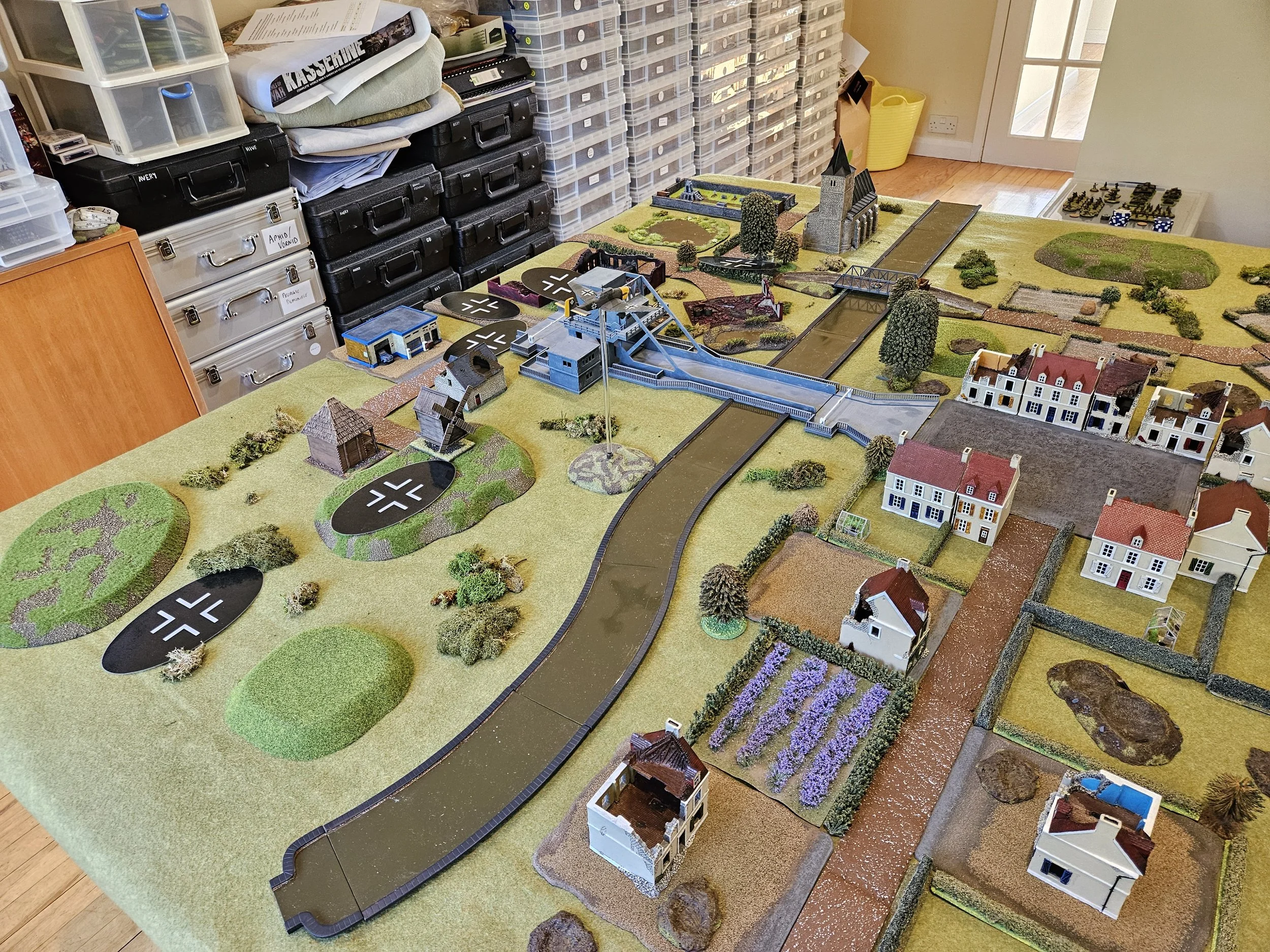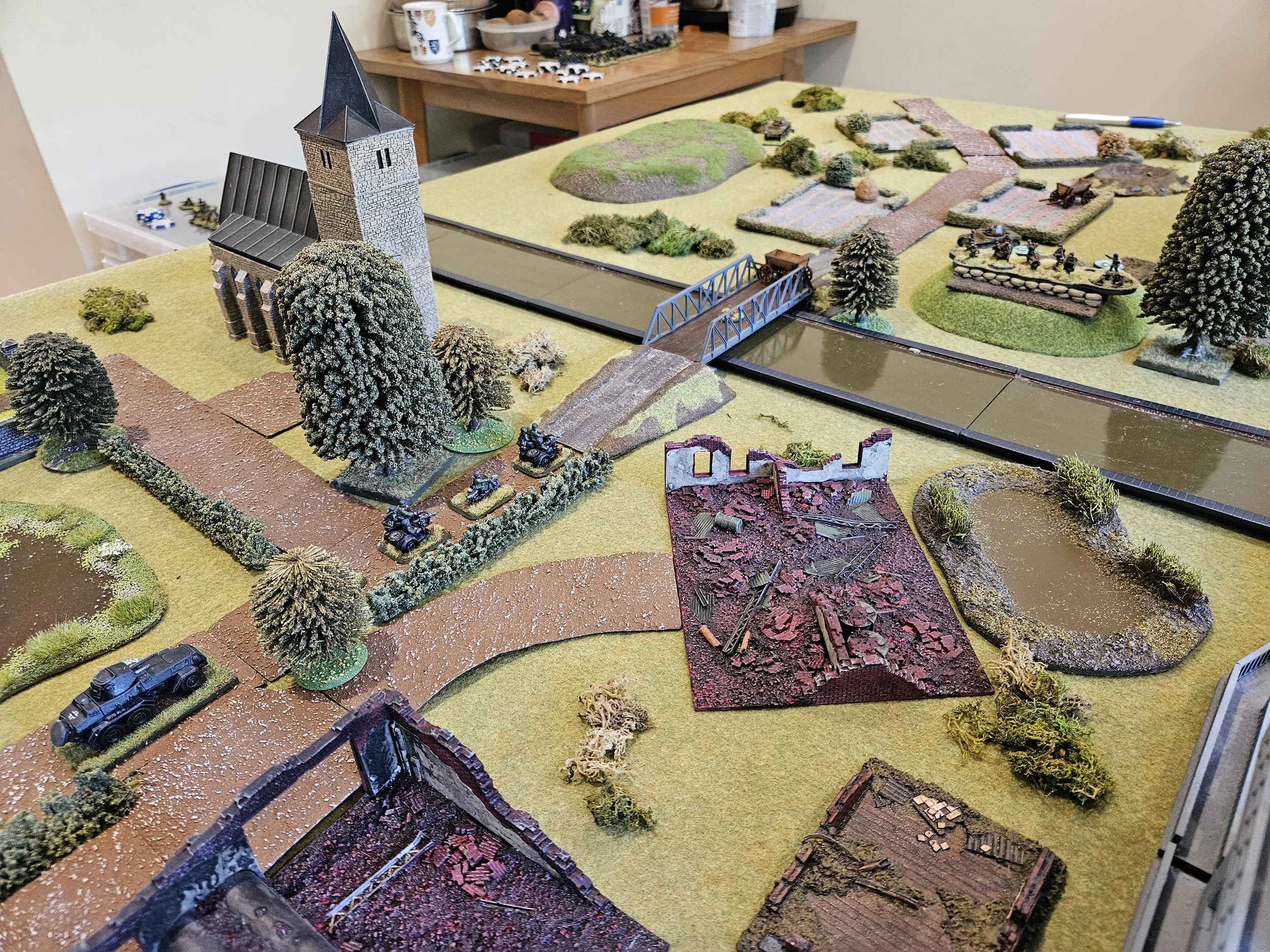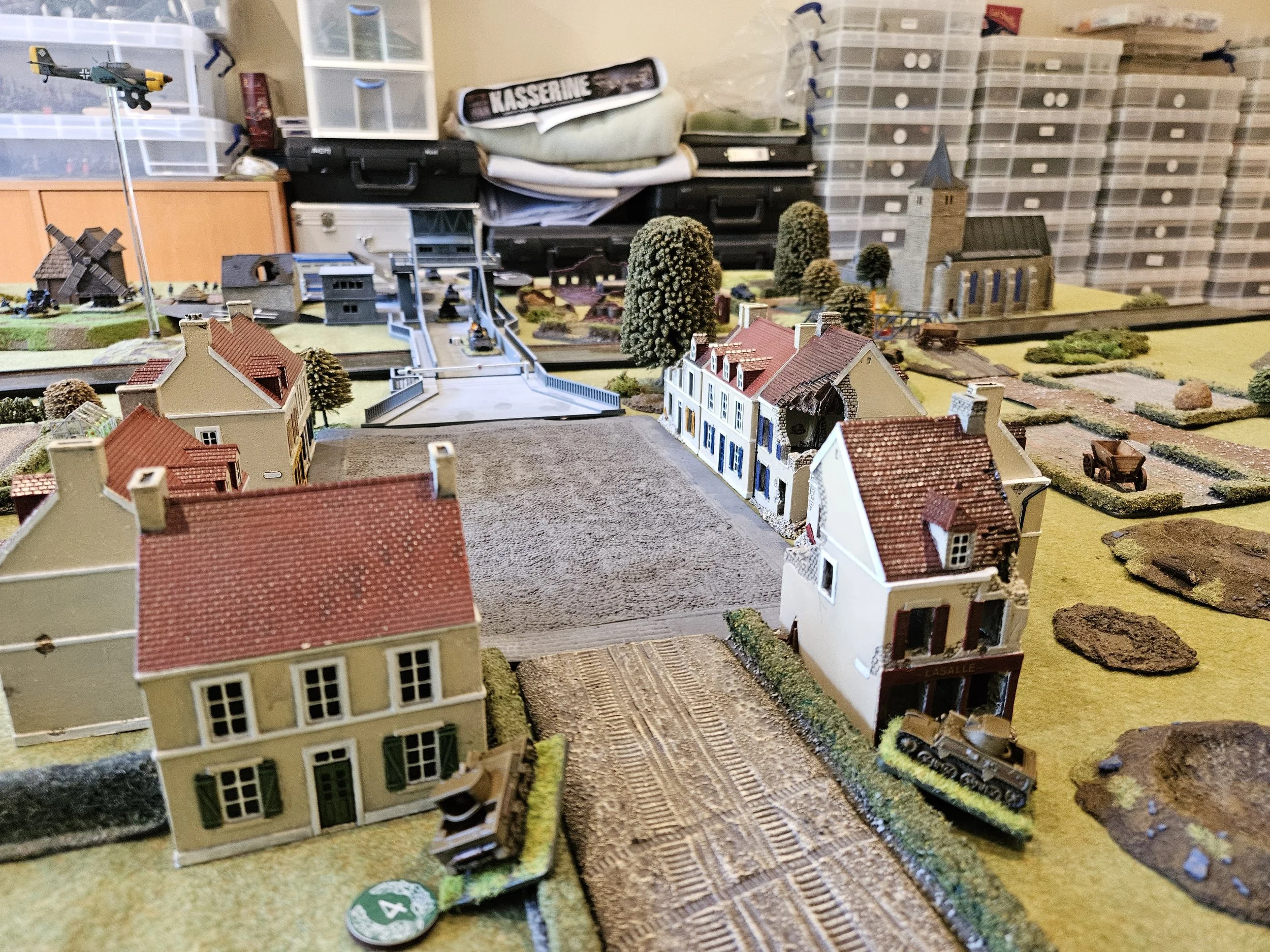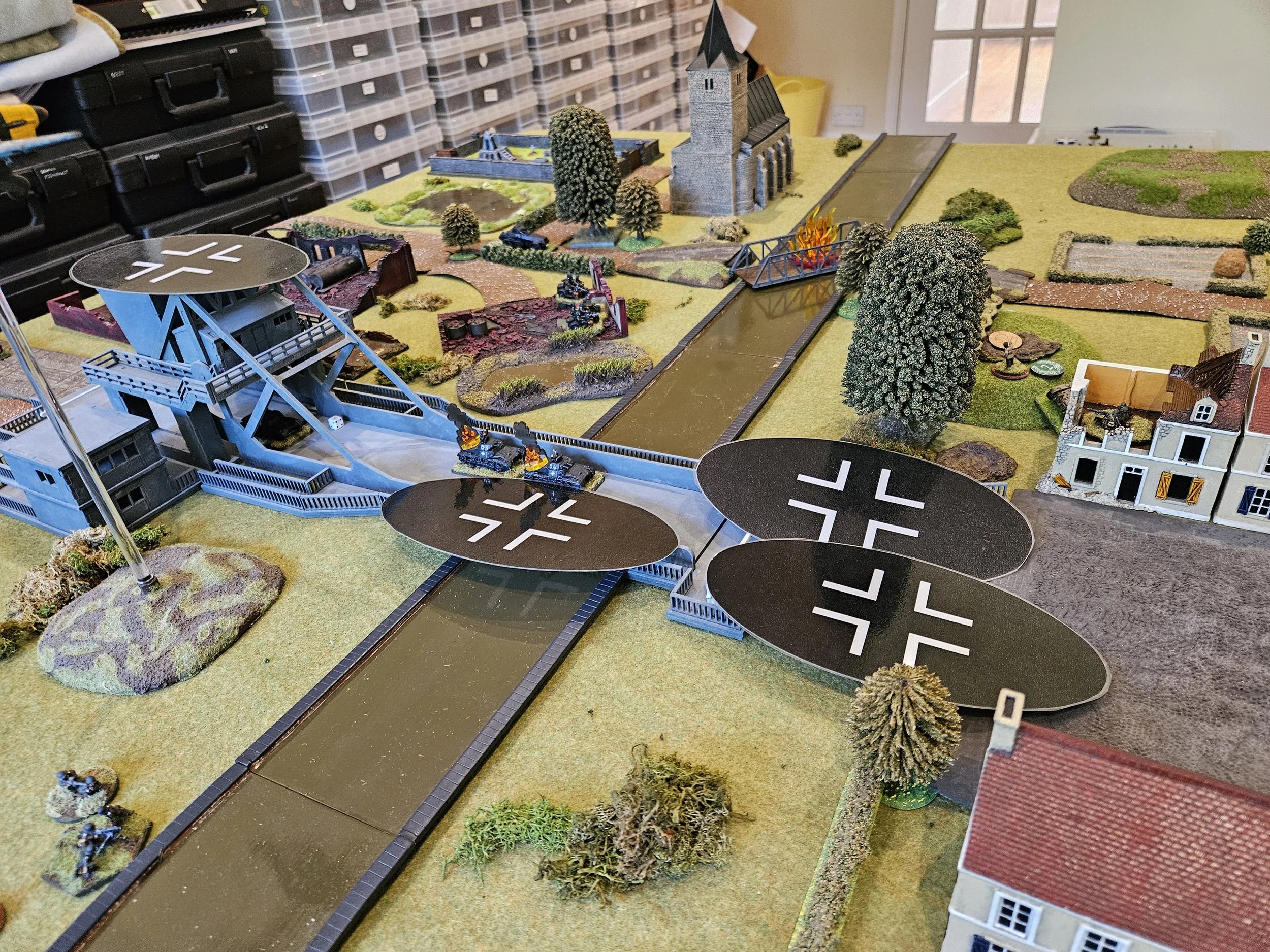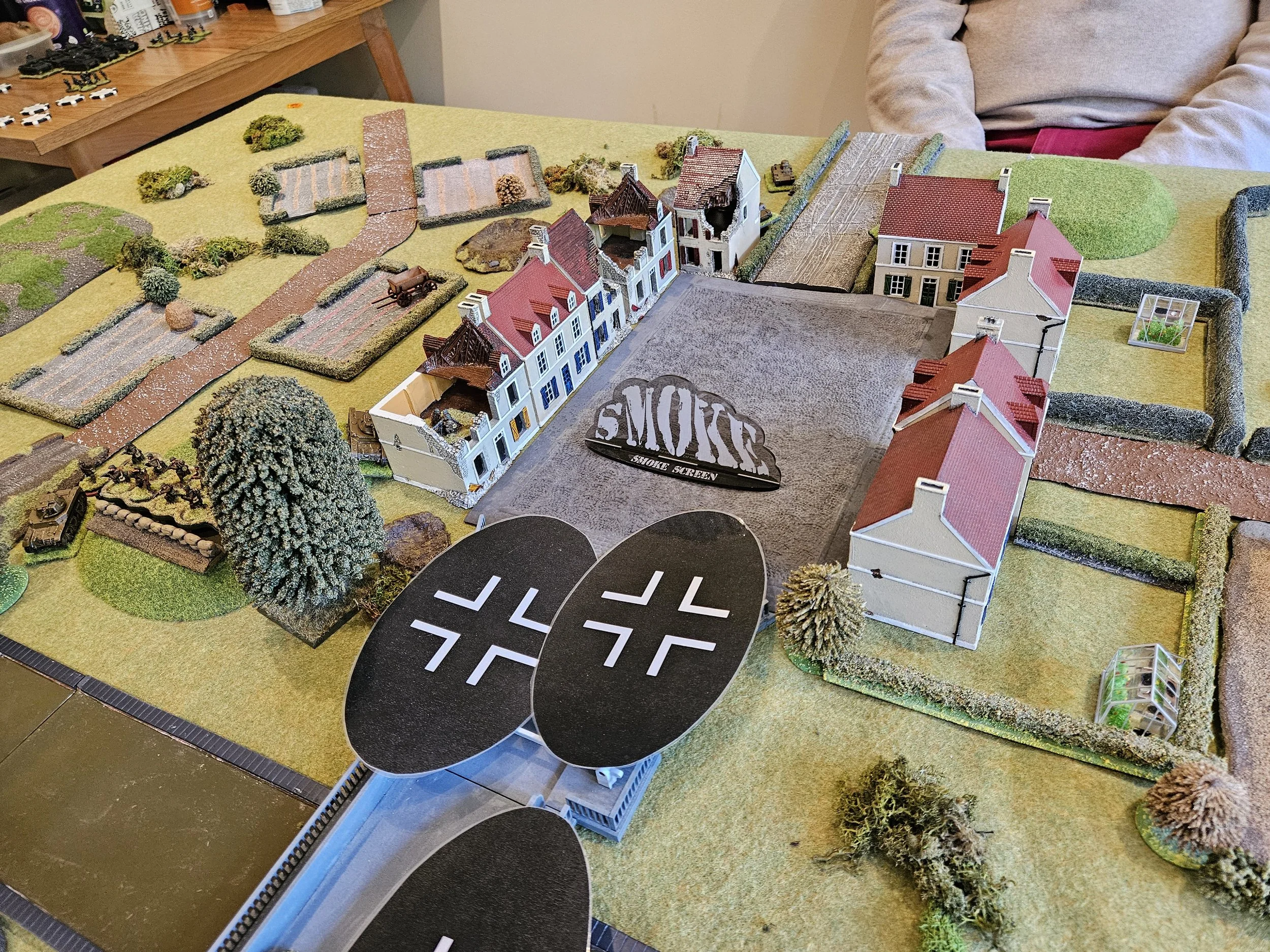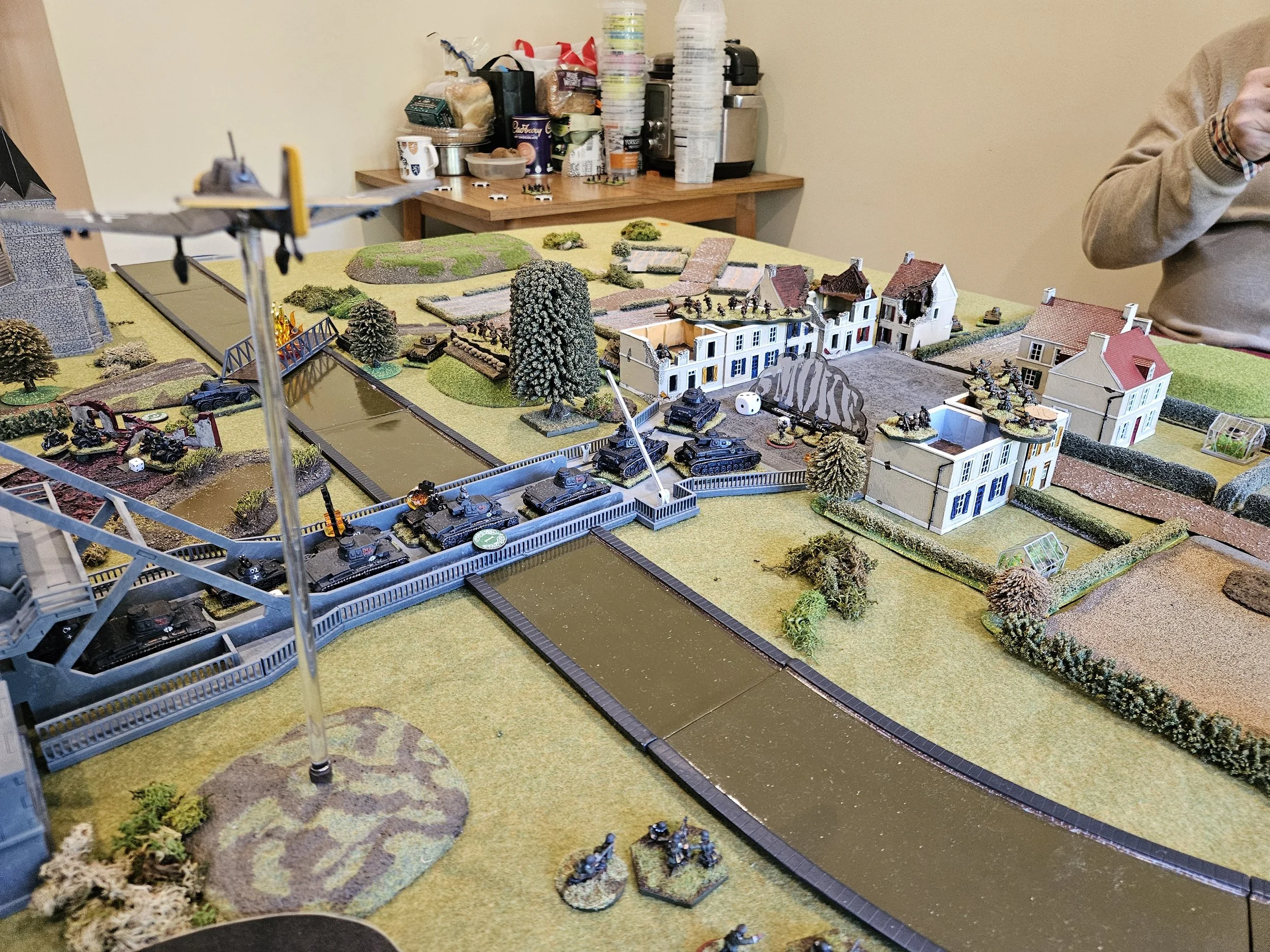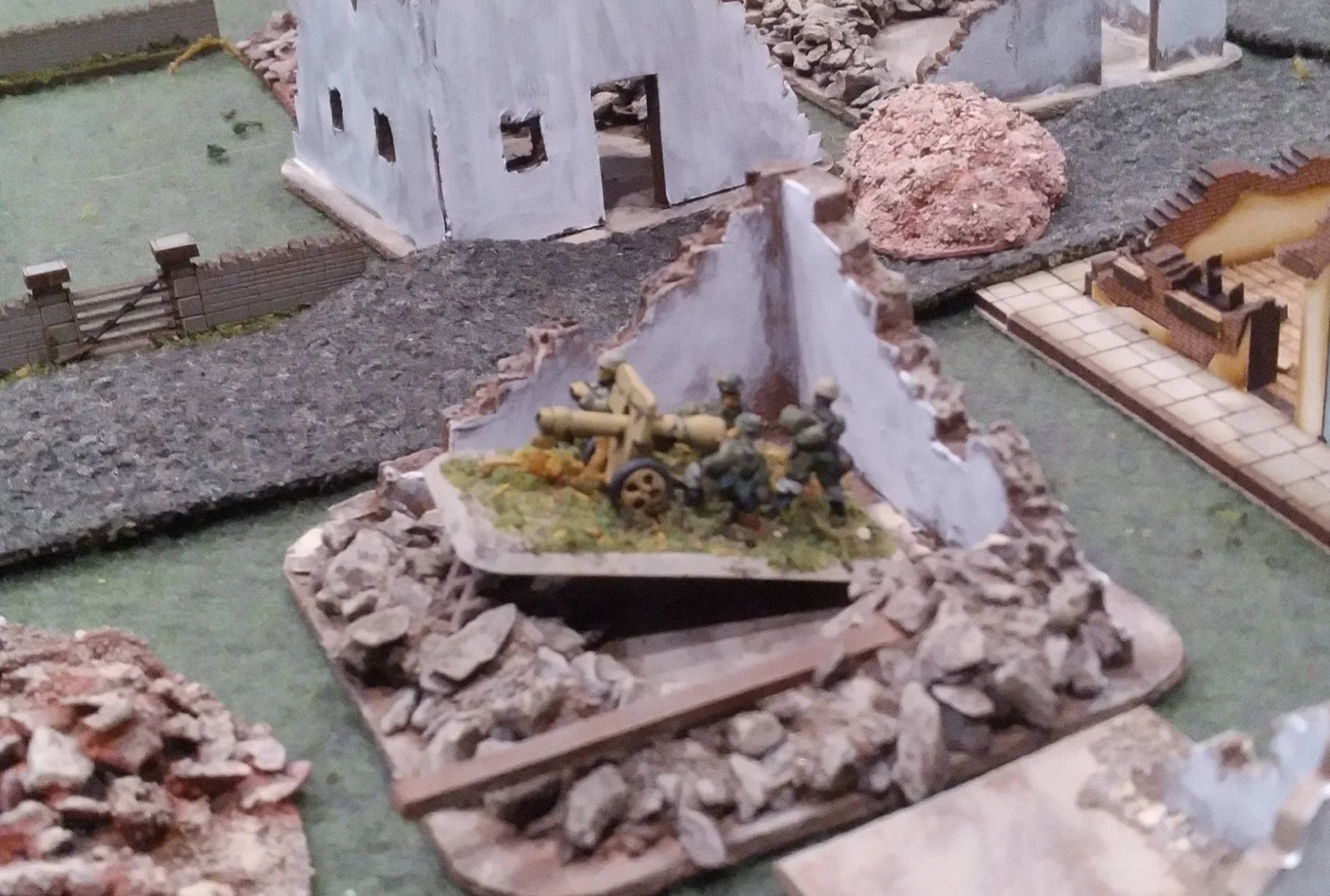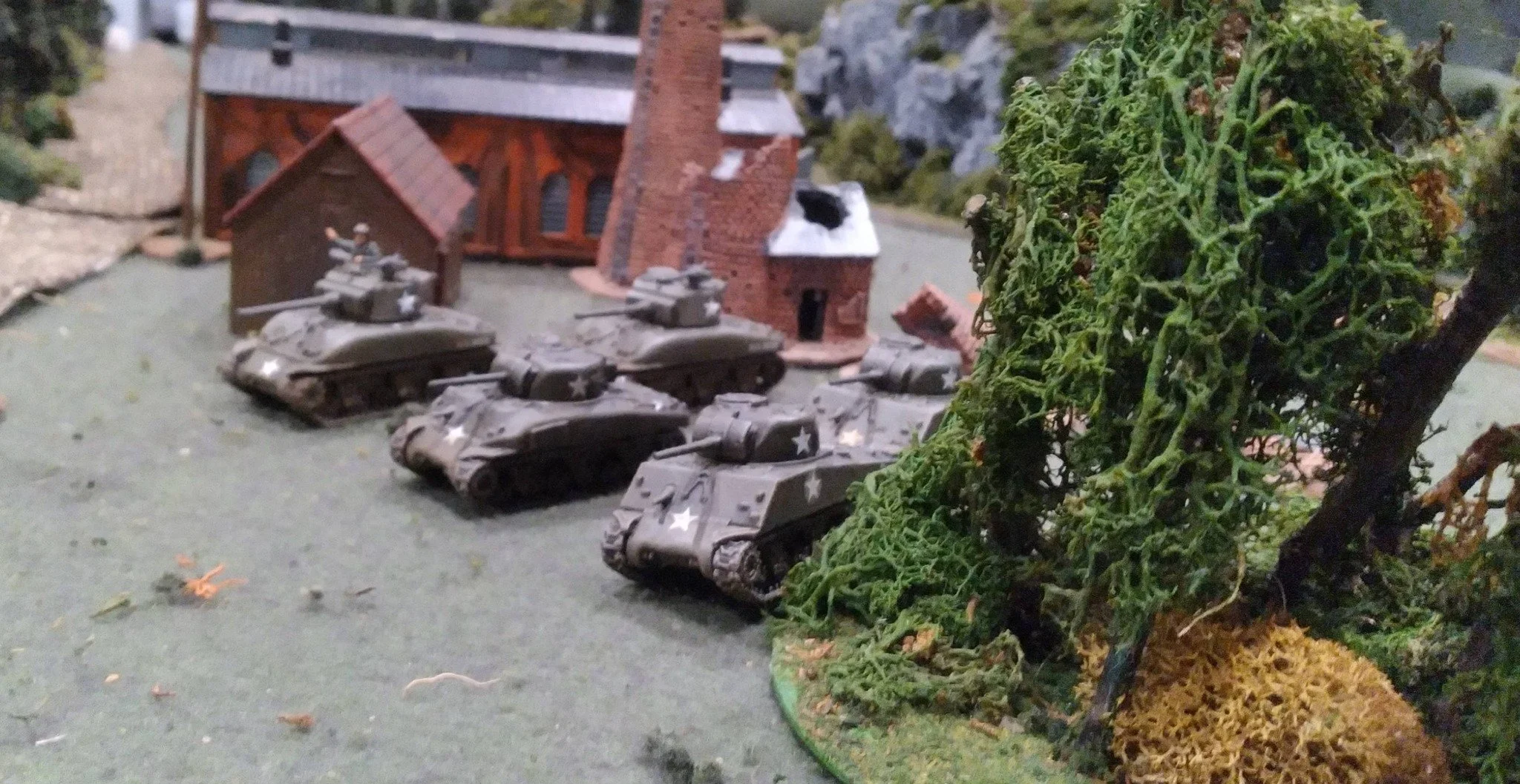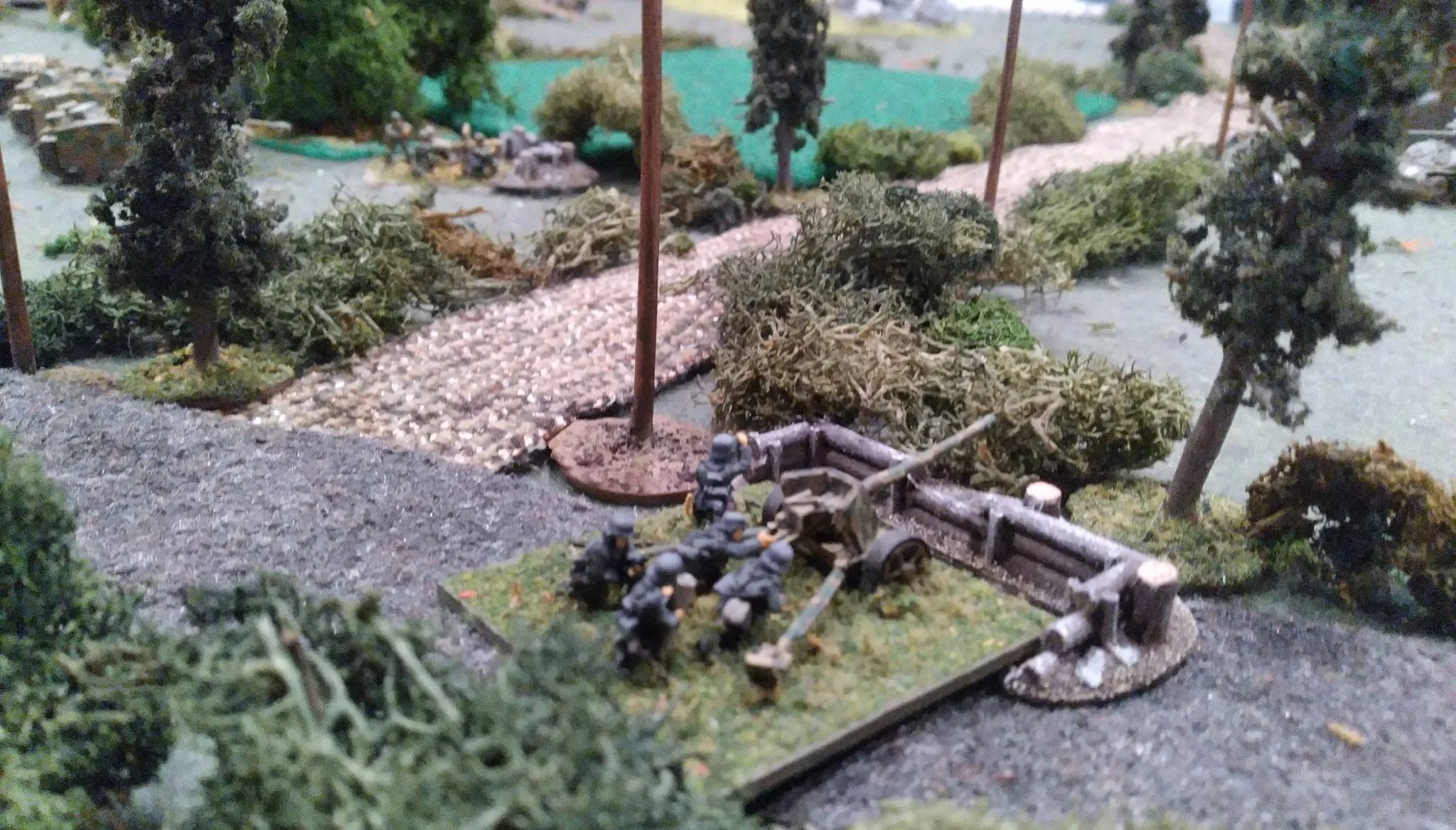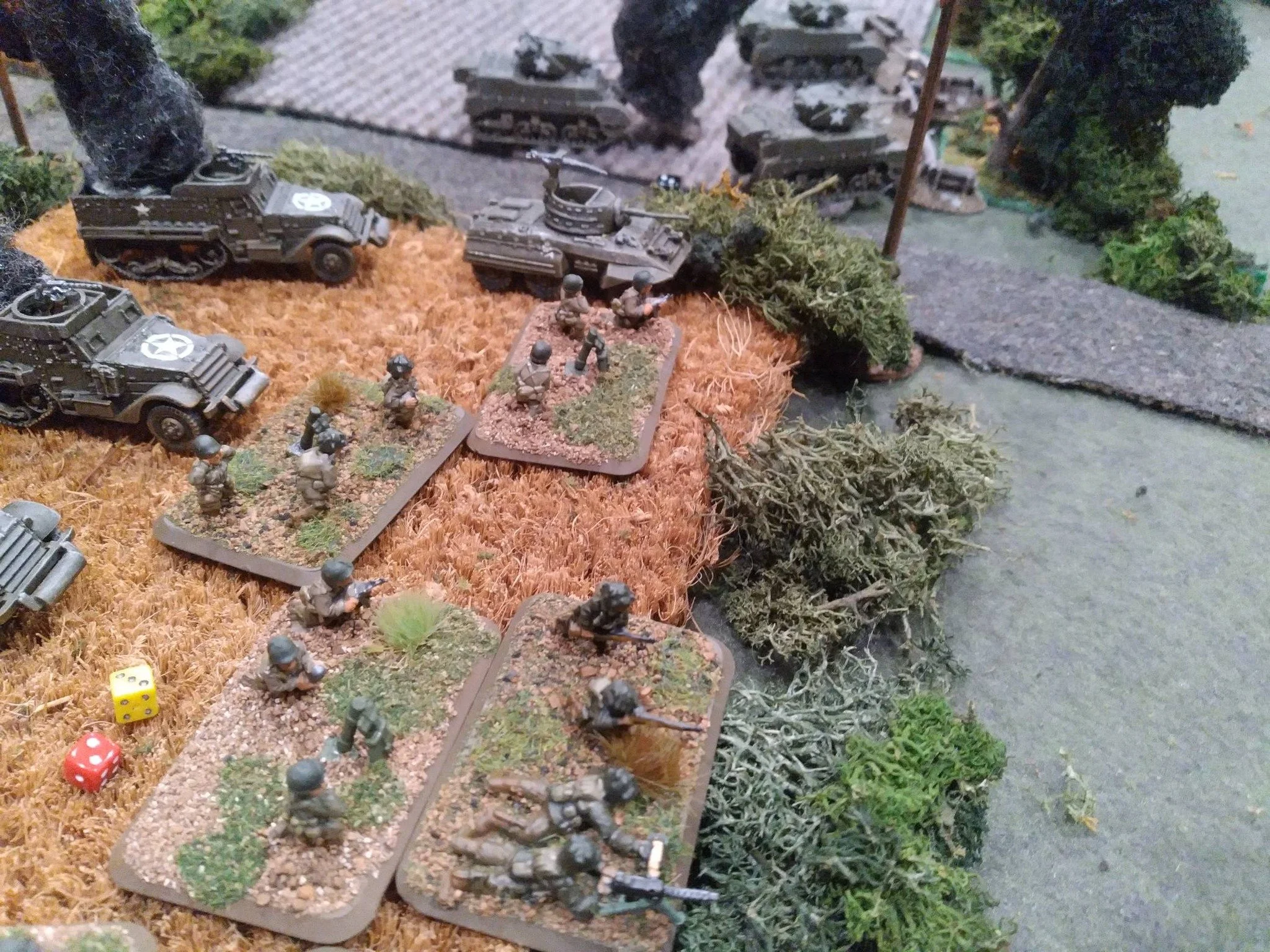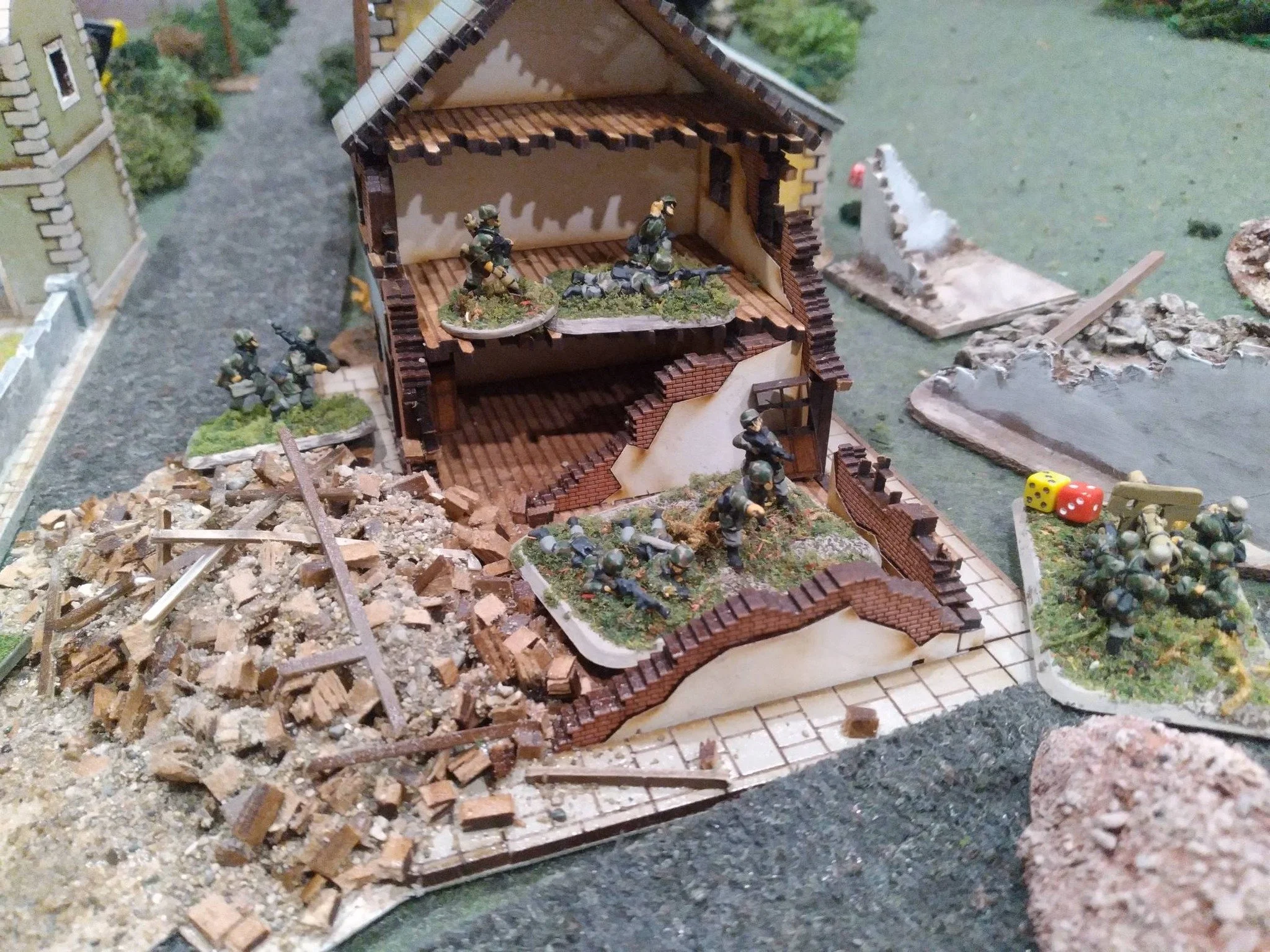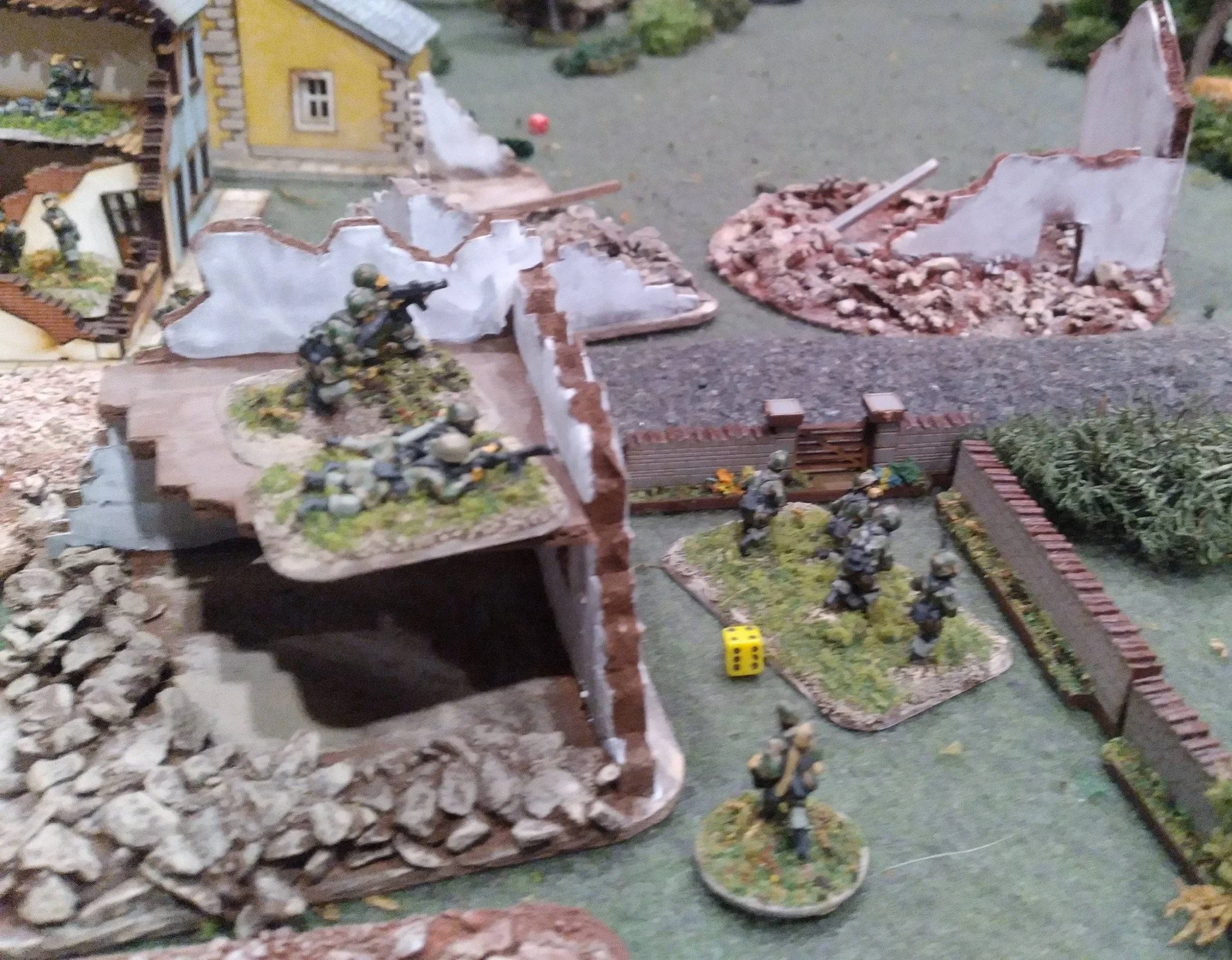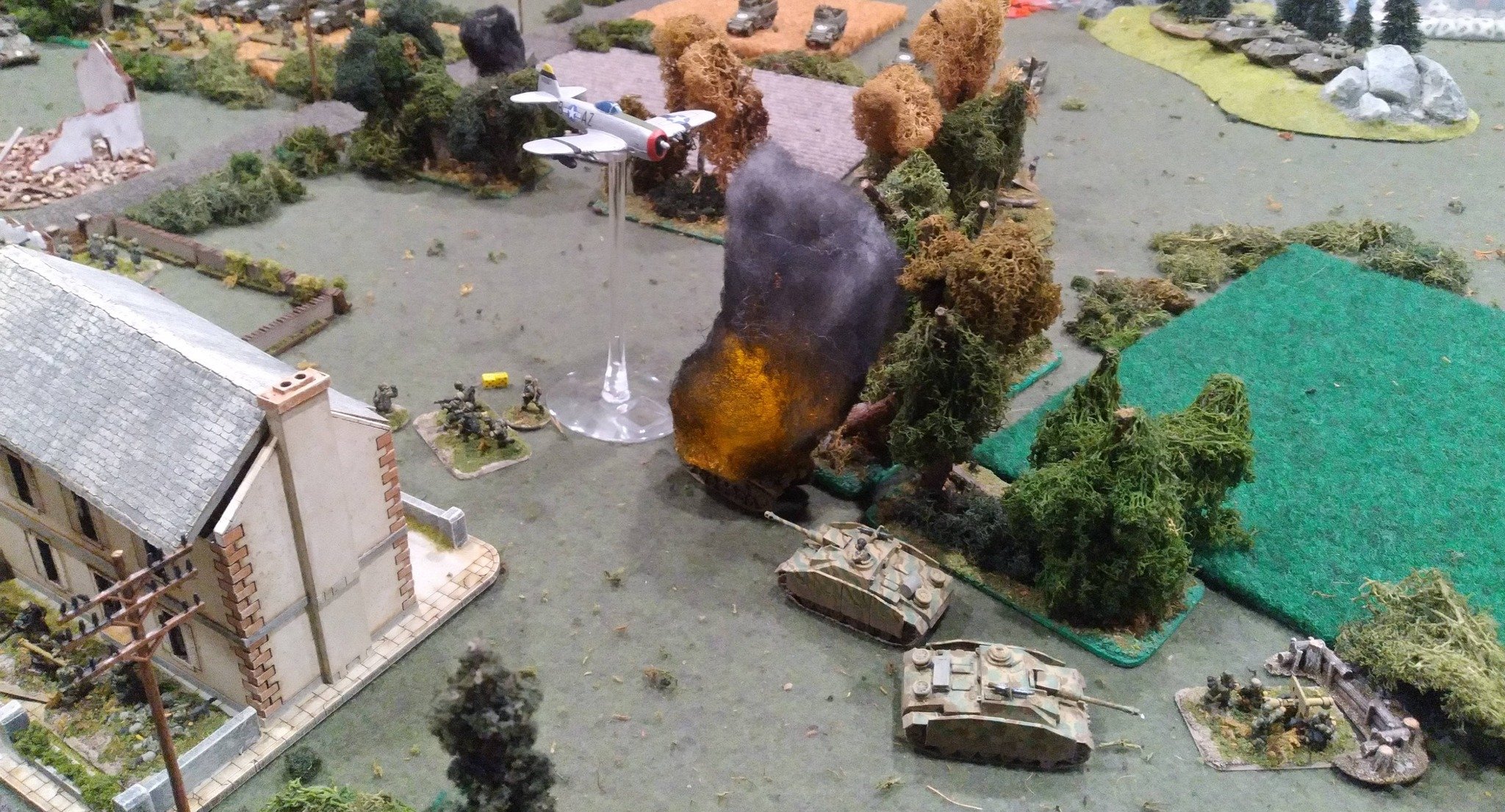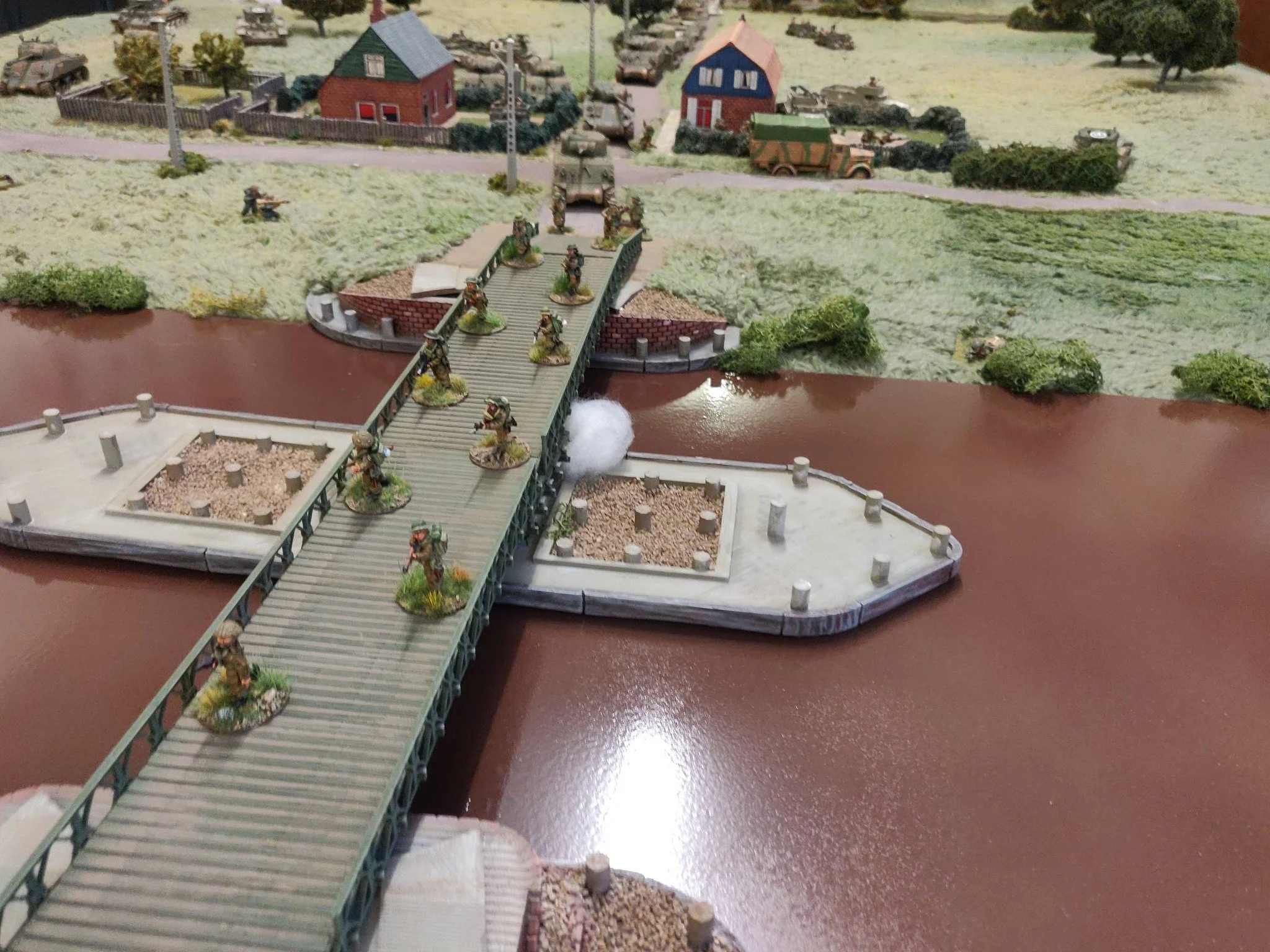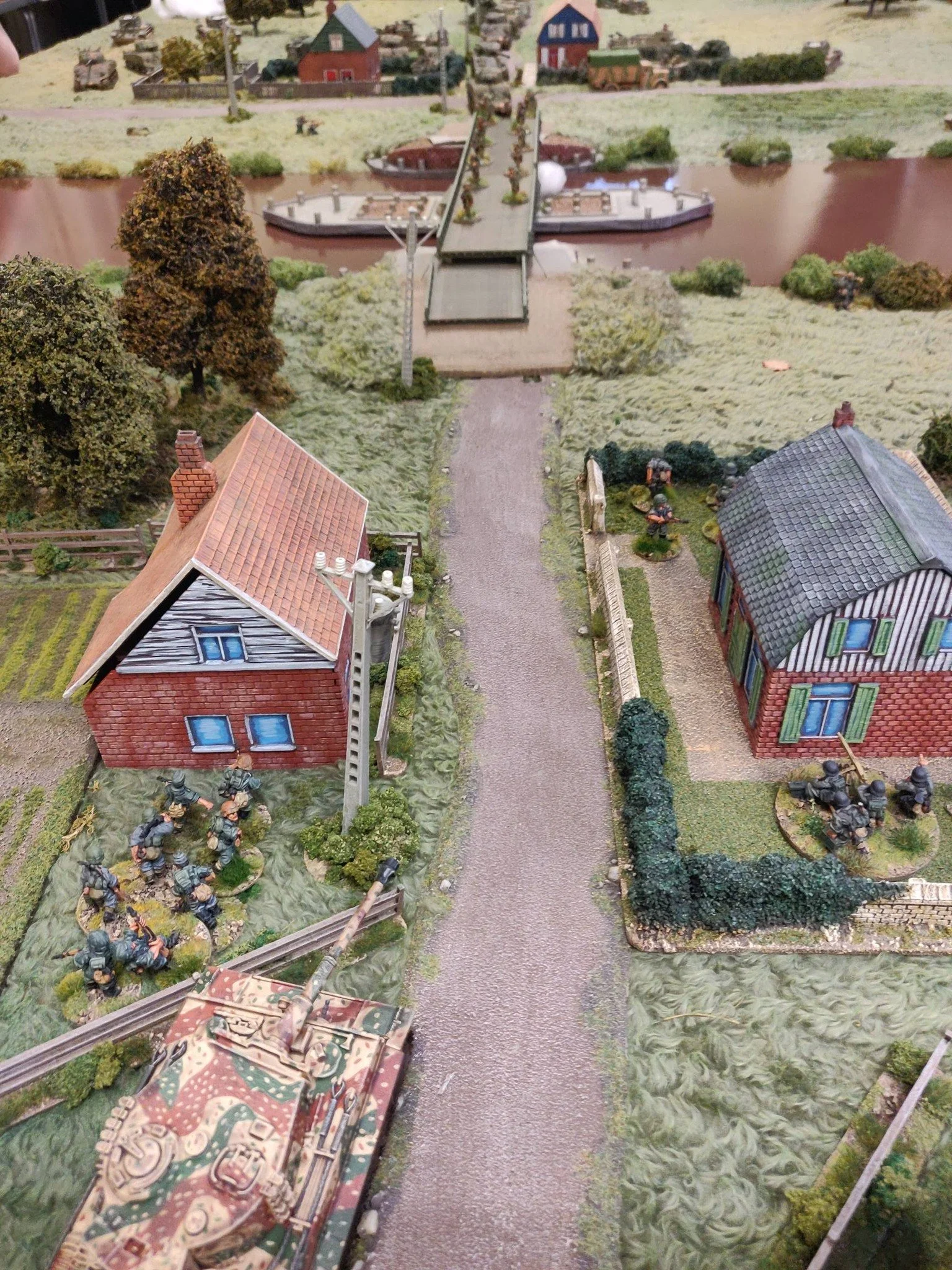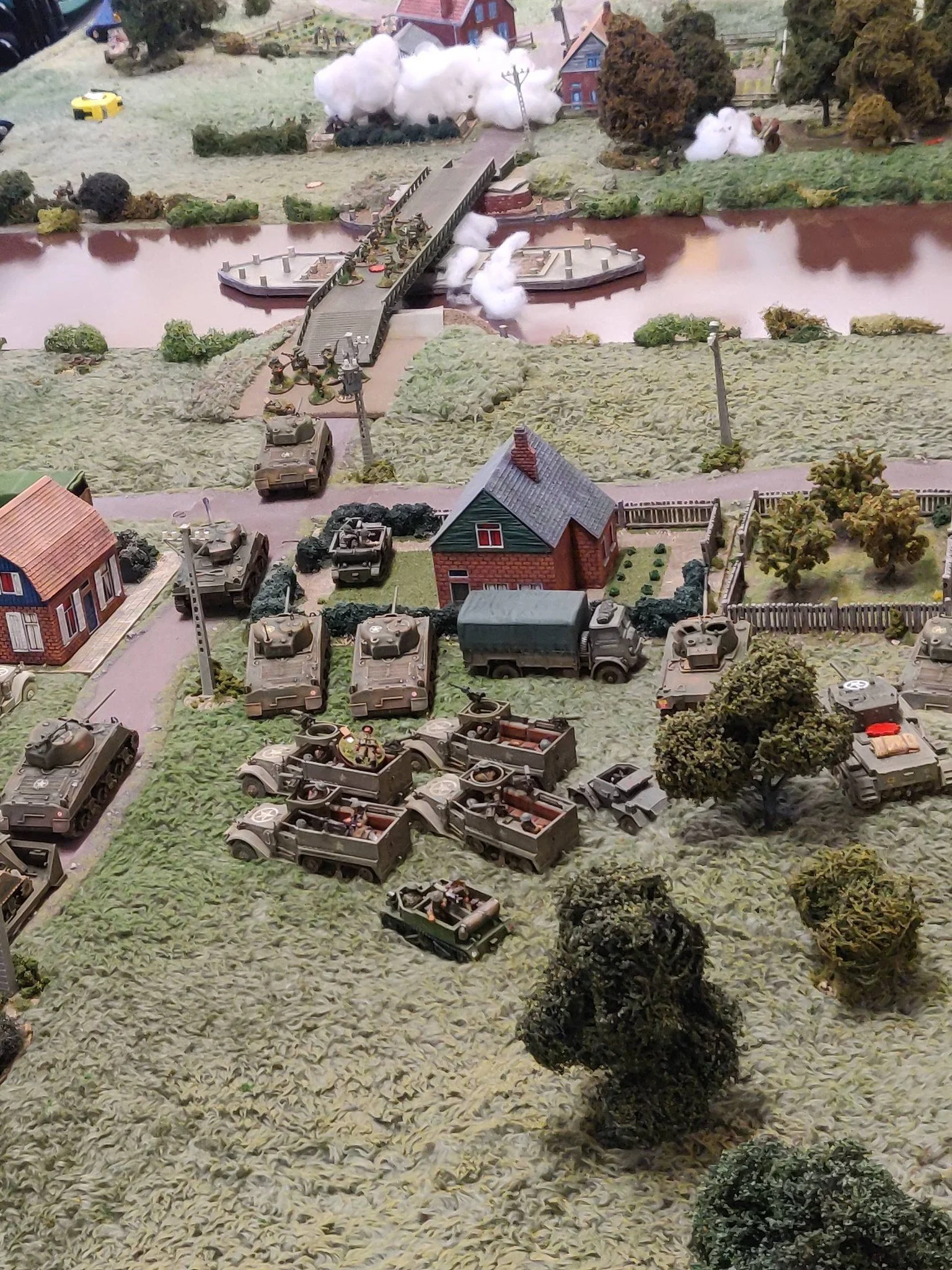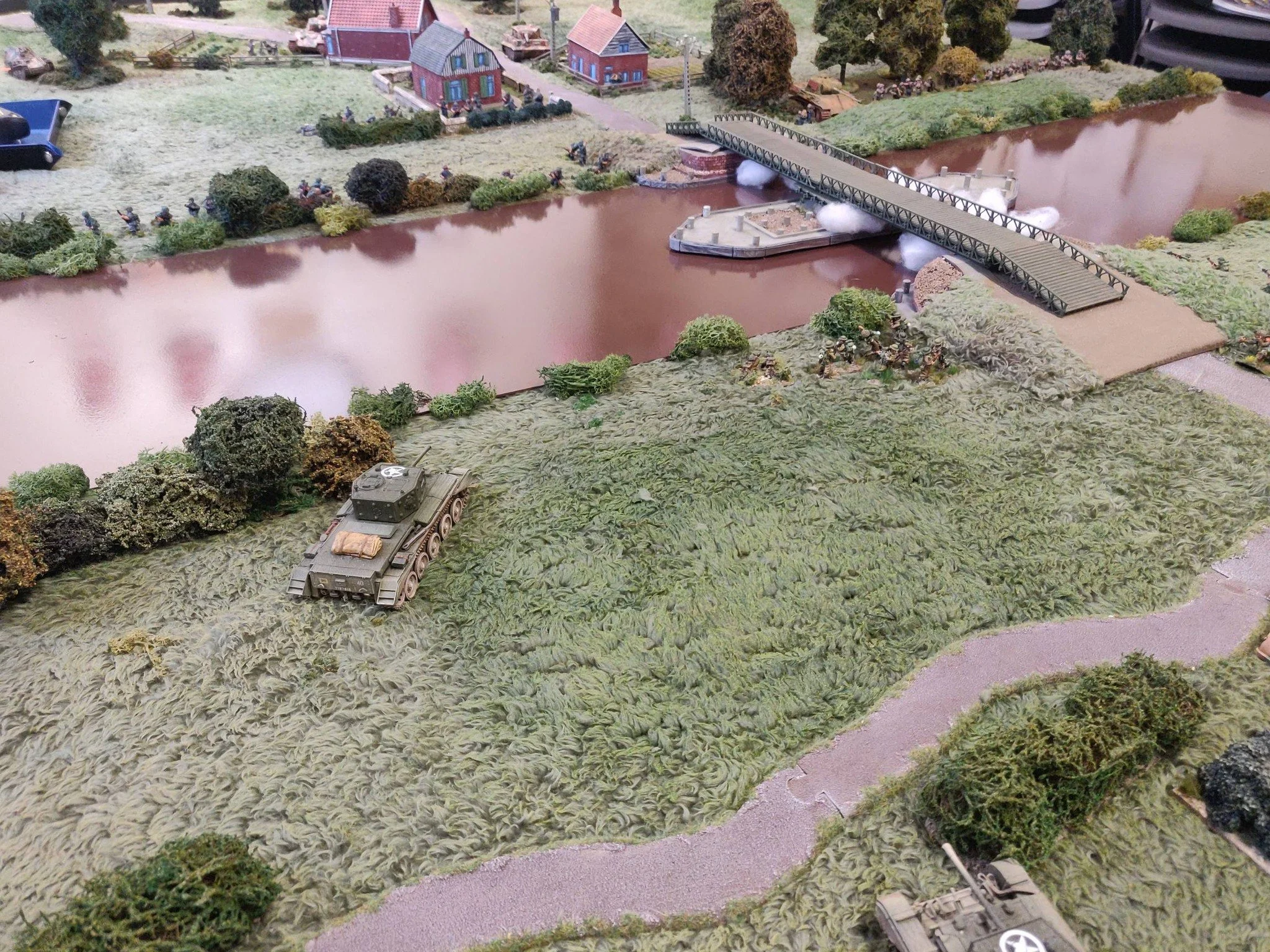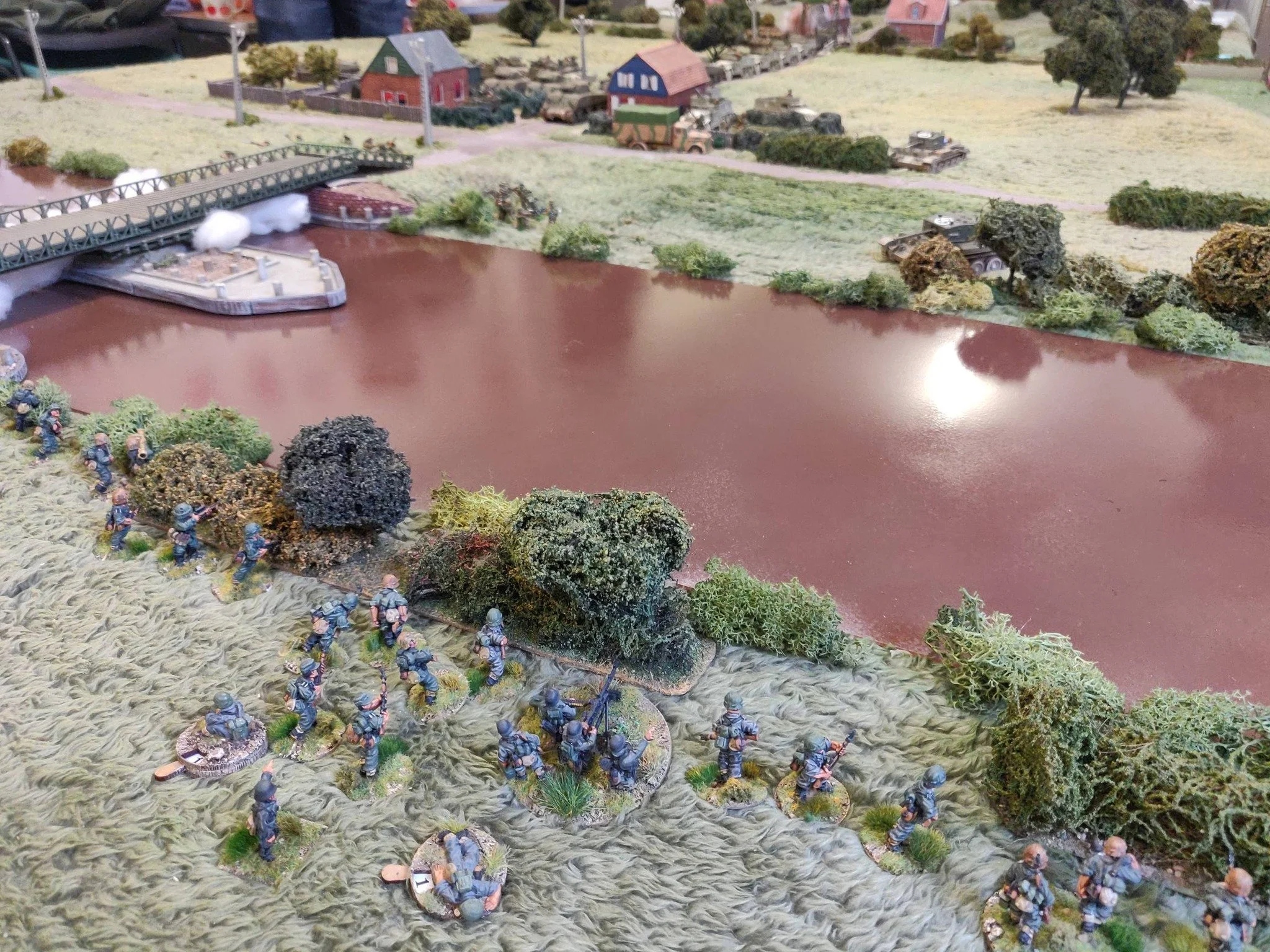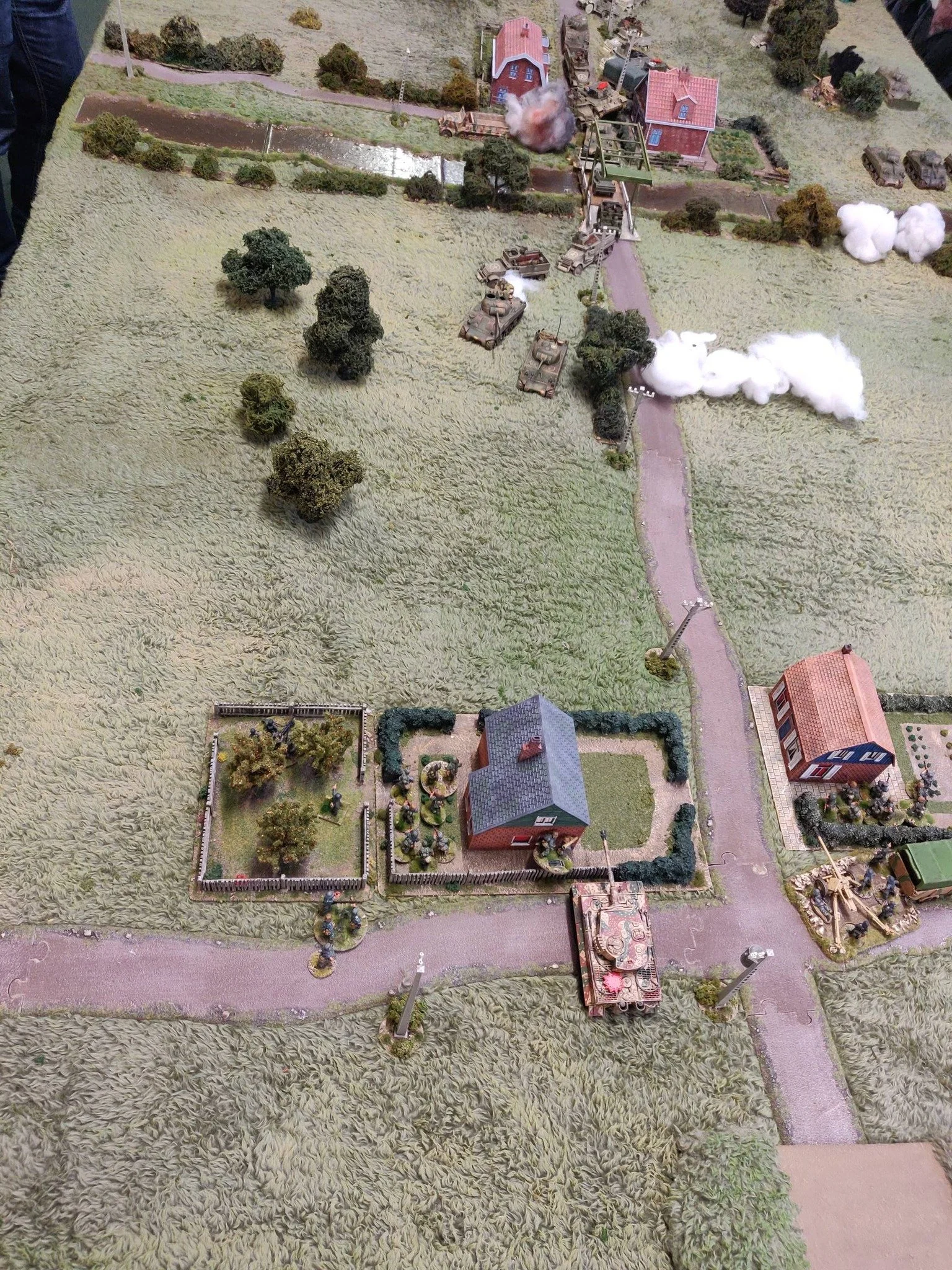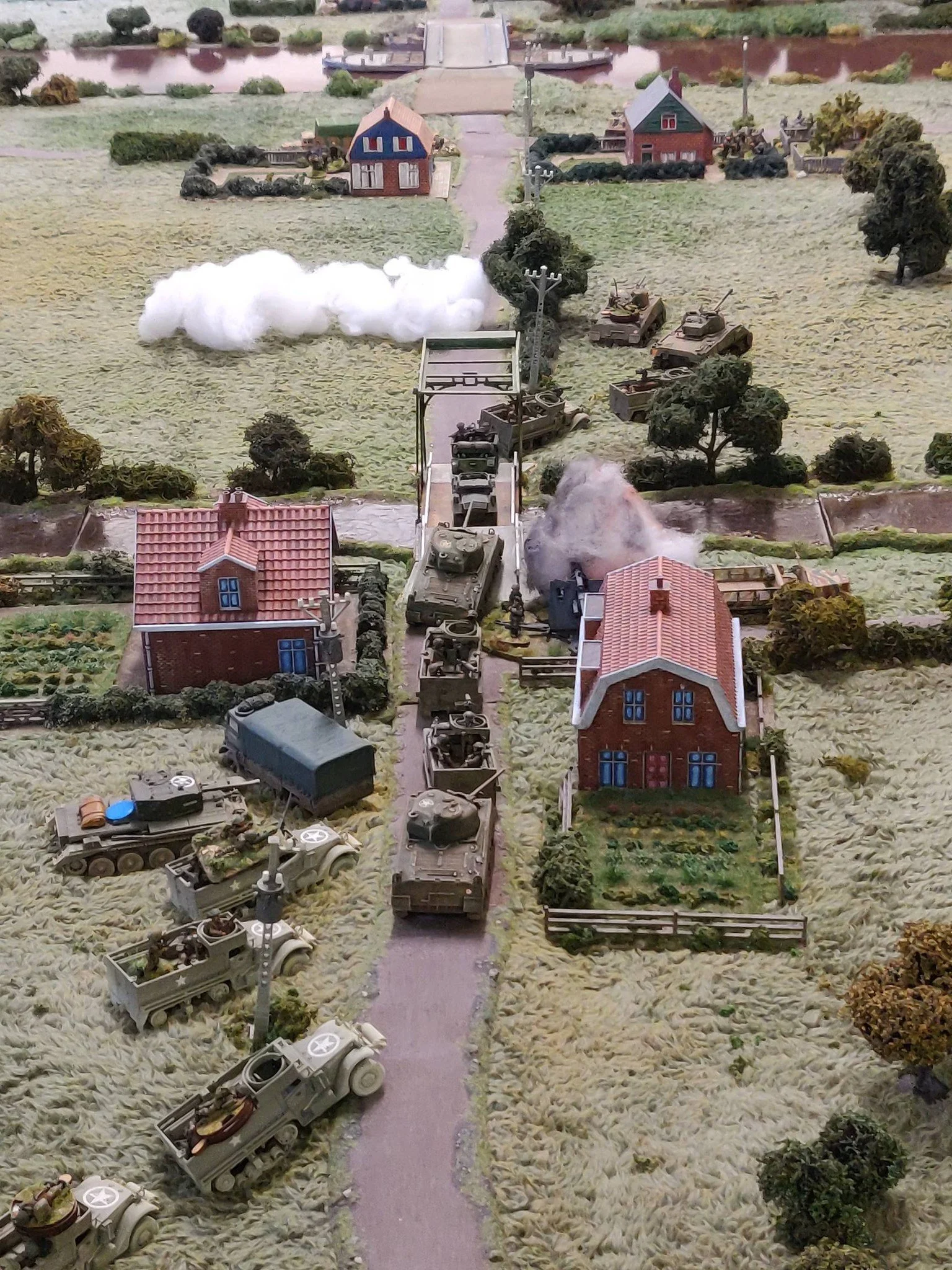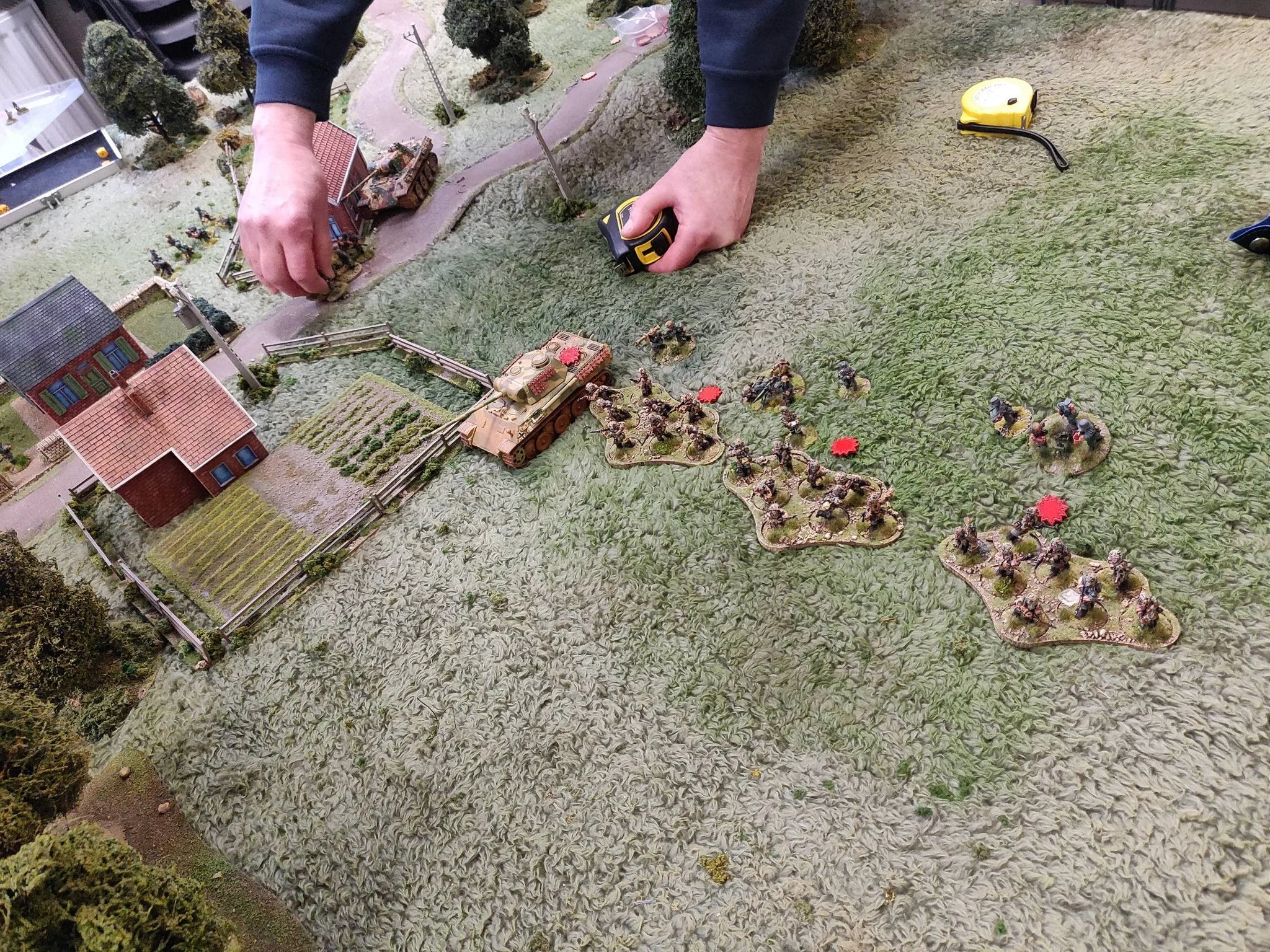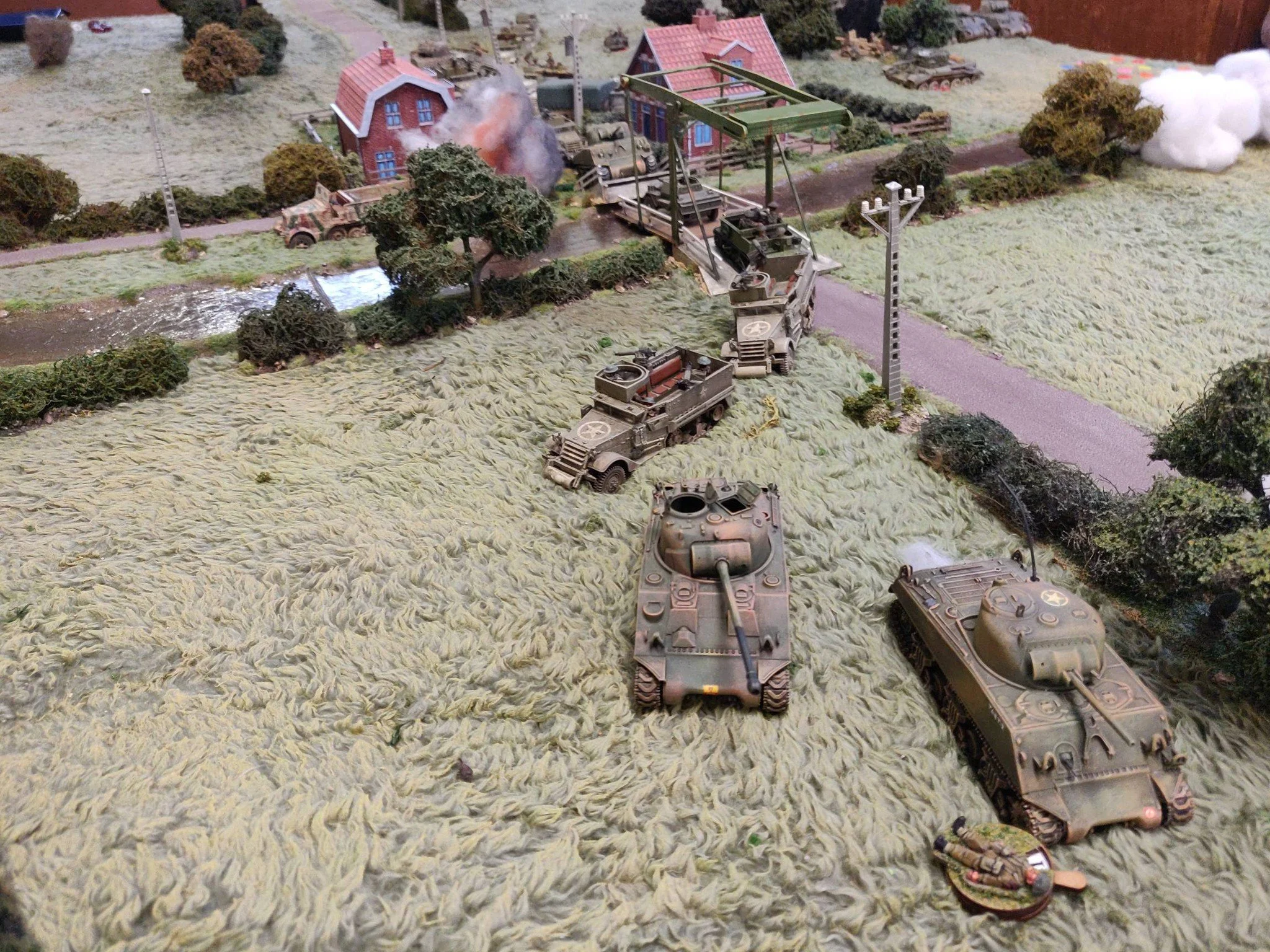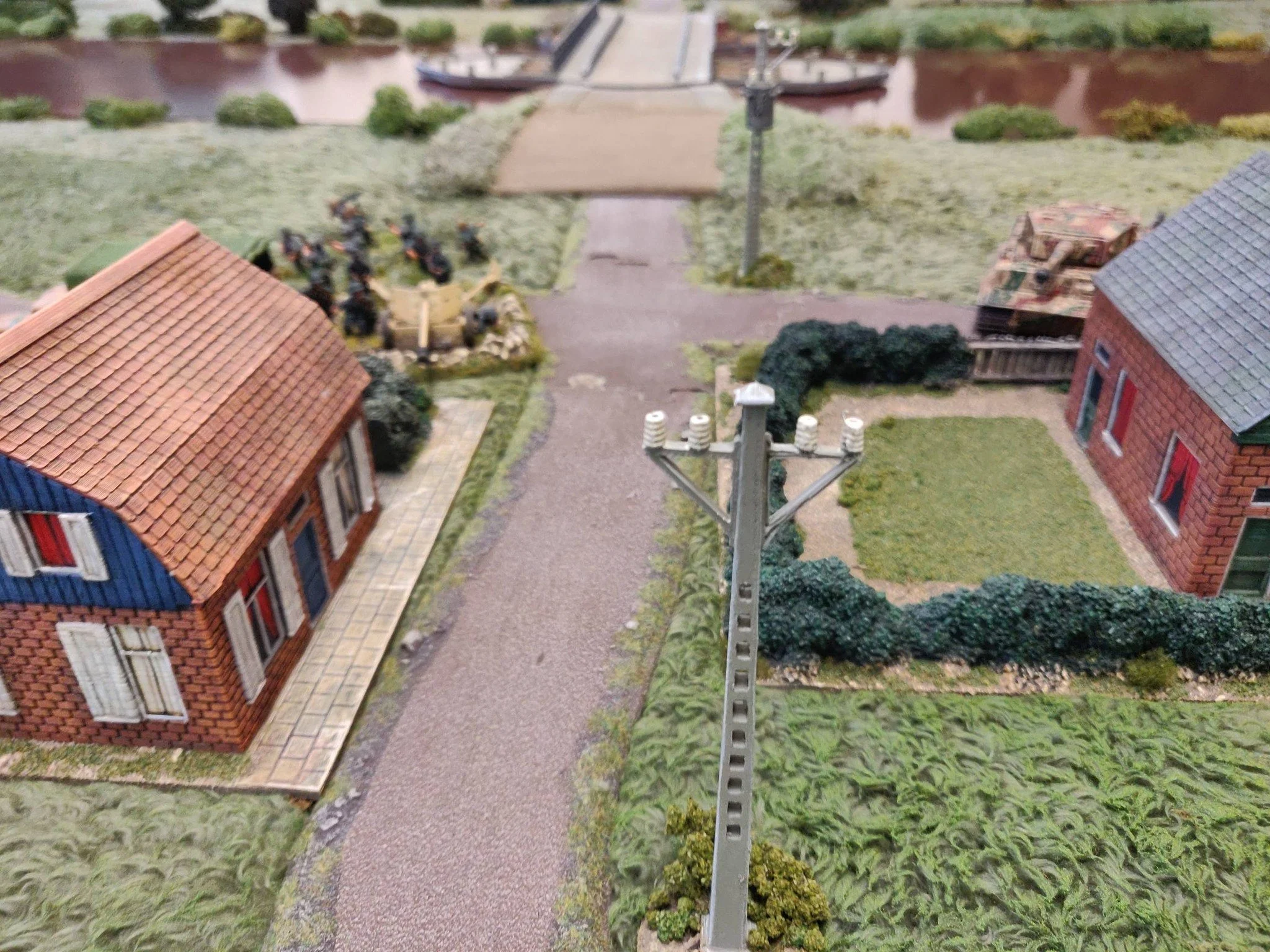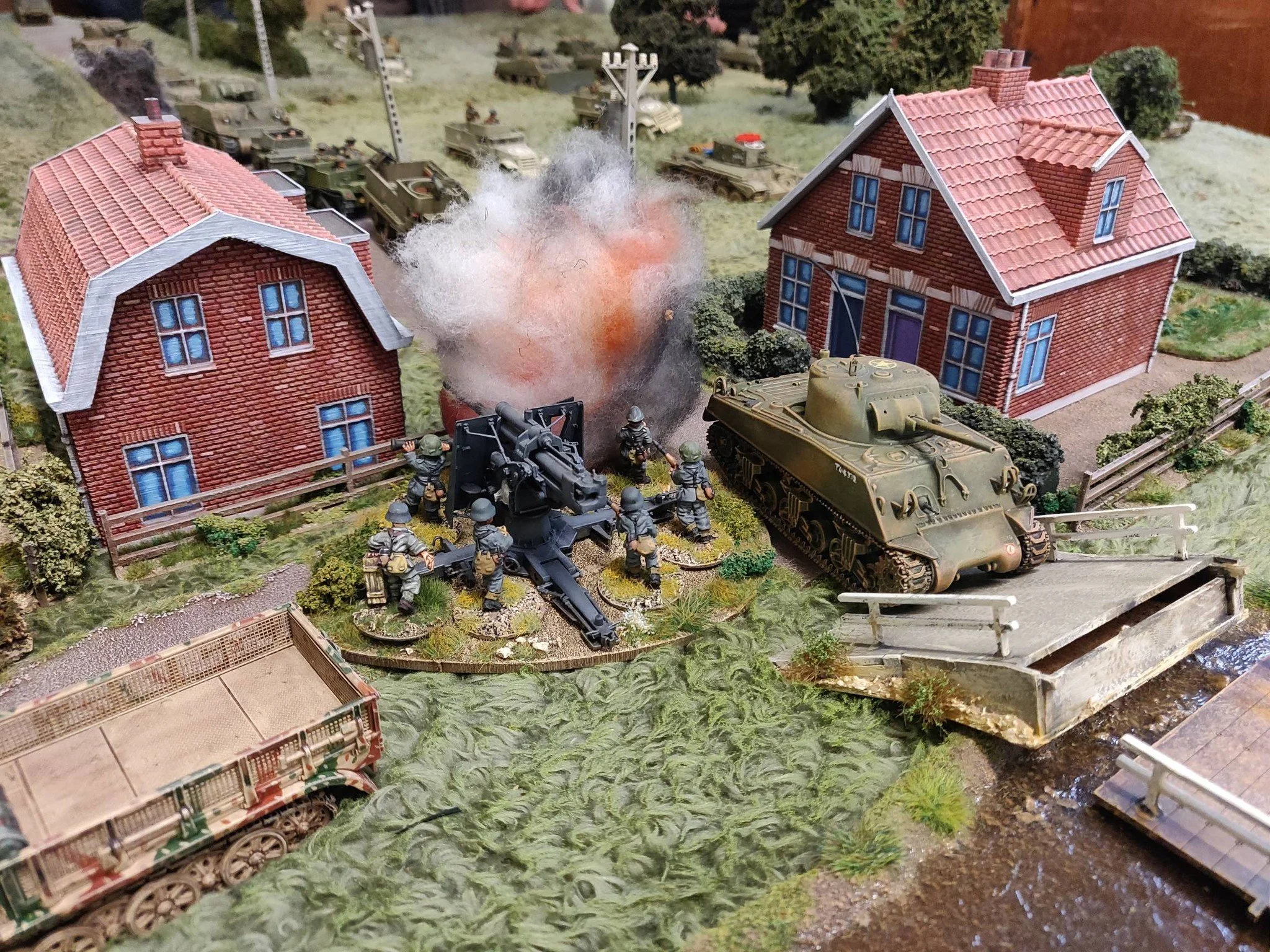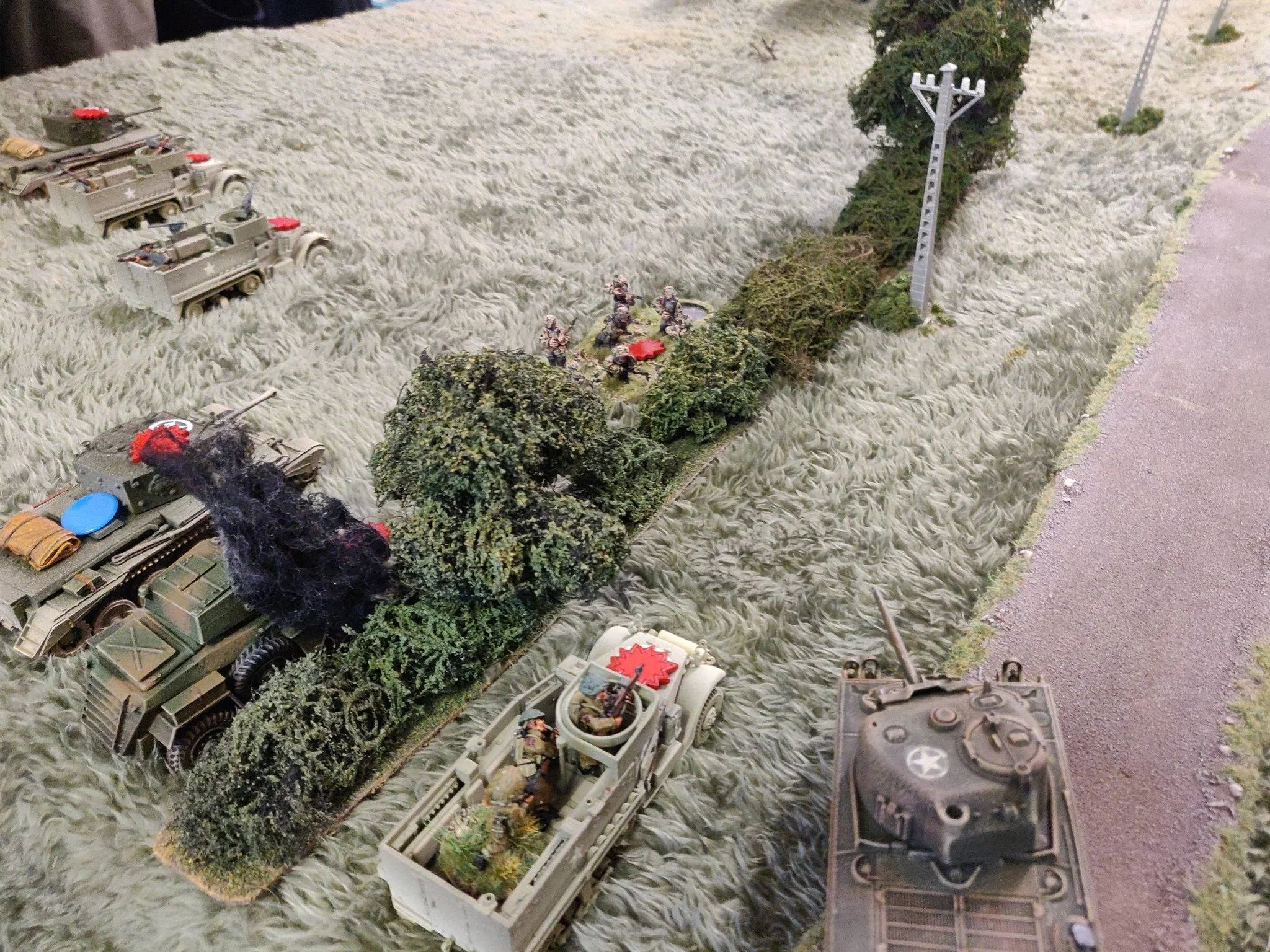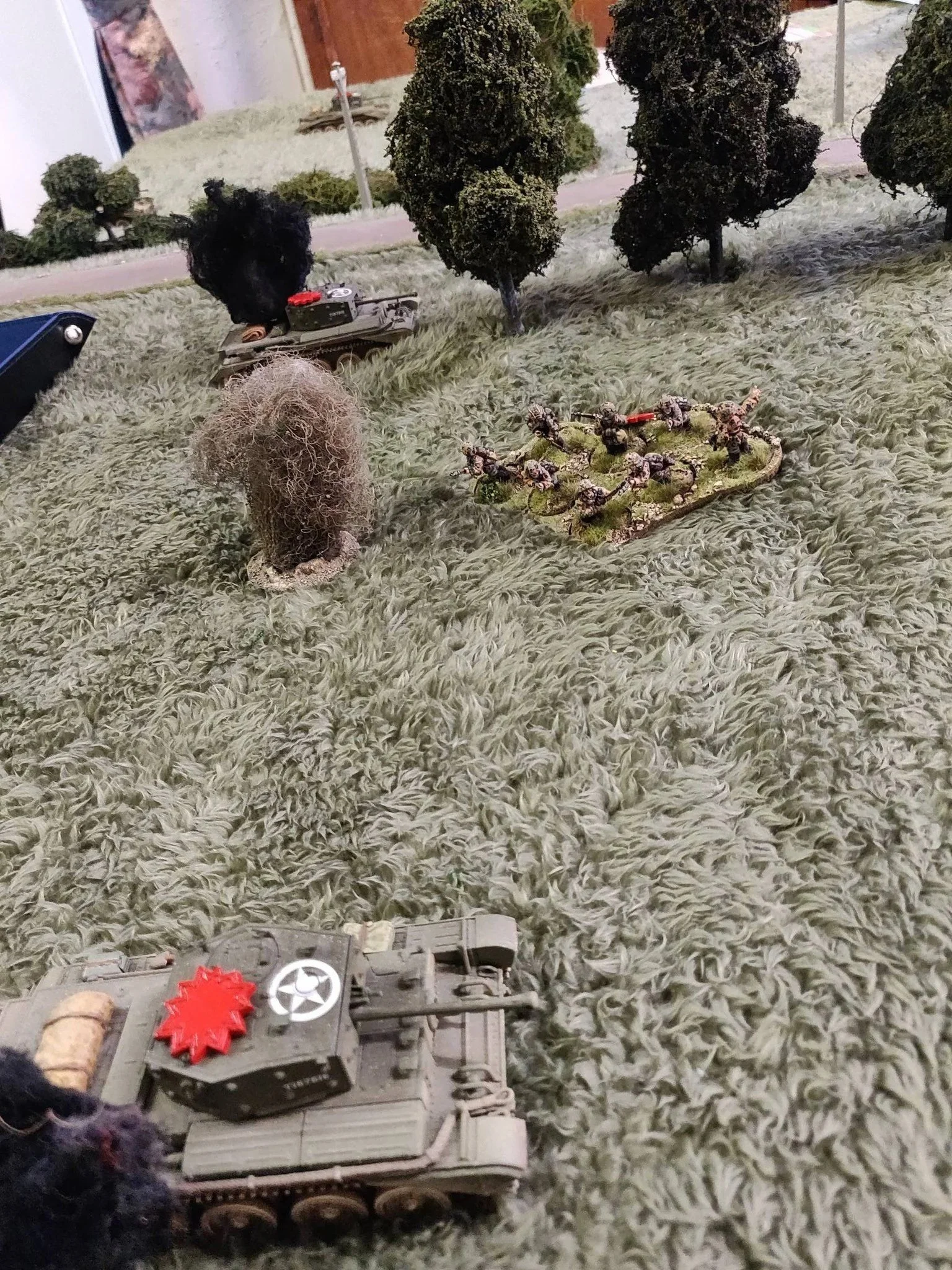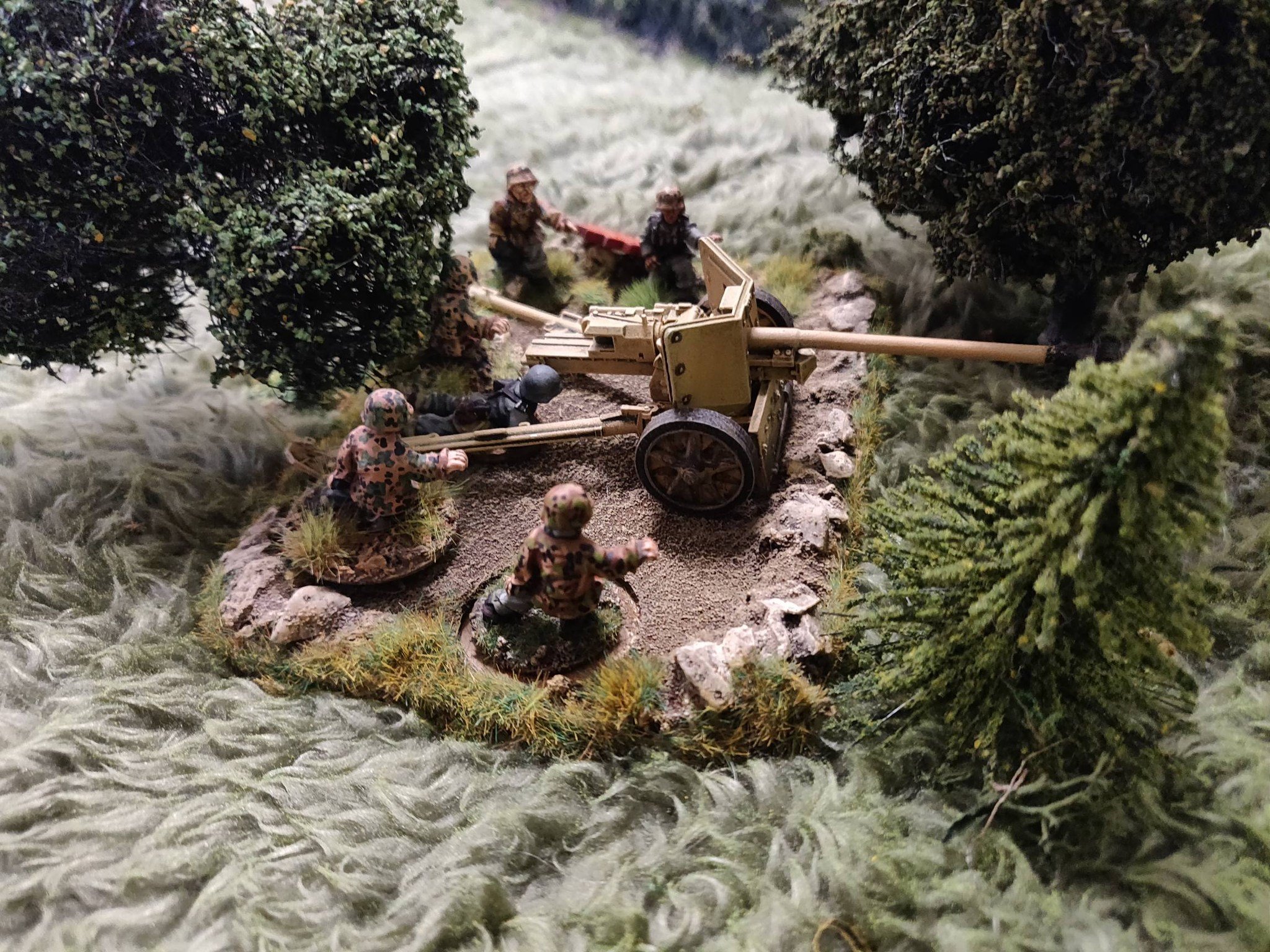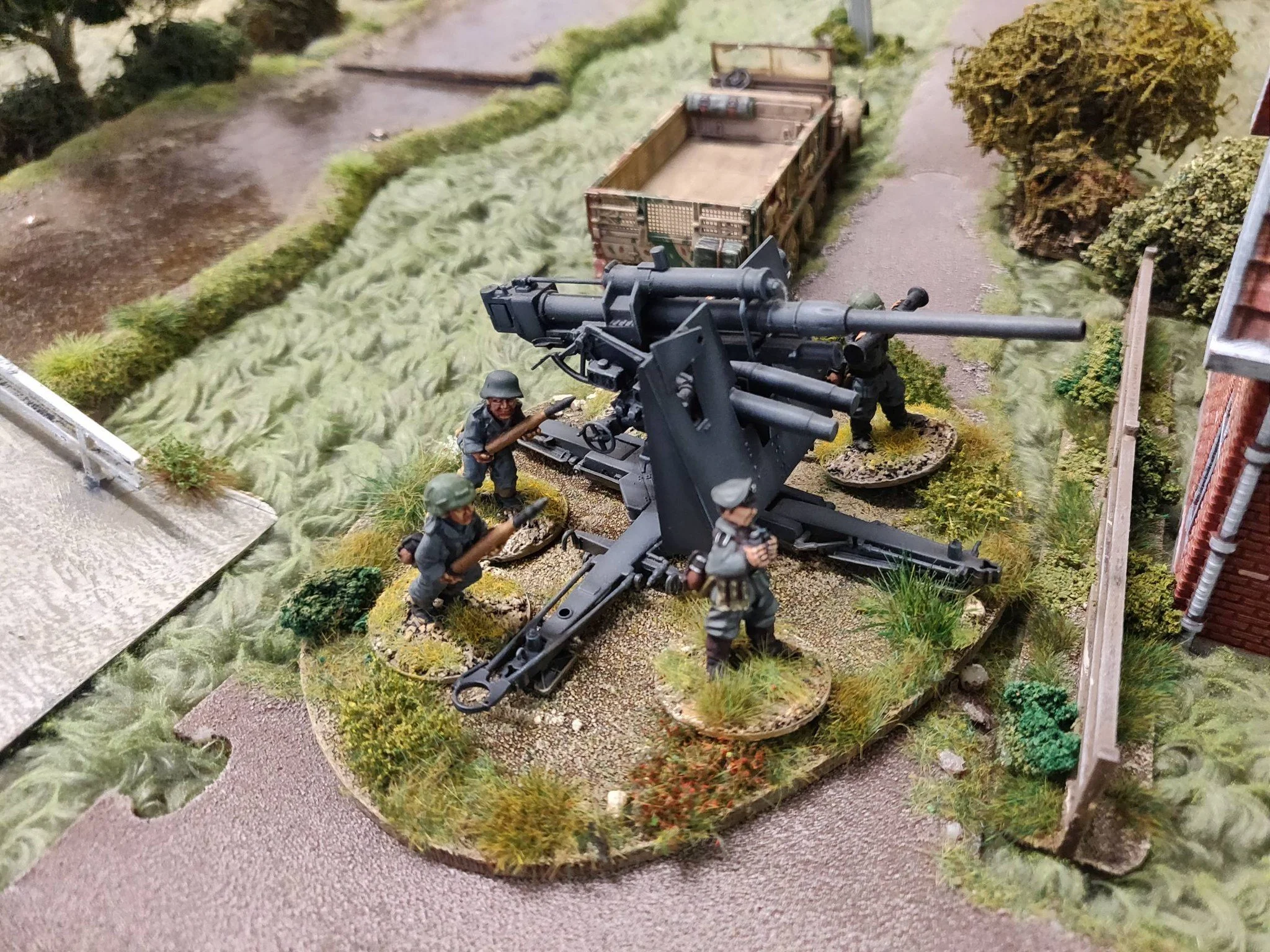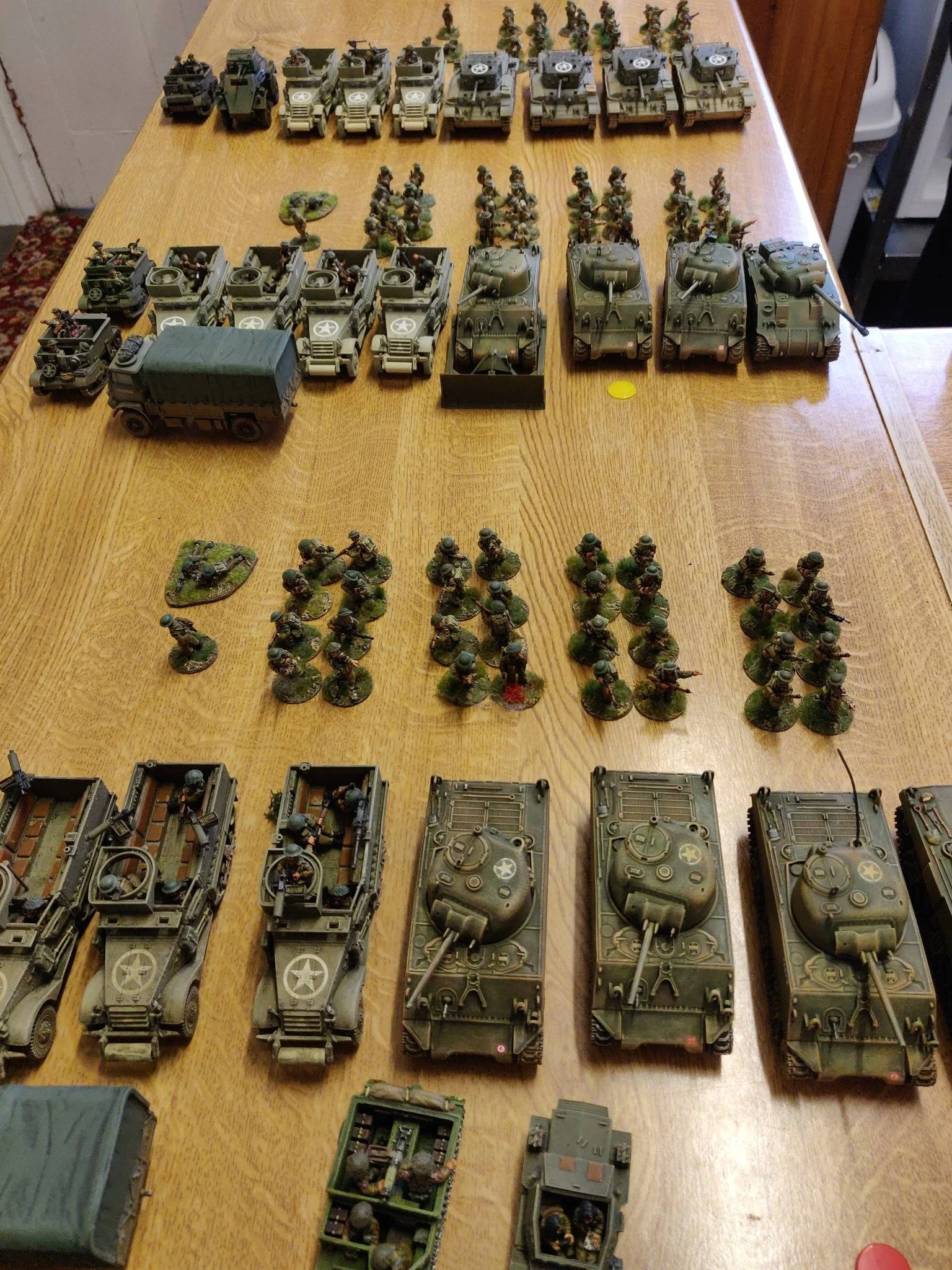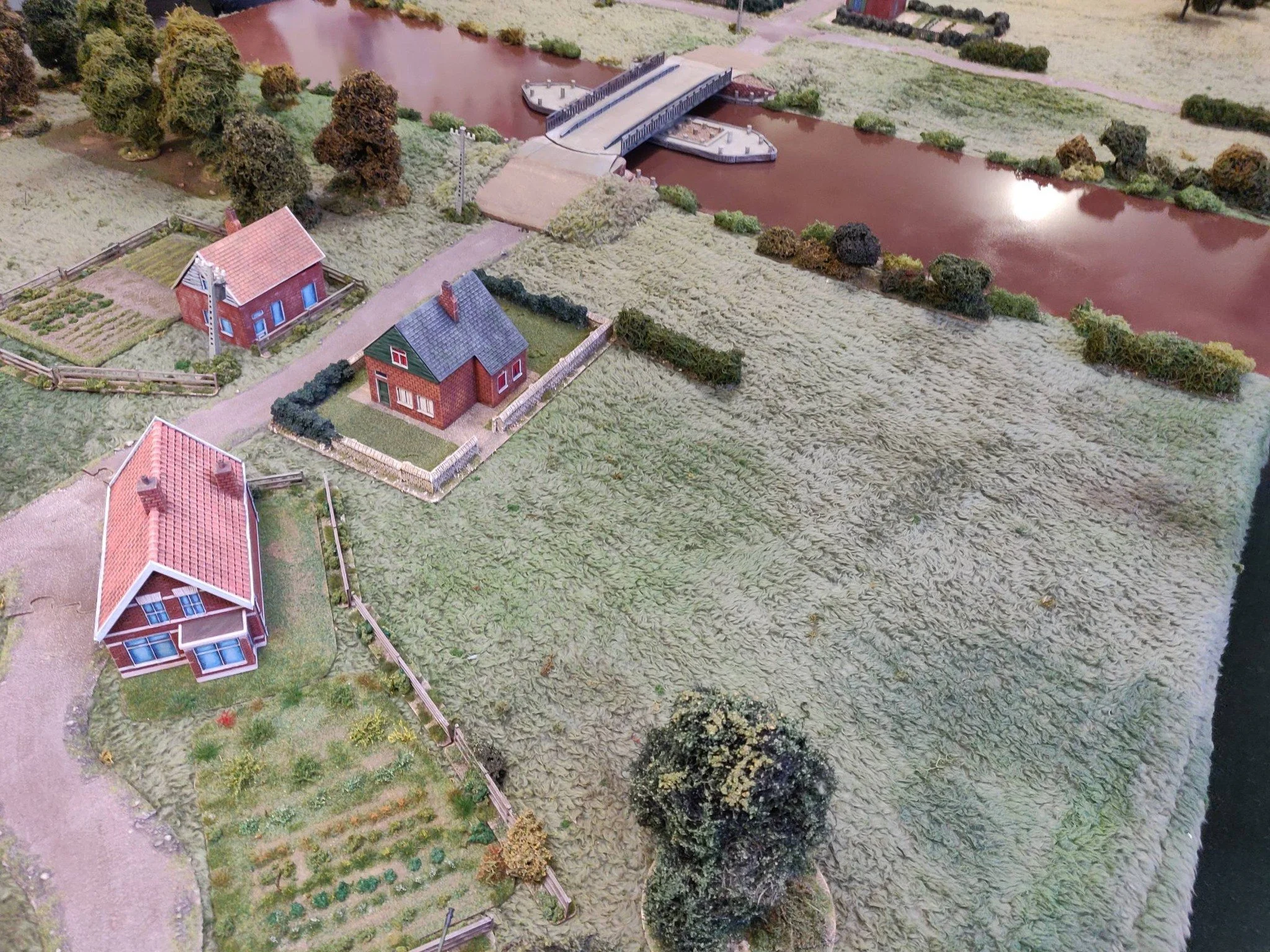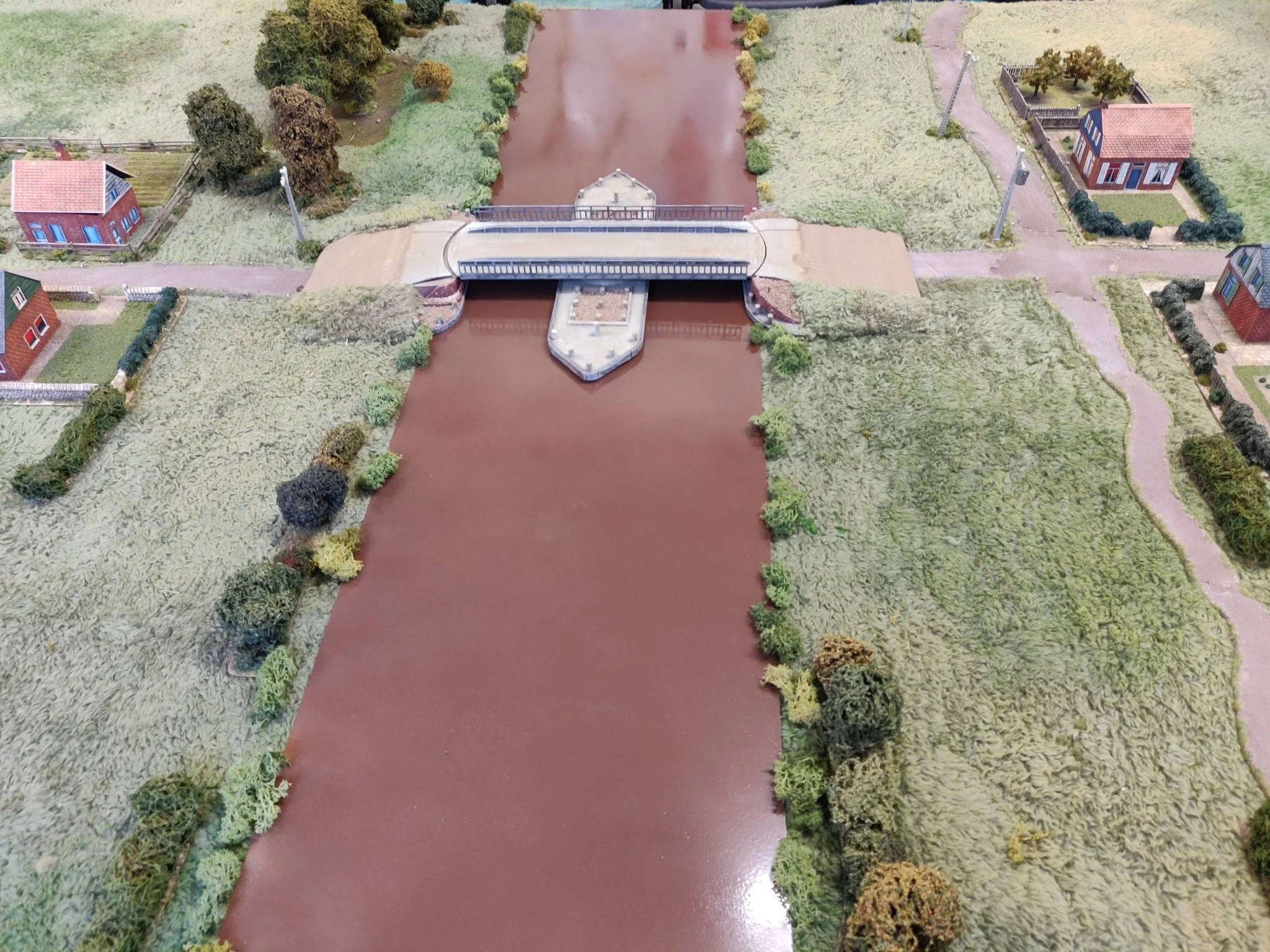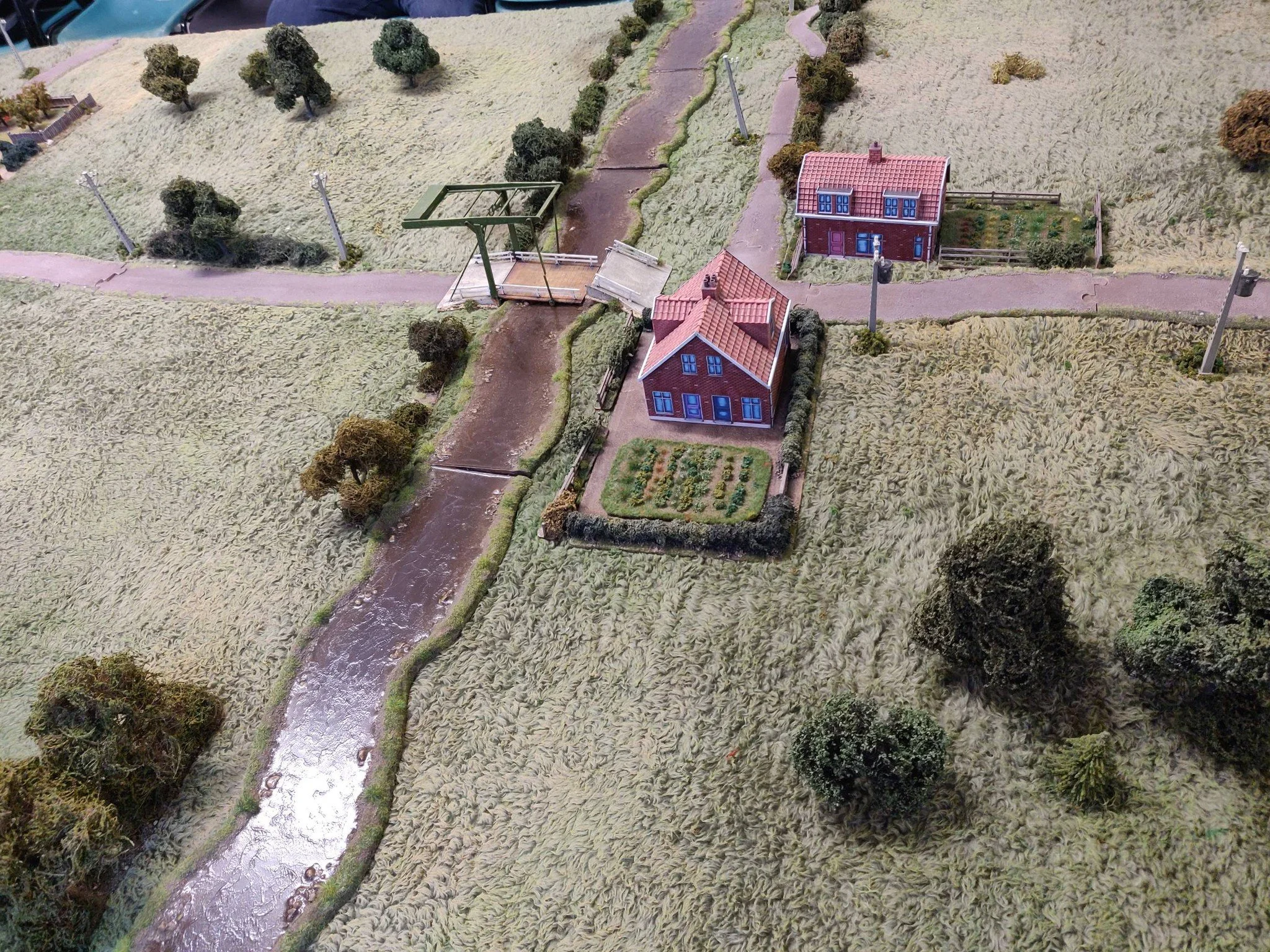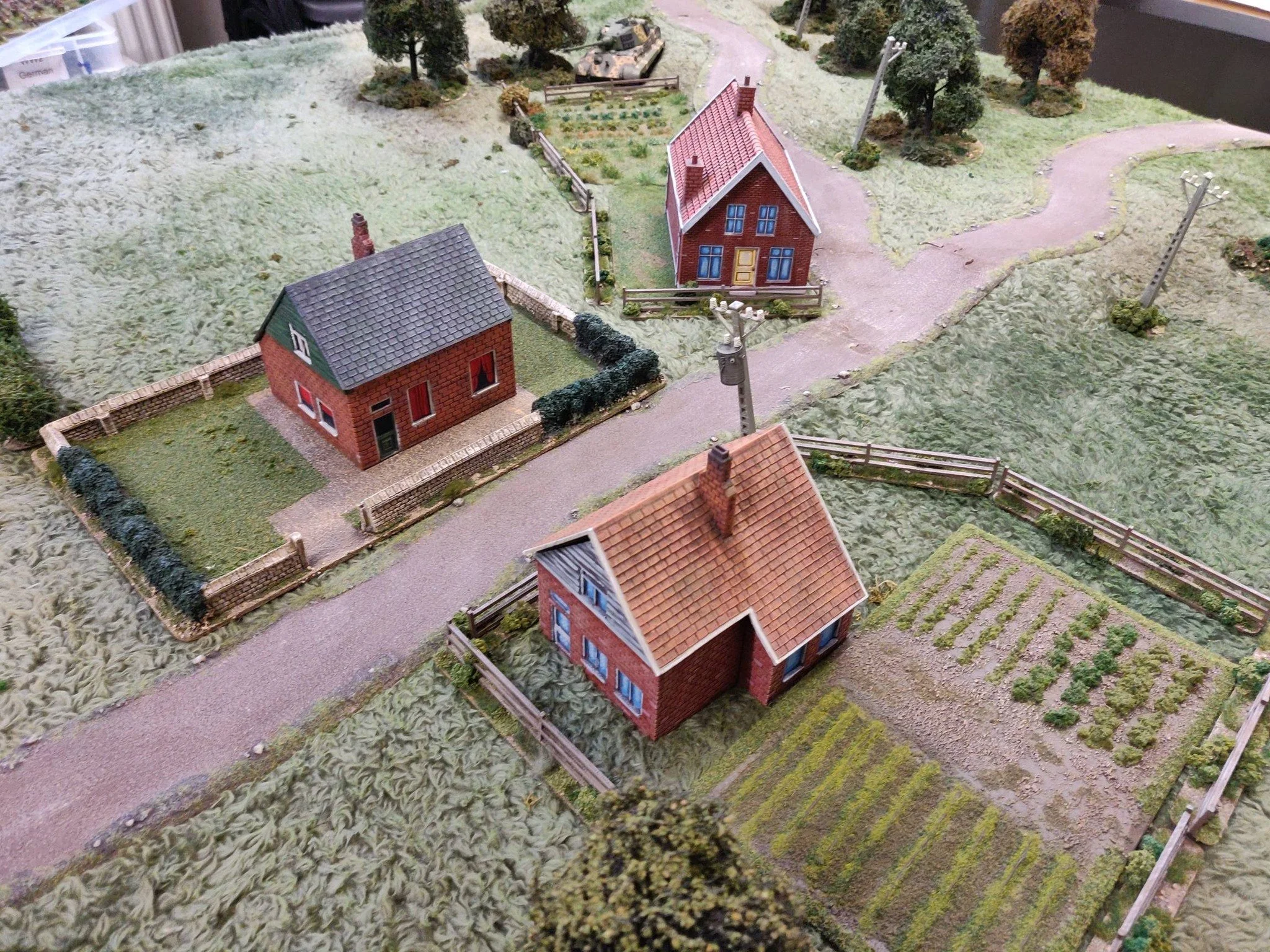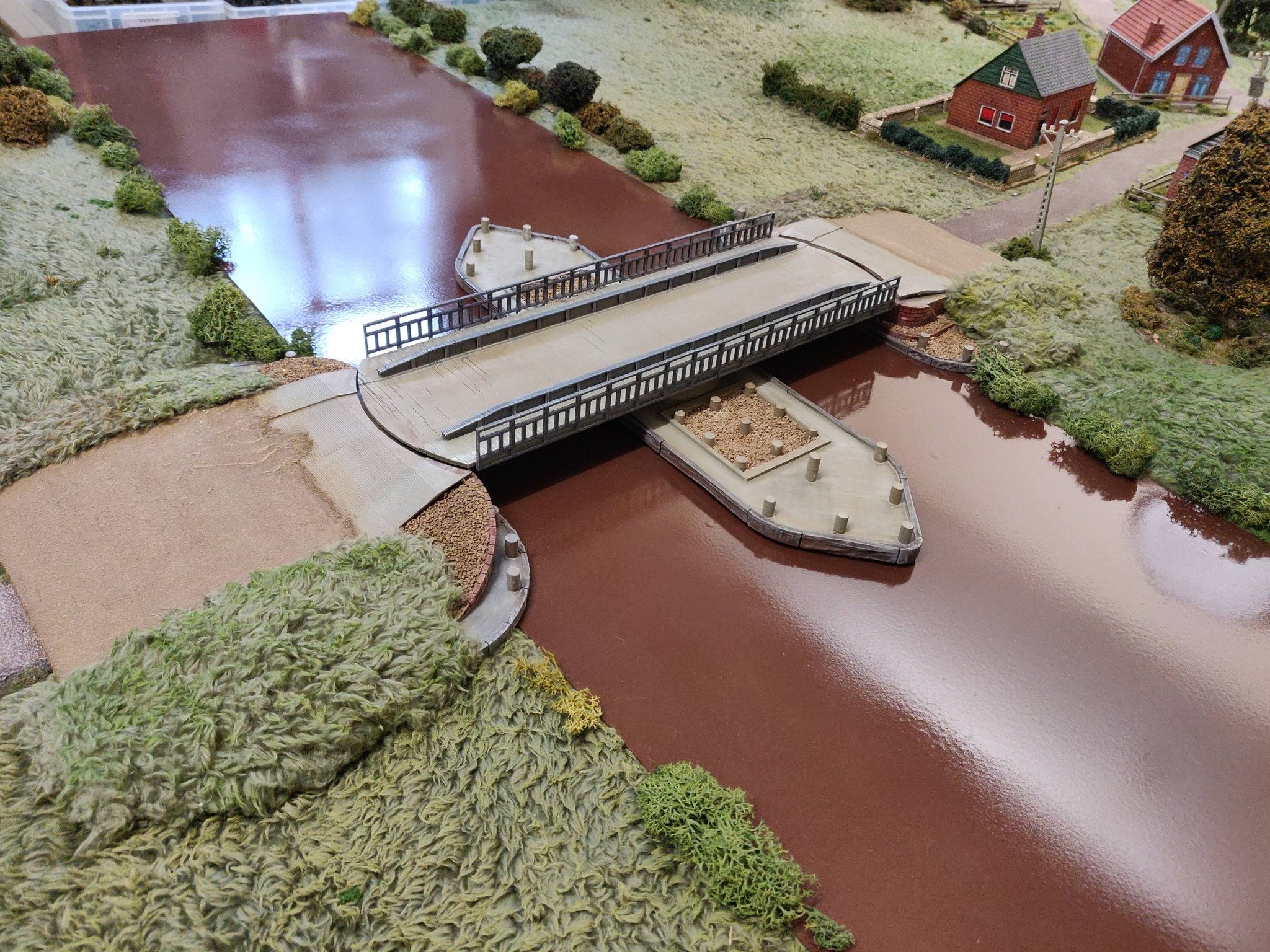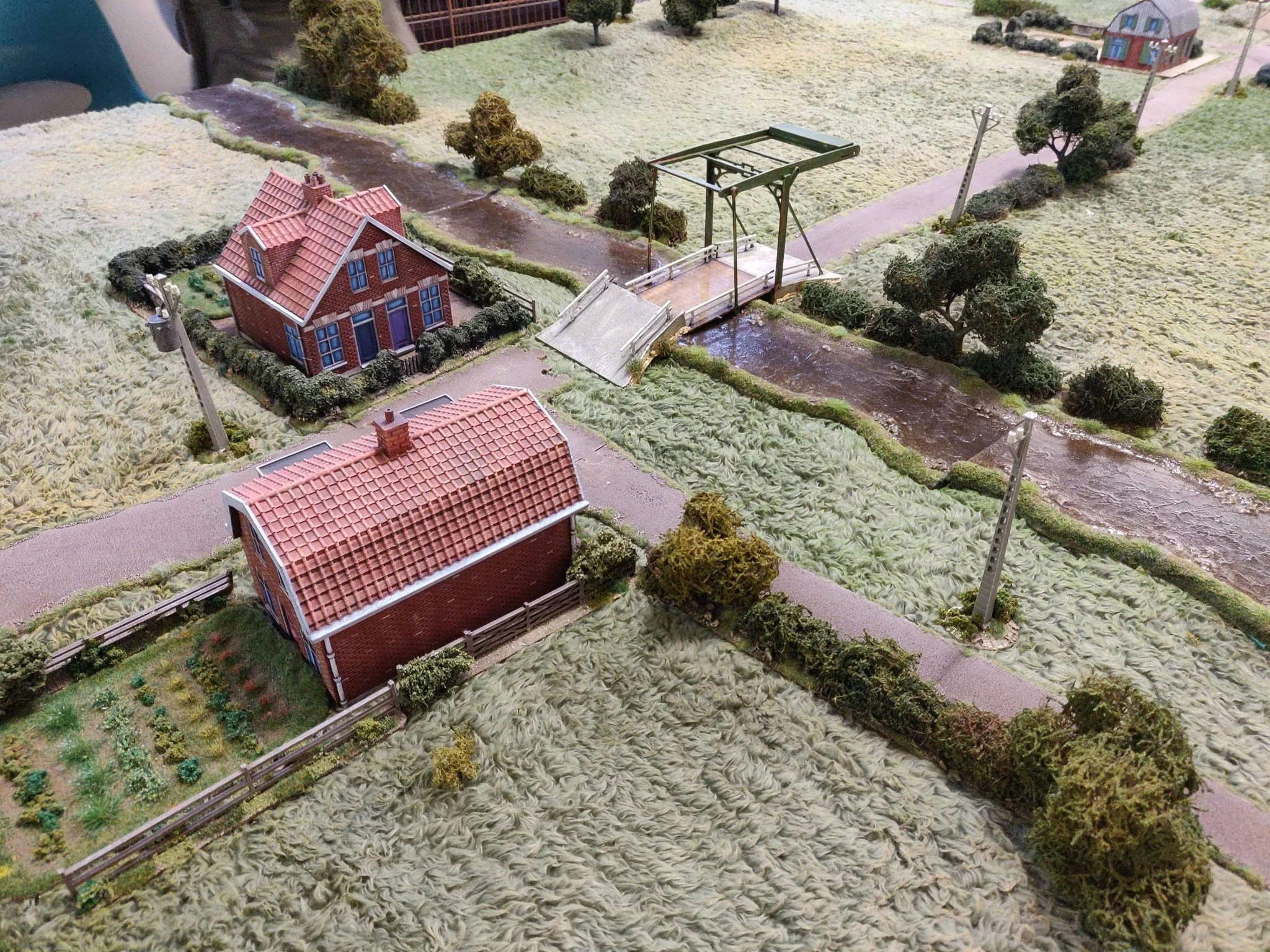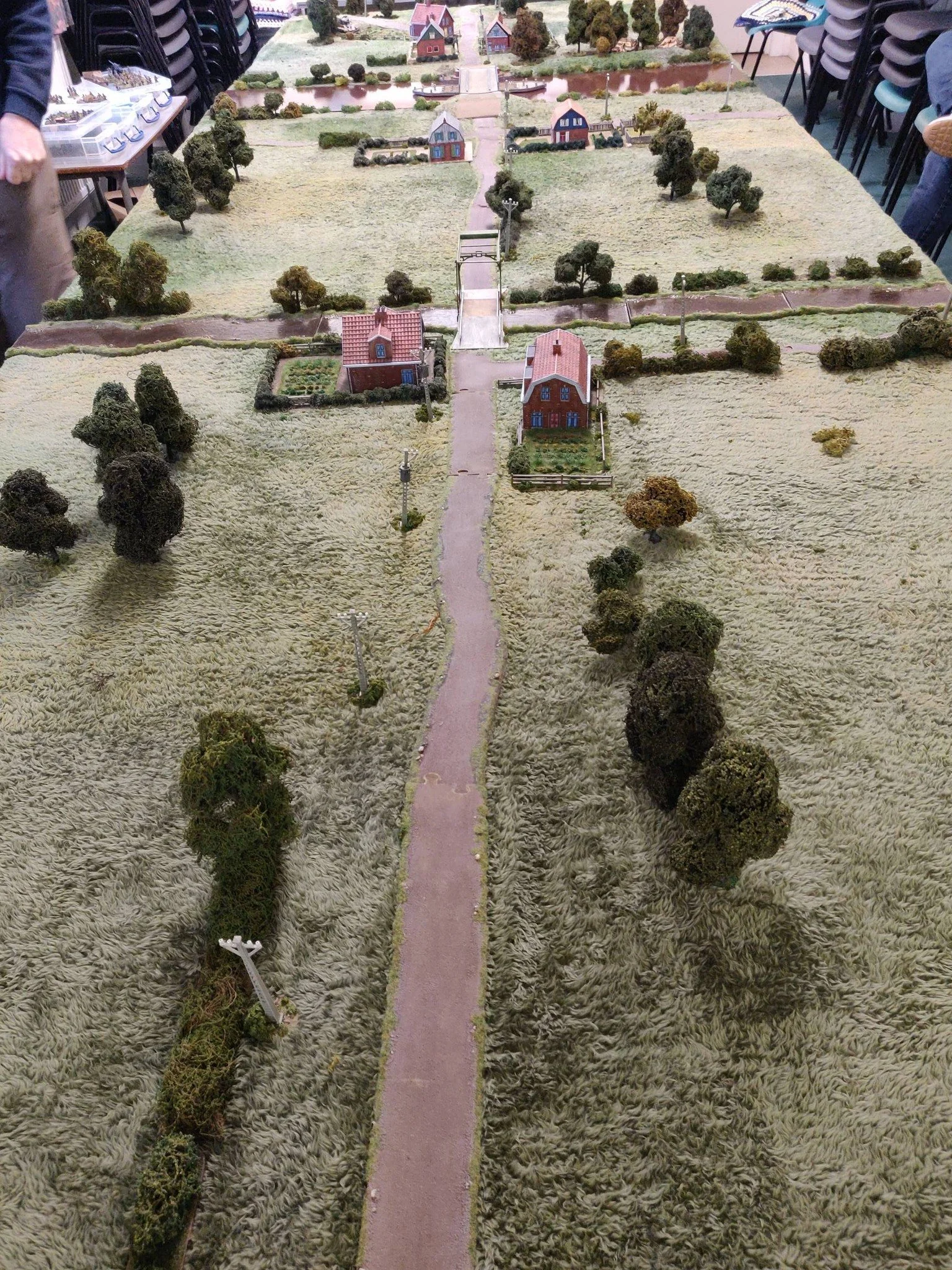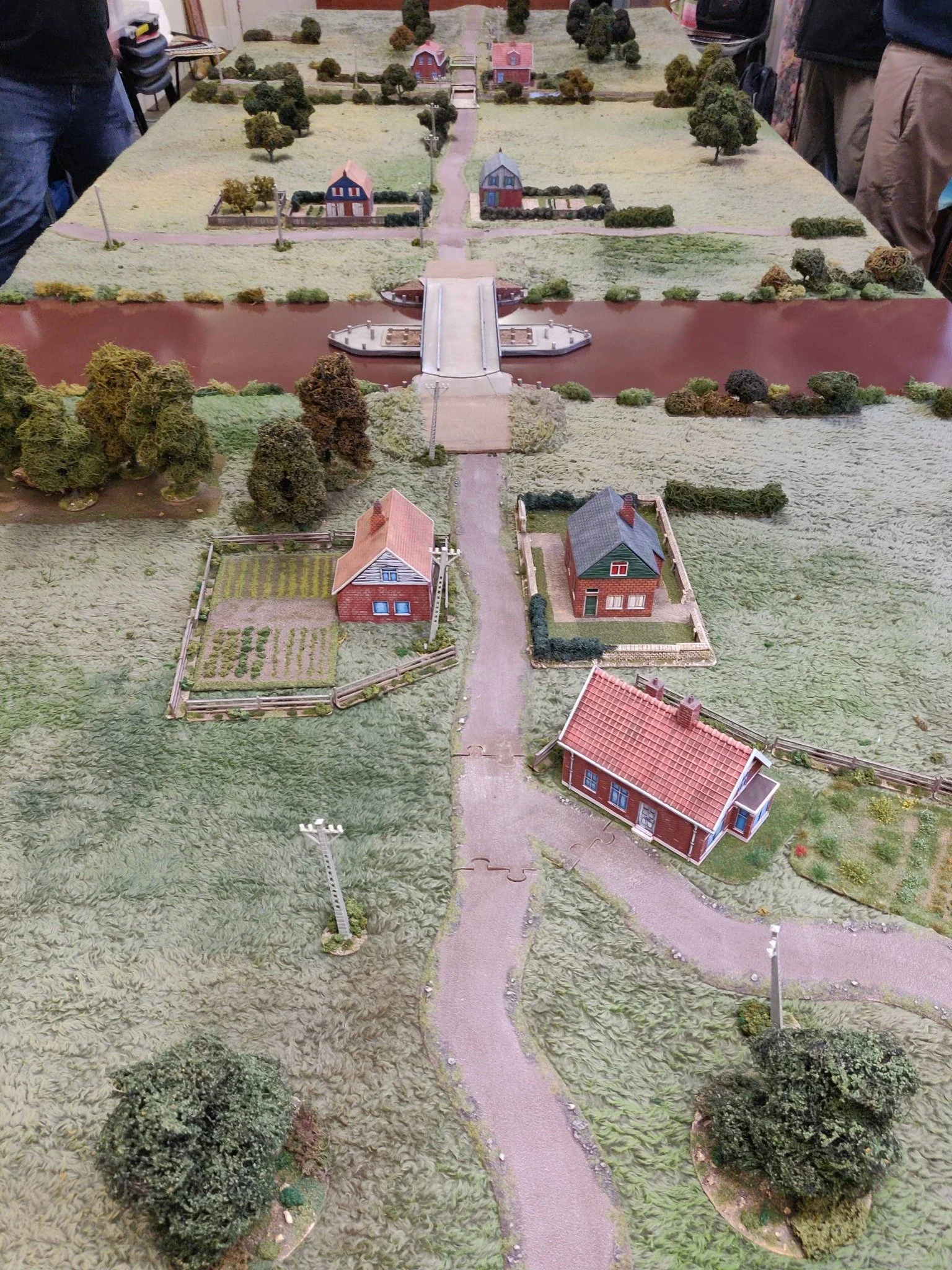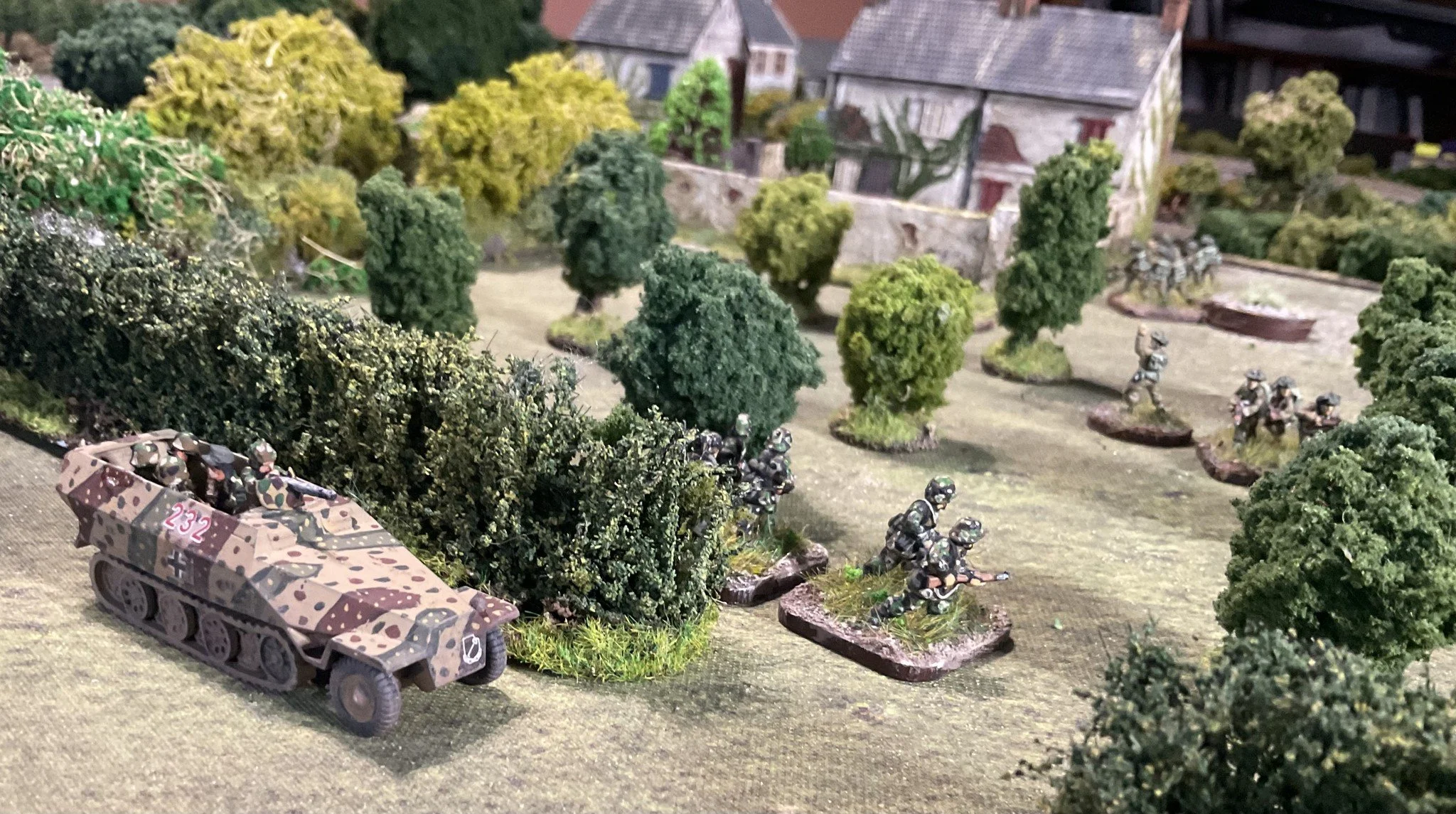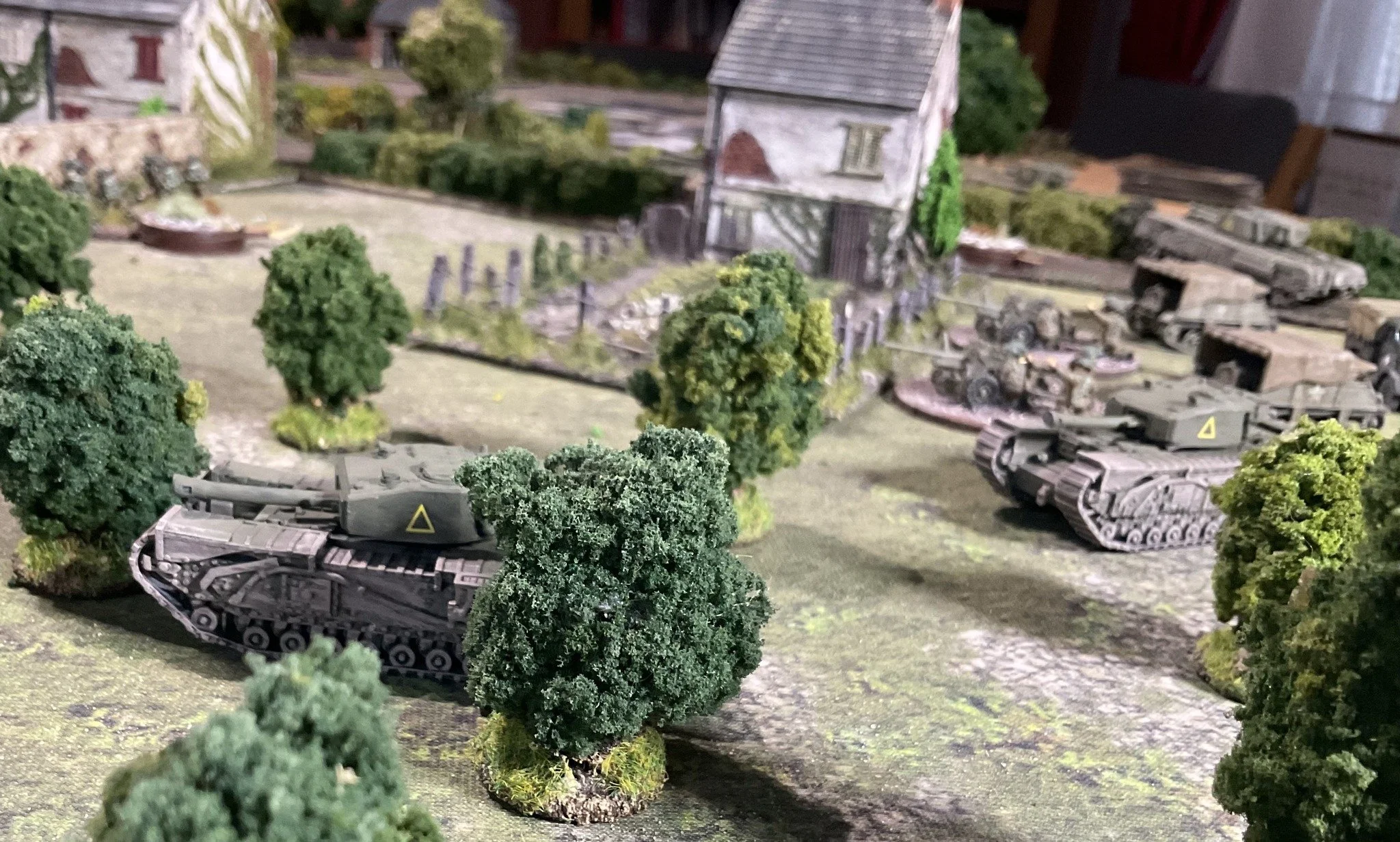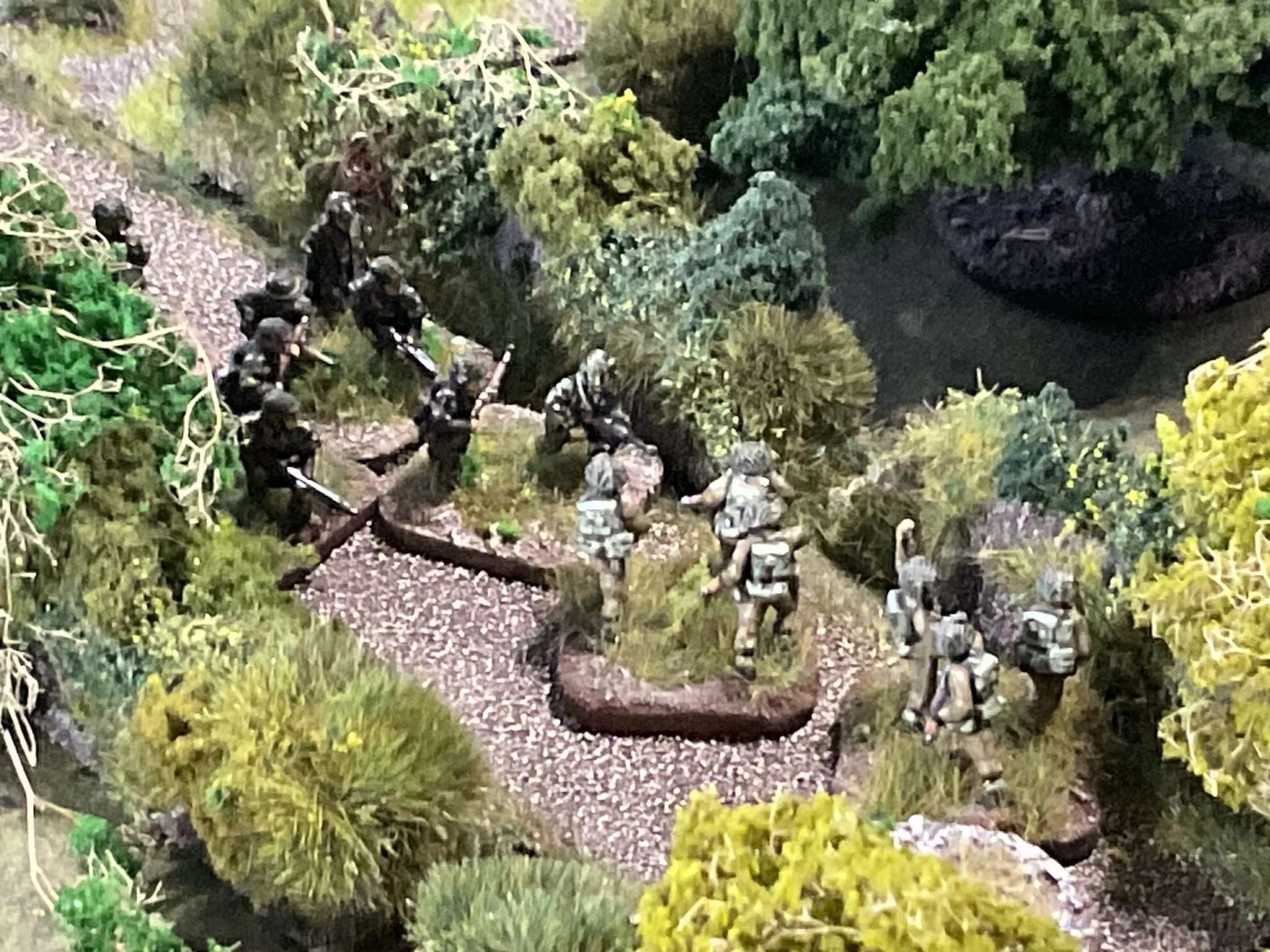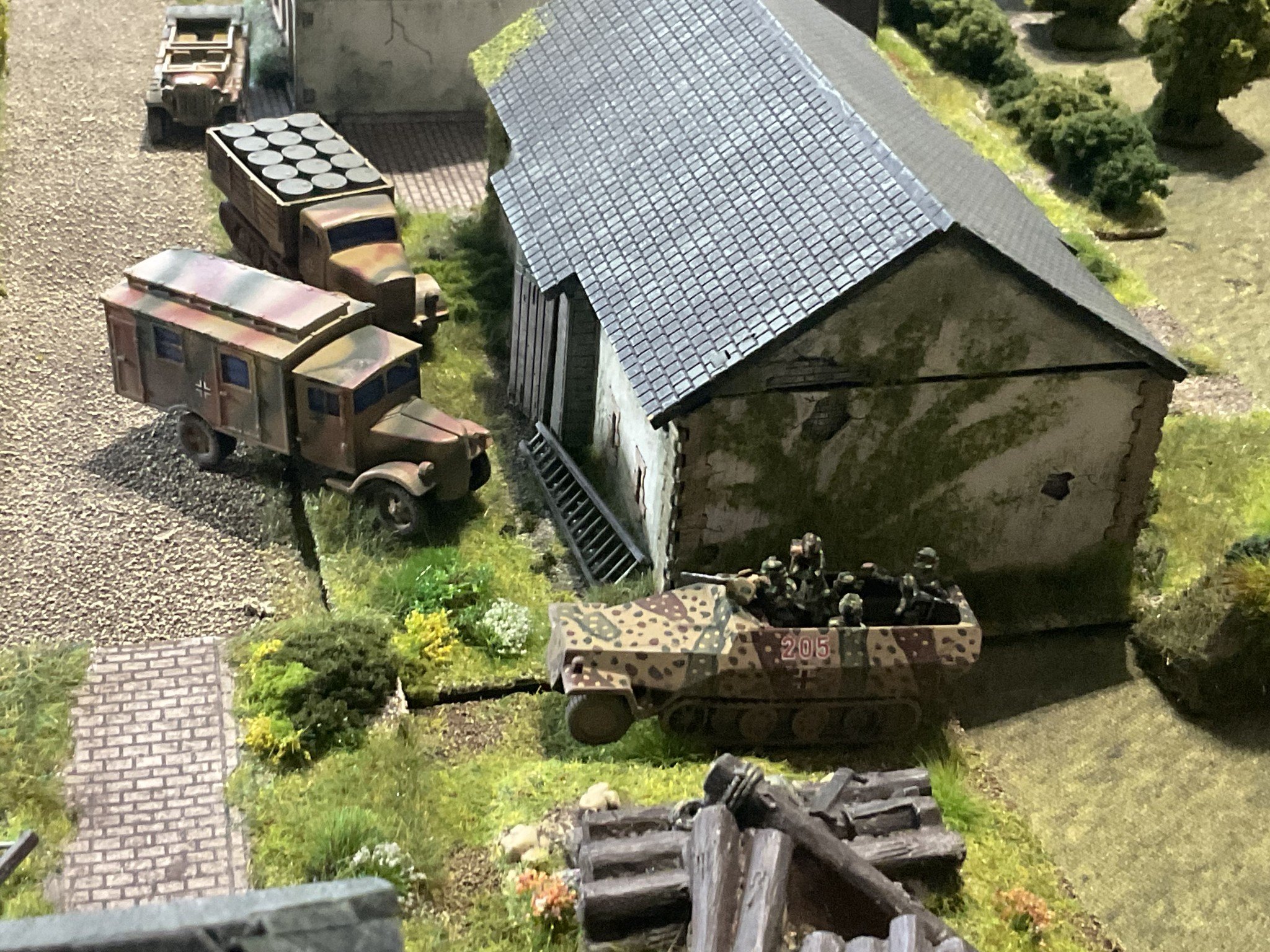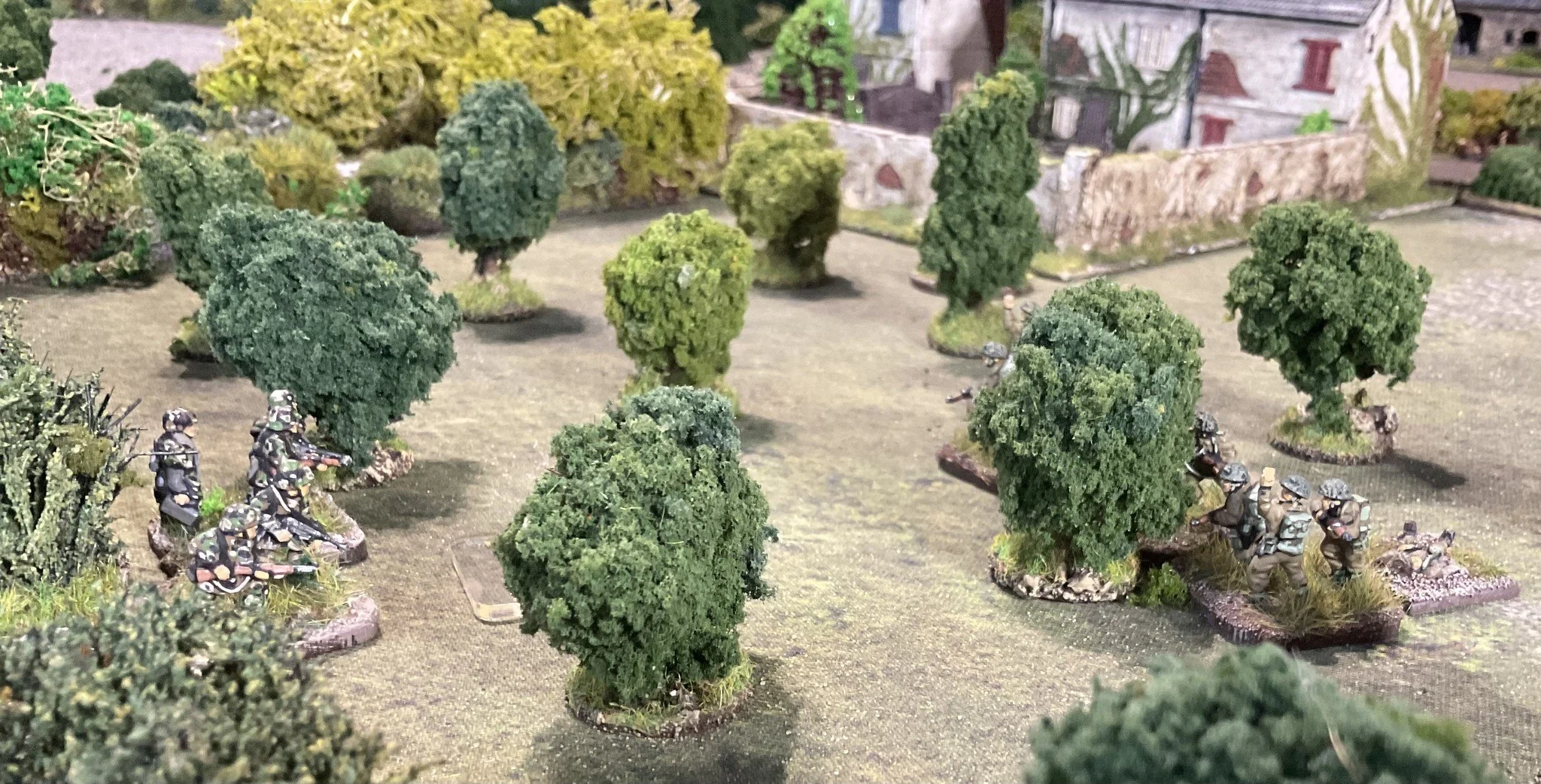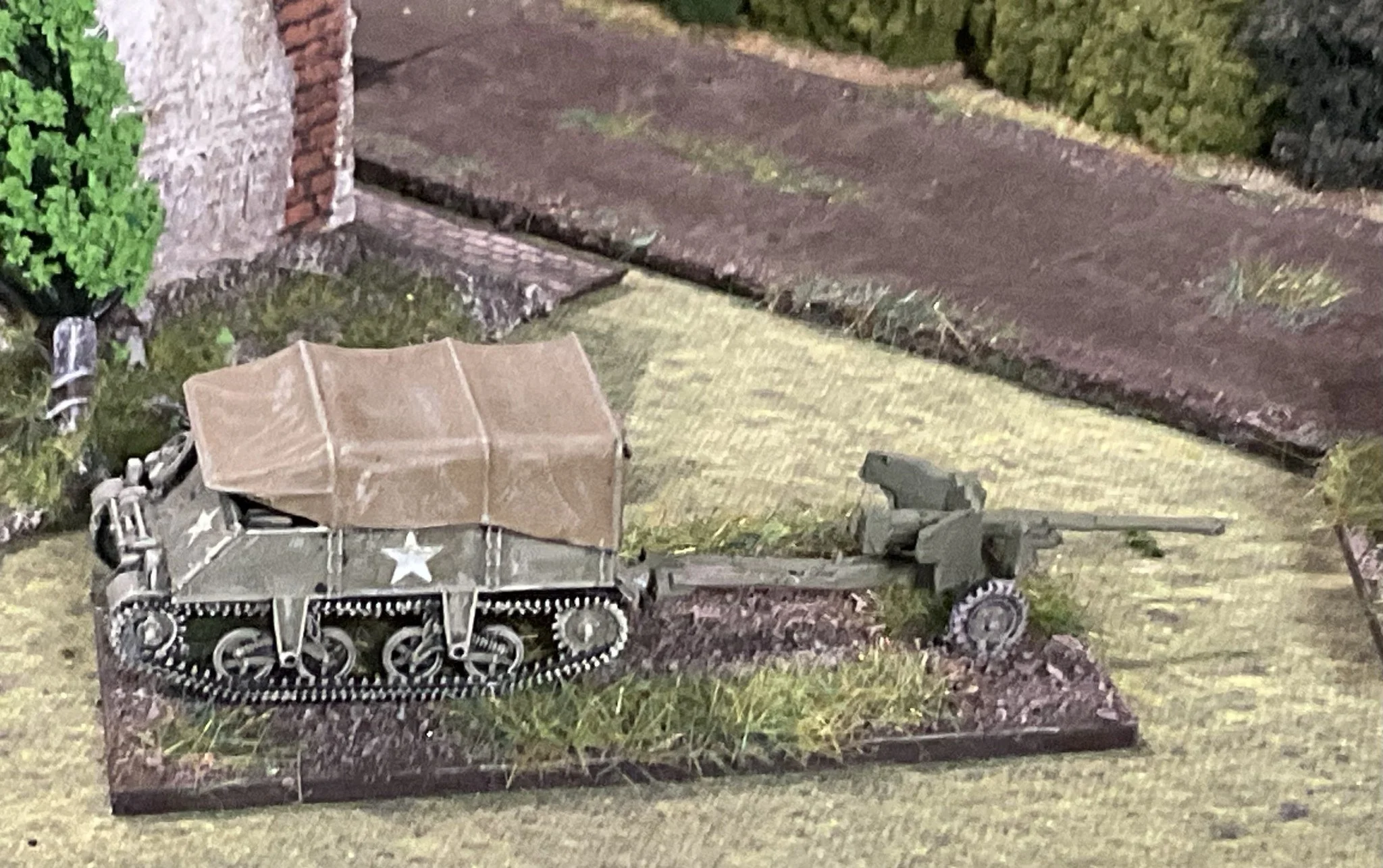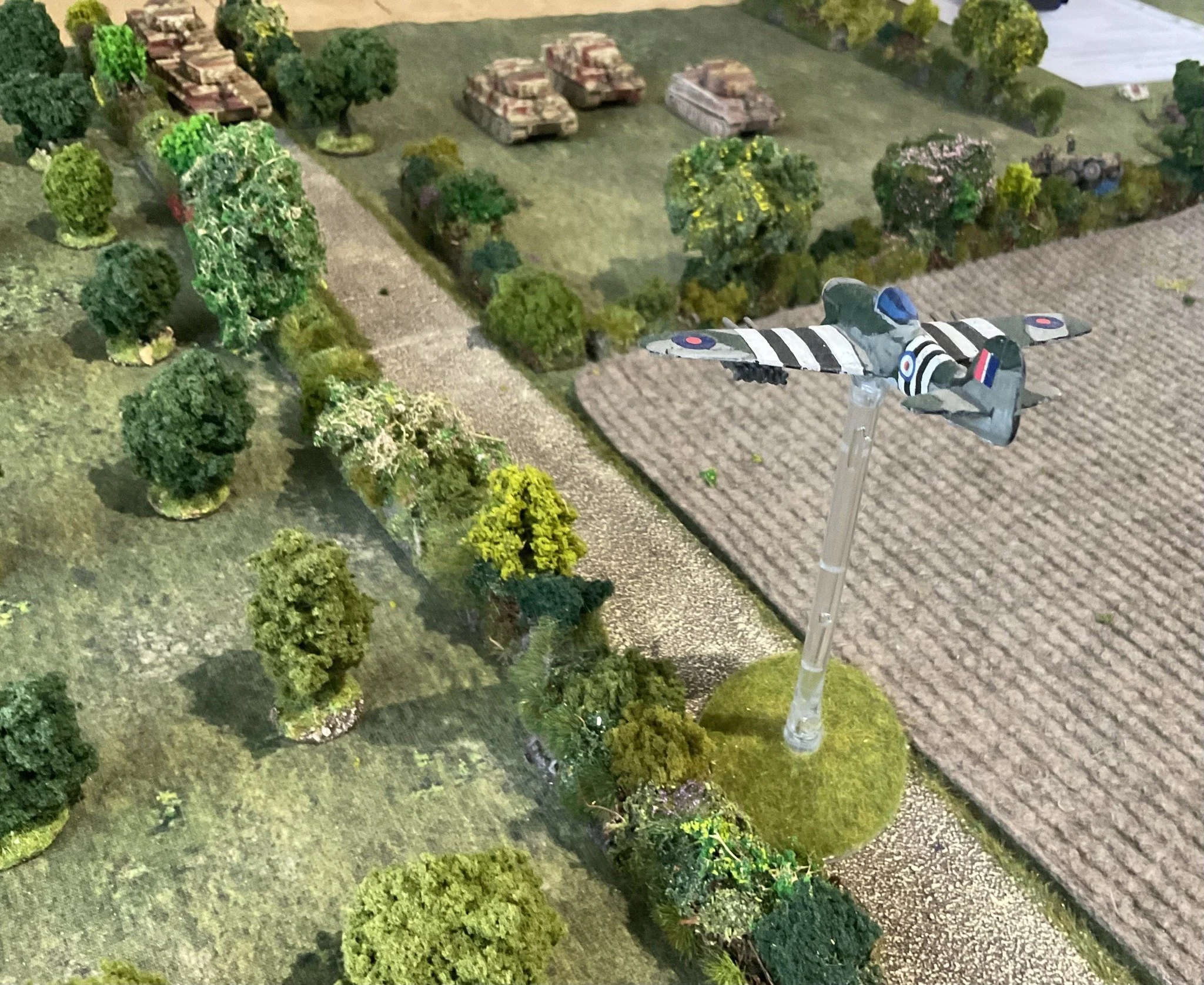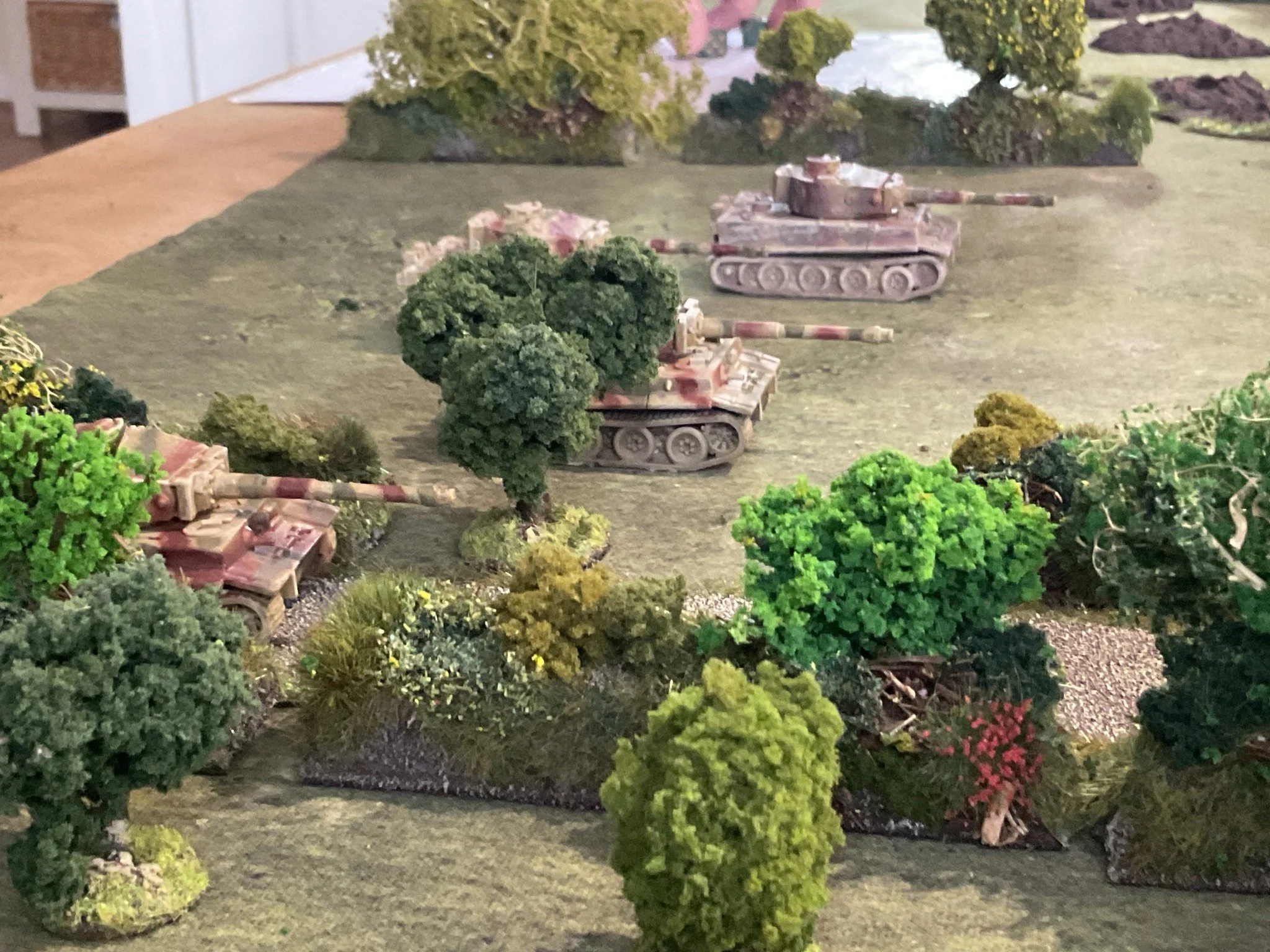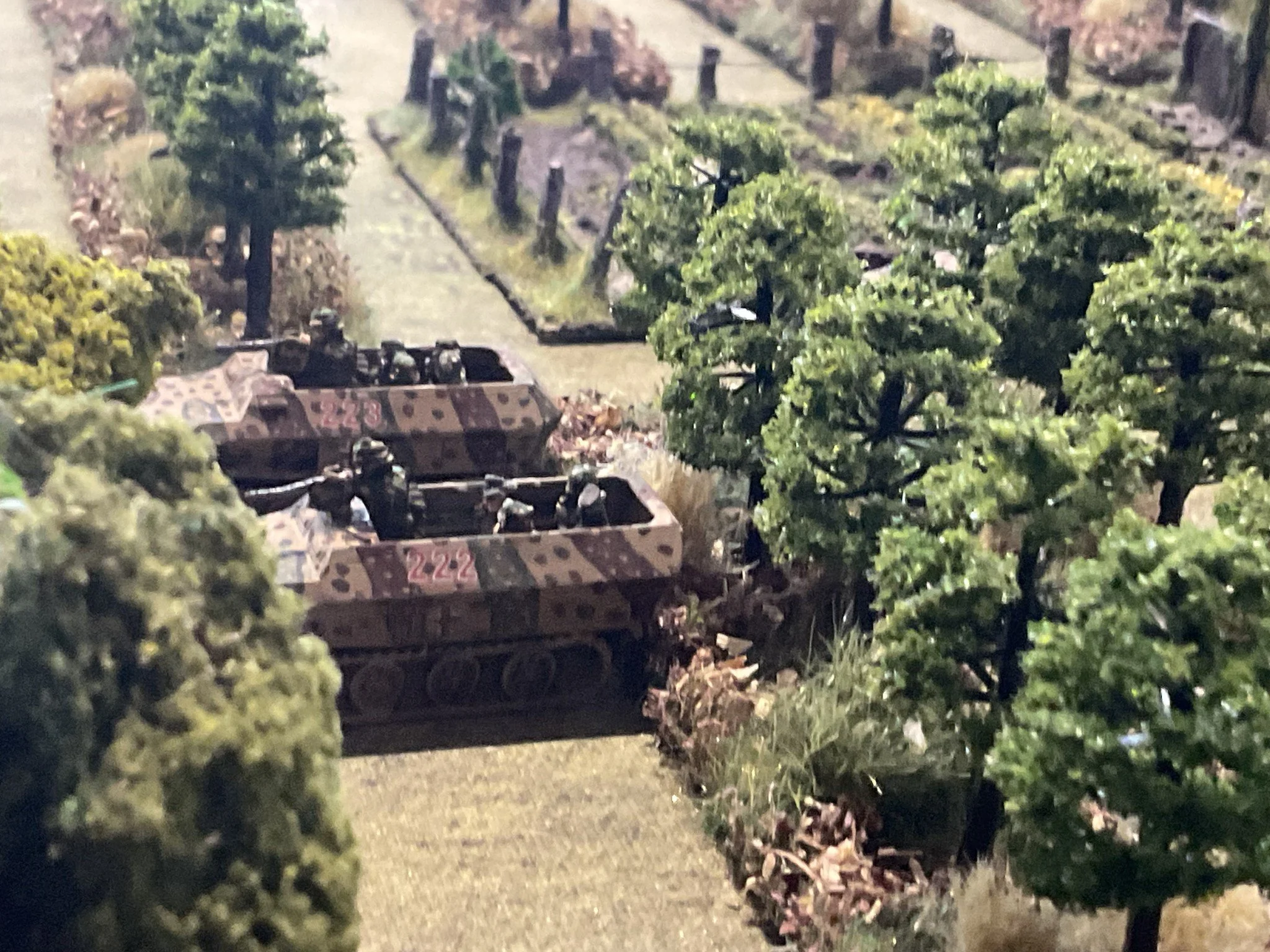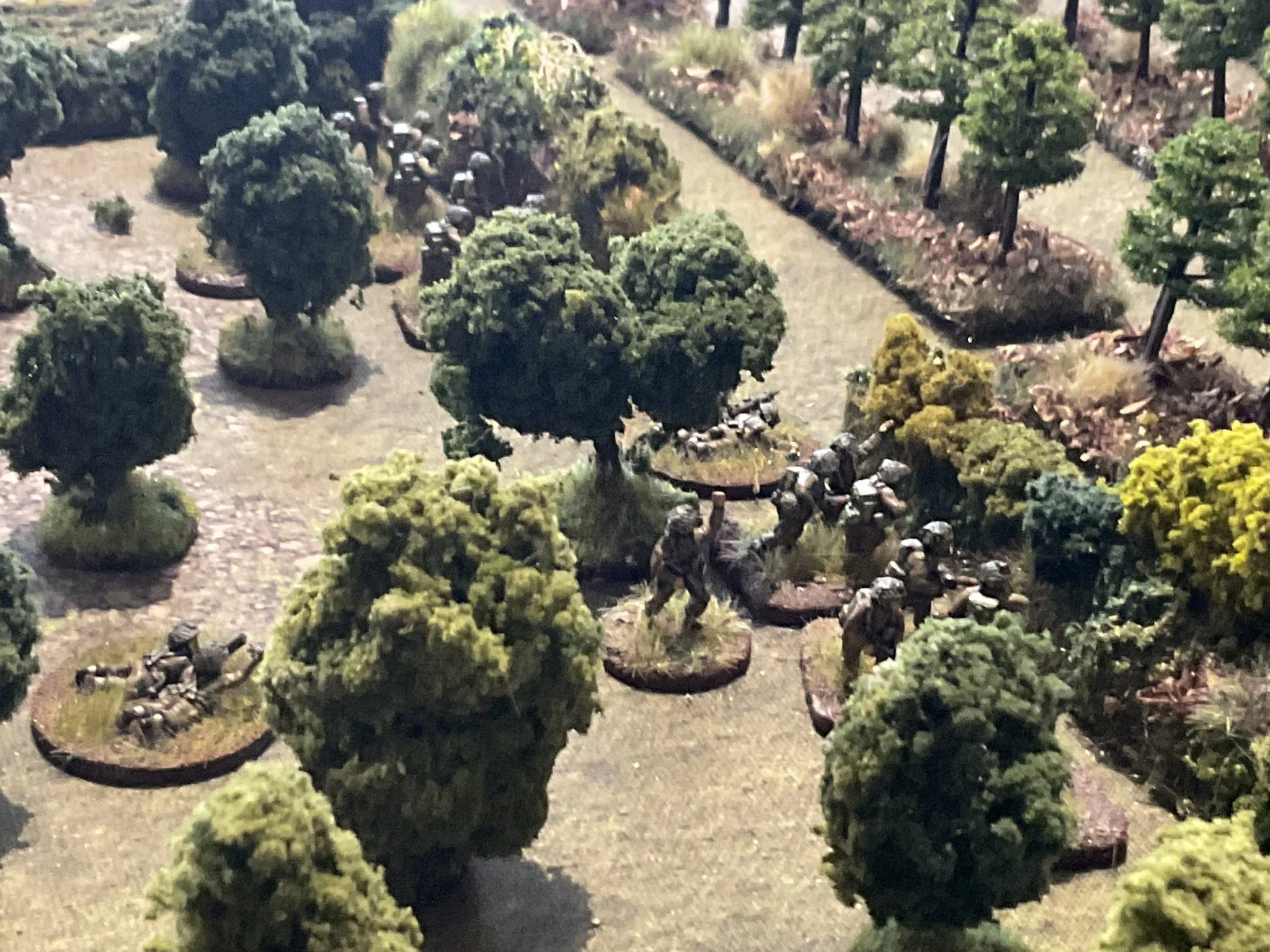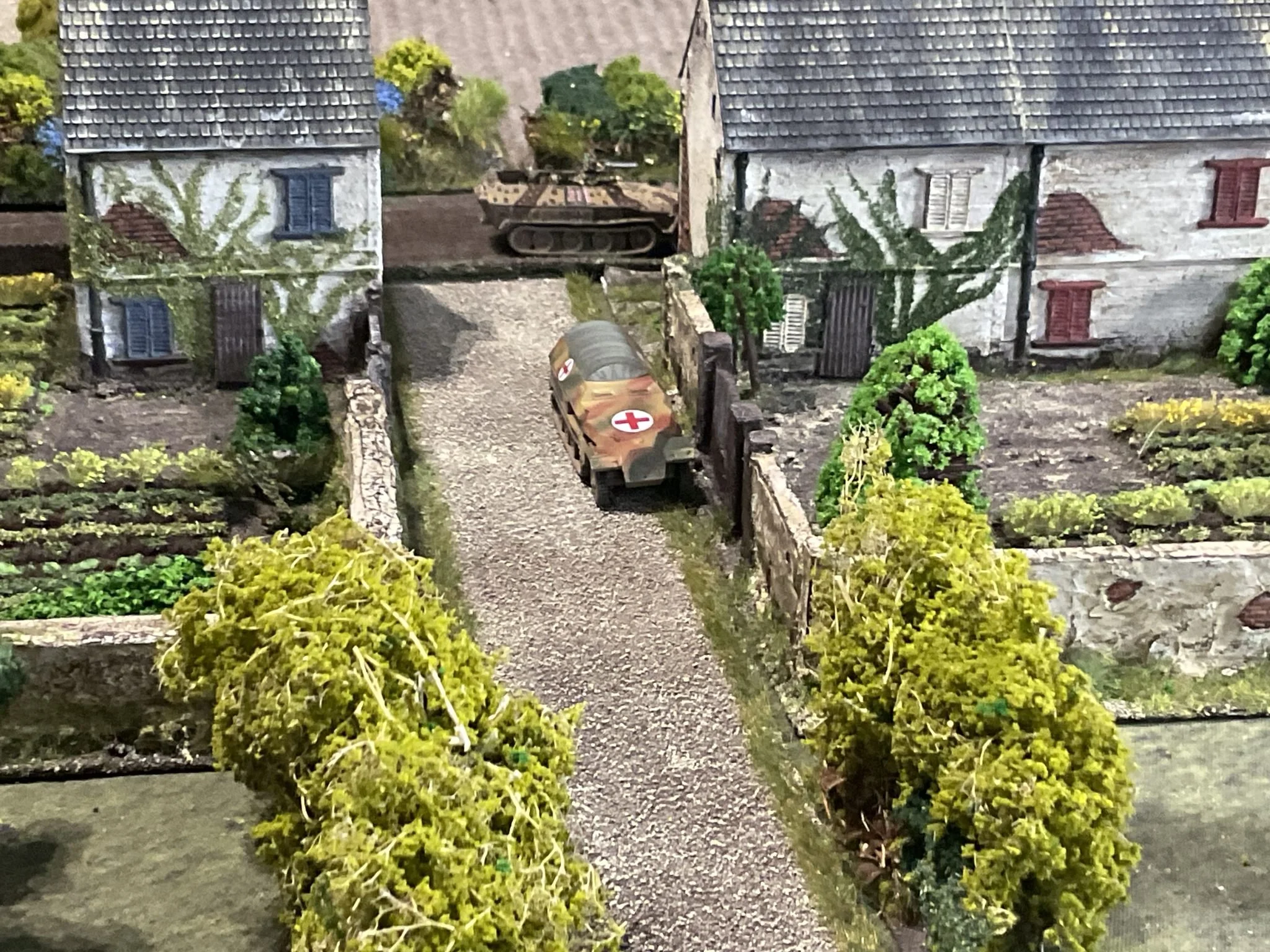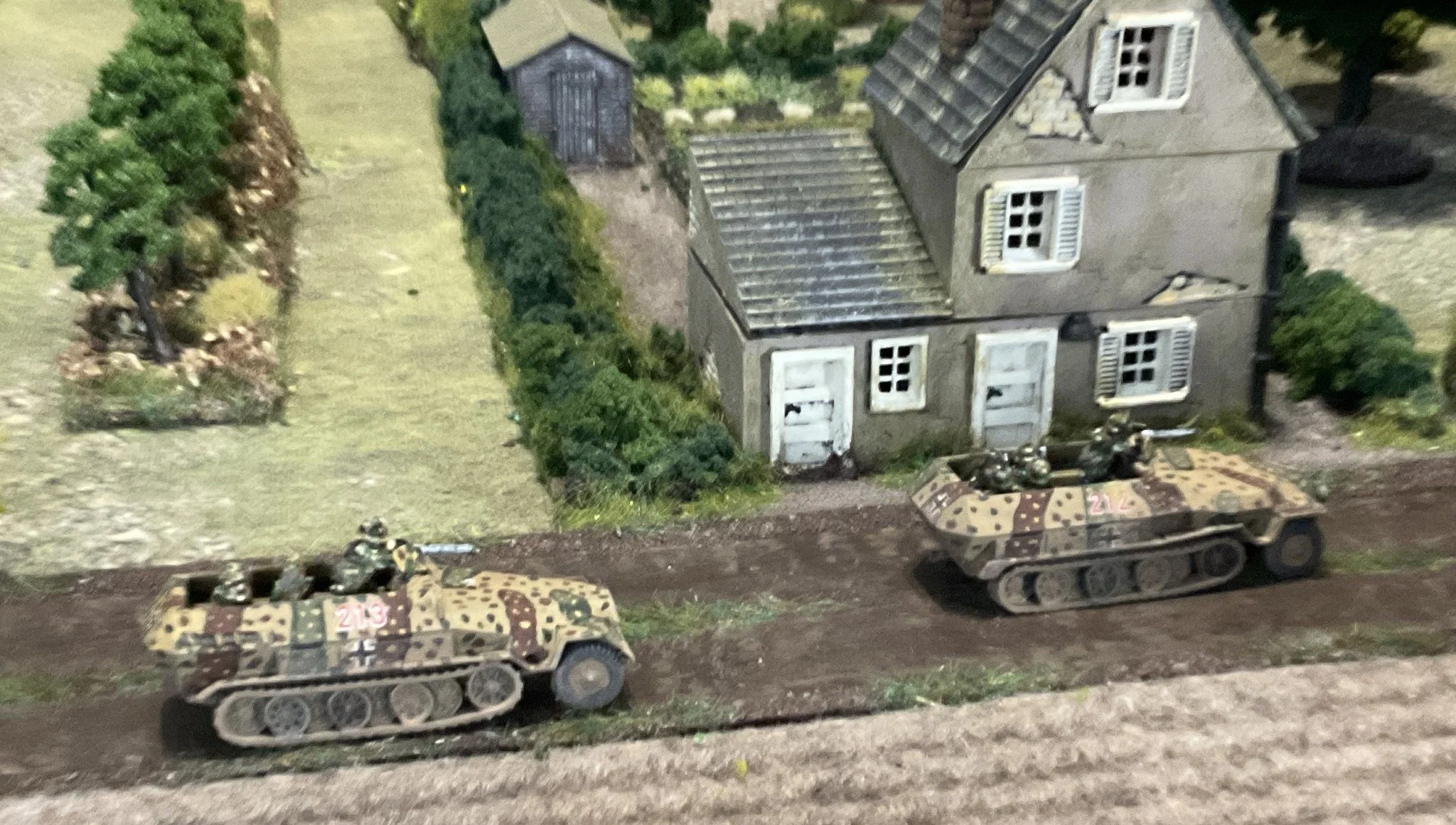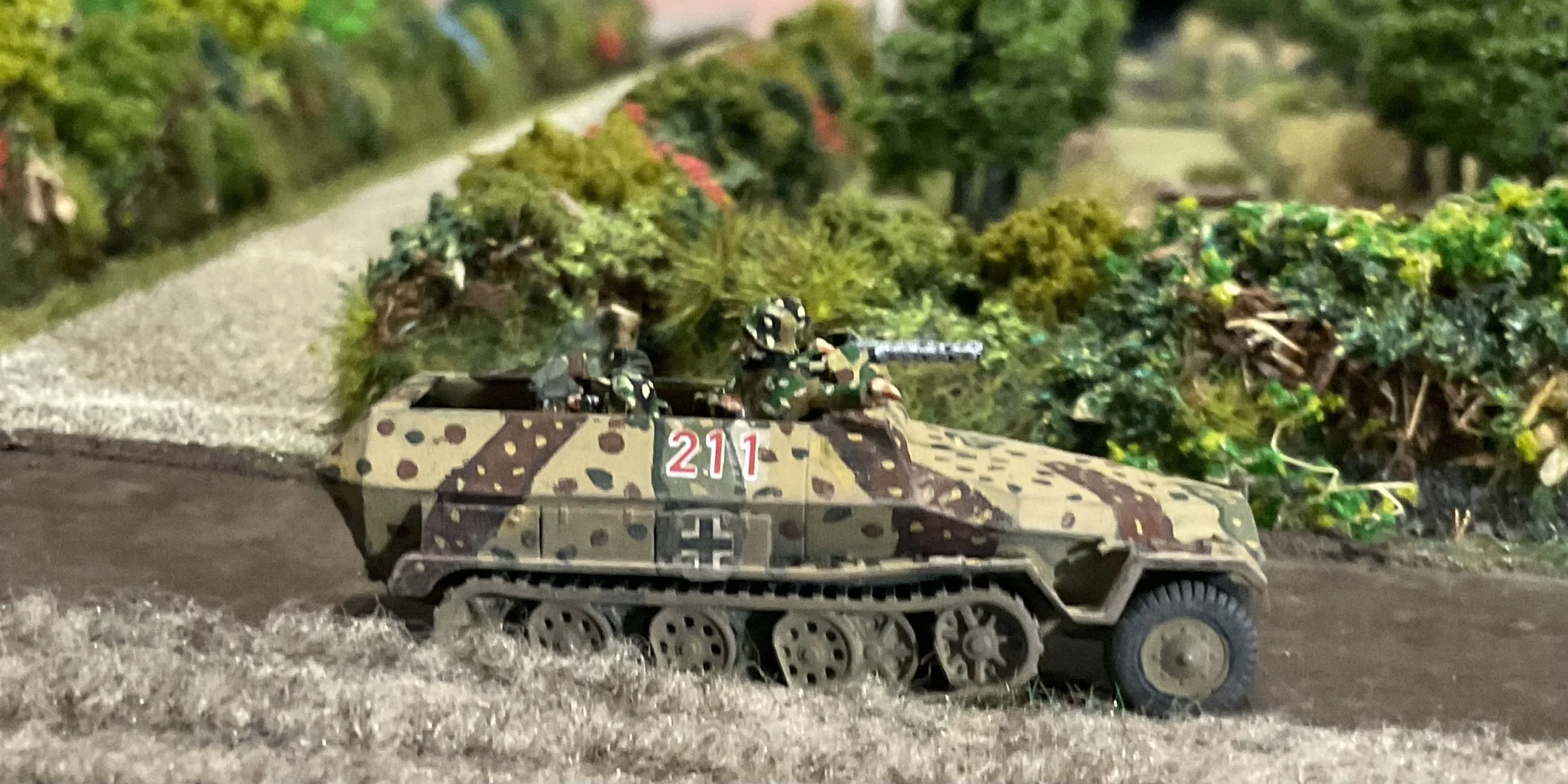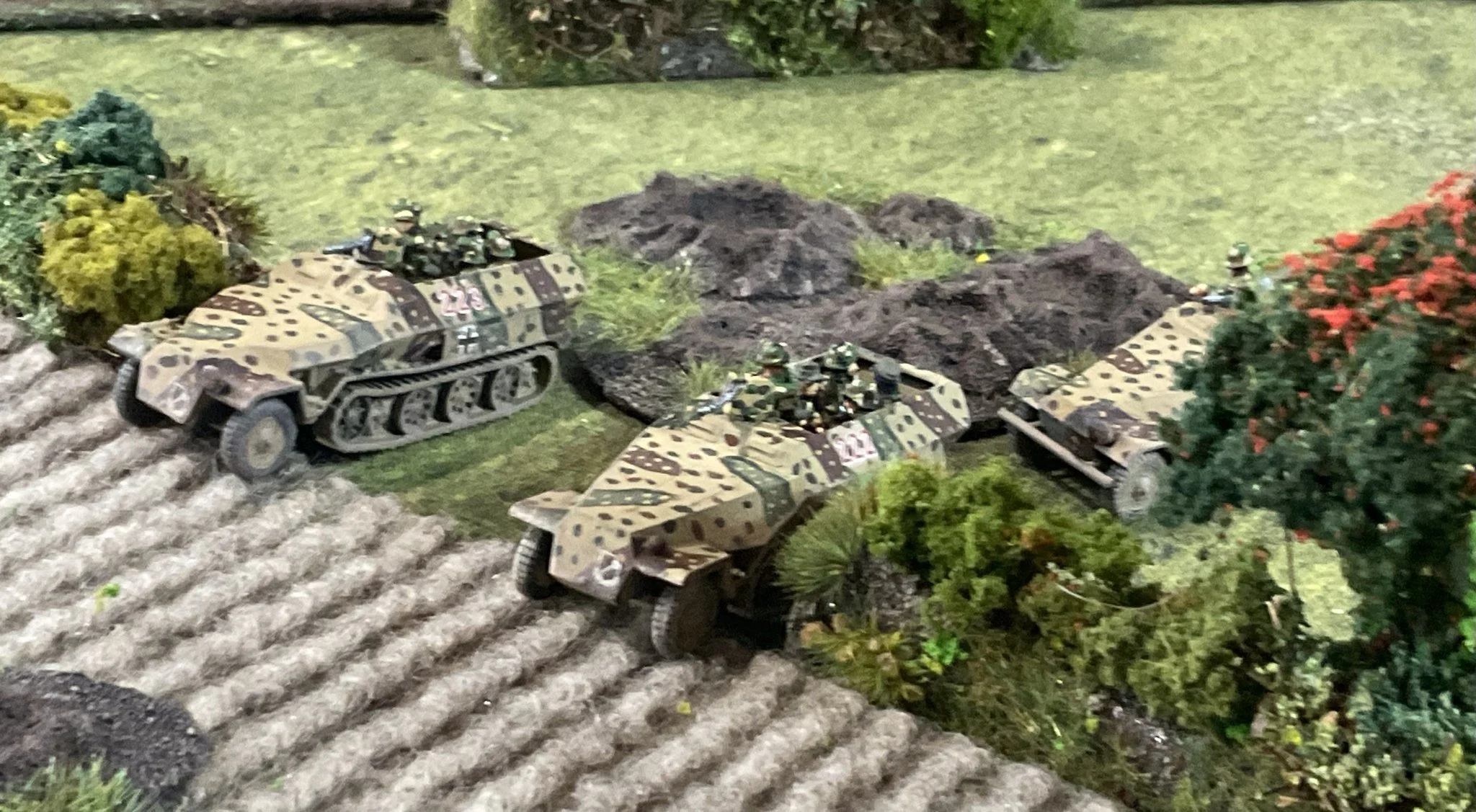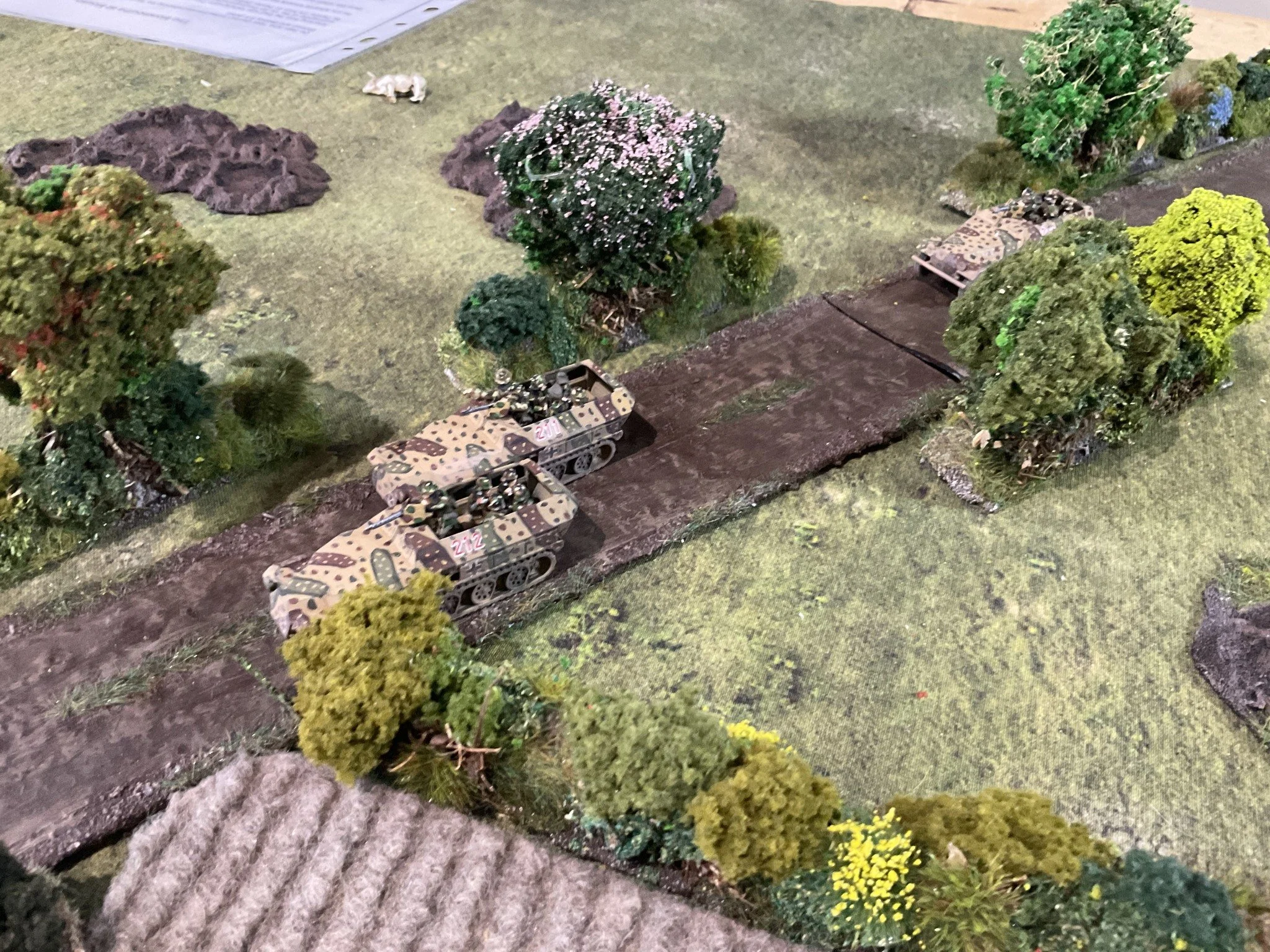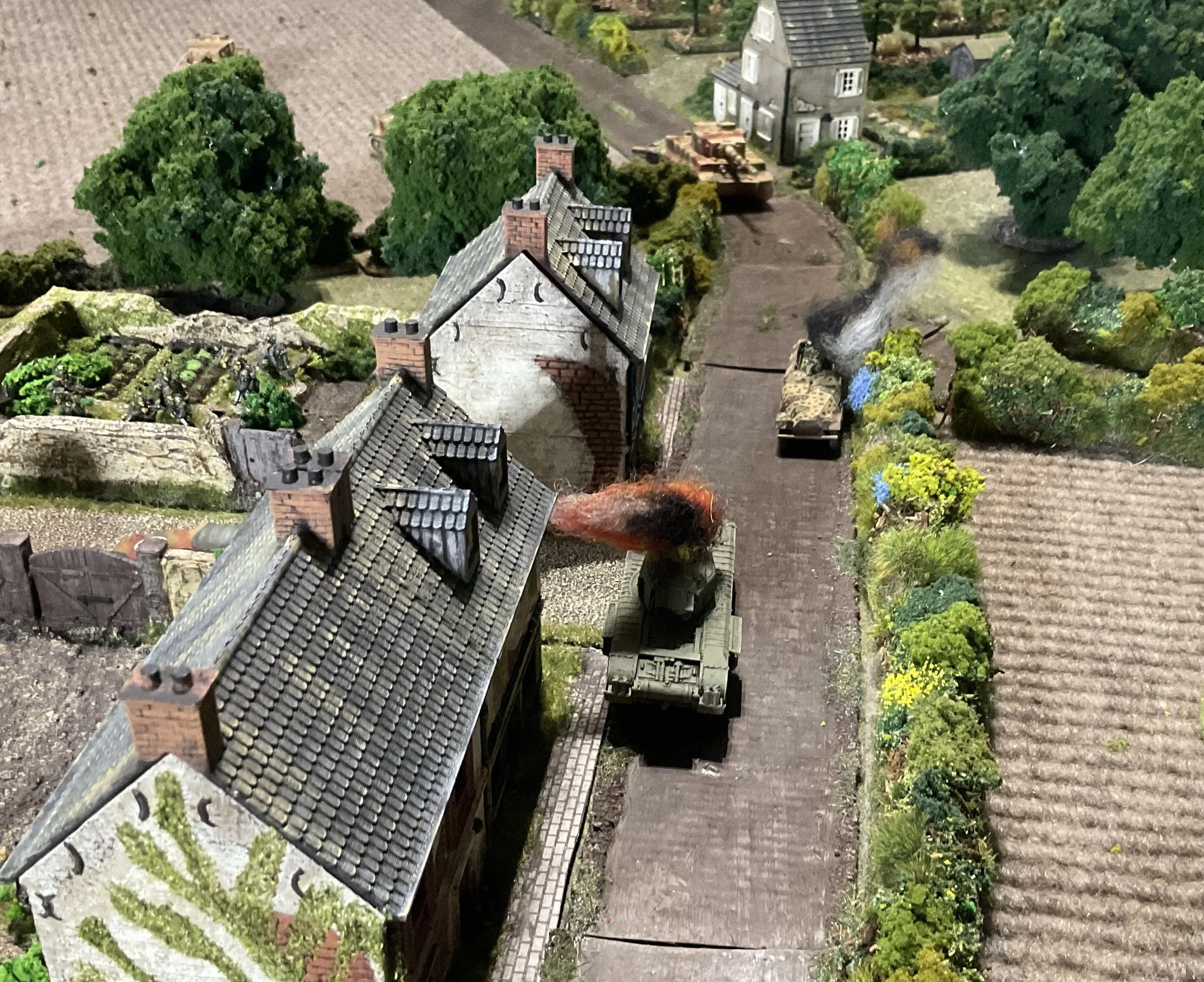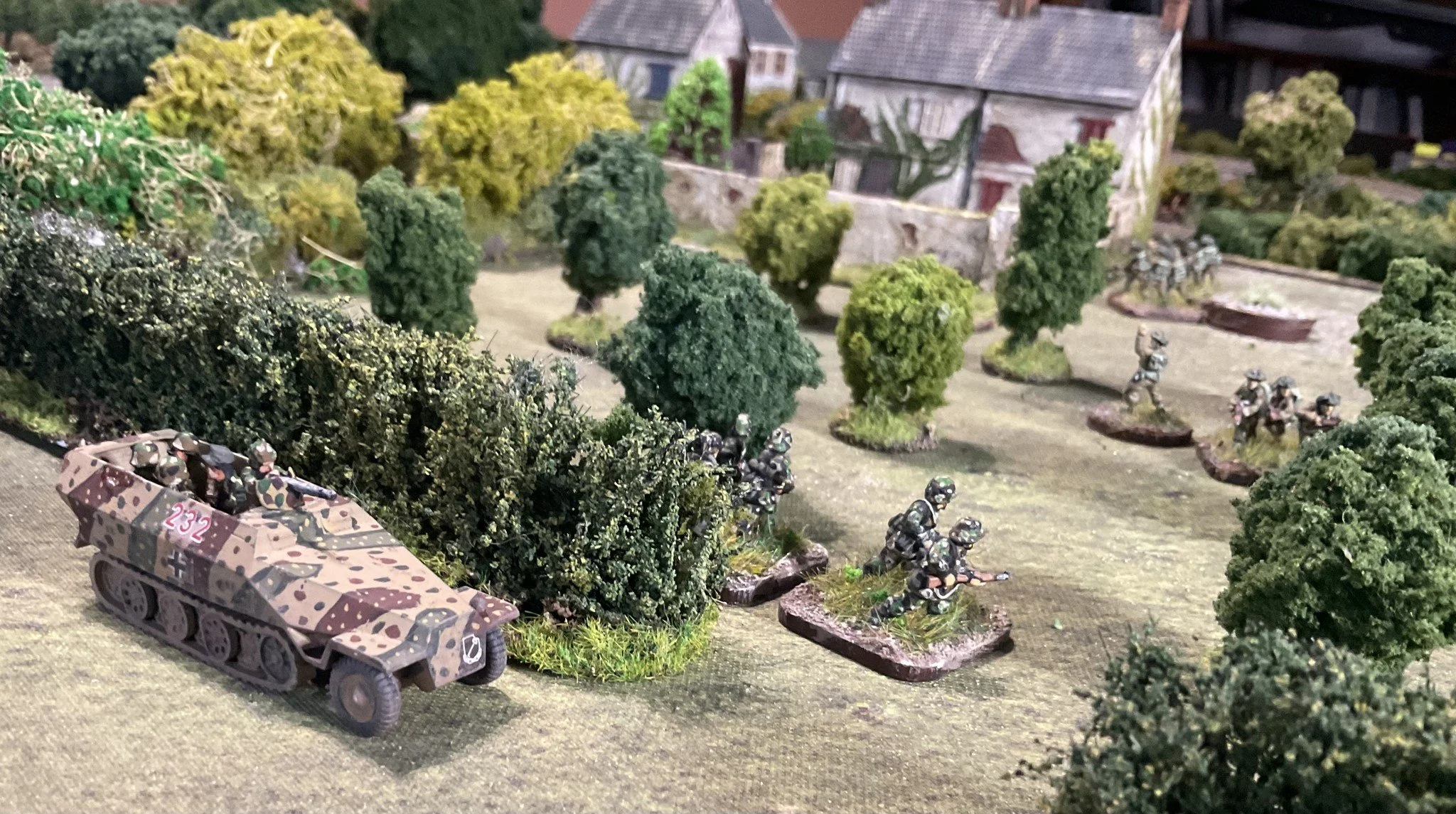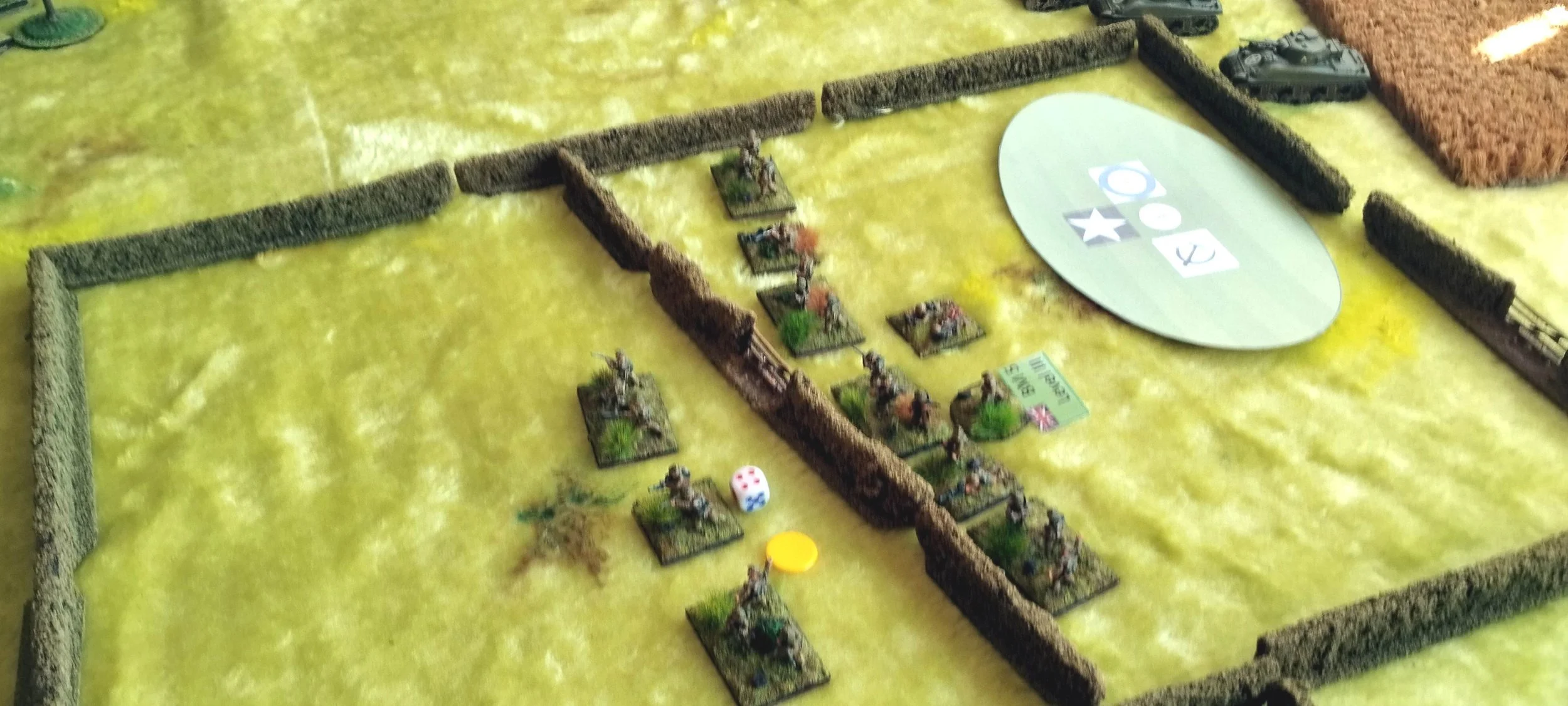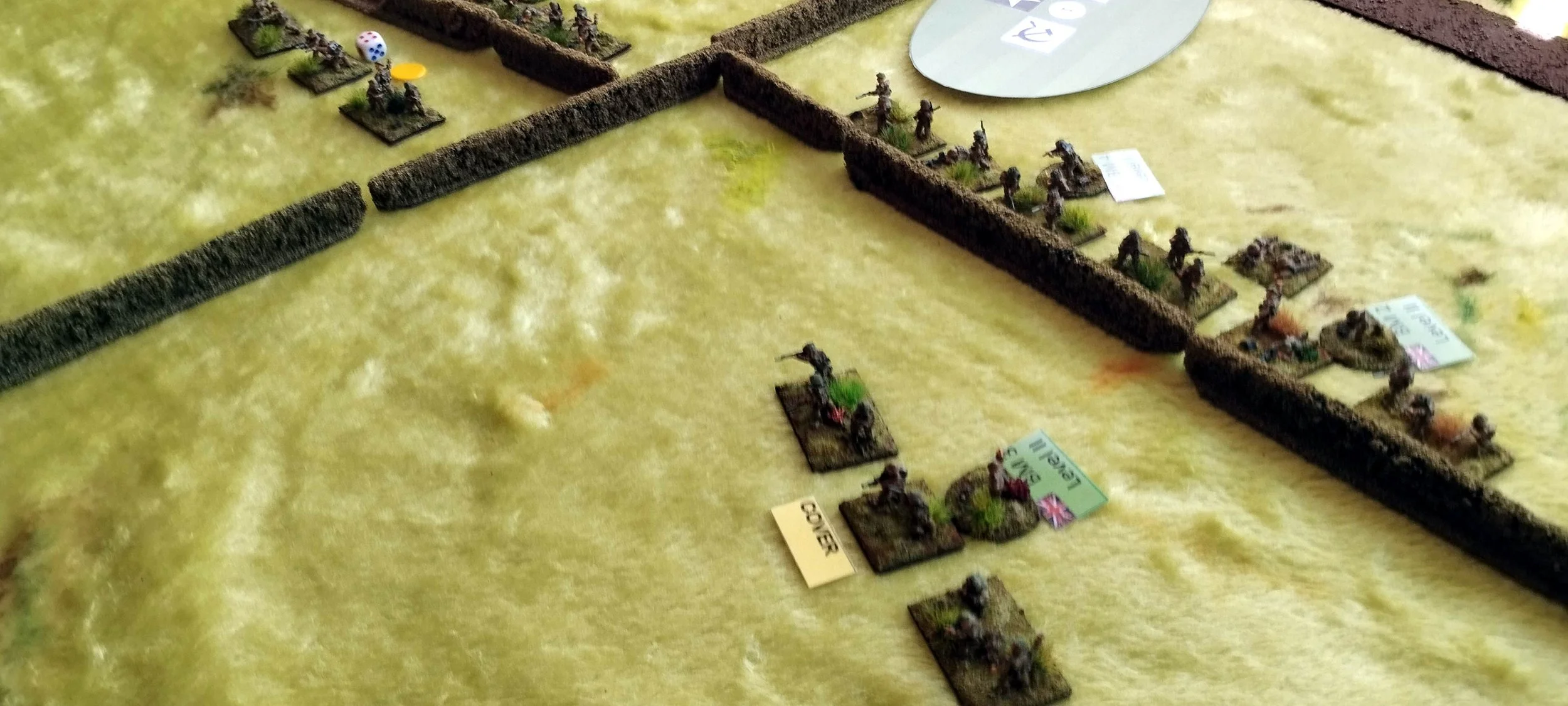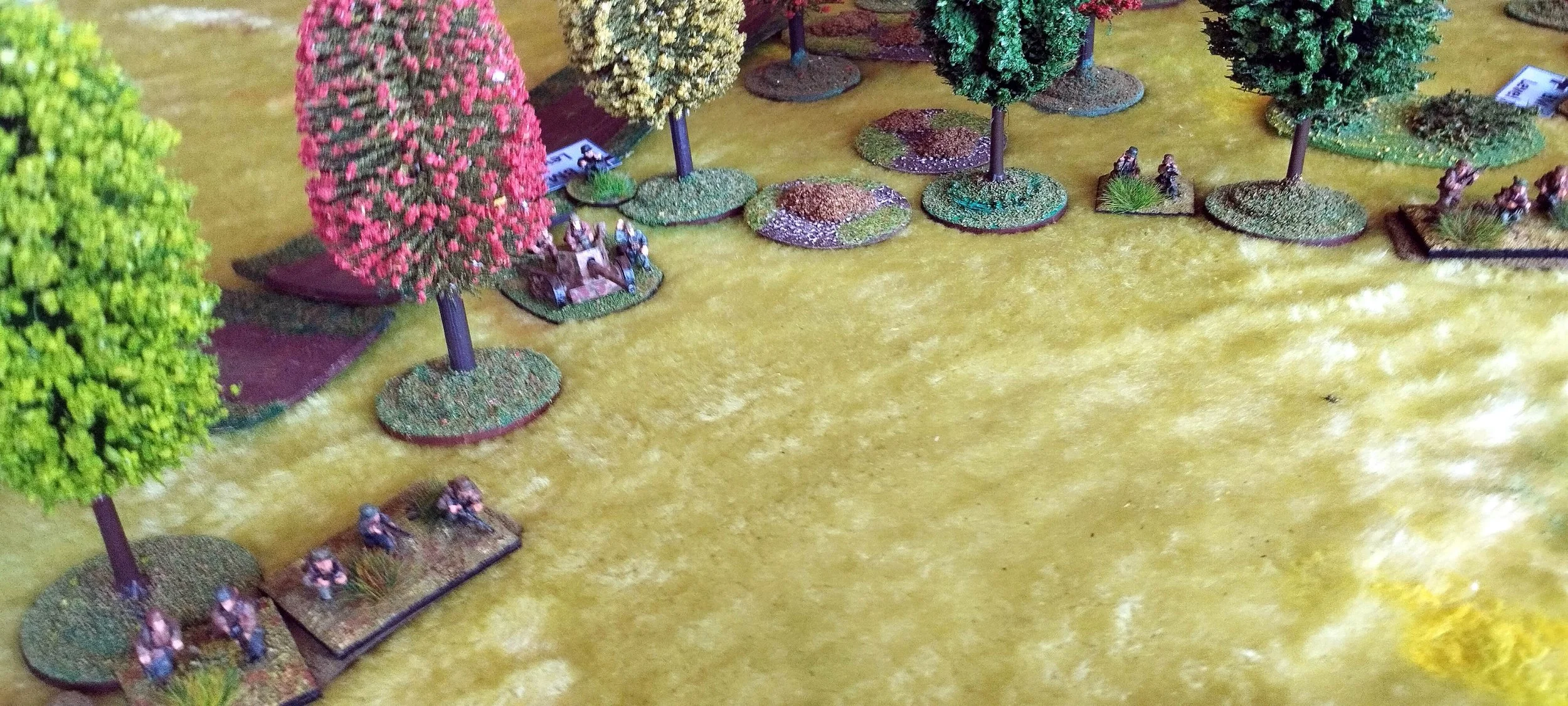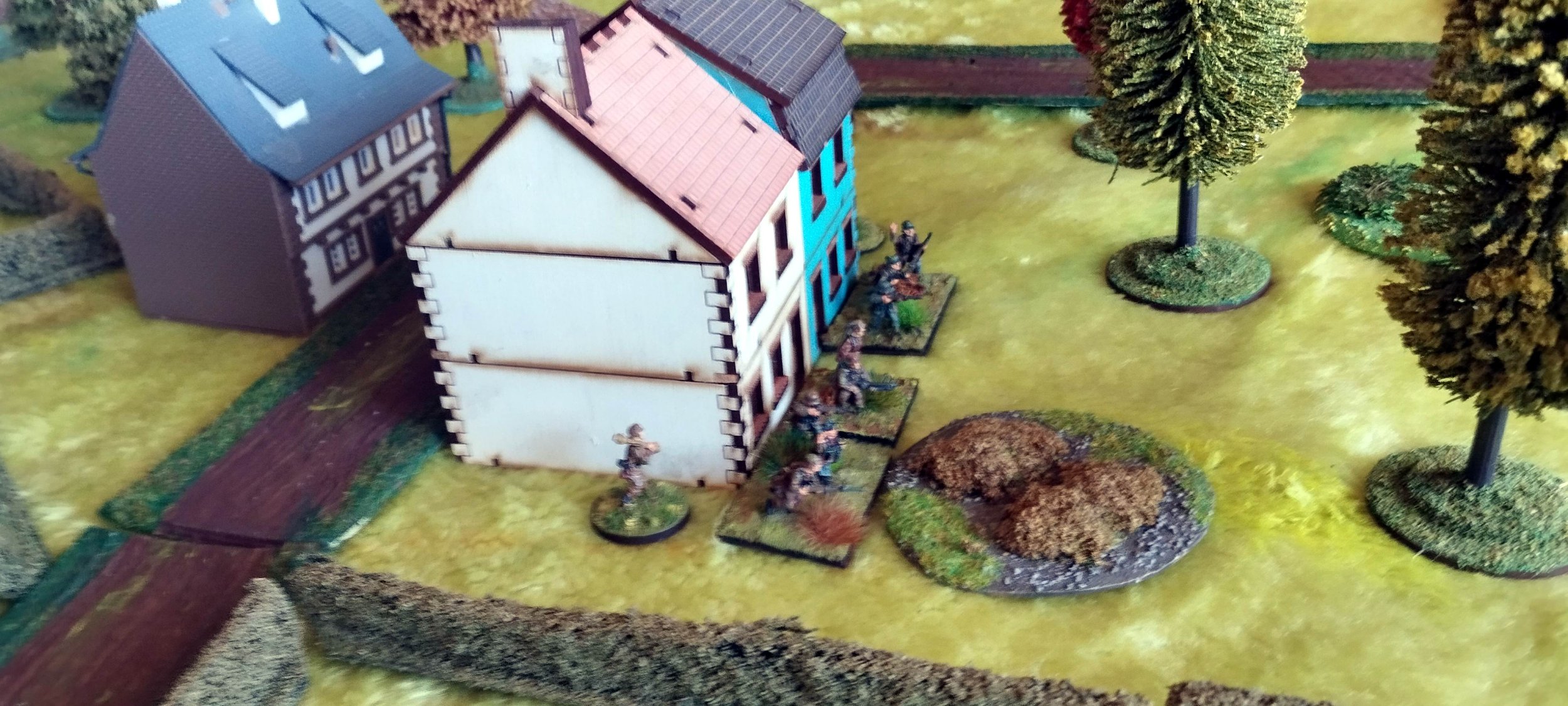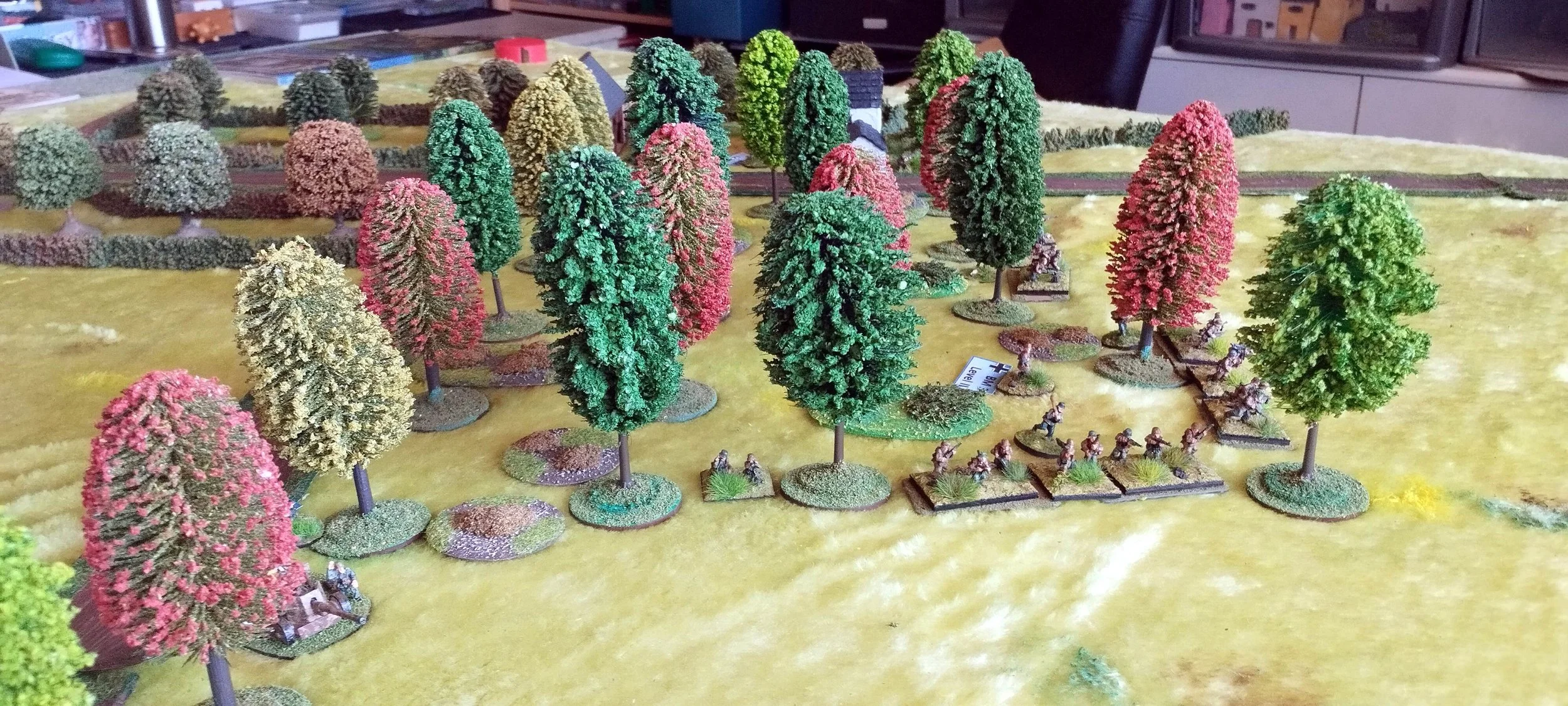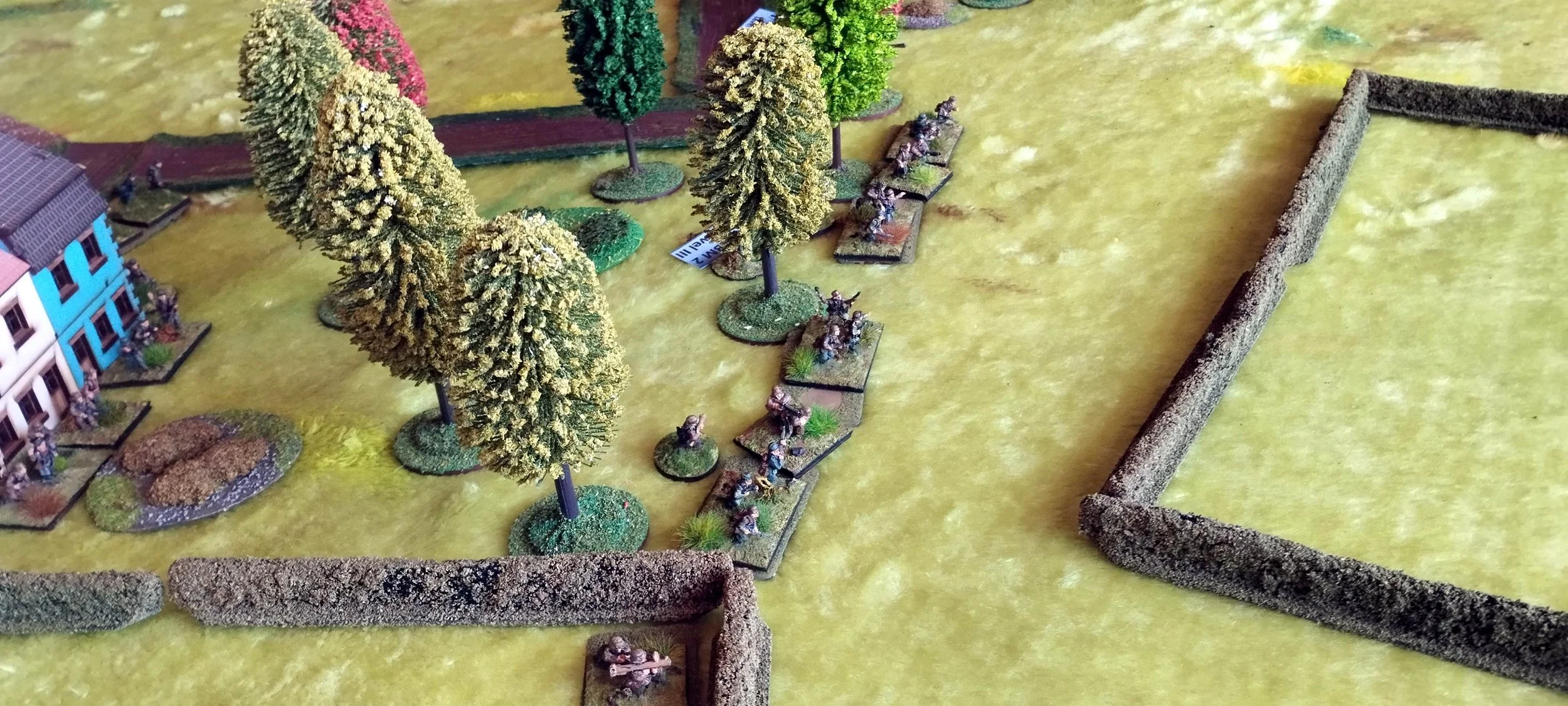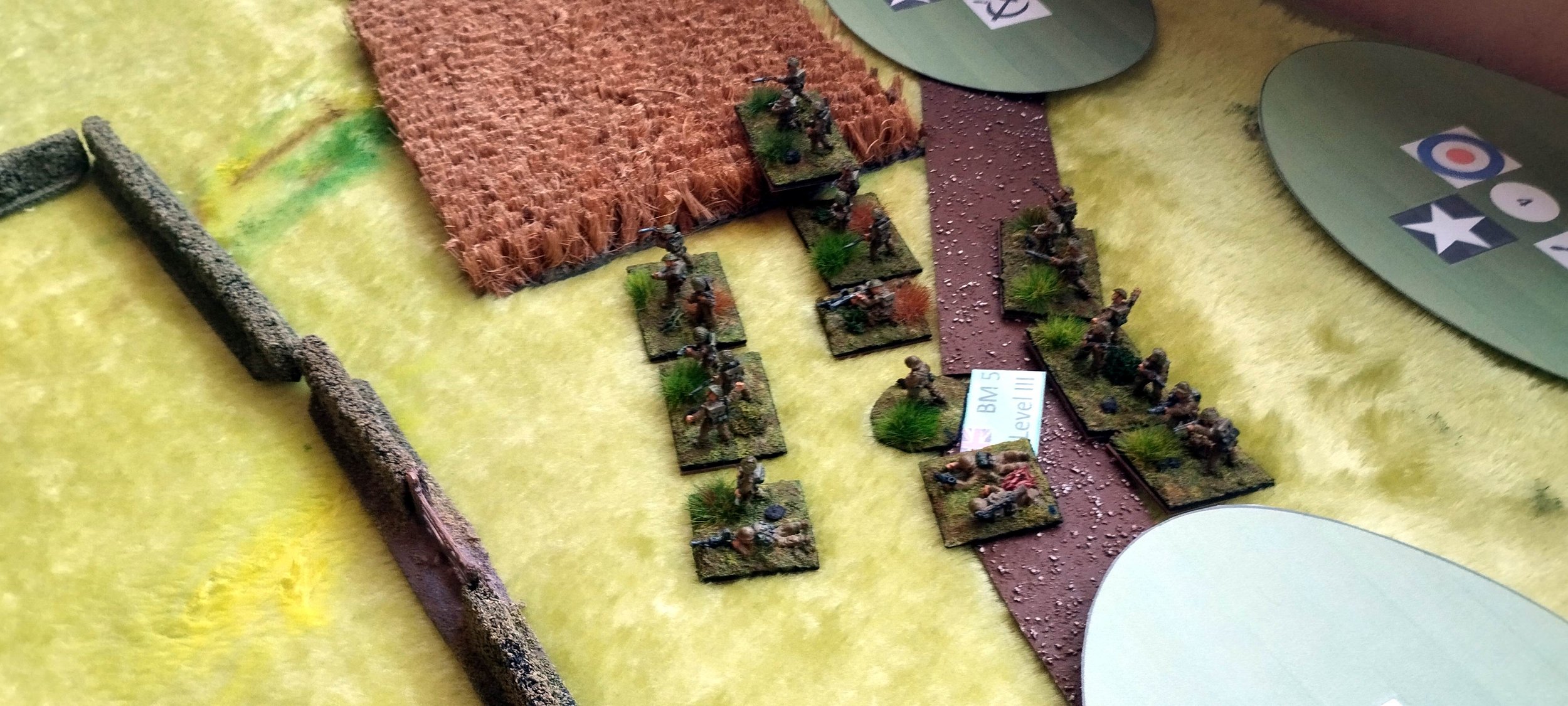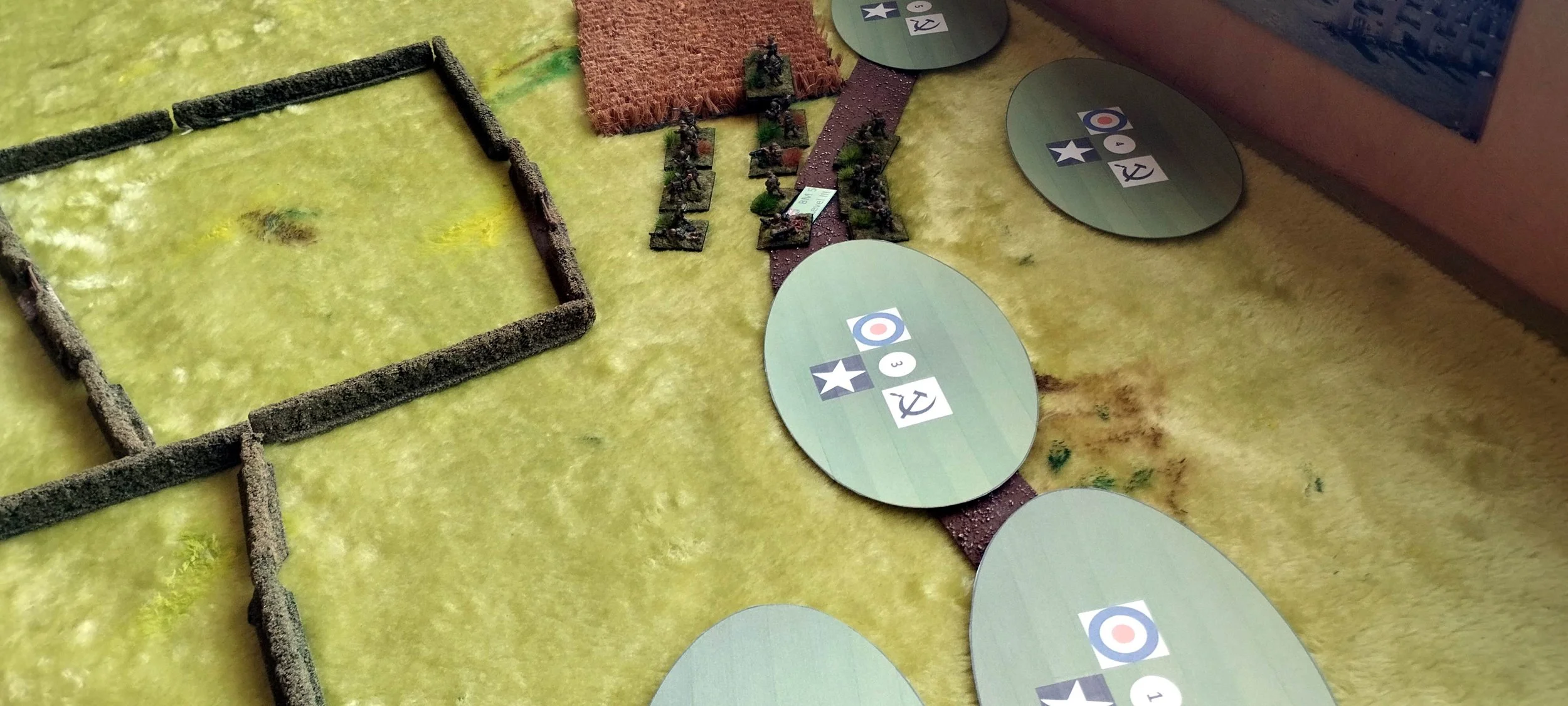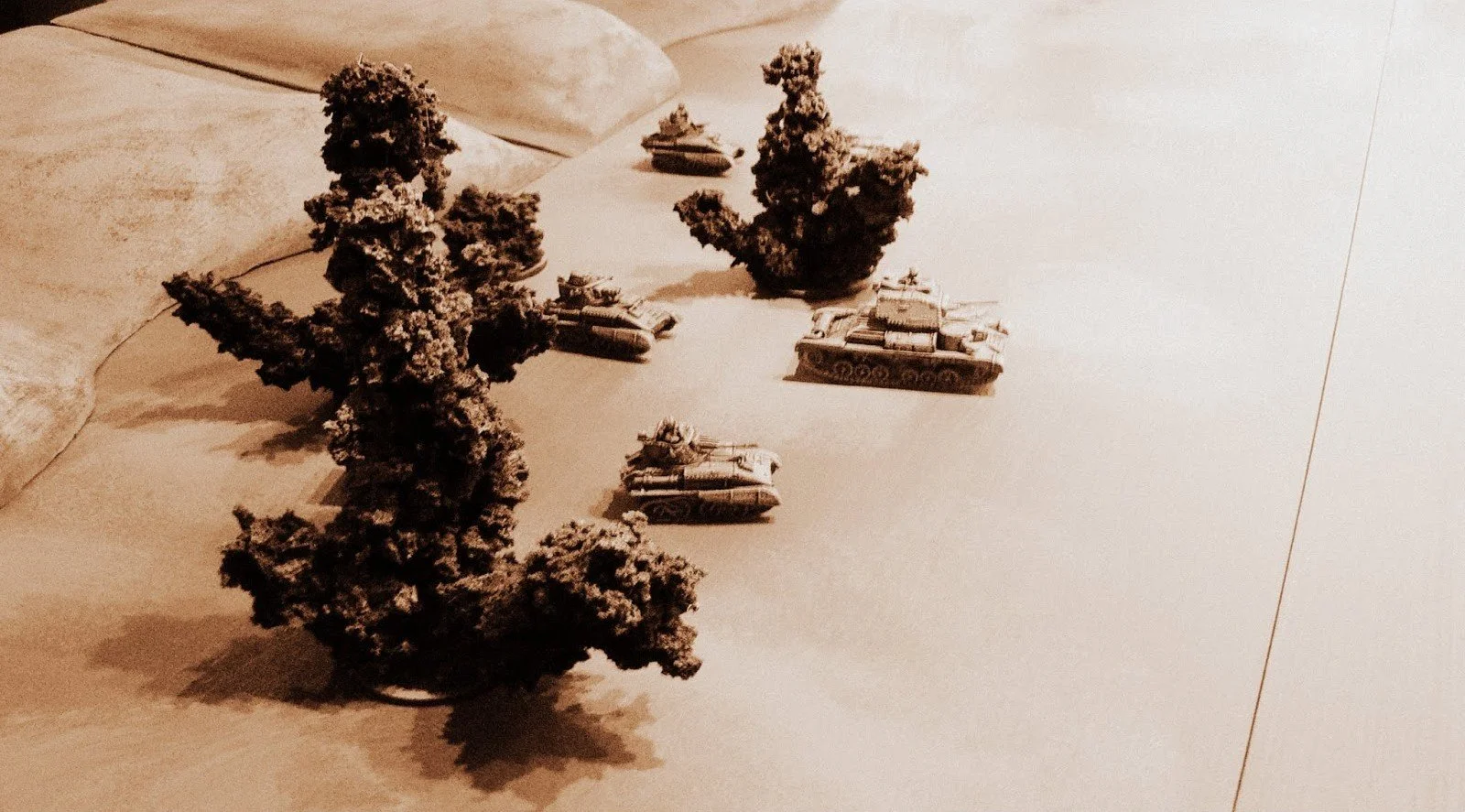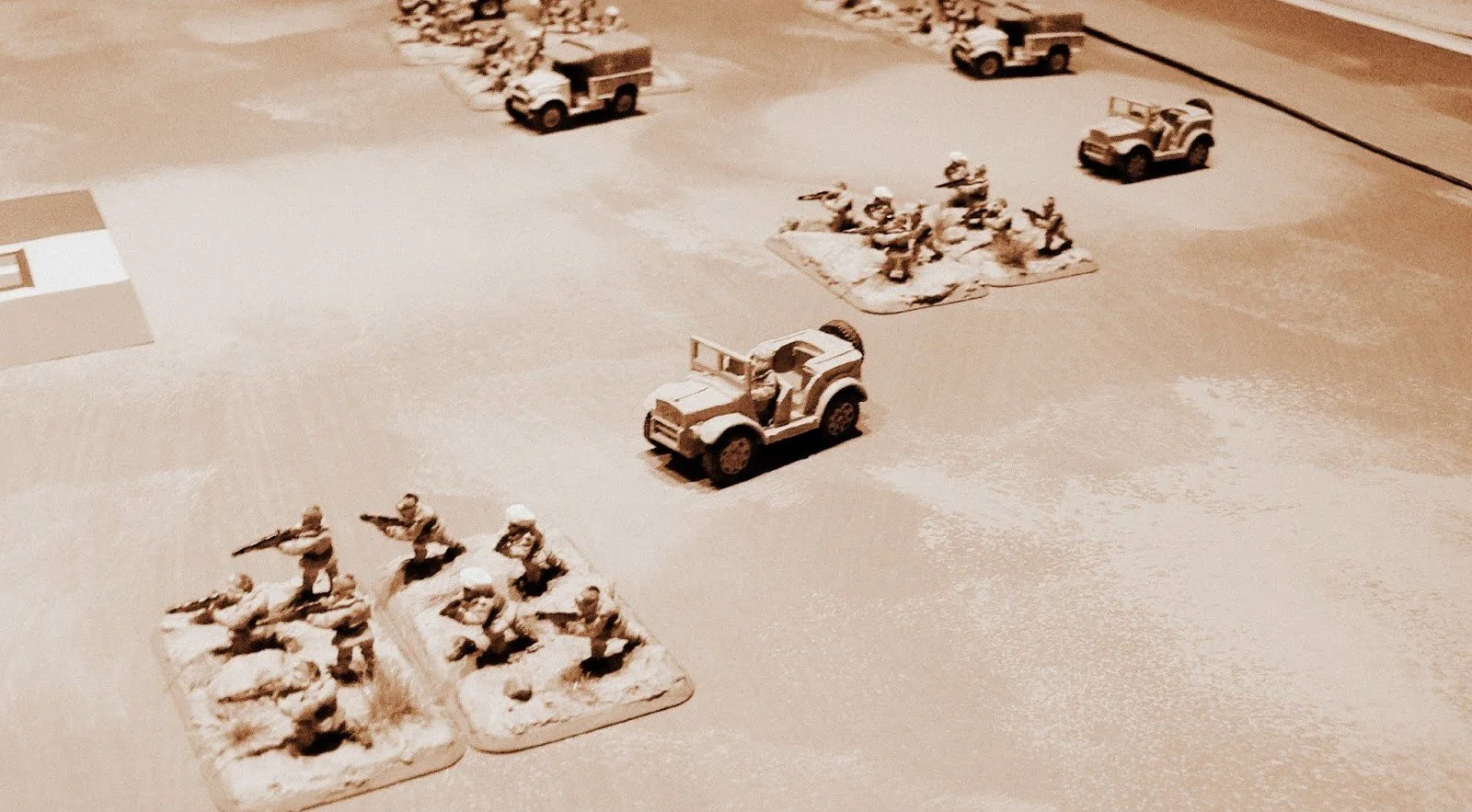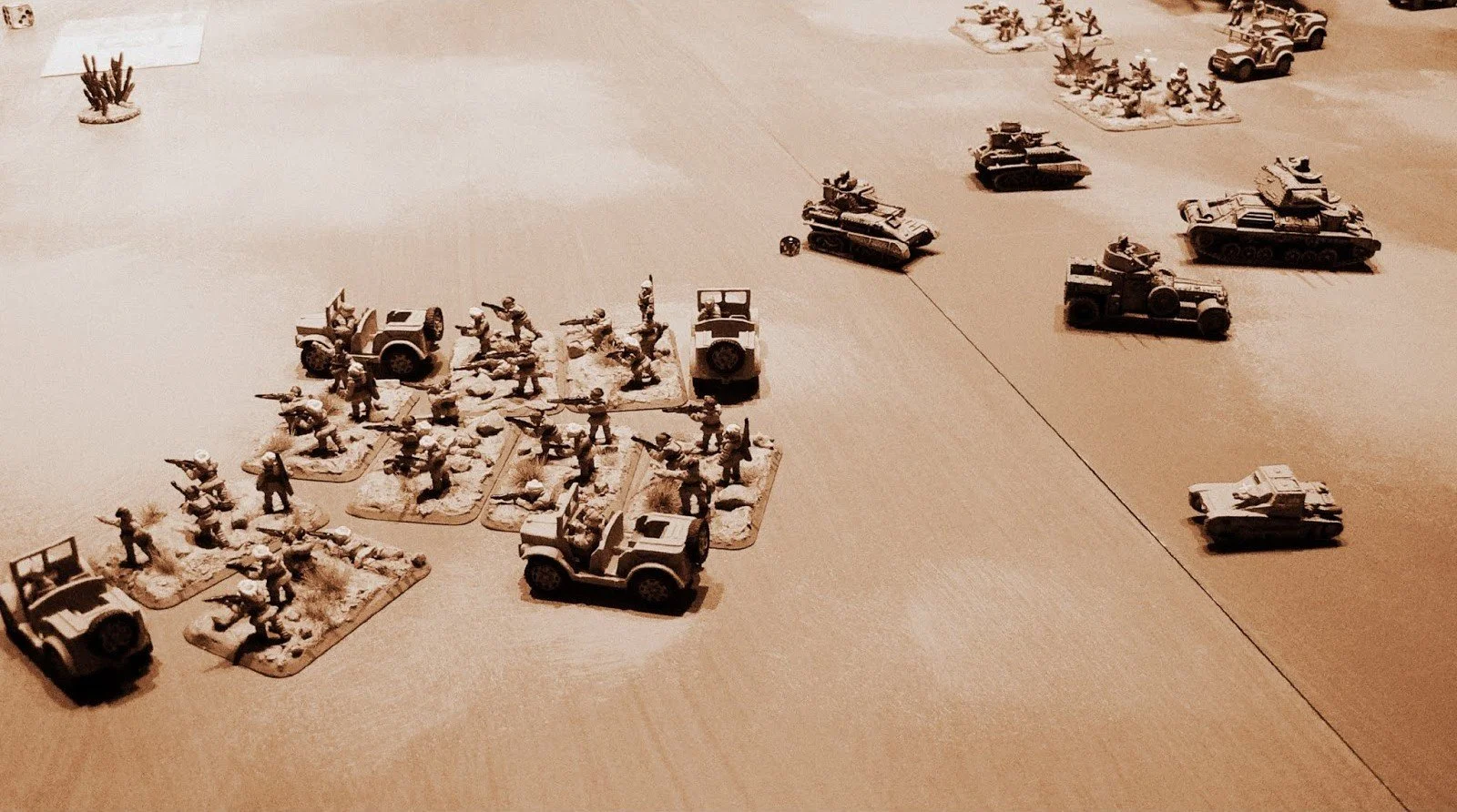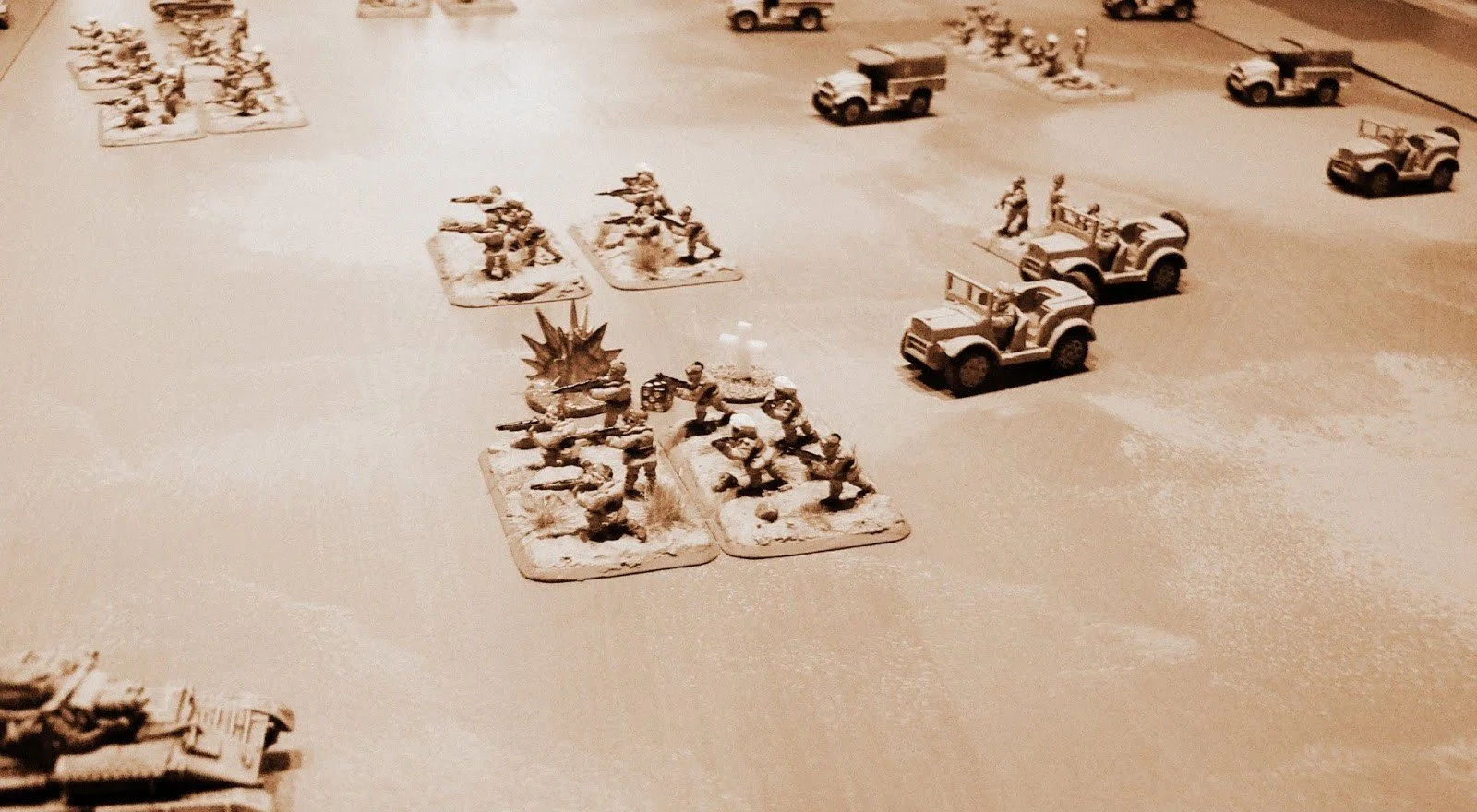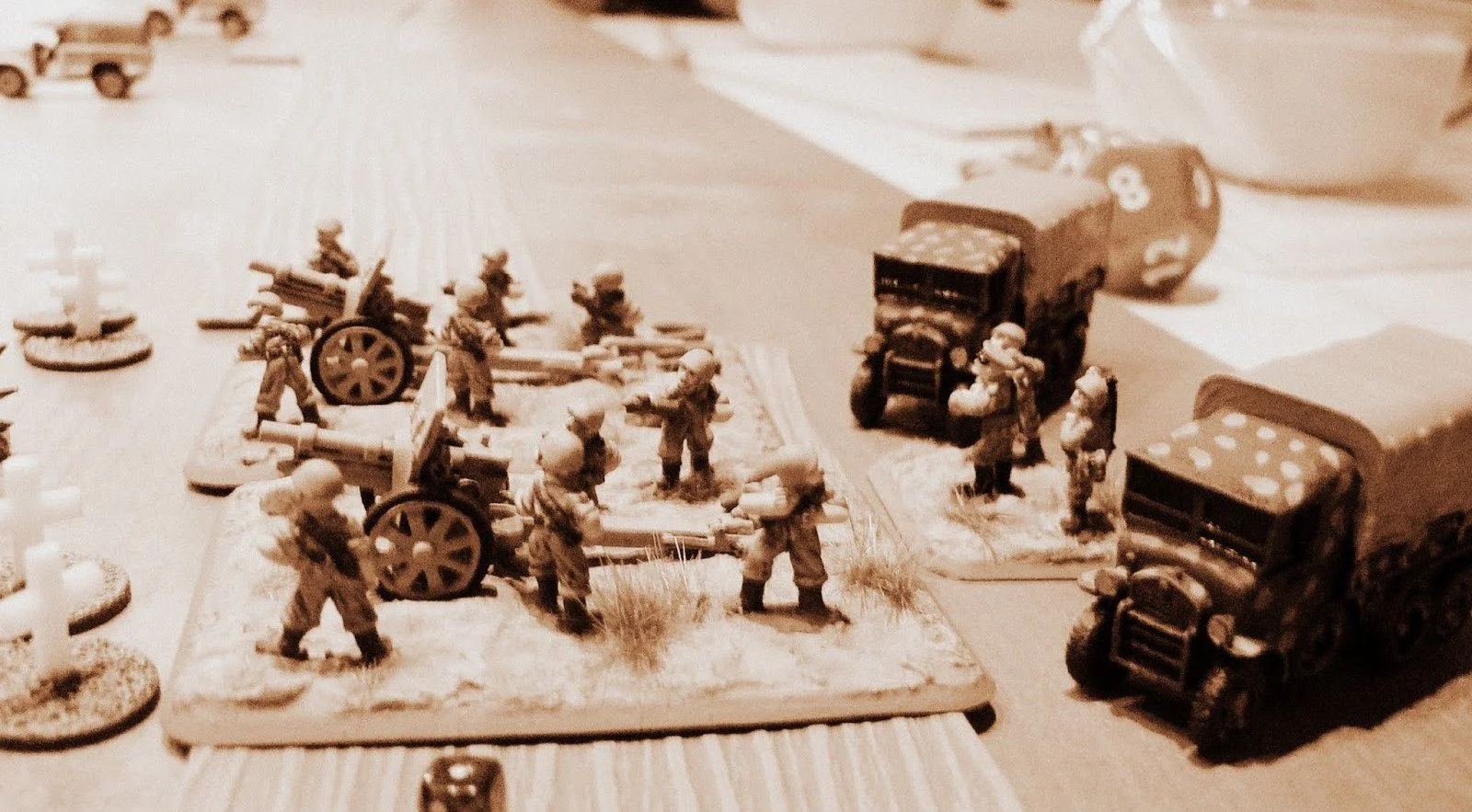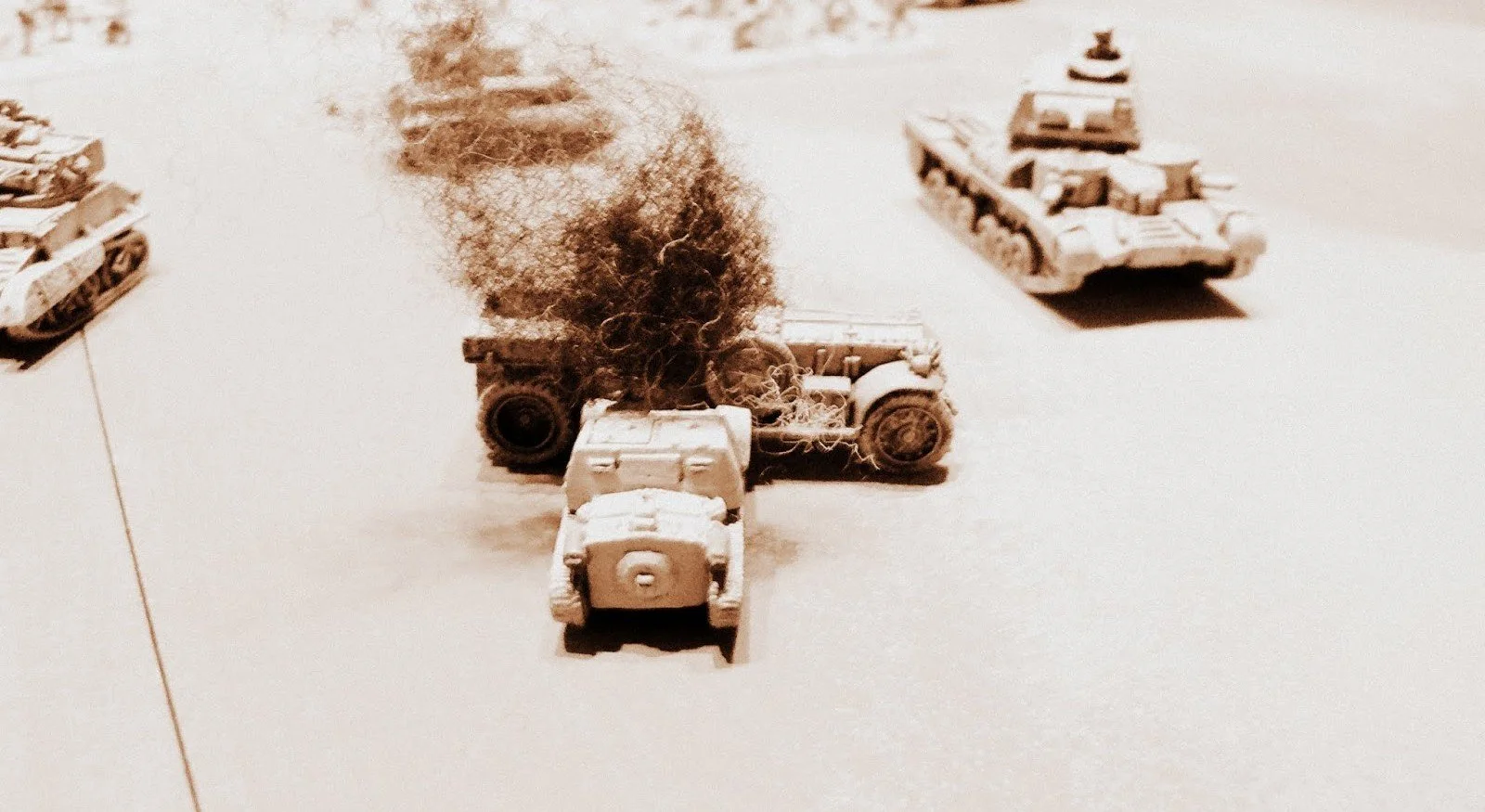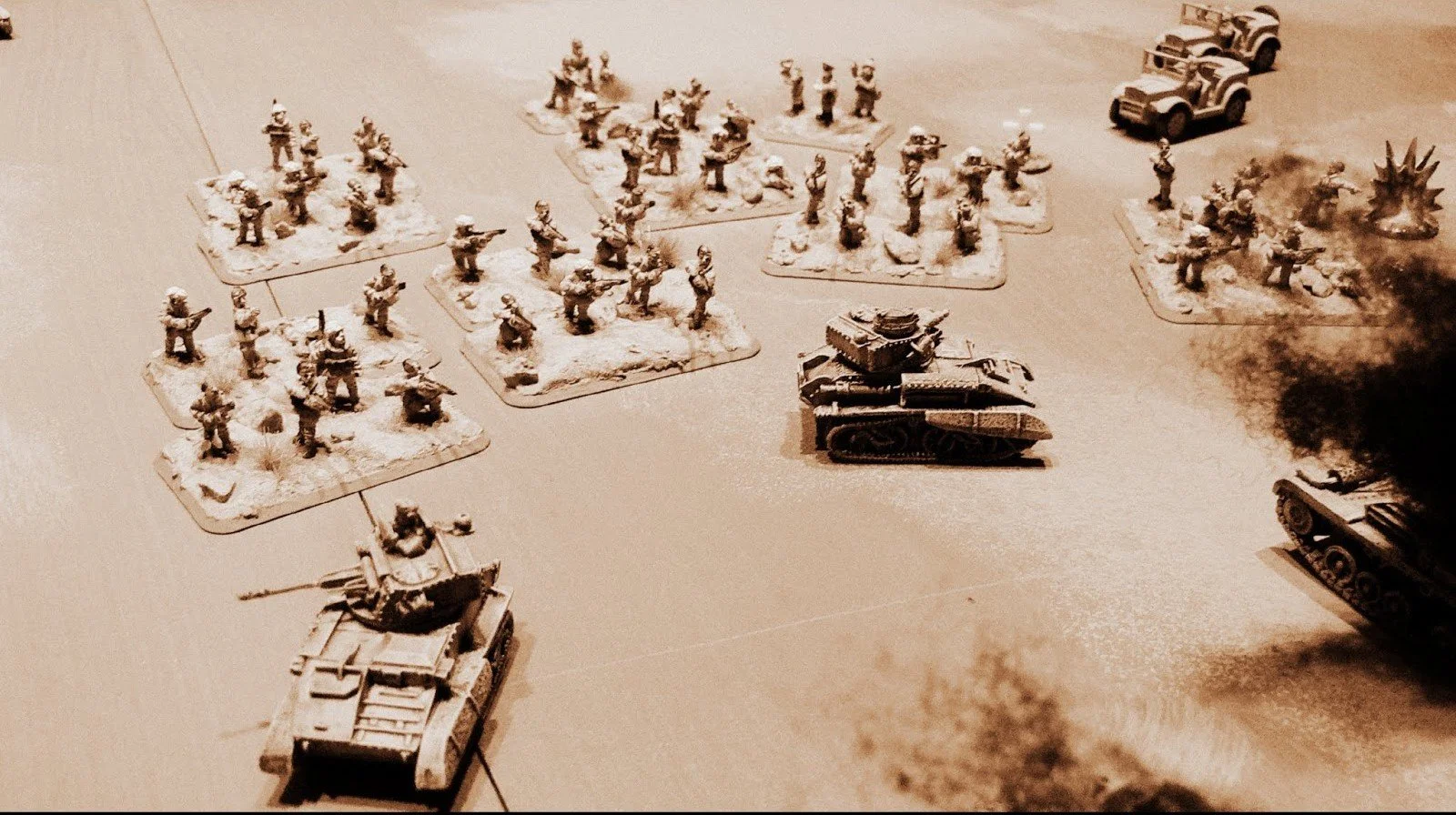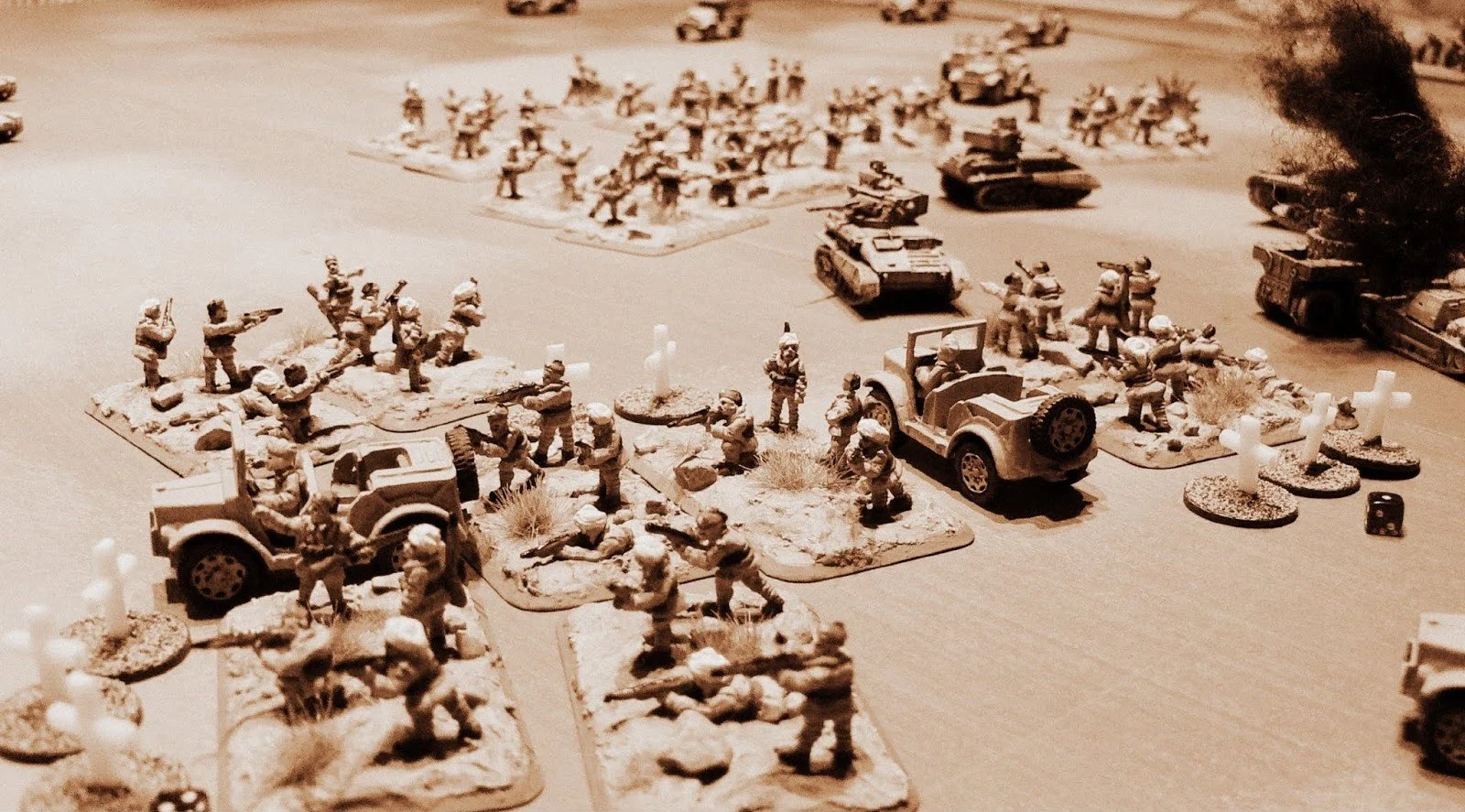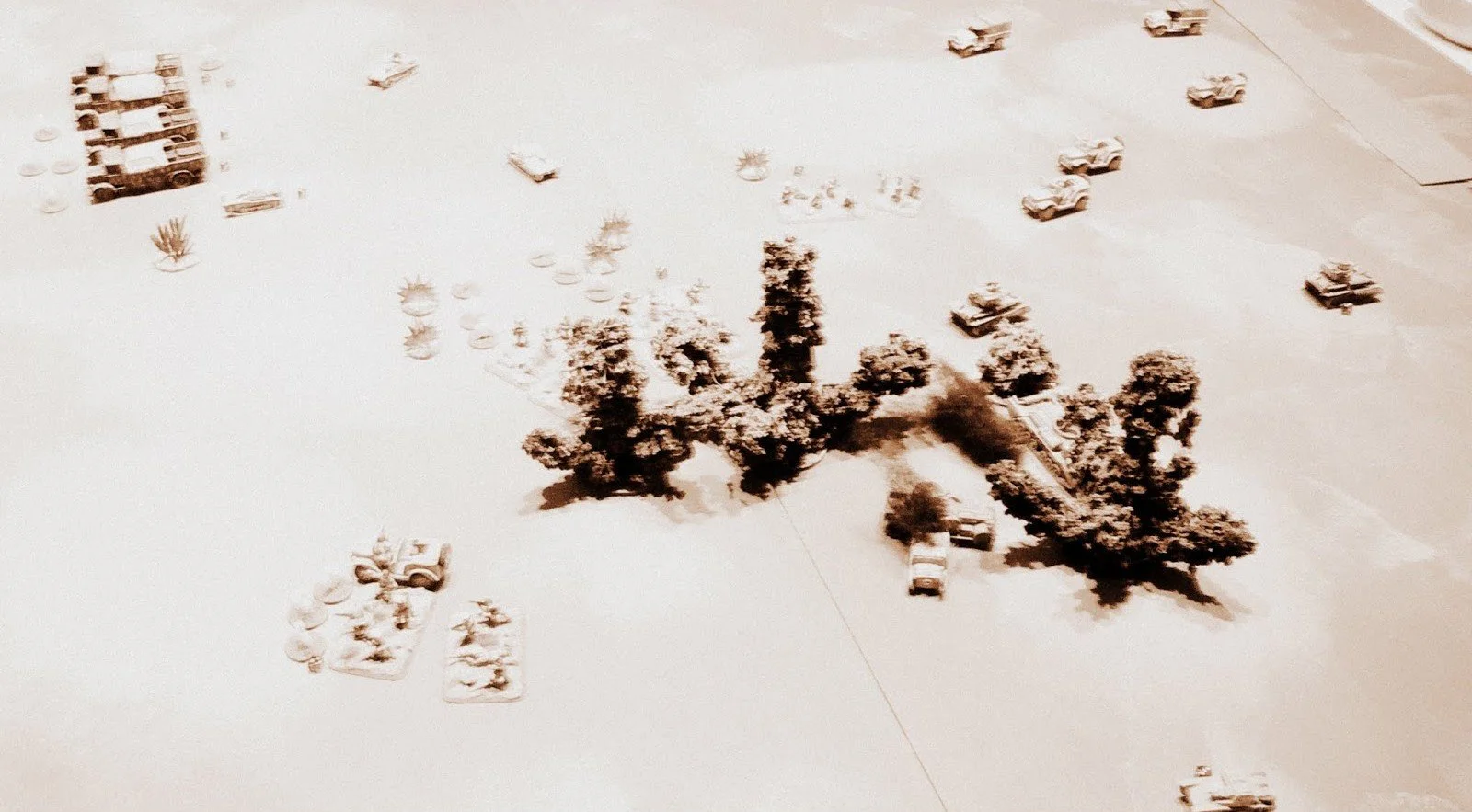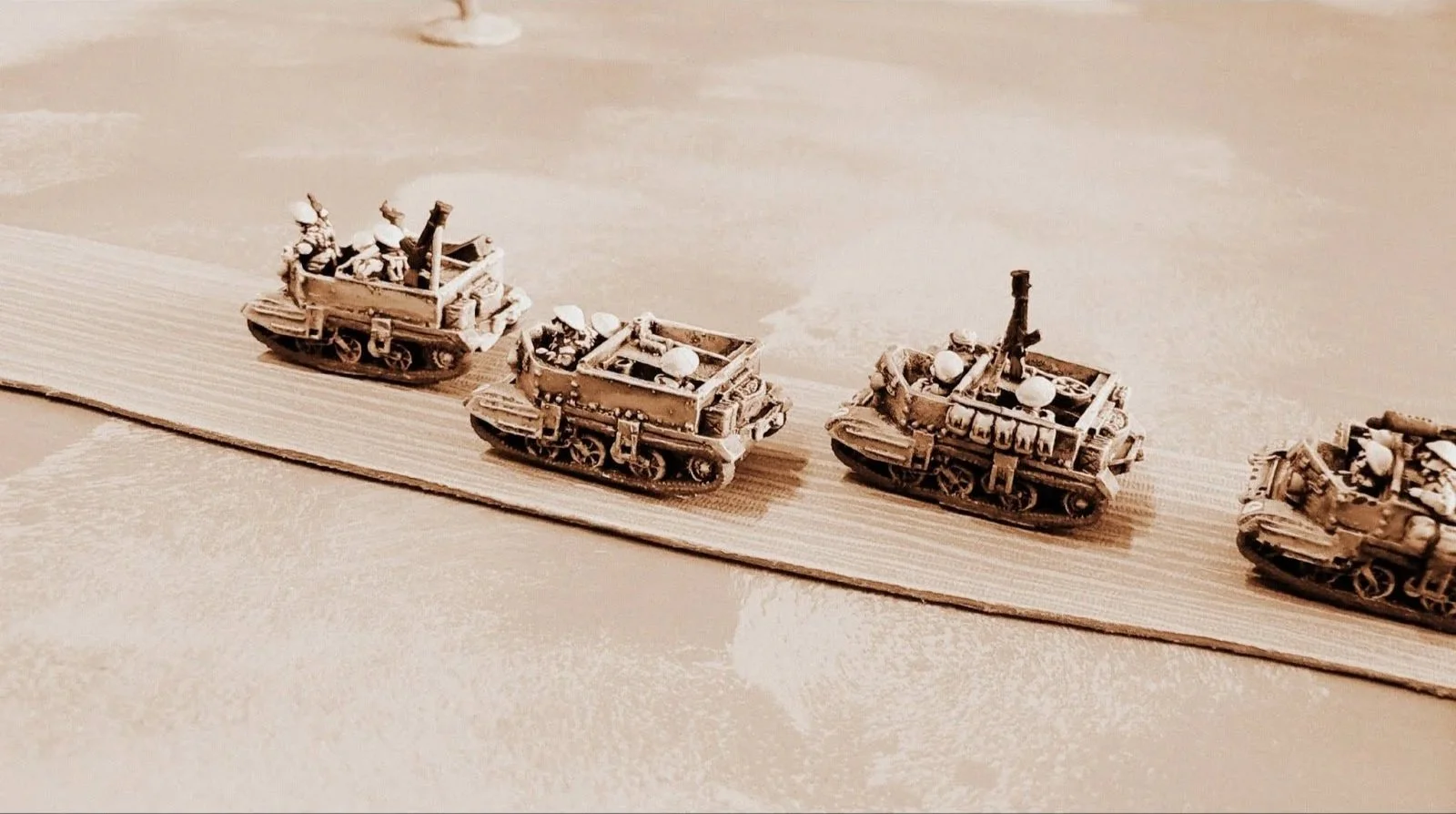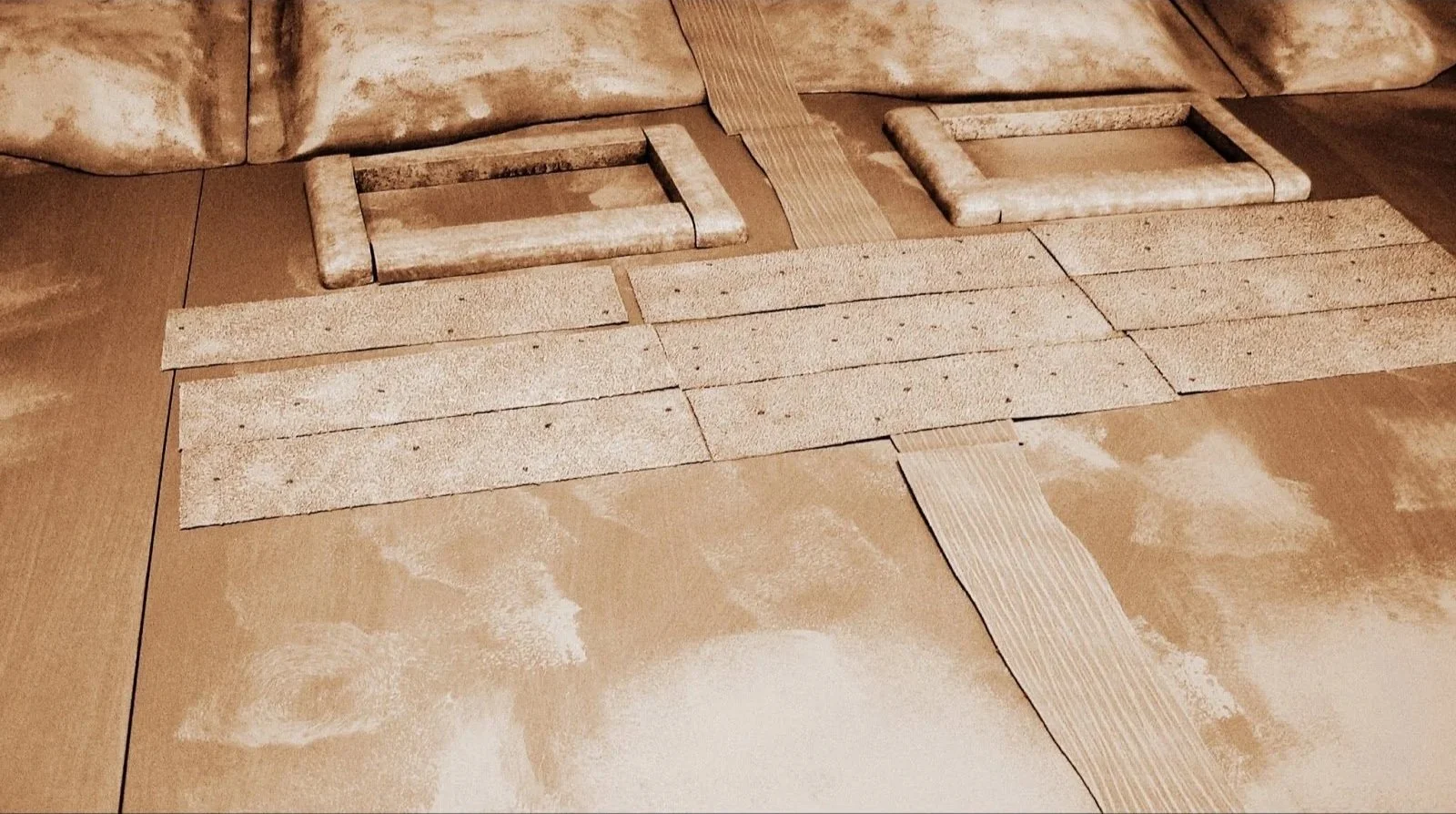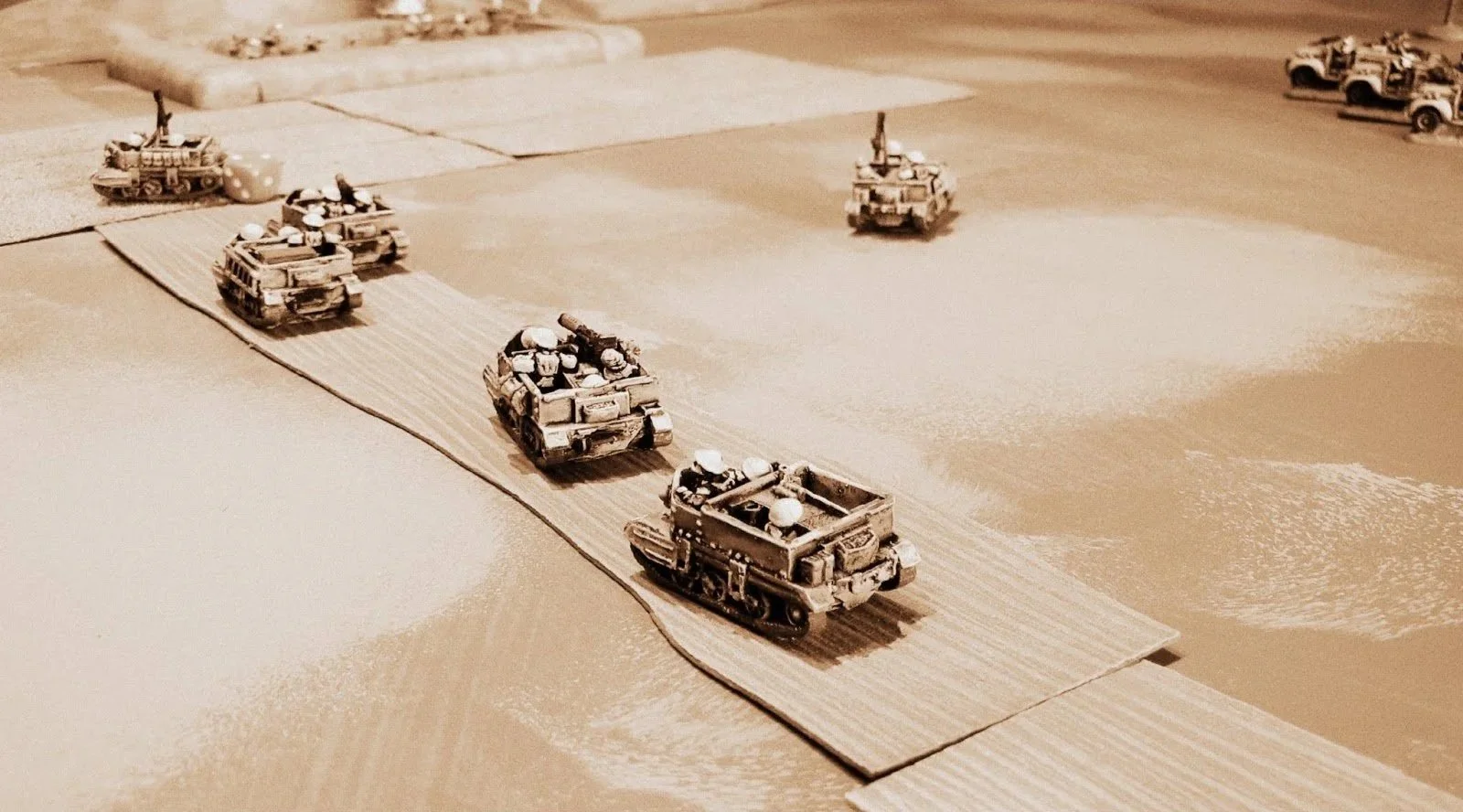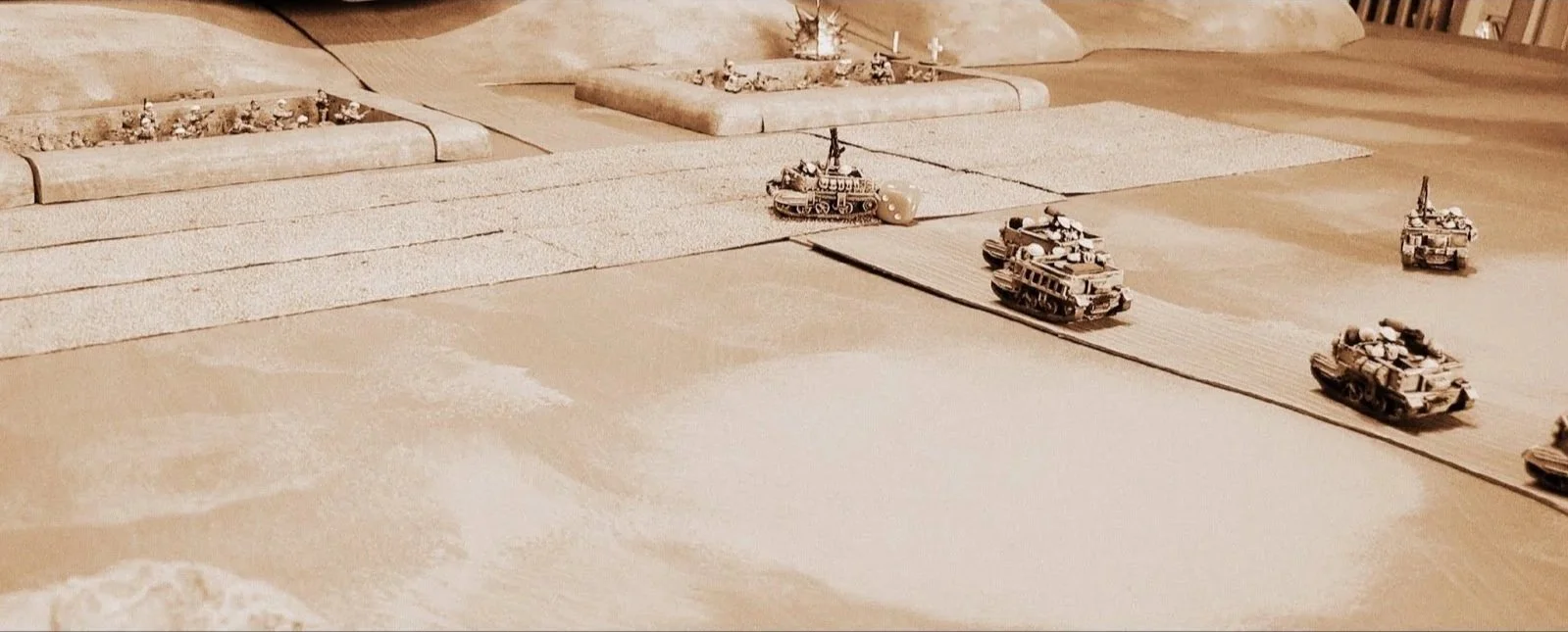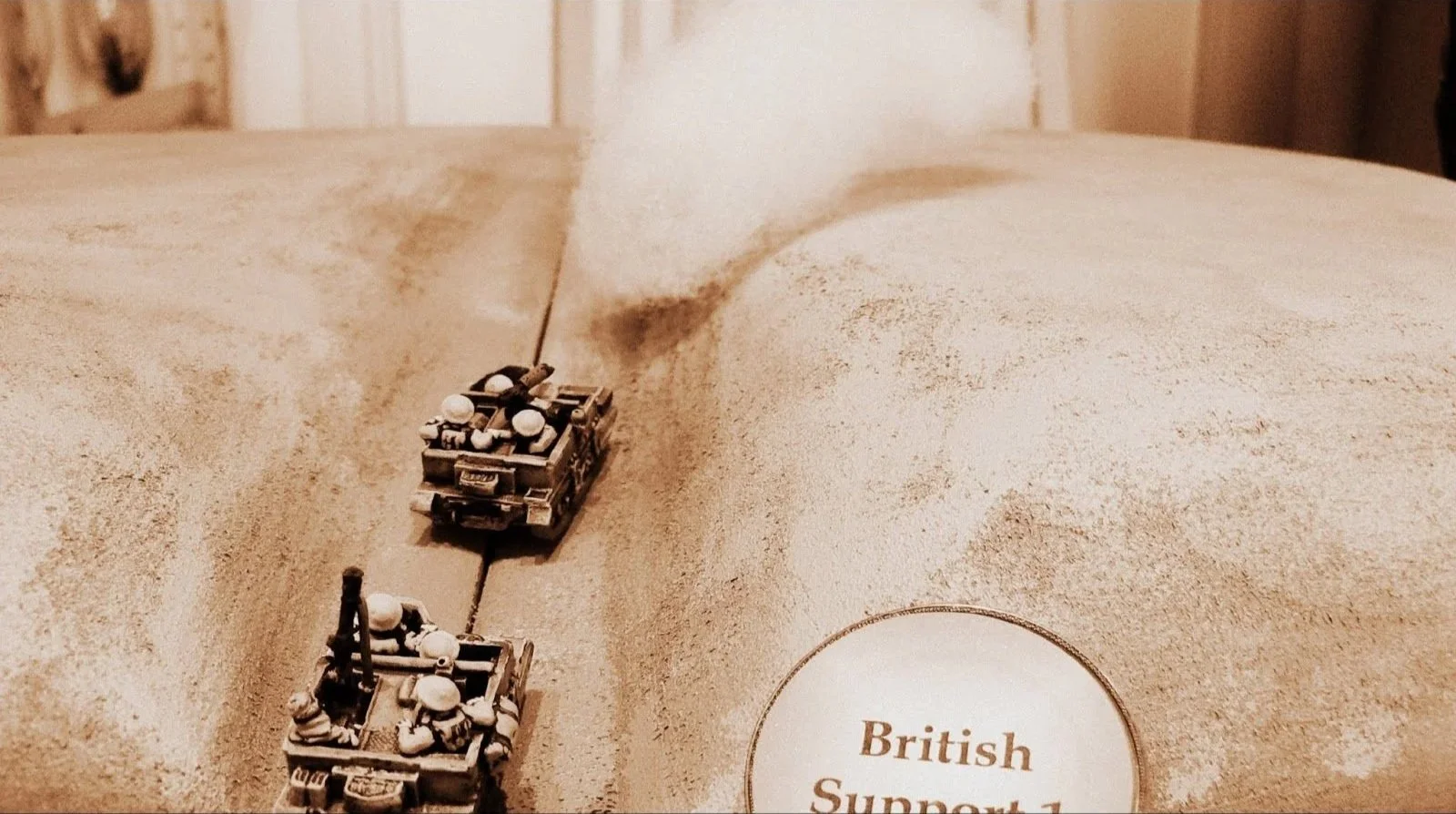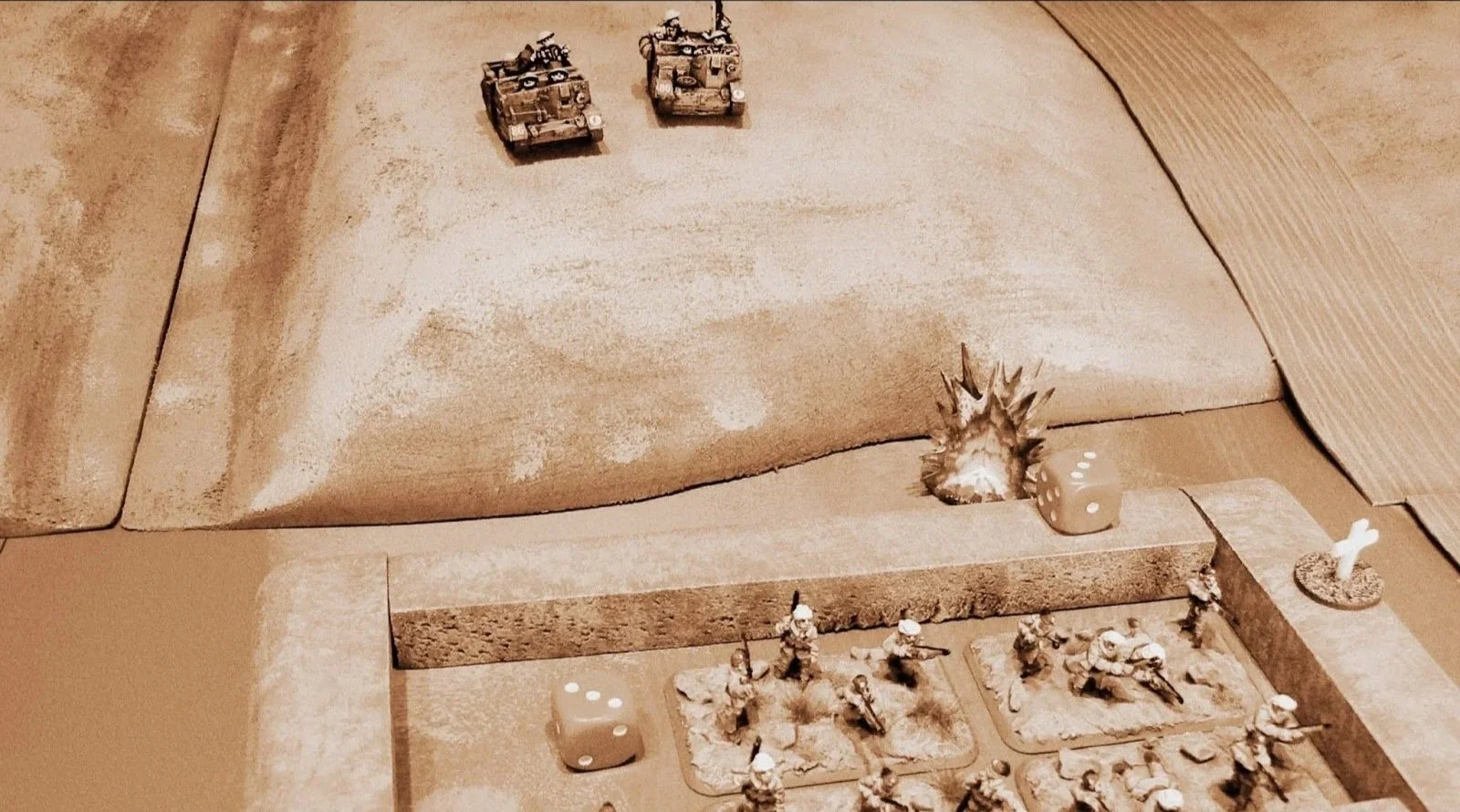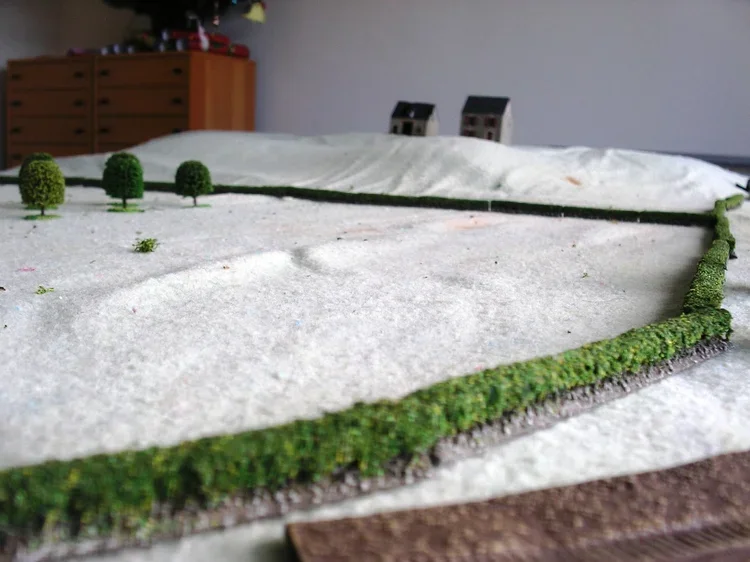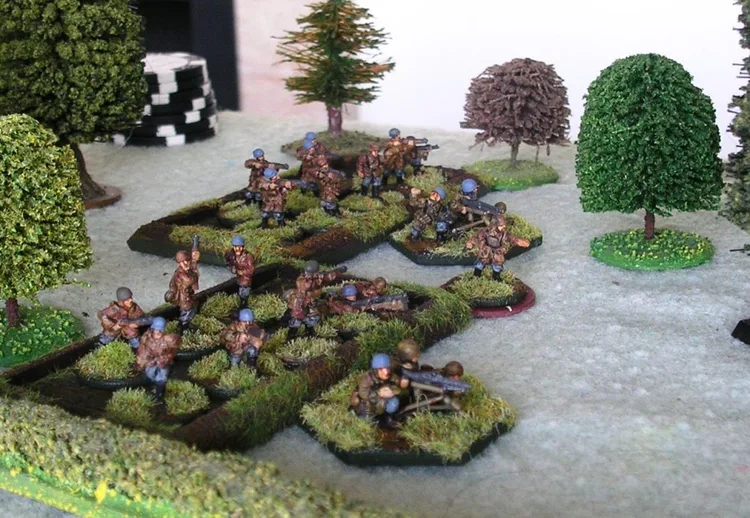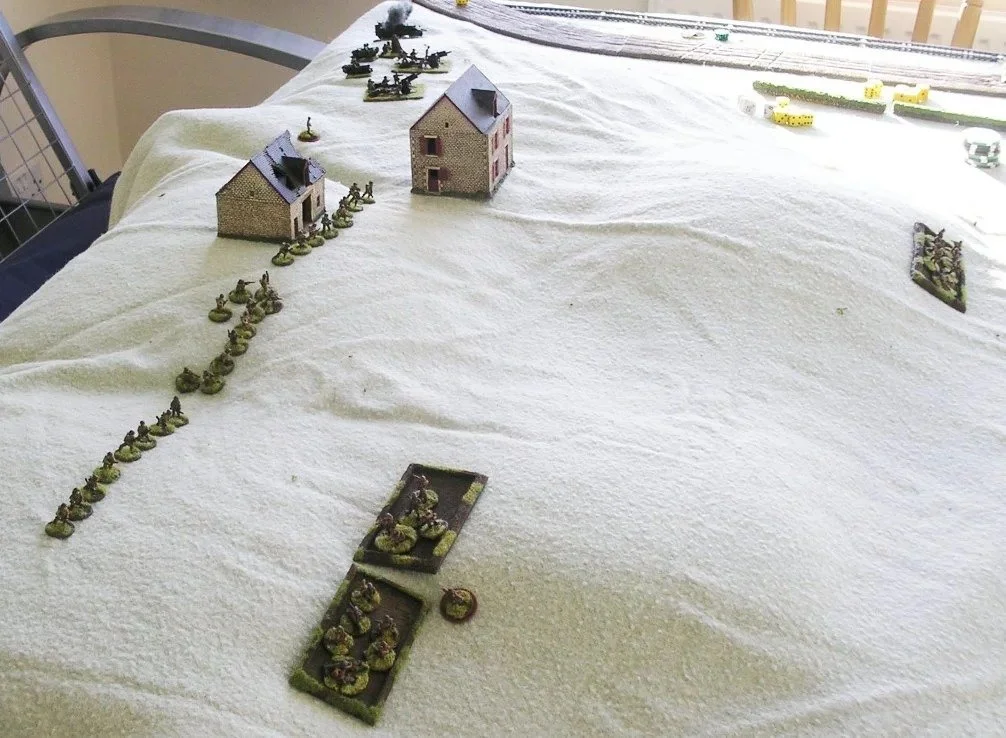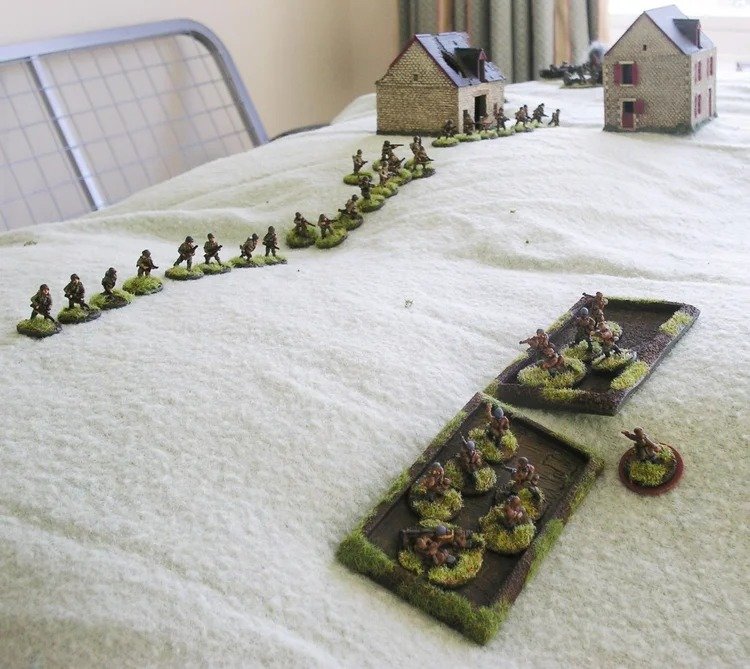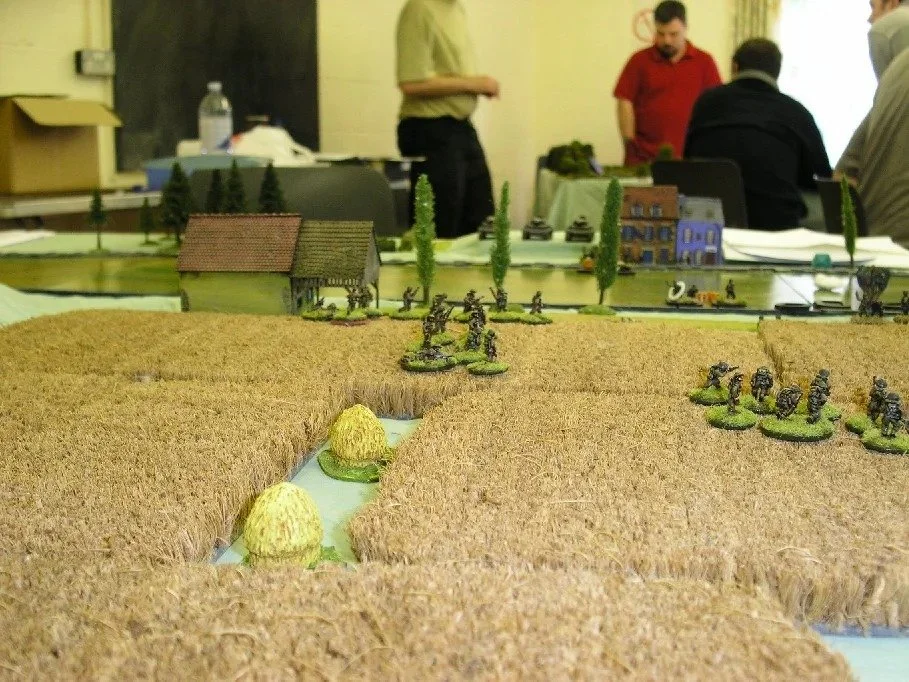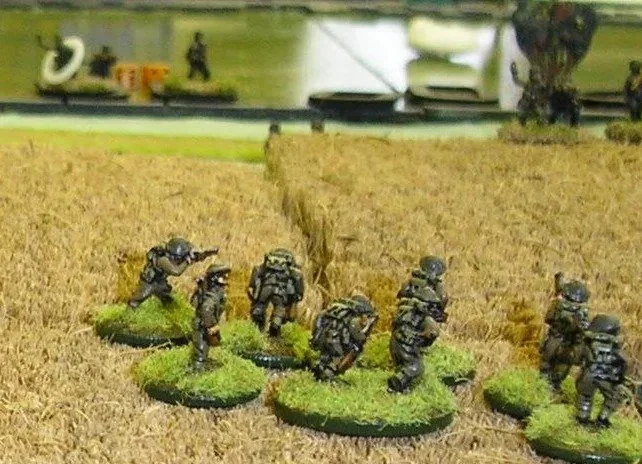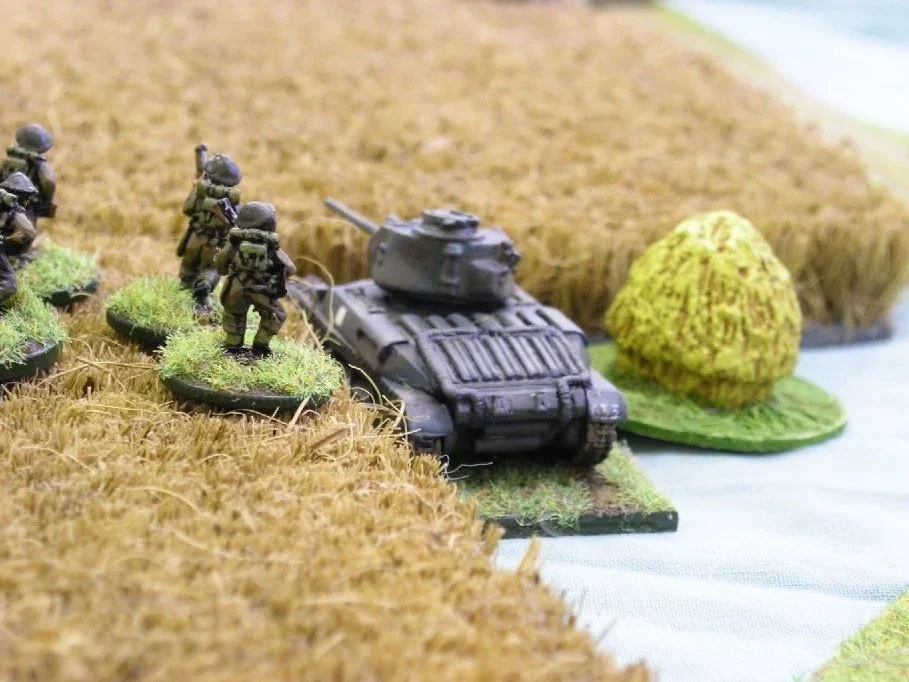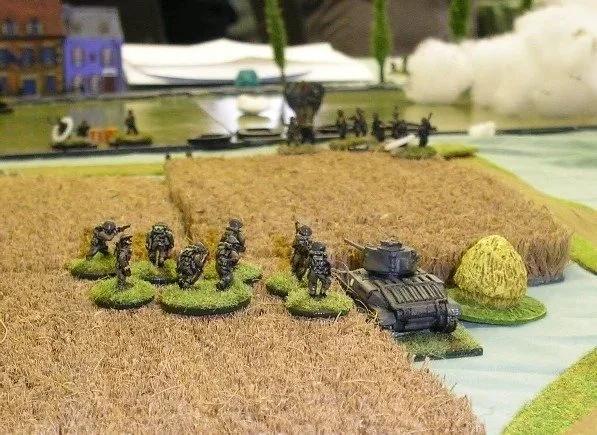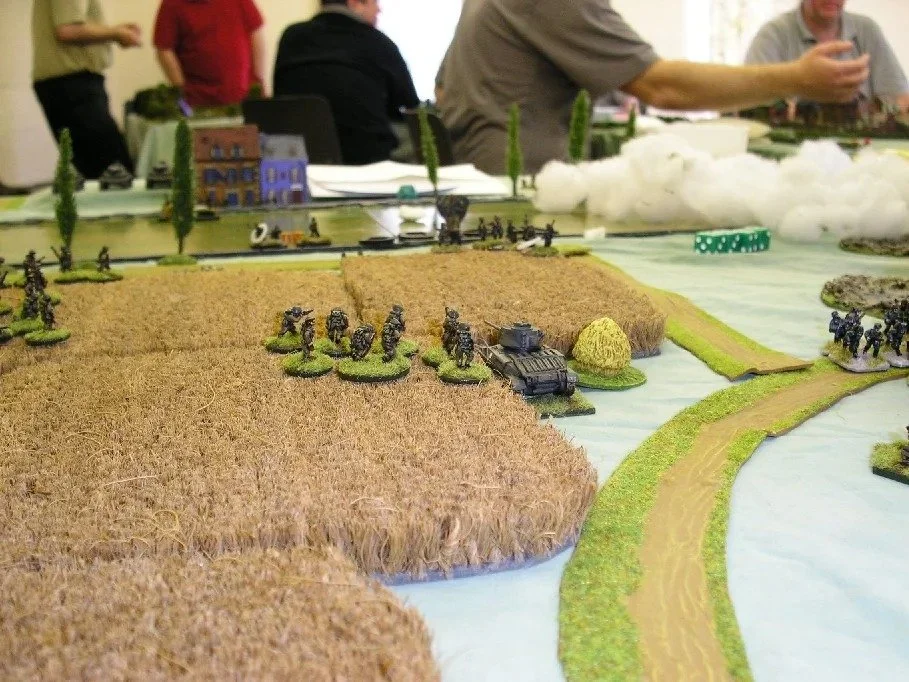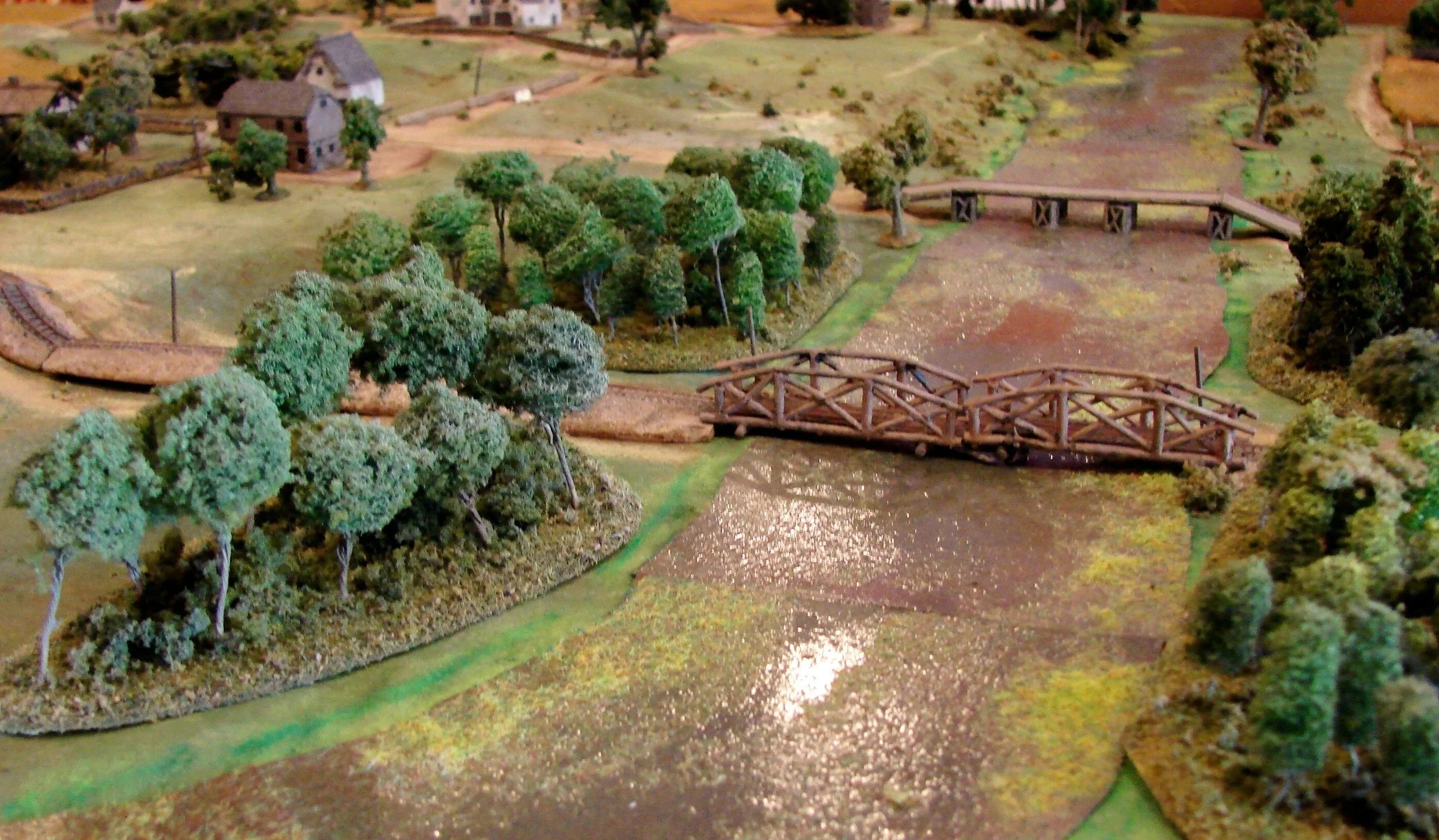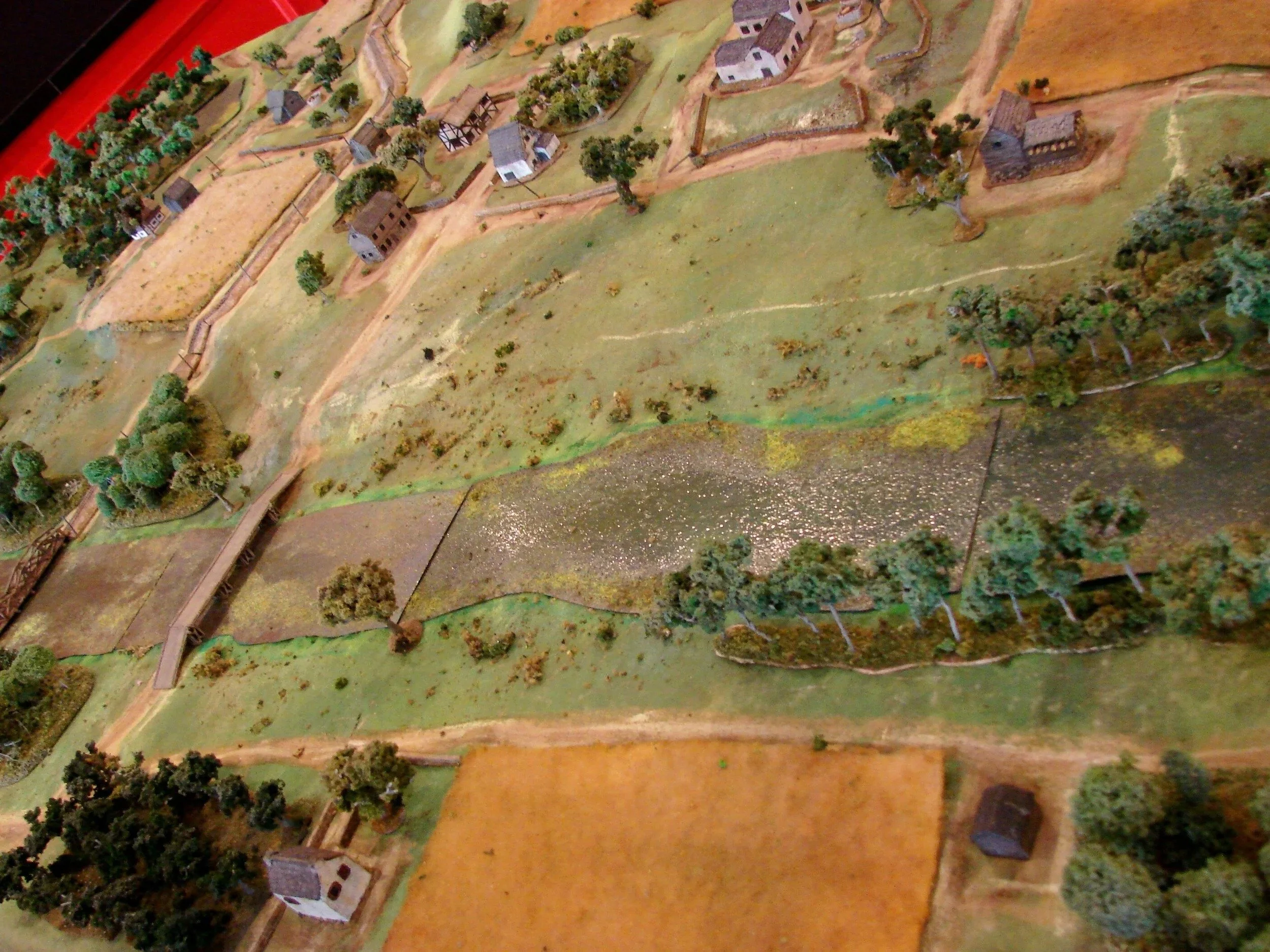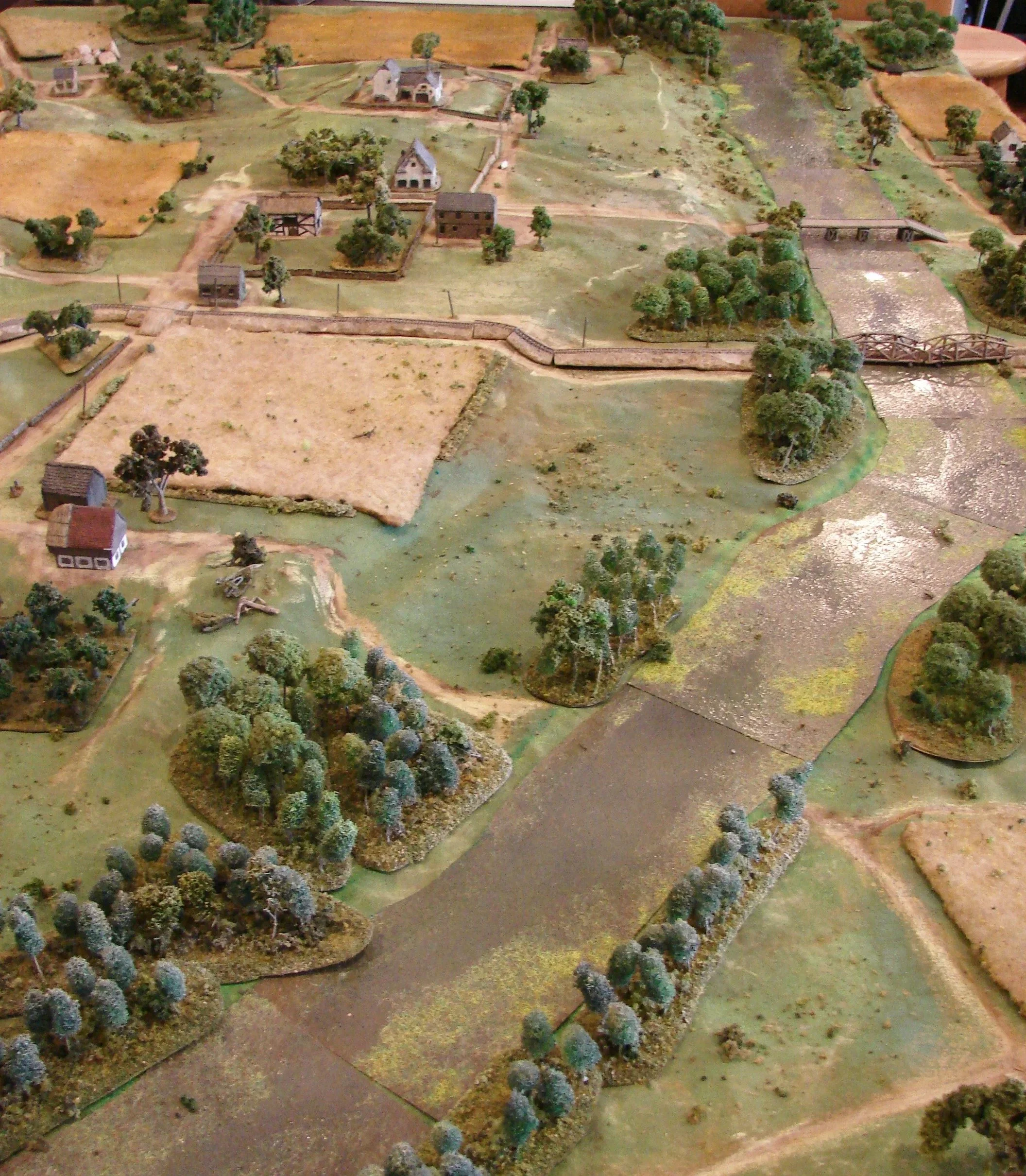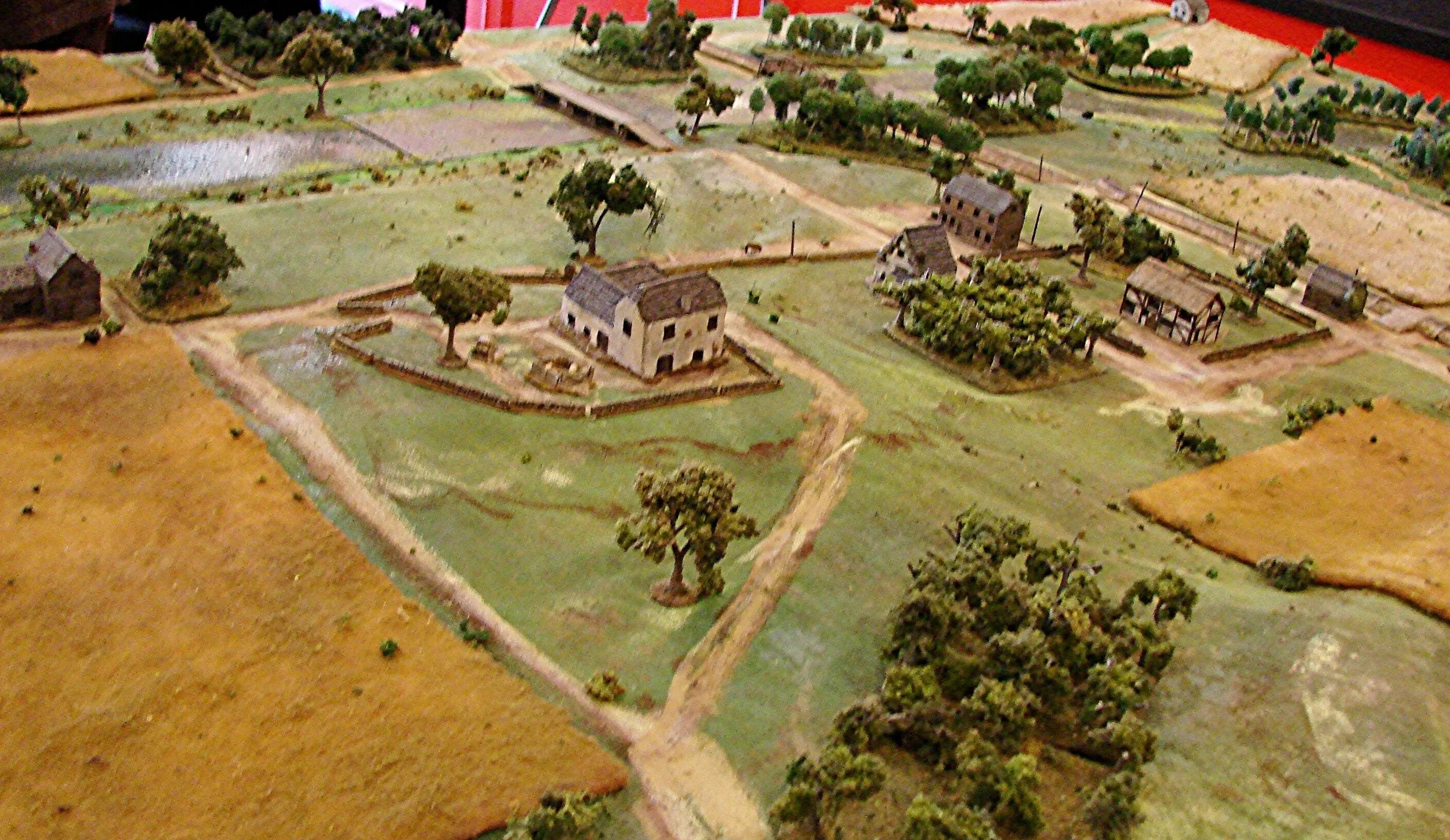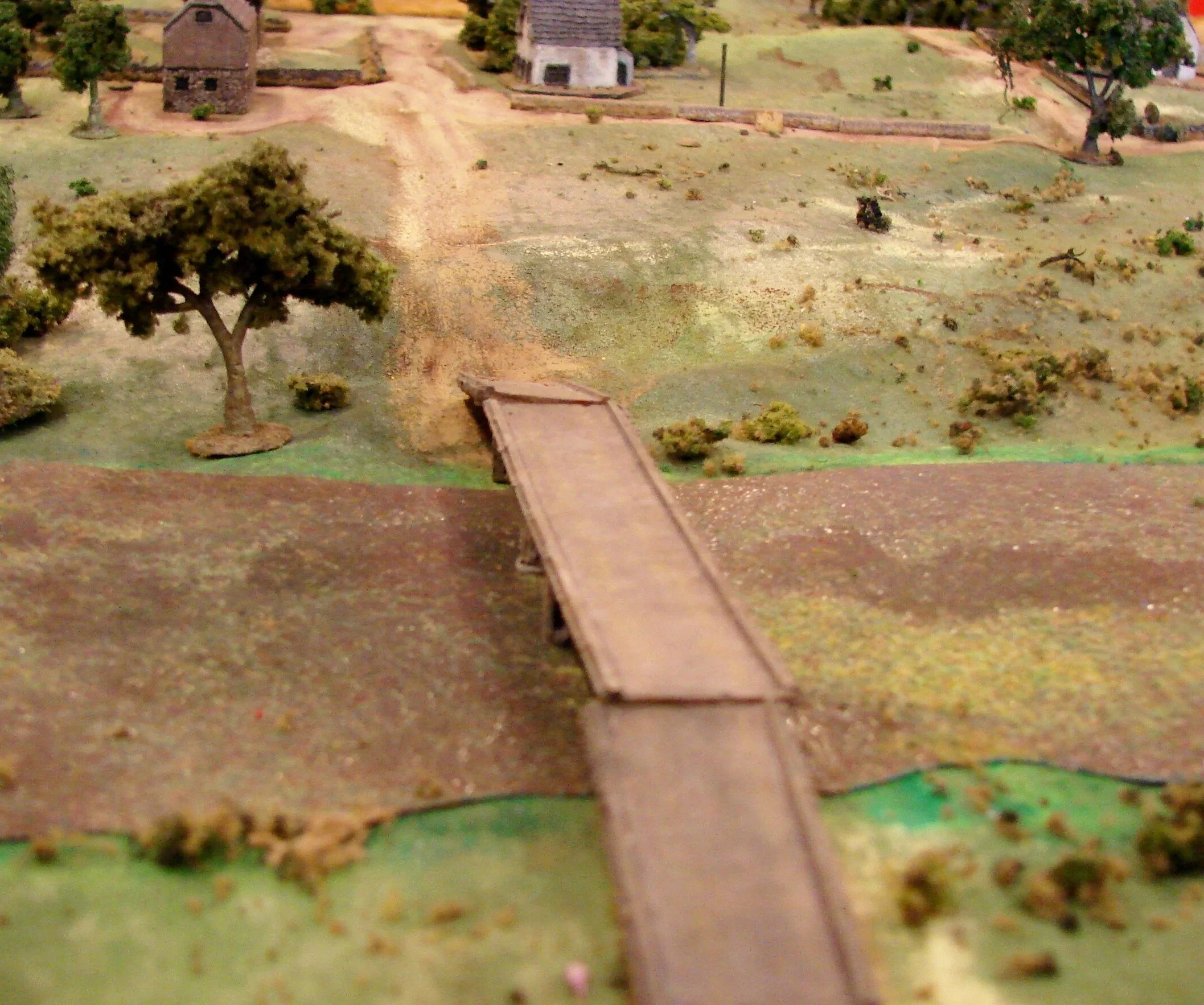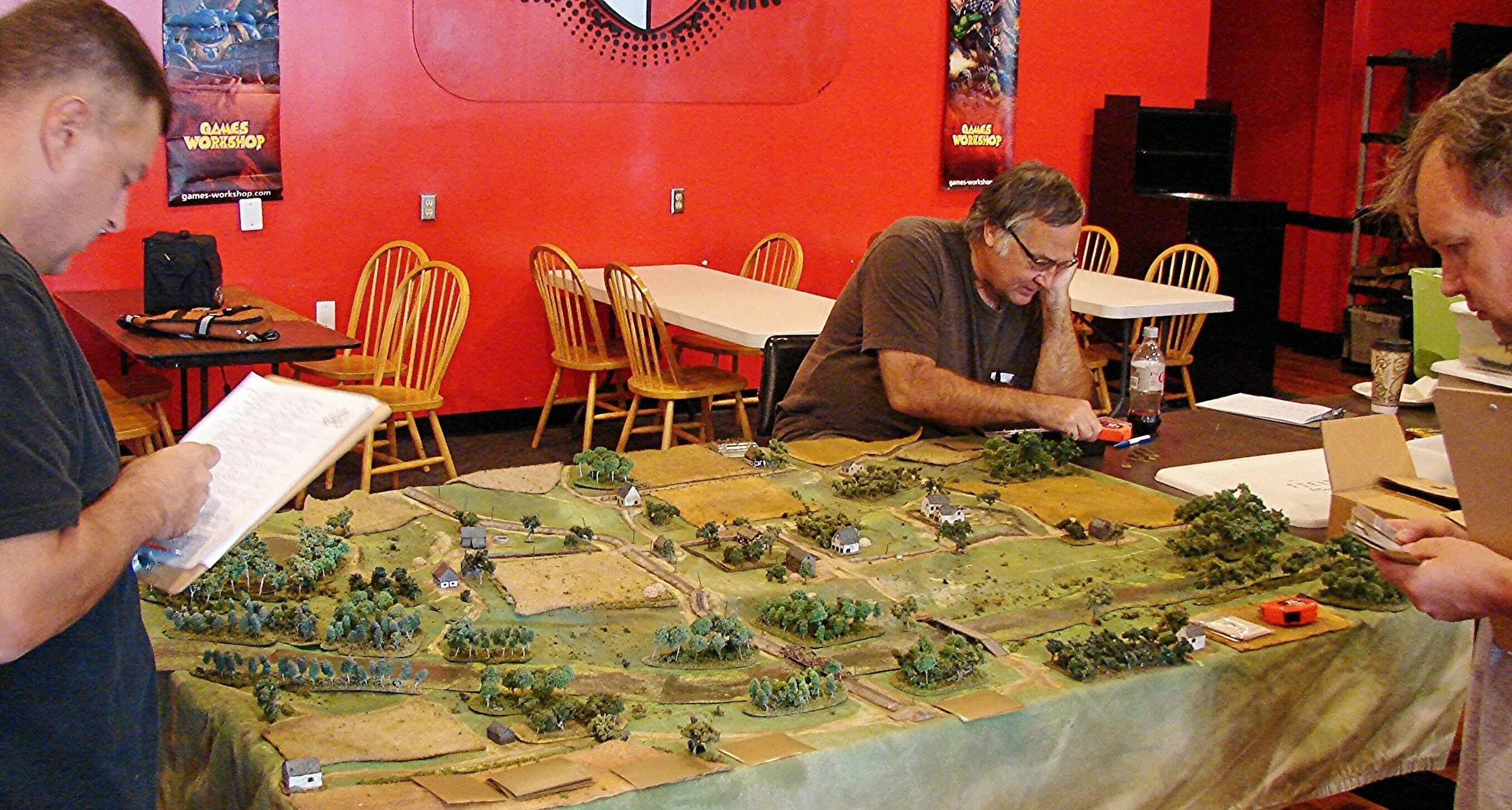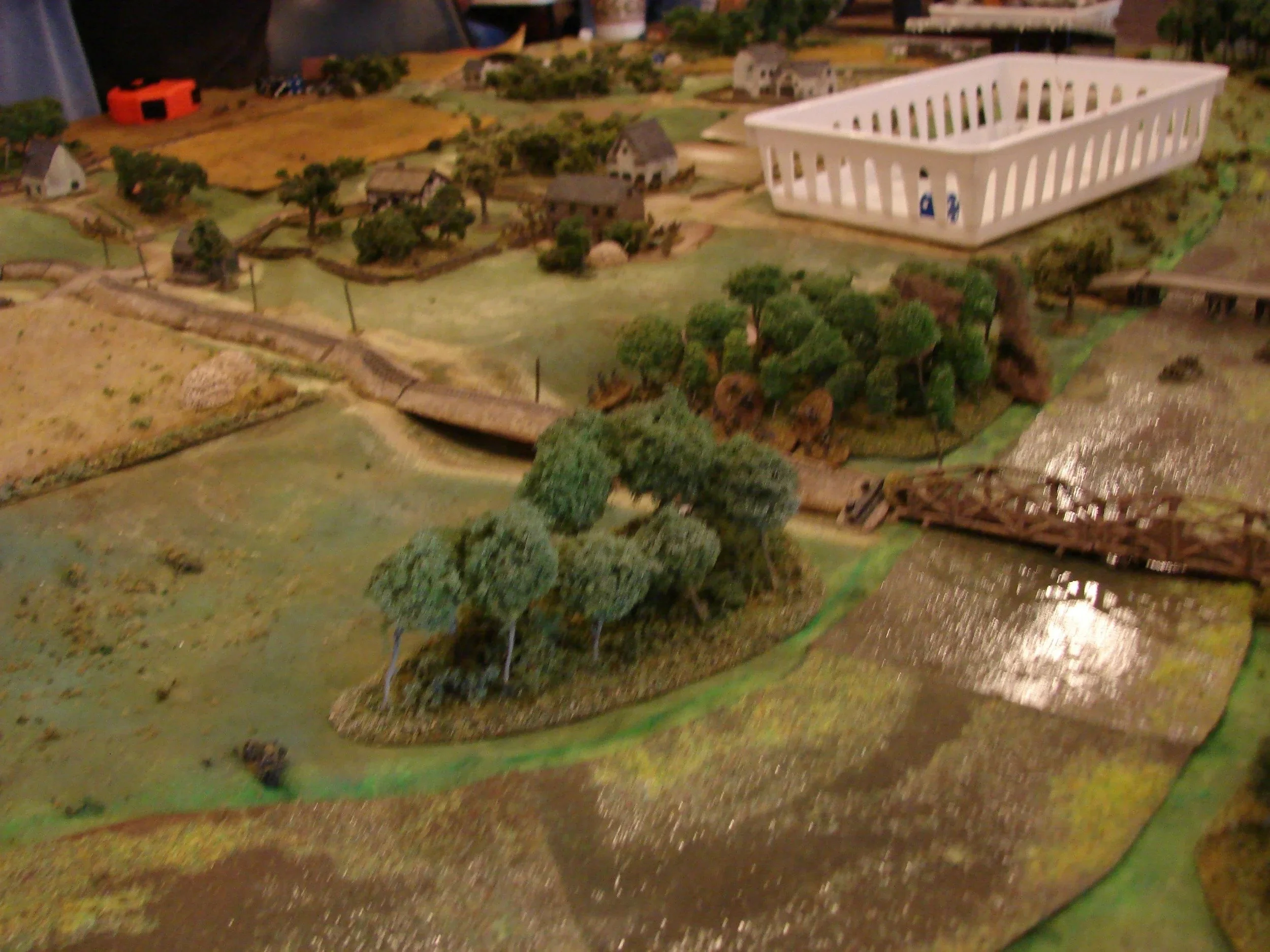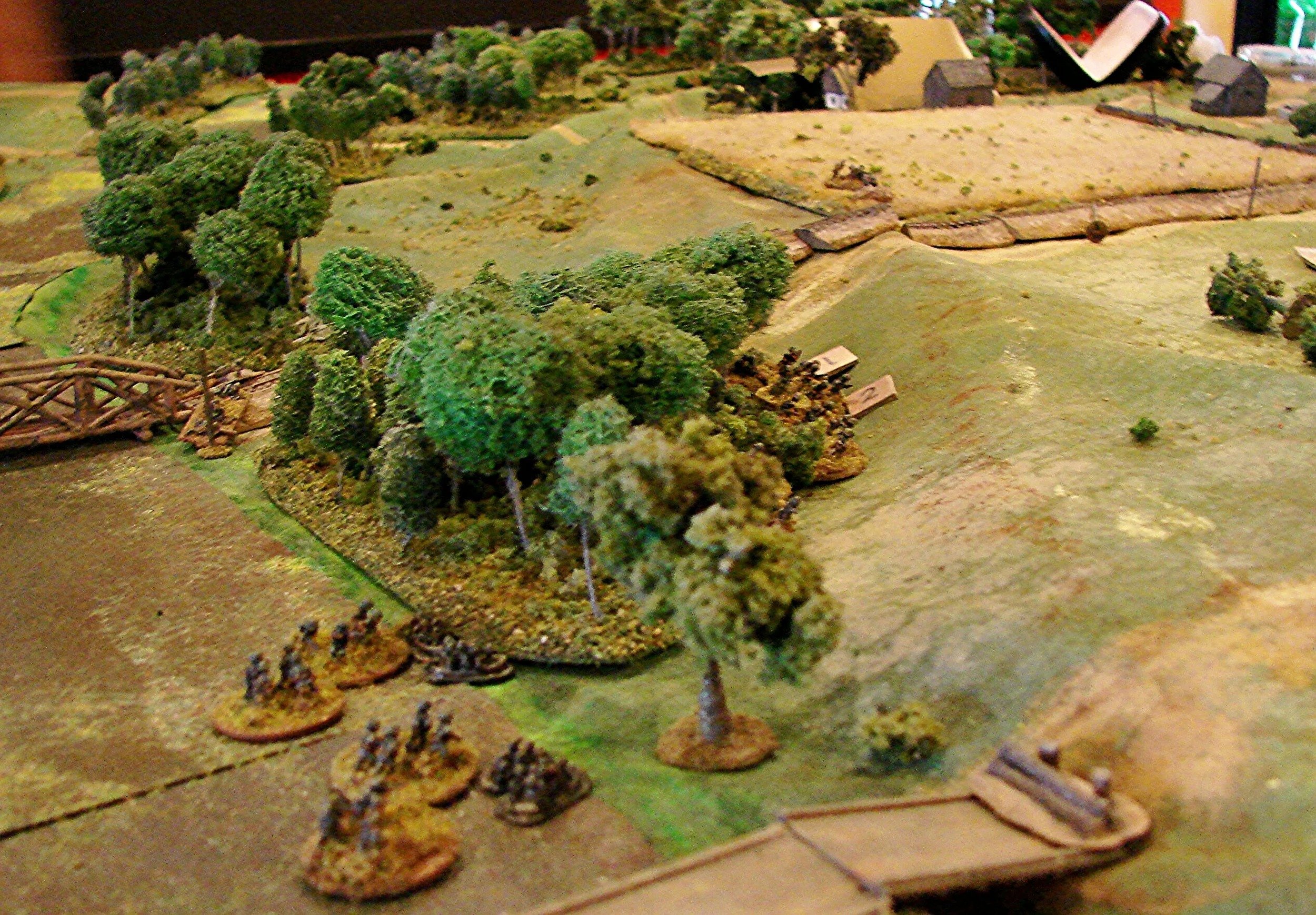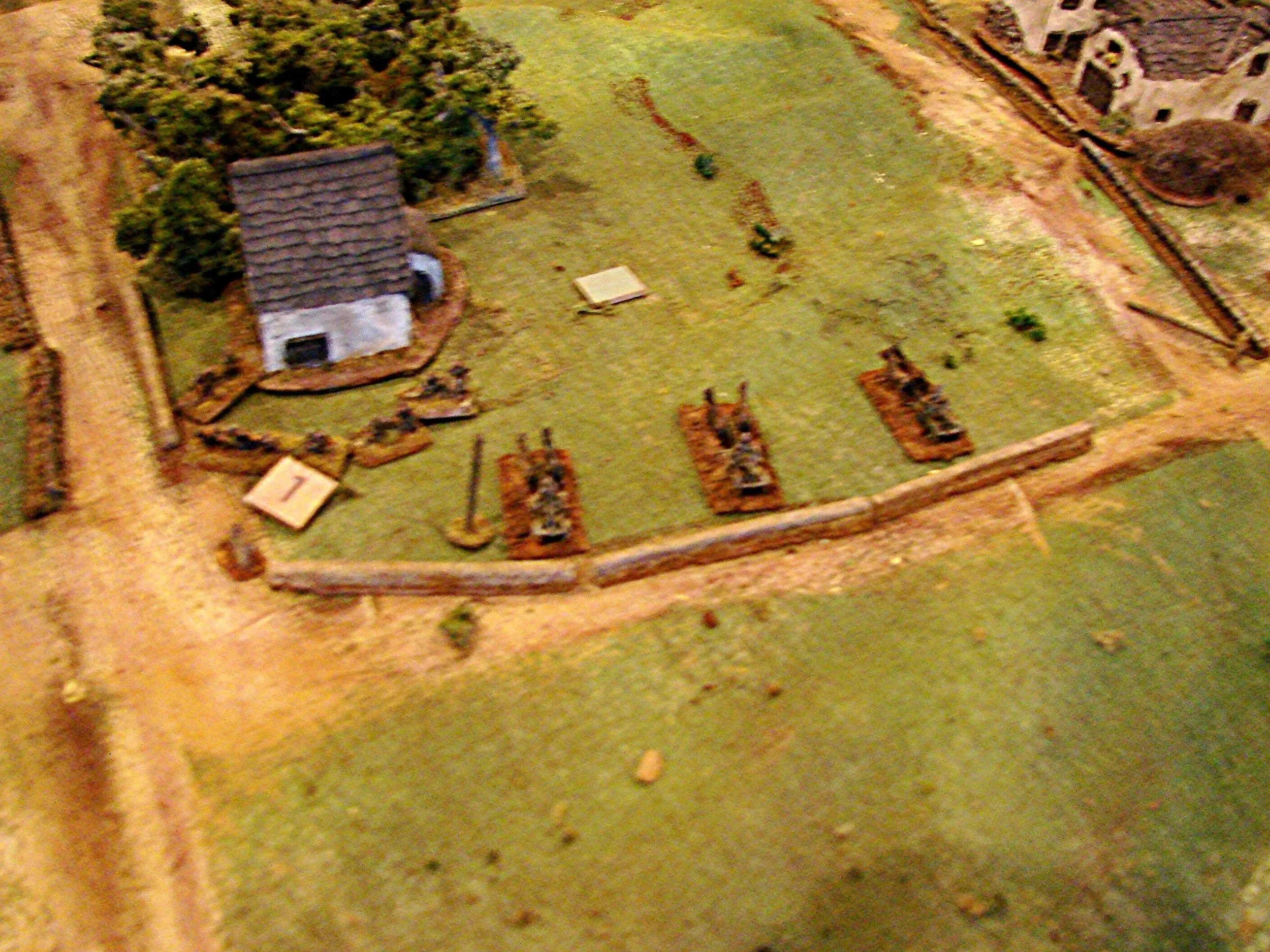
Well the weekend has arrived, and I have spent a couple of hours in the past few days putting together components for a game of I Ain’t Been Shot, Mum by the TooFat Lardies.

This is their company level WW2 wargaming rules set, which is a bit of a first for me. Not because I haven’t played Too Fat Lardies’ games before – because I have played both Chain of Command and Sharp Practice - rather, it represents me stepping out of my normal sphere of skirmish wargames and in to something bigger. Will my tactics hold up? Will I make a fool of myself, as I did in my Sharp Practice game when I couldn’t take the beach?

However, I am a firm believer that you should stretch your wargaming muscles, so company level battles it is. I shall do my best to guide you through the rules as well.

I’ve set the game up in Battleground's Gaming Engine. This is quite possibly the best piece of virtual tabletop software I have found for wargaming and I recommend it. However, do be ready to put in some effort with it as it is quite detailed. You should also be a bit familiar with image creation software as it comes with no components.

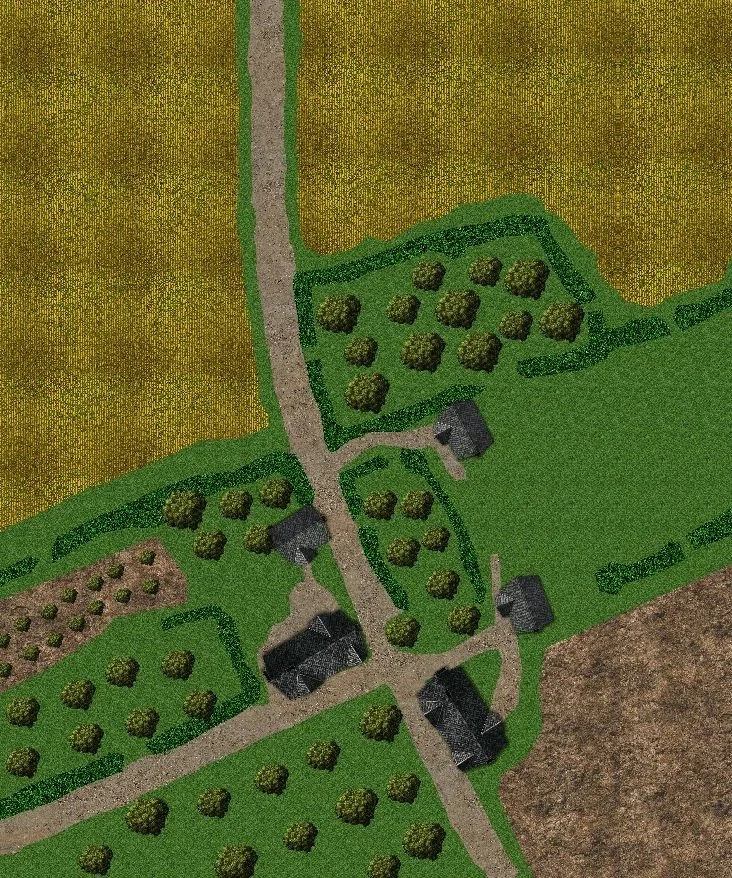
As usual, I have used Junior General (that awesome site!) for my minis, and created the map straight from the IABSM rulebook. I did that by copying the image from the pdf, creating a canvas that was 72 inches long x 60 inches wide (6 ft. x 5 ft.) and then tracing over it using textures. So far so simple.

The Scenario

The scenario is titled “North of Caen” and can be found on page 96 of the IABSM rulebook. It is designed to be simple to play and covers a pure infantry combat, with a British company attempting to capture a small village from a weakened company of German defenders. Simple is good as I am still learning the IABSM rules.

Summary of the British Briefing

Recent patrols inform us that the small hamlet of Le Moulin has been occupied by German troops, probably forming an outpost ahead of their main line of defences.

In view of the forthcoming offensive it is important that we seize the road junction as the fields immediately to the north have been designated as an assembly point for our armour prior to their advance on Caen. To accomplish this you have an infantry company consisting of three infantry platoons.

Your advance will be preceded by an artillery bombardment in the form of a Stonk on three 12” square sections of the table.

Your force will begin the game on Blinds on the northern table edge. You must advance southwards and clear the table of any enemy forces.

Summary of the German Briefing

In the last few days it became clear that the enemy had not occupied the hamlet of Le Moulin so your Company, or what remains of it, has been pushed forward to fortify it. You have been able to make some progress towards digging your force in. However, Tommy patrols have certainly discovered your presence. You can expect to get some unpleasant visitors very soon!

You must defend your position and drive off any British attack. To achieve this, you have two platoons of infantry supported by a couple of MG42s.

You may deploy your force on the table on Blinds (or hidden amongst the terrain features) anywhere within 12” of any building. Additionally five Gruppe or weapons teams may be dug in with foxholes. These provide good cover from fire and spotting. You may keep your MG42 teams together as part of the Kompanie headquarters or may cascade them down to the rifle Zugs.
Summary of Game Notes

For this tutorial scenario both the British and the Germans are Good Regulars. To keep things simple both sides have had their infantry anti‐tank weapons removed from their organisation.

This scenario has no time constraints. It should become obvious that one side or the other will fail to achieve its objectives. If the British manage to take four of the five buildings the Germans will be obliged to withdraw, abandoning their positions.

The table represents the flat open terrain to the north of Caen where the small hamlets and villages are the only features, clusters of buildings surrounded by their apple orchards. The wheat on the northern part of the table is high, standing at around 5’, so provides good cover from spotting. All of the areas of trees are apple orchards and have no undergrowth. The hedges are scrappy affairs with only small banks so provide only light cover. The buildings are well built of Norman stone and provide good cover. The ground is firm apart from in the freshly ploughed field at bottom right which has a -1 pip per dice on any movement.

I will add that the houses are 2 storey affairs.


Playing An IABSM Scenario As a Solo Wargame

I am going to play this IABSM scenario as a solo wargame, so I need to set up some ground rules to help me do that. The primary problem seems to be the pre-game stonk. I should not know where the Germans are deployed – or at least retain some mystery – however, I need to know the effect of the Stonk.

So I came up with a solution.

I would give the Germans three dummy blinds, plus the three they start with (good regulars would normally only get one dummy blind for three units on the table). I will then place these, fire the stonks, record the damage to each blind, and then reveal them as the game goes. In that manner, I won’t know where the German forces are, nor which ones I have damaged, until they actually appear on the table.

When a blind is spotted, to determine if it is a real blind or a dummy blind, I’ll roll a D6 on the following table:

  • 1-3 Dummy Blind

  • 4 Infantry Platoon 1

  • 5 Infantry Platoon 2

  • 6 Company HQ

That way I won’t know where the Germans are deployed. Obviously, as a platoon or HQ is revealed, its number is added to the dummy blinds results. So, if I reveal infantry platoon 1, then the next time I roll on the table, a dummy blind is generated on a roll of 1-4, rather than 1-3.

Finally, once I generate three dummy blinds, the rest will be units. I cannot generate more dummy blinds than there are units.

German Deployment

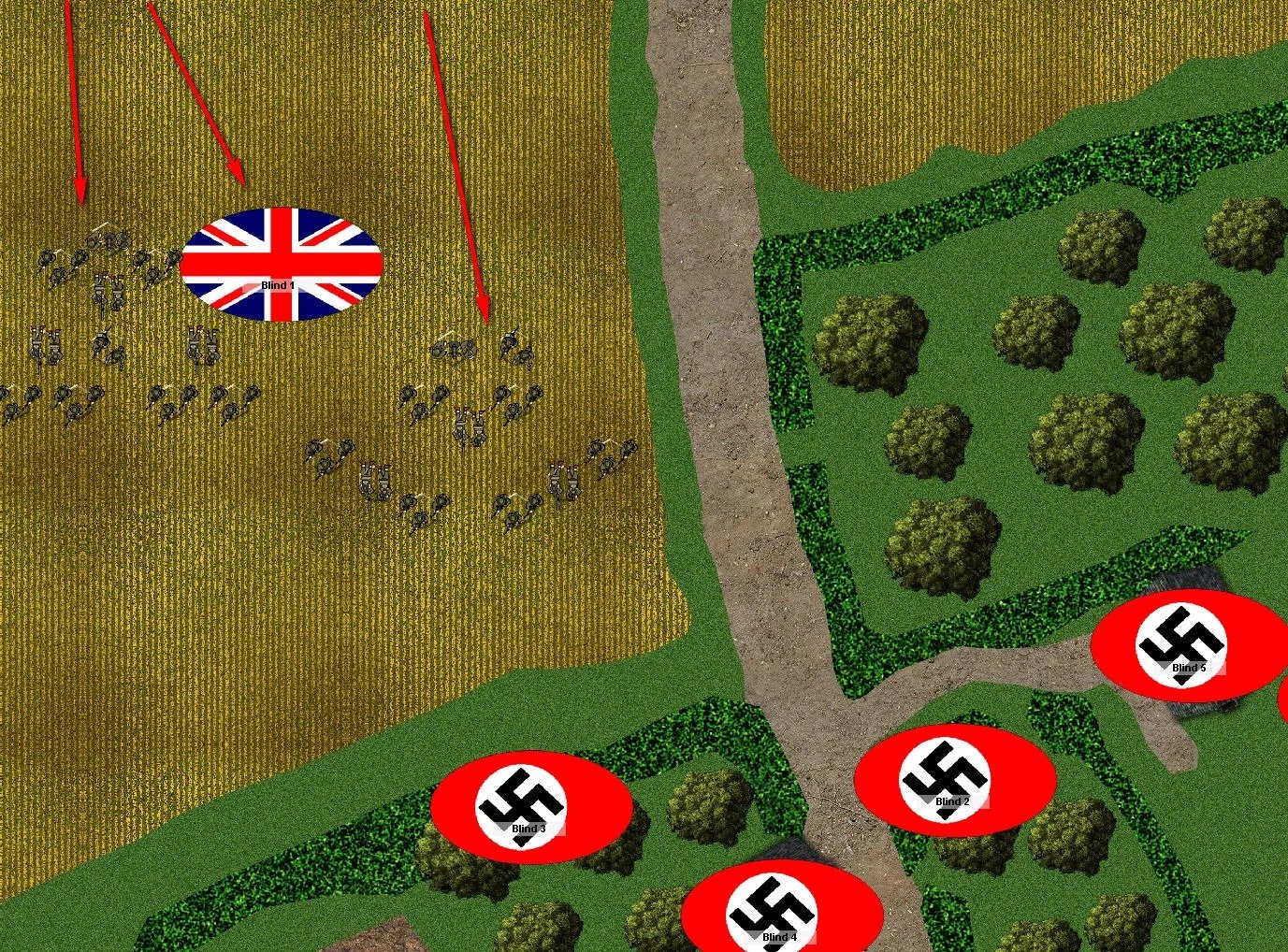
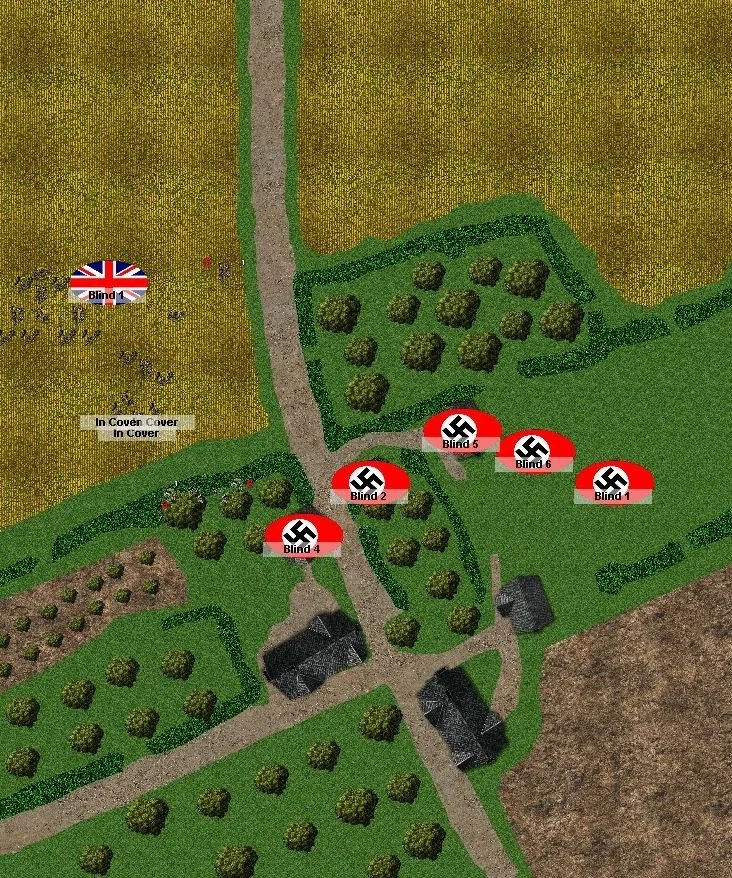
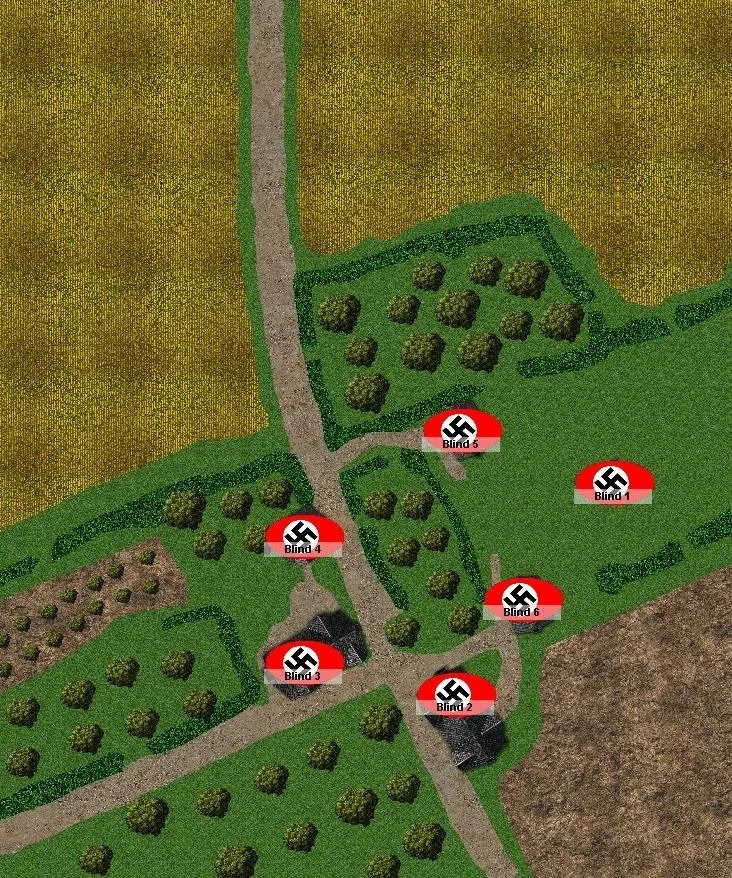
Being as the strongest positions in the game are the houses, I place a blind in each of them. I then place a blind out in the field. If that is revealed to be troops, they will be in foxholes.

This gives the Germans some strong defences. Also, troops can be deployed up to 2″ from a blind (and blind markers are 6″ x 4″) so there is a fair area to deploy in.

I could deploy blinds further forwards, as the scenario states they must be within 12″ of a house. However, a blind on its own will quickly be overwhelmed, and provide minimum benefit. I would rather concentrate the German forces in the village to spot down the road.
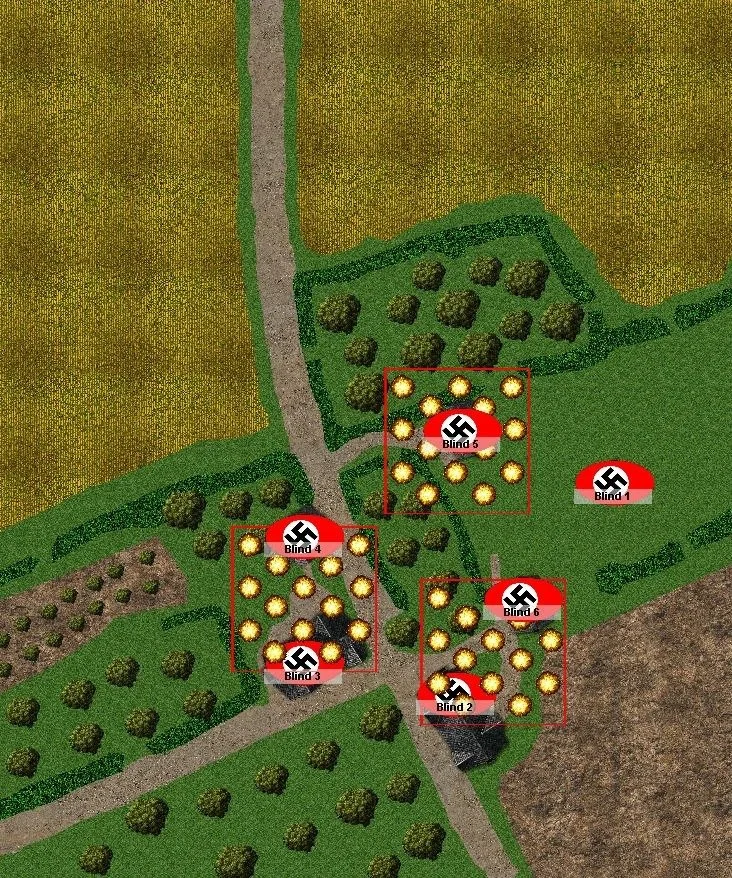

British Stonks and Deployment

Having deployed the German Blinds, it is time to fire the British Stonks. These represent pre-game artillery barrages, which is just as well as the British are attacking without any artillery support.

The first thing I have to do is position the Stonk templates on the map. Each is a 12″ square. I prepared these in Adobe Fireworks (which is an great image program – like Photoshop, but without the many confusing bells and whistles).

Next I rolled for both the infantry and crew served weapon effects of the Stonks on each blind. Why? Because I don’t know if there is going to be infantry or MMGs there until the blind is revealed, so I need to know the effect on both.

The results were as follows:

  • Blind 1

    • Infantry: unaffected by stonk

    • Crewed Weapon: unaffected by stonk

  • Blind 2

    • Infantry: 3 shock

    • Crewed Weapon: 3 shock

  • Blind 3

    • Infantry: 1 dead, 3 shock

    • Crewed weapon: 6 shock

  • Blind 4

    • Infantry: 2 dead, 4 shock

    • Crewed Weapon: weapon KO’d

  • Blind 5

    • Infantry: 2 dead, 4 shock

    • Crewed Weapon: 6 shock

  • Blind 6

    • Infantry: 3 shock

    • Crewed Weapon: 1 dead, 3 shock

Now I could have concentrated the stonks for cumulative effect. But seeing as half of these German blinds are dummies, I thought spreading them out would be better. We shall see if I was right. However, my feeling is I have made an error by not concentrating the fire.
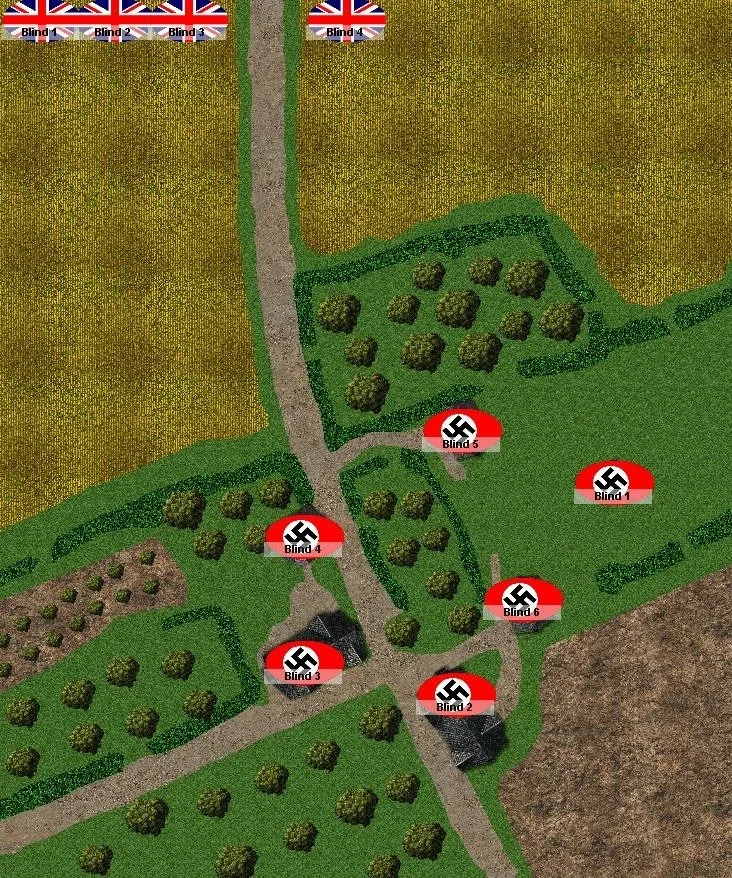

Next, I place the British blinds on the table. They can deploy along the northern edge, and do so.

Now, I have no intention of splitting up my force and engaging in lost of equal fire fights. My intention is to concentrate in one mass and punch through German defences and defeat Jerry in detail. No messing around around. The good, old, “squash Jerry in detail” trick. Why would I consider massing them on one side? Because the Germans have no artillery. If they did, I’d be a lot more concerned.

So I stick all my troops on the west flank, with a dummy blind thrown on the other side for good measure and to scout out.


The Game

Turn 1
Oh yeah – BGE’s got it’s own card table

I Ain’t Been Shot, Mum has a turn sequence whereby units are activated by cards drawn from a deck. So let’s activate the Battlegrounds Gaming Engine card table.

Because everyone is on blinds, the only cards applicable are the blinds cards and the Tea Break card. So these turns may be a bit short until we get troops on the table.

Axis blinds is drawn first. Now they get 4 actions each blind. Yes, this is more than most units get, but reflects that while troops are unspotted and not being shot at, they act much more efficiently.

The Axis Blinds card allows all of the German blinds to remove a point of shock. So I update the table as follows:

  • Blind 1

    • Infantry: unaffected by stonk

    • Crewed Weapon: unaffected by stonk

  • Blind 2

    • Infantry: 2 shock

    • Crewed Weapon: 2 shock

  • Blind 3

    • Infantry: 1 dead, 2 shock

    • Crewed weapon: 5 shock

  • Blind 4

    • Infantry: 2 dead, 3 shock

    • Crewed Weapon: weapon KO’d

  • Blind 5

    • Infantry: 2 dead, 3 shock

    • Crewed Weapon: 5 shock

  • Blind 6

    • Infantry: 2 shock

    • Crewed Weapon: 1 dead, 2 shock

I’ve been quite lucky with my stonk rolls and that will make my life much, much easier. But I still have a niggling feeling I should have concentrated fire.

Now, some of the German Blinds can have a go at spotting my British blinds. That will make my movement slower, and allow the Germans to fire on my troops as I move in.

I’ll start with German Blind 4.
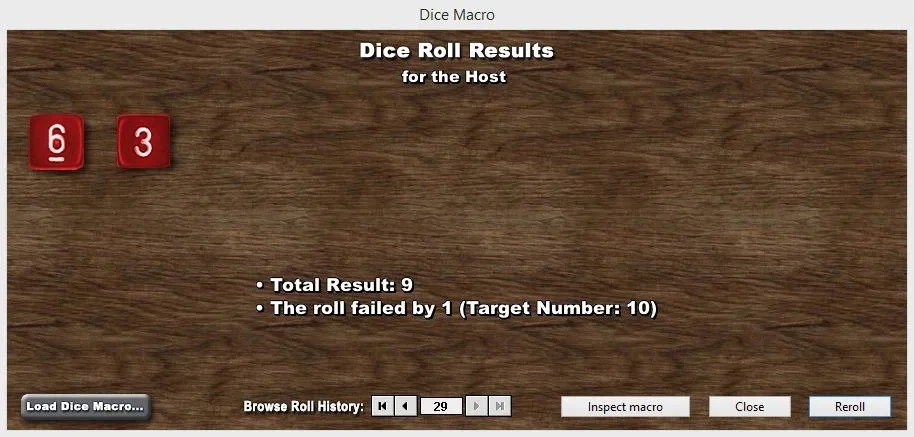
Yes, I am showing off what BGE can do!

The British blinds are well over 24″ away (they are around 45″ distant), and badly obscured by the 5′ high wheat. That gives a base target of 14 for the Germans to spot. The Germans can use all four actions to spot (troops on blinds all get four actions, irrespective of quality) and occupy the upper stories of the houses to gain a height advantage. That gives them a +4 modifier (+3 for actions and +1 for the height) so they need to roll a 10.

Blinds 1, 6 and 2 cannot spot. There is just too much in the way.

Blinds 3 and 5 have a bunch of trees in the way, in addition to the wheat. That means they can only spot British troops if those troops move within 9″. That means the Germans may need to send out some patrols to delay the British.
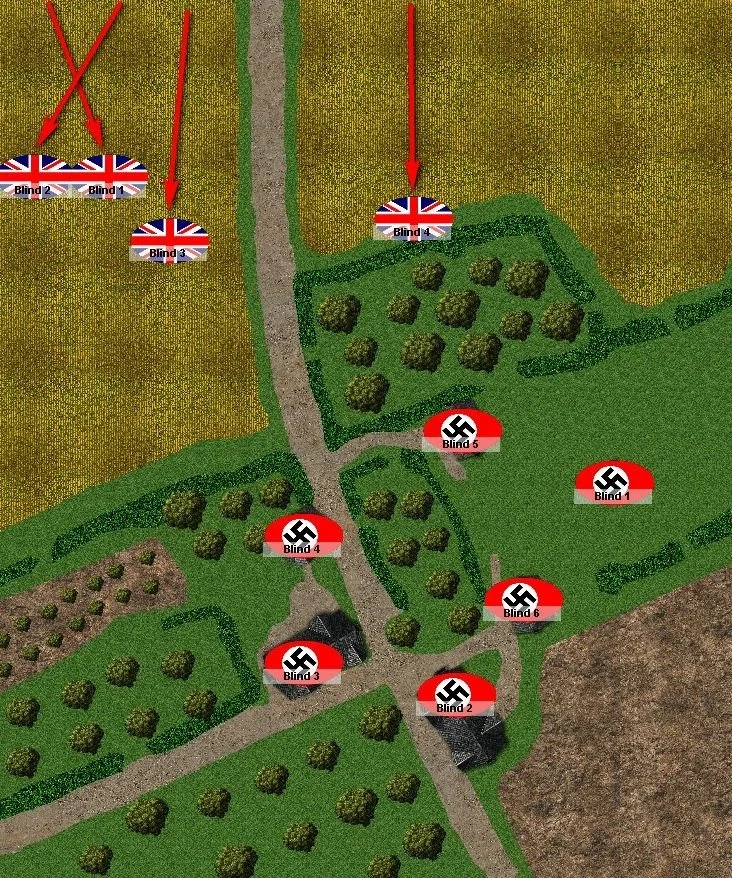
British Blinds Advance Rapidly

Aggression is key here. We need to get up to the town as quick as possible and knock out the Germans while they still have shock from the pre-game bombardments. All dice will be used for movement.

The British Blinds have advanced around 15″ on average, closing the distance quickly. I’ll need to be a little careful in subsequent turns so one does not pull well clear of the rest. I will also want to spot the Germans. So, as I get closer, it will be a little bit of a juggling act with actions.

Turn 2

The Tea Break card is the first one out of the deck. So we move to Turn 3.

I could deploy troops from blinds on the Tea Break, but don’t want to yet.

Turn 3

Axis Blinds is drawn. All German blinds recover a point of shock. German Blind 5 attempts to spot British Blind 4, but fails. German Blind 4 also attempts to spot British Blind 3, but also fails. The Tea Break then ends the turn.

Hmmm… it would seem getting my men on the table will help me move them faster as with just three cards in the deck, I am struggling to get men across the table. Next time I activate we deploy!
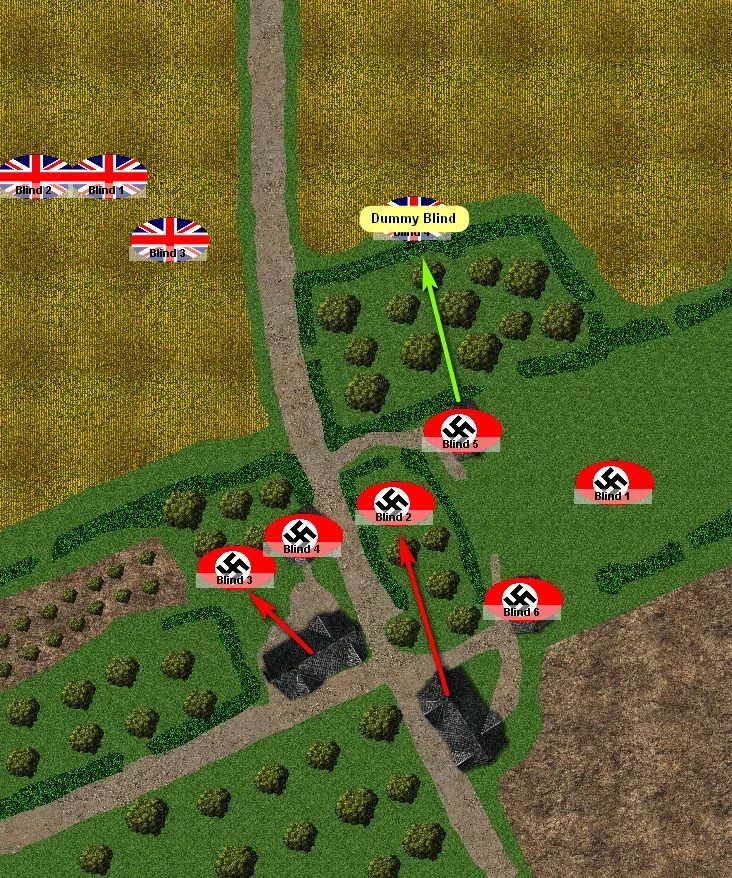


German Blinds advance and spot

Turn 4

The Axis Blinds card comes out first and all German blinds recover one shock. Blinds 2 and 3 move up. Time to catch the Tommies in the field!

Blind 4 fails to spot British Blind 3, but Blind 5 spots British Blind 4 as a dummy.

Out comes the Tea Break card, ending the turn.
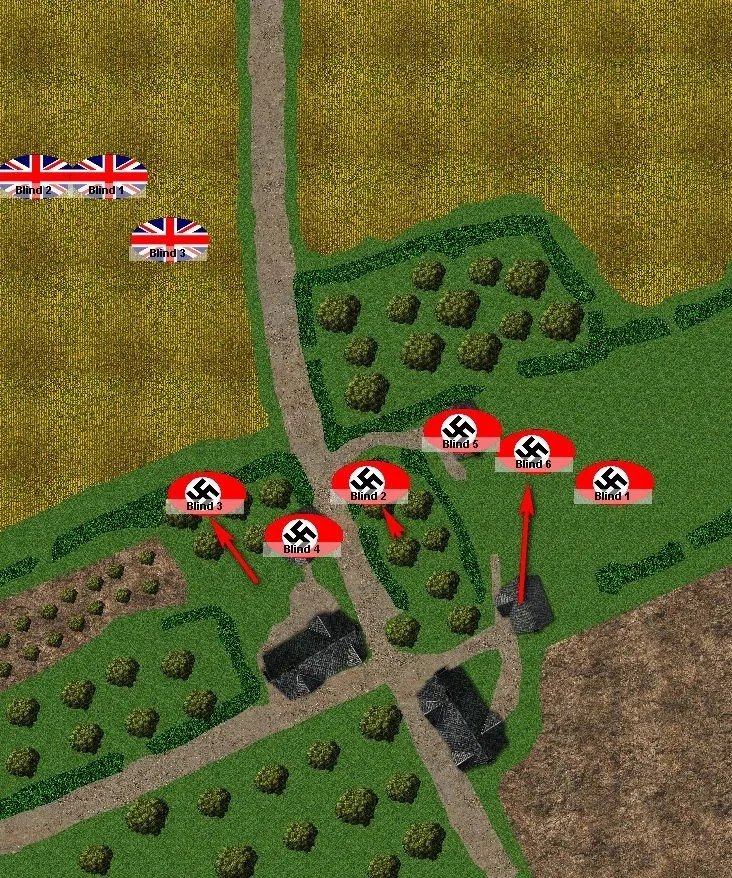

Turn 5

An Axis Blinds again. All German blinds recover one shock – most are almost recovered completely now. Blinds 2 and 3 move up in to cover, while Blind 6 starts a flanking manoeuvre now that the Germans know they have the British penned in one flank.

The Germans stand as follows:

  • Blind 1

    • Infantry: unaffected by stonk

    • Crewed Weapon: unaffected by stonk

  • Blind 2

    • Infantry: unaffected by stonk

    • Crewed Weapon: unaffected by stonk

  • Blind 3

    • Infantry: 1 dead

    • Crewed weapon: 2 shock

  • Blind 4

    • Infantry: 2 dead

    • Crewed Weapon: weapon KO’d

  • Blind 5

    • Infantry: 2 dead

    • Crewed Weapon: 2 shock

  • Blind 6

    • Infantry: unaffected by stonk

    • Crewed Weapon: 1 dead

Spotting occurs, but no British are spotted.

An Allied Blinds card allows me to move and deploy.

The Blind uses two dice to move, and then deploys. It uses its remaining two dice to spot German Blind 3, but fails. Blind 3 moves and deploys, while Blind 1 moves up.

That means I now have platoons 2 and 3 deployed, while Platoon 1 is still on blinds in reserve. I will attack “2 up and 1 back” to see how that goes. The British Cards “Platoon 2″, “Platoon 3″, and the two big men get added to the deck.


Turn 6

First card out is the Allied Blinds. I really need to spot some Germans so I can shoot at them, and so use all four actions of British Blind 1 to spot. But I fail.

British Platoon 3 is the next card out. Section 3, being the closest to German Blind 3, roll to spot and succeed. The Blind turns out to be the German Company HQ. The German MMGs and commanders are deployed, with markers for the two shock each MMG team has as a result of the British pre-game stonks. Now to overwhelm those MMGs before they can fire!

We fire the mortar at MMG 1, causing a point of shock. We then fire section 1 at MMG 1, rolling a miserable 5 on 3d6 which causes a single hit. However that hit is a kill. I mark the kill with a white number token to differentiate it from the red shock ones. Section 2 I move 2d6 and use their final action to take cover.

The next card out is the Axis Machinegun Bonus card (which went in to the deck when the blind was revealed). That allows one MG squad a free activation. MMG 2 activates and fires on British Section 3 of 3rd Platoon. They roll a total of 7, which as the British are in the open being fired at by an MMG, causes 7 hits. those hits translate in to two shock and twohree kills, and the section is automatically pinned. I remove two men and mark the men pinned. The pinned status will not have any effect on the British troops as they have already moved and fired this turn and the pinned status will be removed at the Tea Break card.

The next card out is the Axis HQ card. It is a dark day for the British. MMG 1 fires first at Section 2 of 3rd Platoon, scoring 15. However, as the MMG has three shock, that is reduced to 12. The British have taken cover and so count as being in light cover, but still suffer five hits, which translates as two kills and two shock. I adjust the British section accordingly.

MMG 2 fires again at British Section 3, causing a massive five kills and three shock. That leaves just a single man with a Bren gun, with five shock. The British unit falls back 8″ (2″ for every point of excess shock).

Things are not going well for my attack.

Sergeant Mick McAlpine, the Level 3 sergeant in charge of 3rd Platoon, activates next. He runs forward to the second section and rallies their two shock.

The Tea Break card then ends the turn and removes any pinned statuses.
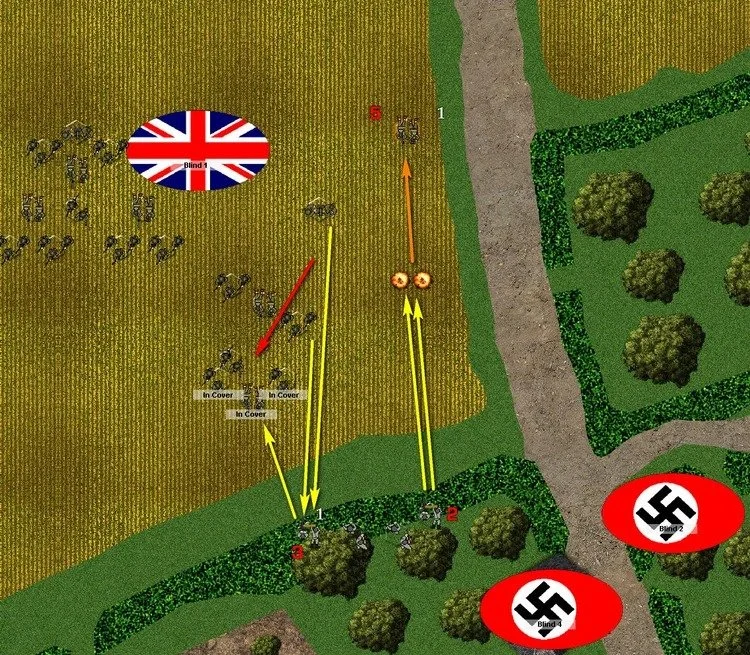

Turn 7

The Axis Blinds card is first out of the deck. Both Blind 1 and 6 immediately begin to move in to flanking positions. Blind 4 deploys as German Platoon 1 (I diced for it), which means out of the four remaining blinds, only one is a German platoon. Section 1 opens fire on the British Section 2 of 3rd Platoon, causing two kills.

The Axis Machinegun Bonus card comes out next. I hold my breath, but MMG1 firing at close range still only causes two points of shock to 3rd Section of 3rd platoon.

Allied Platoon 3 comes out next. I decide to pile on some fire to the Germans to get my men moving forward, hoping to stick to my original plan (which is rapidly falling apart and turning in to a pile of dead English bodies). The British troops open fire, but only manage to cause two points of shock to MMG 2, and one point of shock to MMG 1. The British 2nd Section now only has four men remaining, meaning it only has one action per turn, so can’t fire with more than a single d6. That means it is pretty ineffective. An entire British platoon has been mostly neutralised. Finally, the British mortar adds another point of shock on German MMG 1, which causes it to fall back 2″ as its shock now exceeds the number of men in the team.

The German machineguns are losing their bottle. If I can keep that up, I can bring up more men and get a foothold on the village.

Sergeant McAlpine activates next and removes the shock on 2nd Section.

The British Blind card is next and the British troops advance and deploy, ready to take over from 3rd platoon that has been mauled. The lead section fires at German MMG 2, causing a casualty. The MMGs are suffering. As the British troops have come within 4″ of German Blind 6, the blind is automatically spotted. It turns out to be the remaining German platoon (a 1 in 5 chance) and I now have to contend with being surrounded and outflanked.

I fire on the newly revealed German troops, but with no effect. The platoon mortar adds another point of shock to MMG 2, making that weapon fall back. At least there is some mercy for me.

The Tea Break card then ends the turn. I removed the other German blinds as they are dummies and there is no further spotting for them to do.
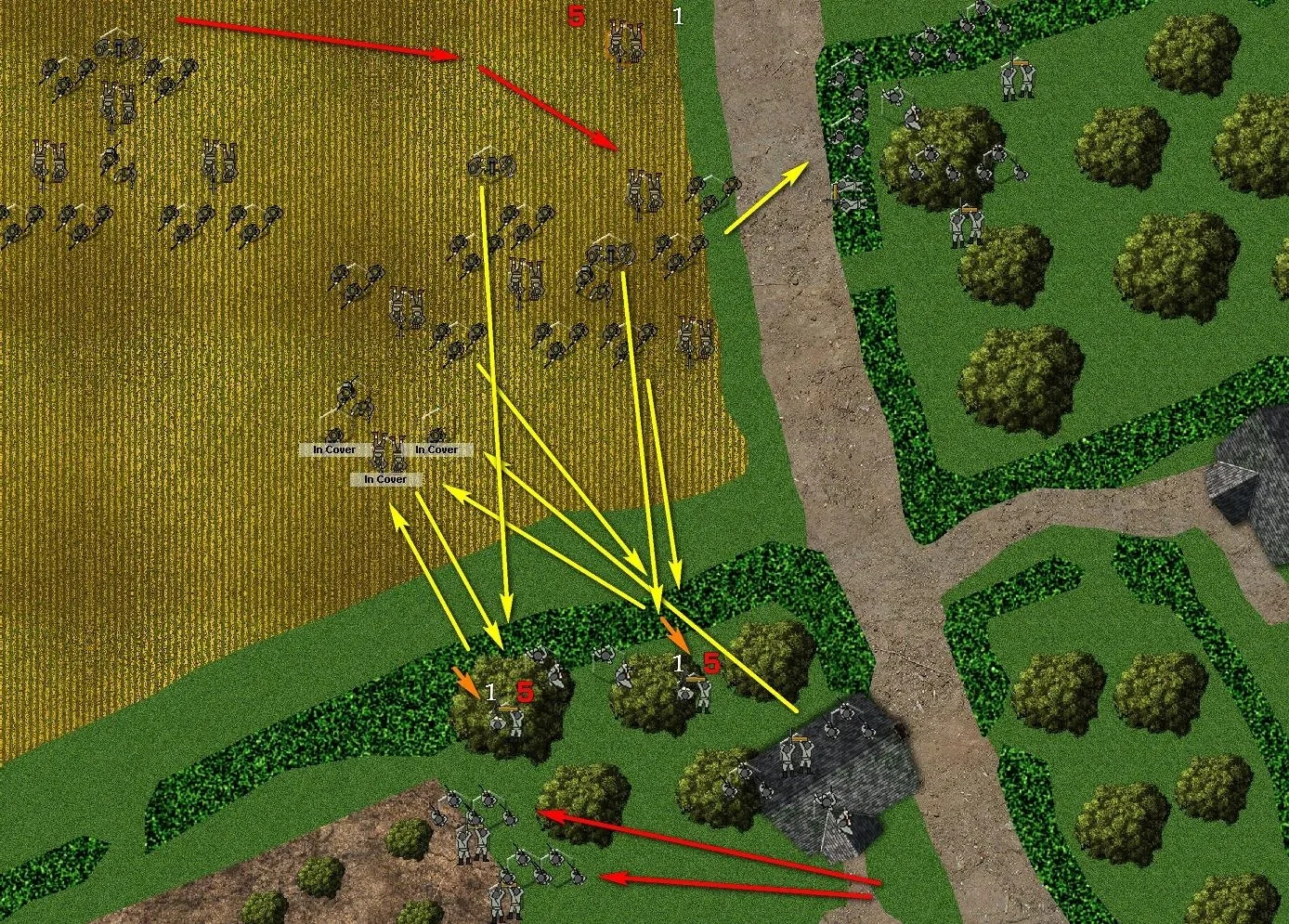
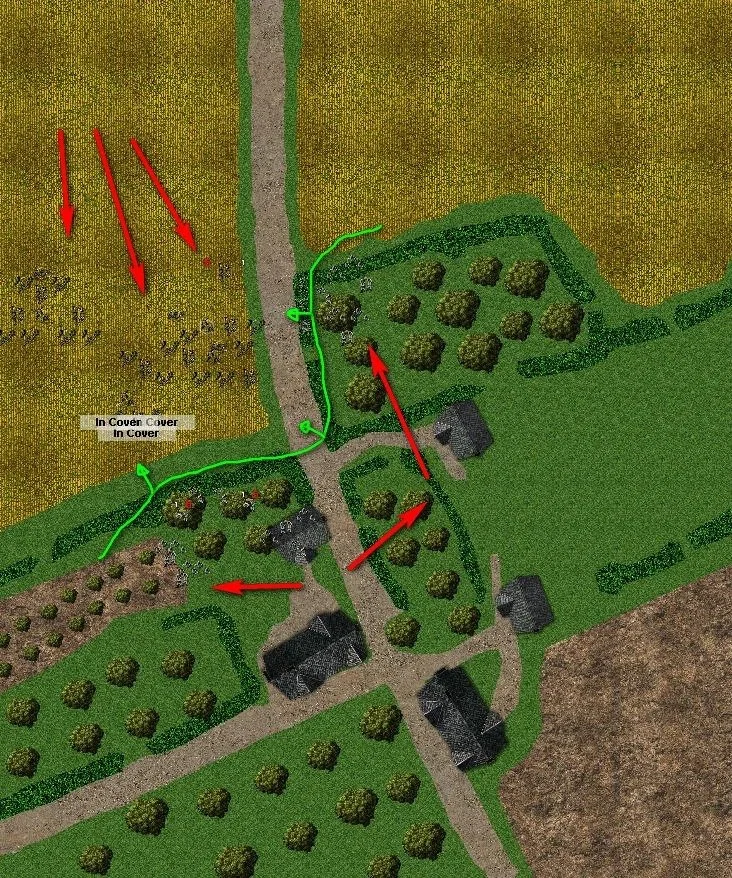
Turn 8

British Platoon 3 are the first to be activated. I can see a window of opportunity here. The German CO is still in the front line, while his MMG teams have pulled back. So I move forward a section and shoot at him, hitting and killing him. The other, mauled section shuffles forward, while the mortar misses.

The next card out is Feldwebel Adler, the Level 3 commander of the German 2nd Platoon. He uses all three initiatives to activate his three squads. German Section 1 fires on Section 2 of the British 1st Platoon, gaining a bonus +2 to firing due to the proximity of the platoon mortar team to their target. They wipe out the mortar team, and cause two shock and two kills on the British Section. The British Section is also suppressed (marked with red base markers).

Not good.

Section 3 of the German 2nd Platoon moves up to the hedge and fires in to the massed British. They cause two kills and four shock which are spread between two British sections. Finally, the German 2nd Section moves out on a flanking manoeuvre. Both British sections are pinned. (marked with yellow base markers).
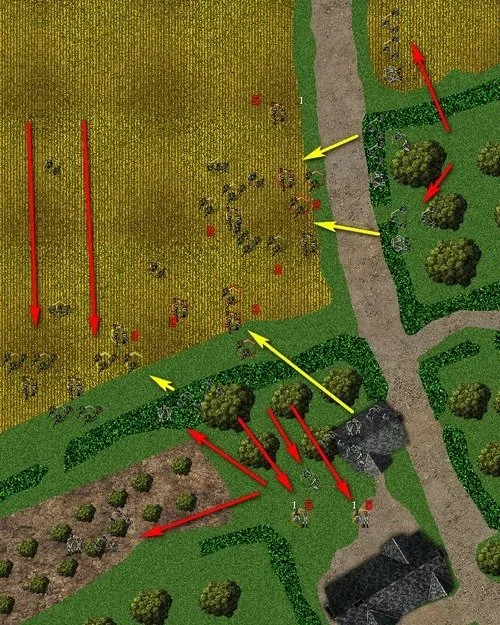
The British decide it is time to withdraw

So far the British have lost seventeen men, while the Germans have lost three. Worse, the British have a platoon pinned and suppressed, one mauled one, and one out of the main action.

The German HQ activates next and the MMGs fall back towards the houses. There they will be able to recover shock and keep up the fire.

The British Lieutenant Watson activates next. As the leader of 1st Platoon, he moves forward and removes the pinned status on both sections in his platoon.

Lieutenant Toby Scott of 2nd Platoon is next. He activates two sections and sends then running forwards.

Obergefreiter Mittel of the German 1st Platoon is next. He moves in to contact with 1st Section and directs their fire against the advancing British. The fire catches 1st and 2nd sections of the battered British 3rd platoon, leaving four dead and a bundle of shock. The British troops are suppressed.

Next card is Axis Platoon 1. They move a section and gun down more British, pinning them too. A second section takes up position in the vegetable patch to act as a reserve and to hold the flank.

Allied Platoon 1 comes out next and the British move up another section in to the meat grinder. Gefreiter Beyer comes out next and moves back with the MMGs.

Finally the Tea Break Card ends the game.


A Review Of The Battle

Firstly, let me say Battlegrounds was fantastic. It did everything I needed it to do and more. It was easy to use and a joy to game with. This is definitely my “go to software” for wargaming.

The battle itself did not go anywhere near as planned. The Germans were able to organise an aggressive defence and took the fight to the British, catching them in the open field and turning the stiff upper lip to quivering jelly. By enveloping the British, the Germans could pour fire from everywhere. I stopped the game as the British had lost about a platoon of men and had little chance of breaking through the German line. The British squads were rapidly becoming pinned and suppressed from the close range firefight, and to play on would have simply resulted in their utter destruction.

The scenario is designed to help you learn the game. It certainly did that. I Ain’t Been Shot, Mum is a hugely fun game, that really does offer some deep tactical choices.

This just became my new favourite set of rules.

And I really enjoyed the company scale too. I am definitely looking forward to my next game. Hopefully, I can handle the Brits a bit better in that one!

The Wargaming Addict



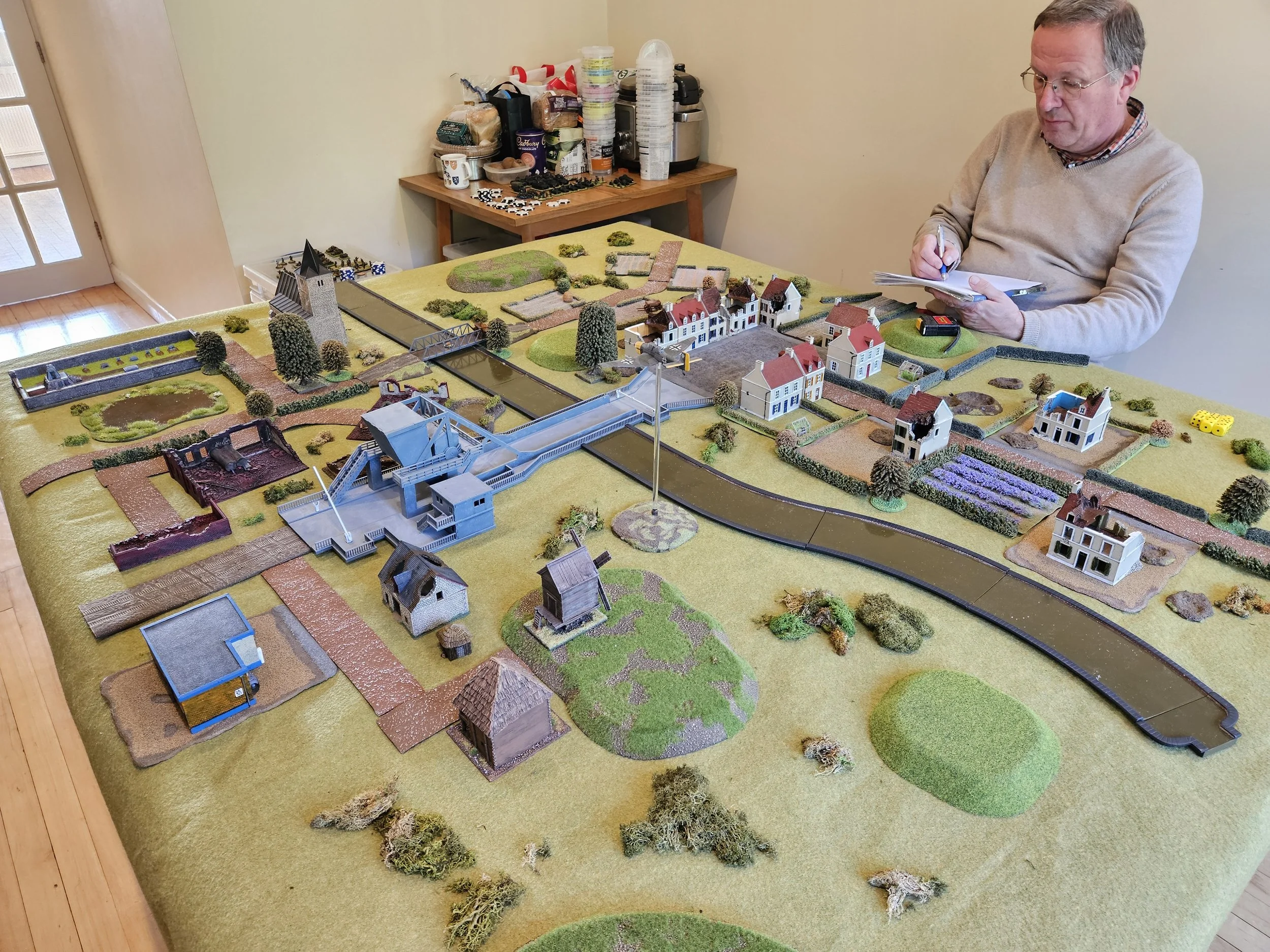
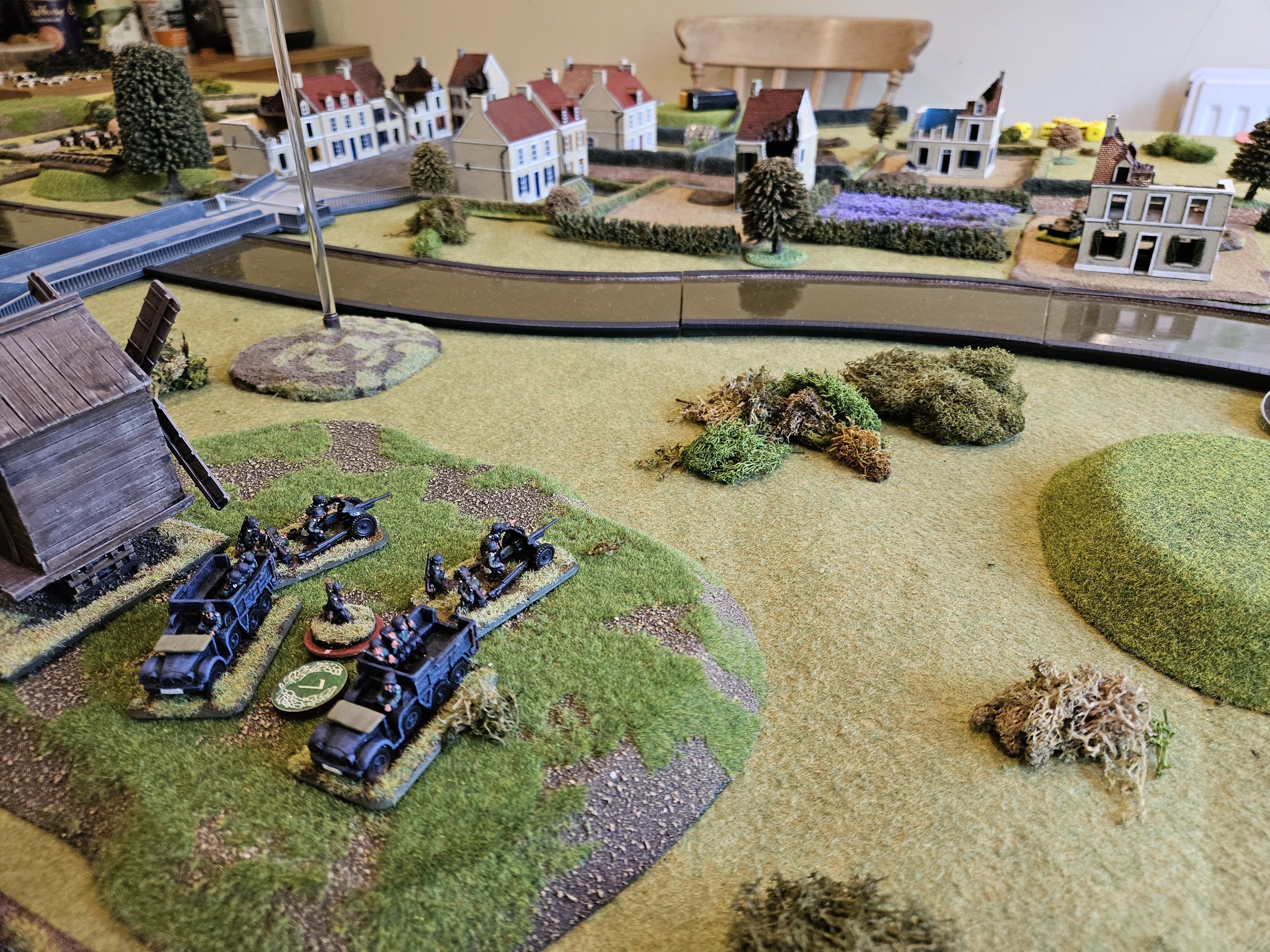
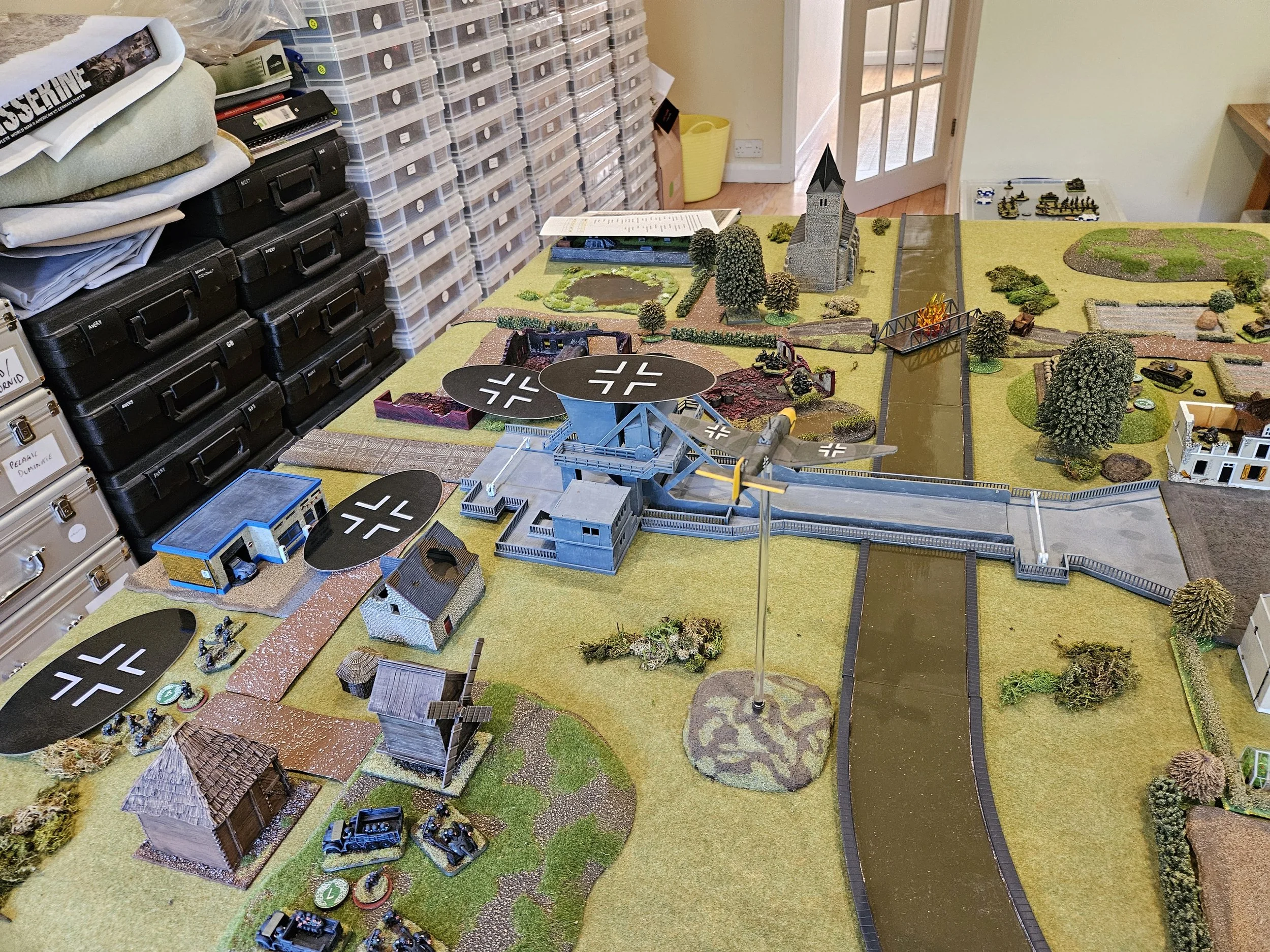
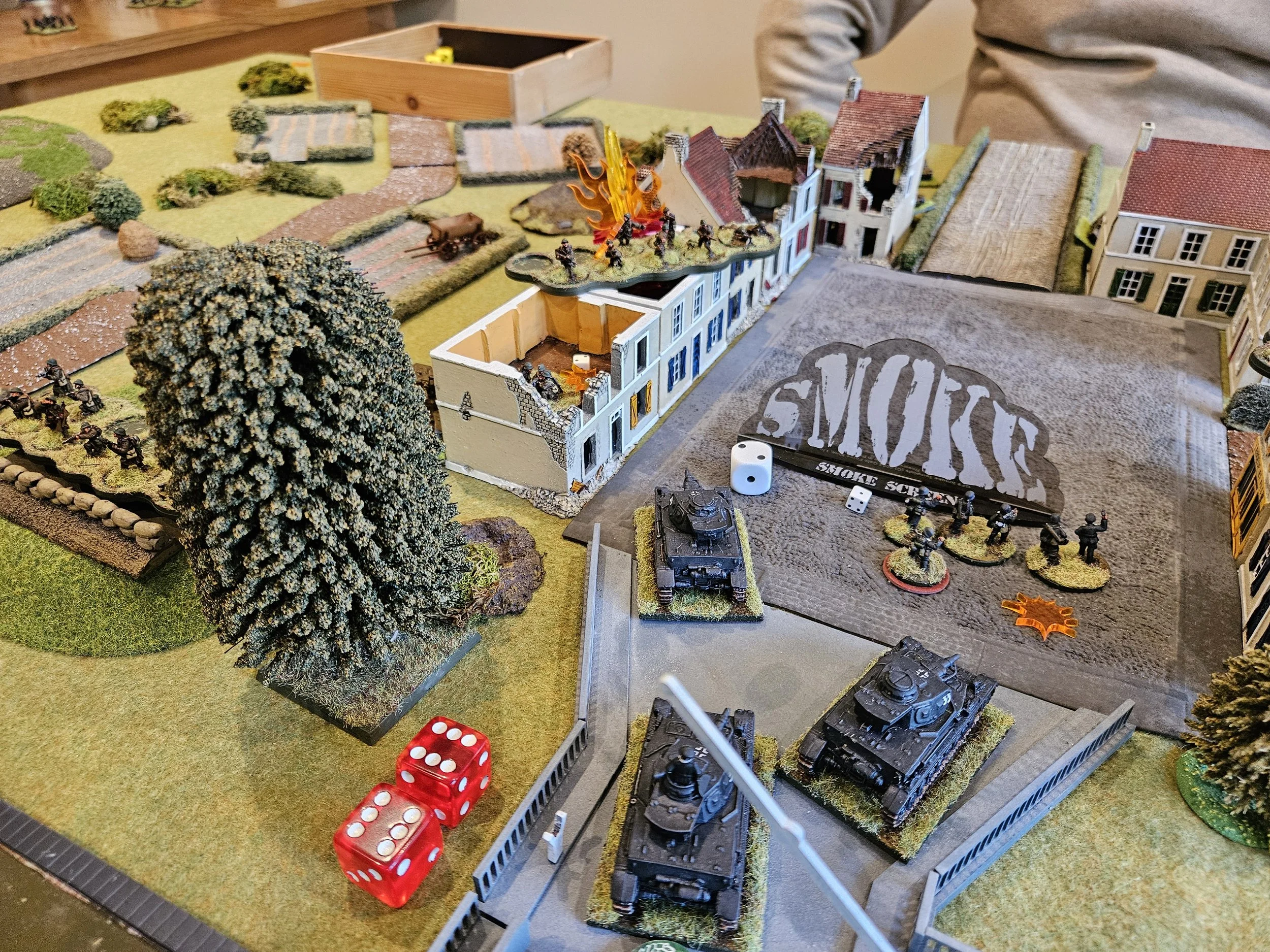
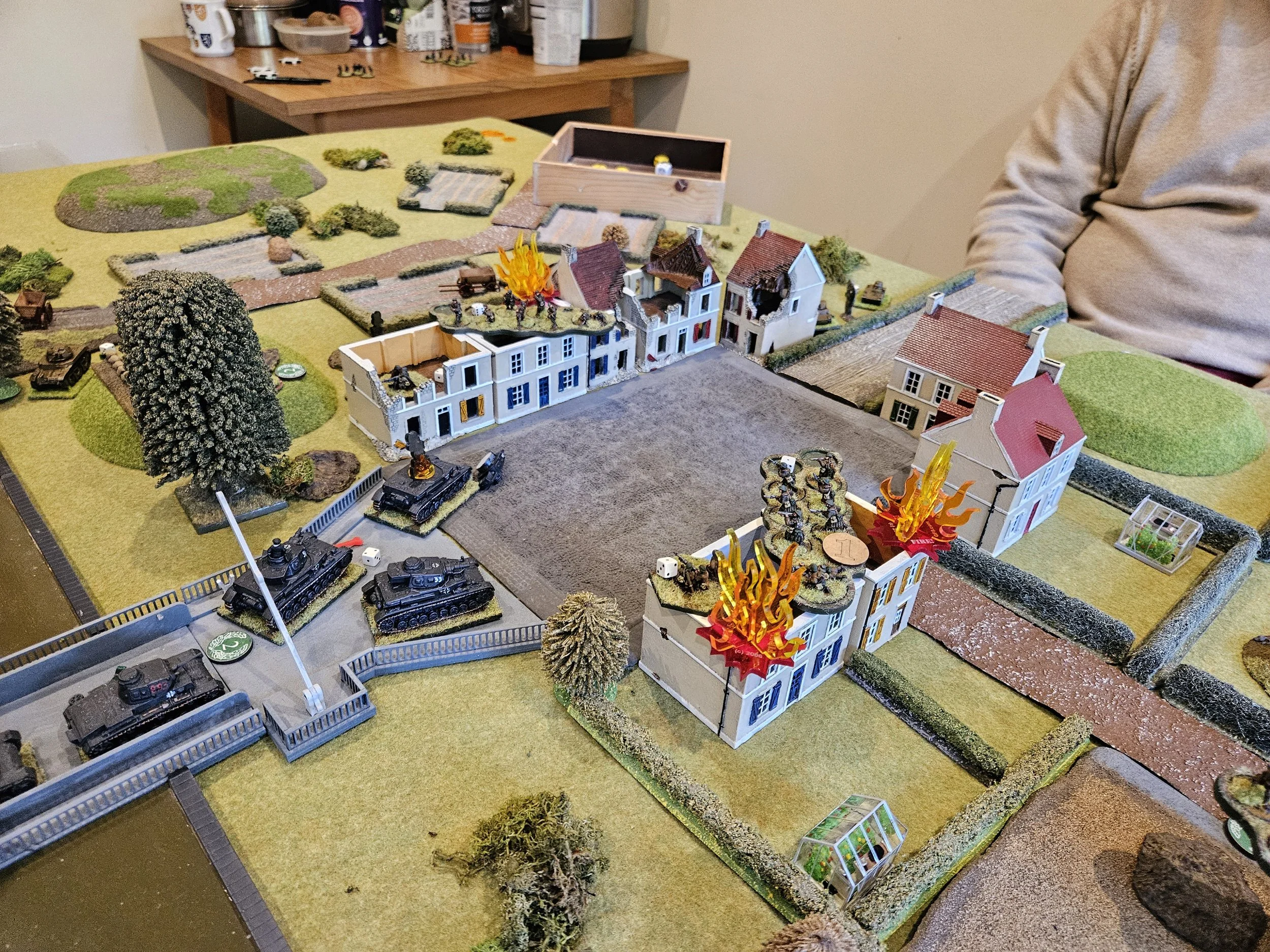
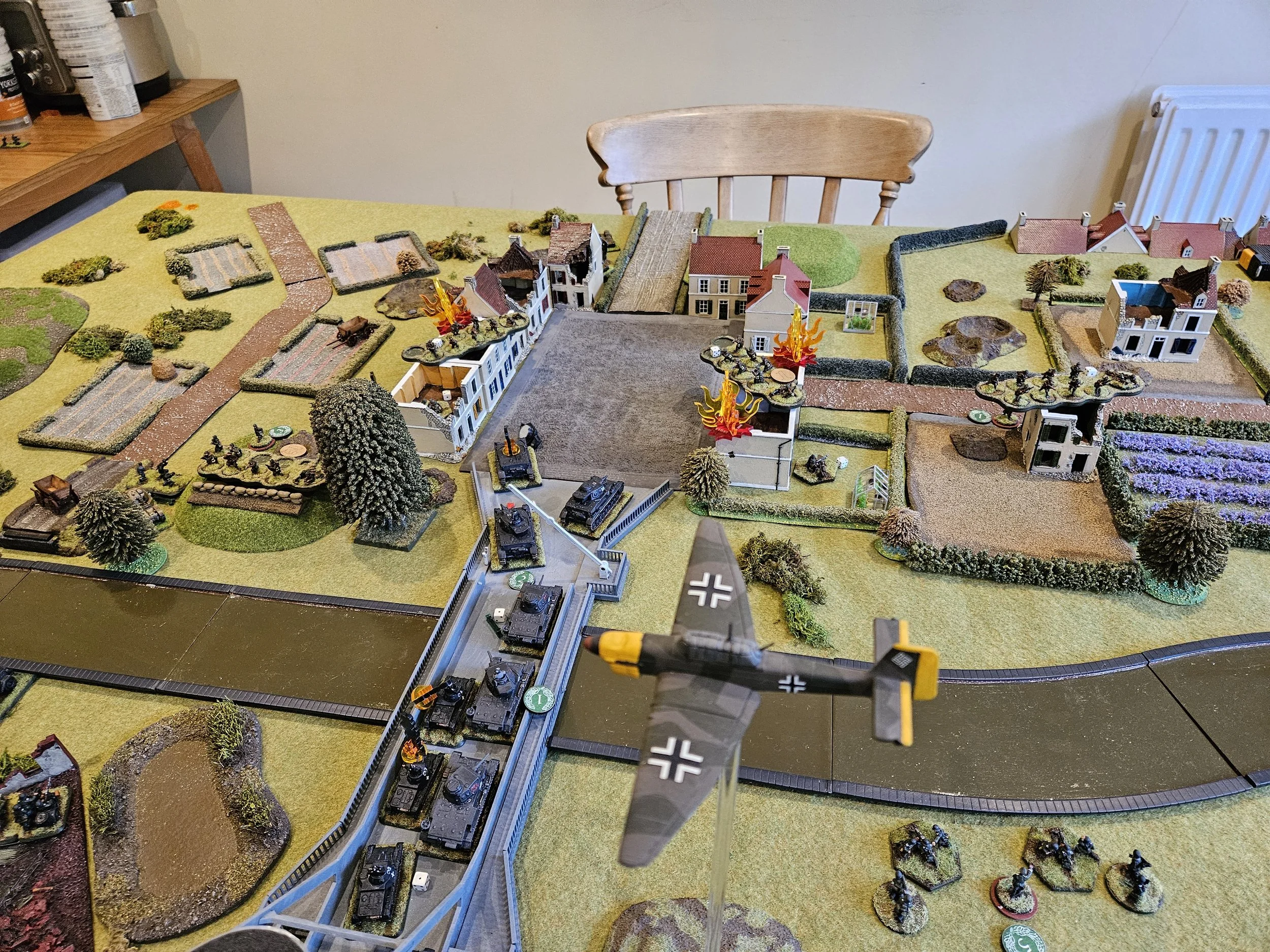
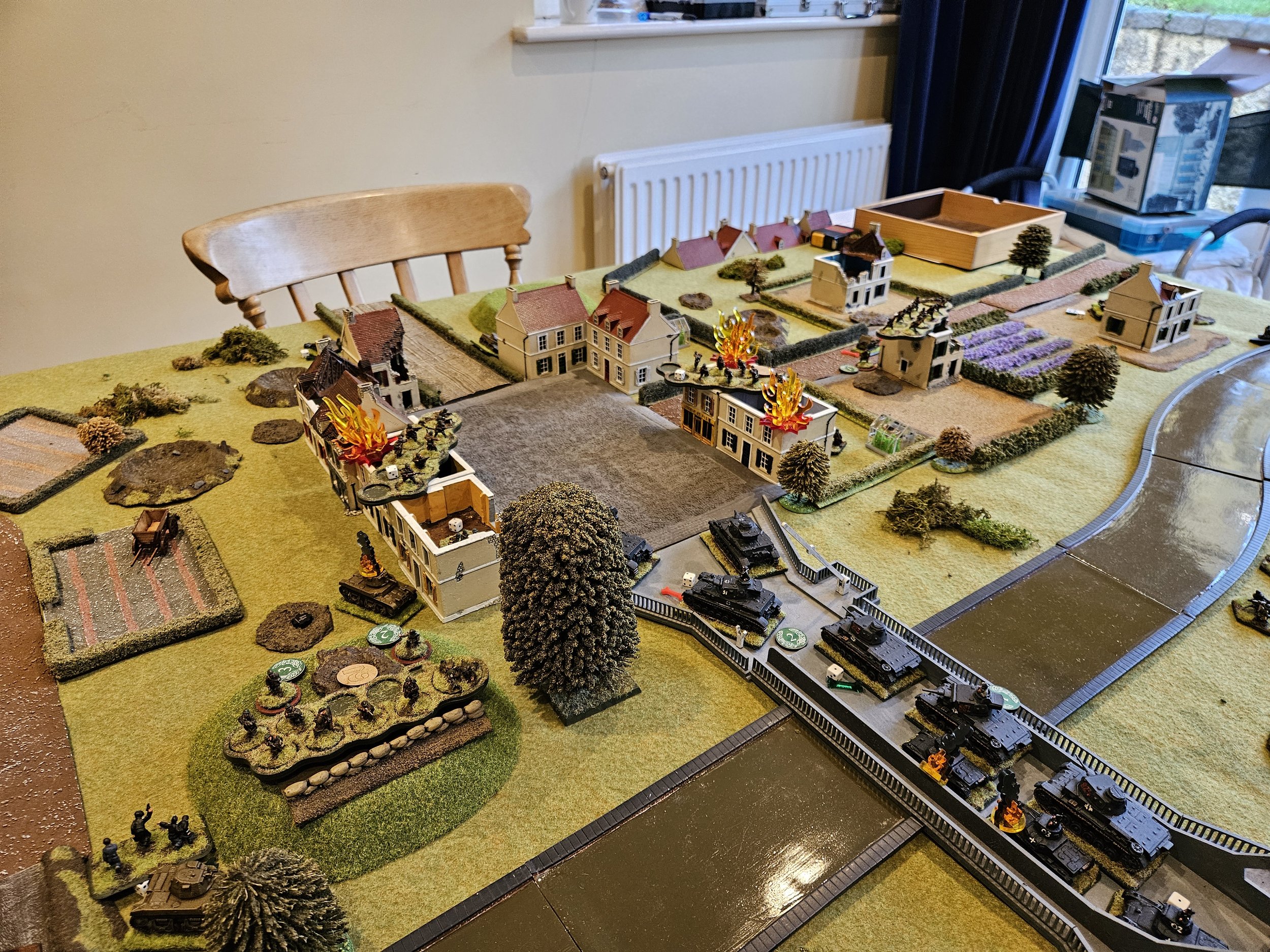
Having painted all the Belgian armour from bayonetsandbrushes.com, I was keen to get them onto the table, so set up a scenario where elements of the German 3rd Panzer Division would attempt to force the crossing of a canal “somewhere in Belgian” around 11th-12th May 1940.

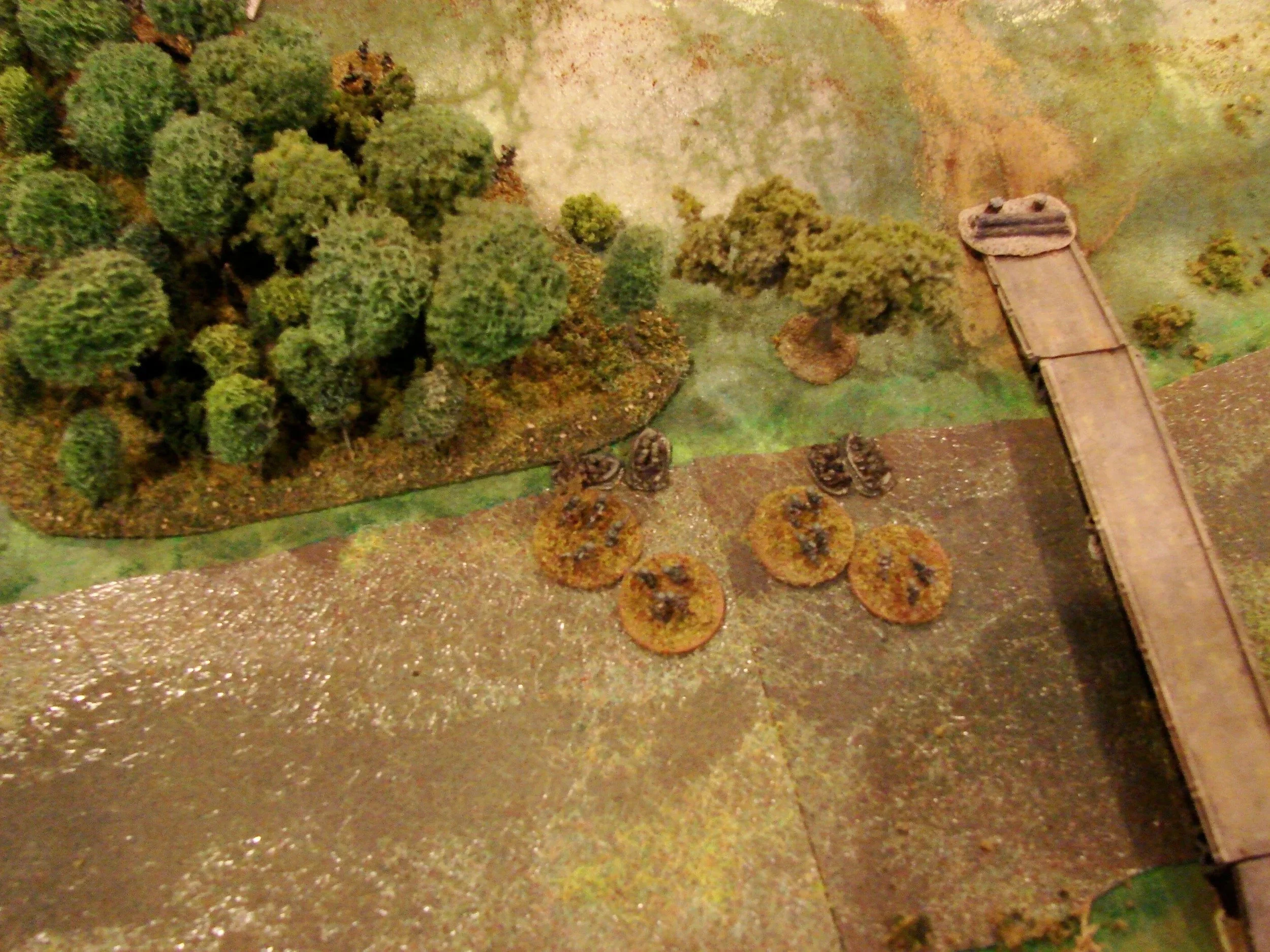
As the game began, German blinds poured onto the table. The reconnaissance element heading for the foot bridge over the canal was spotted almost immediately, and took some fire from a squad of dug-in Belgian infantry.

Meanwhile, a platoon of German anti-tank guns decloaked on the hill overlooking the town, hoping to deny any movement to any Belgian armour present.

At this point the Belgians blew up the footbridge, not quite with the German recon platoon on it, but it was a near run thing!

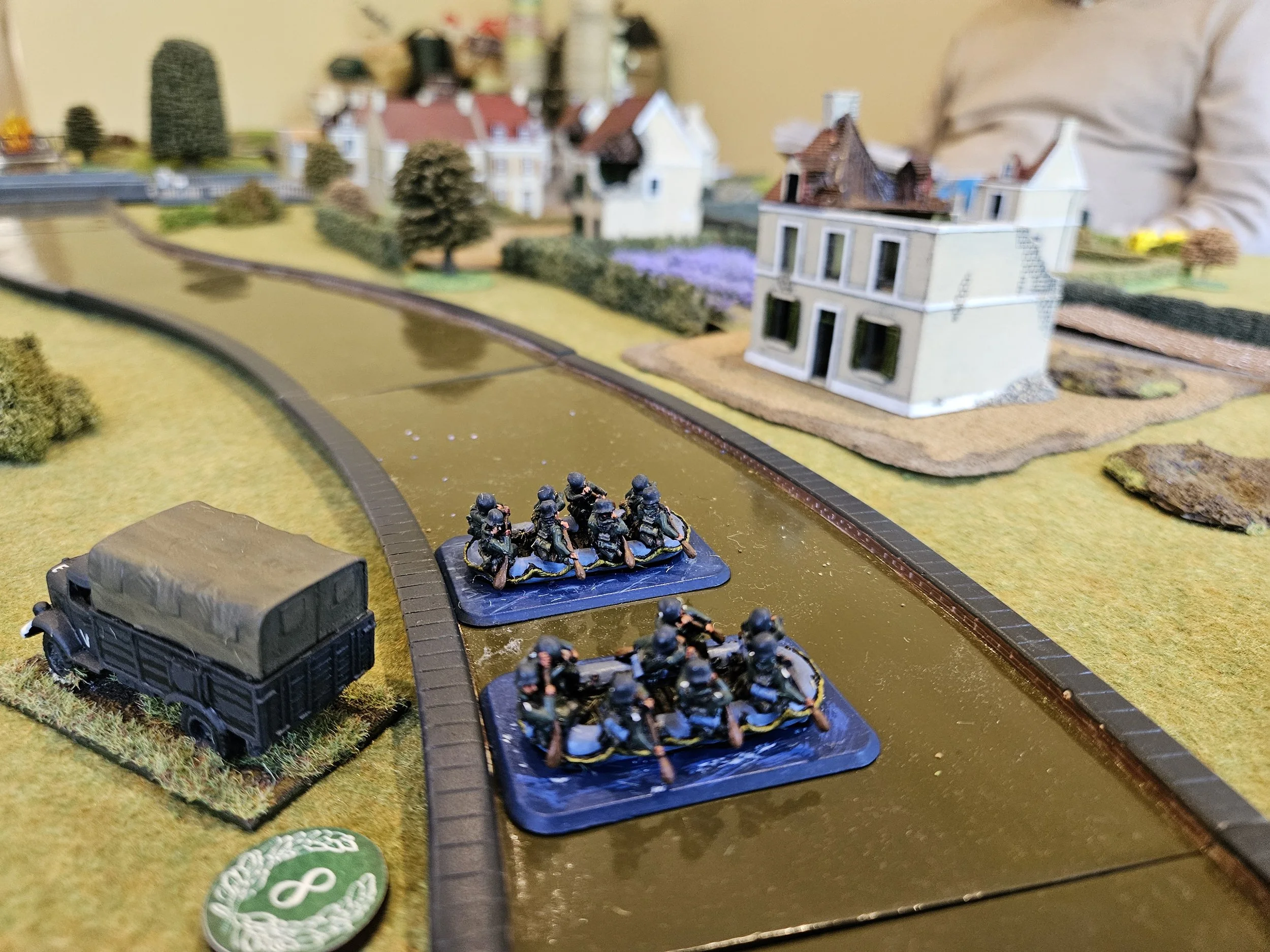
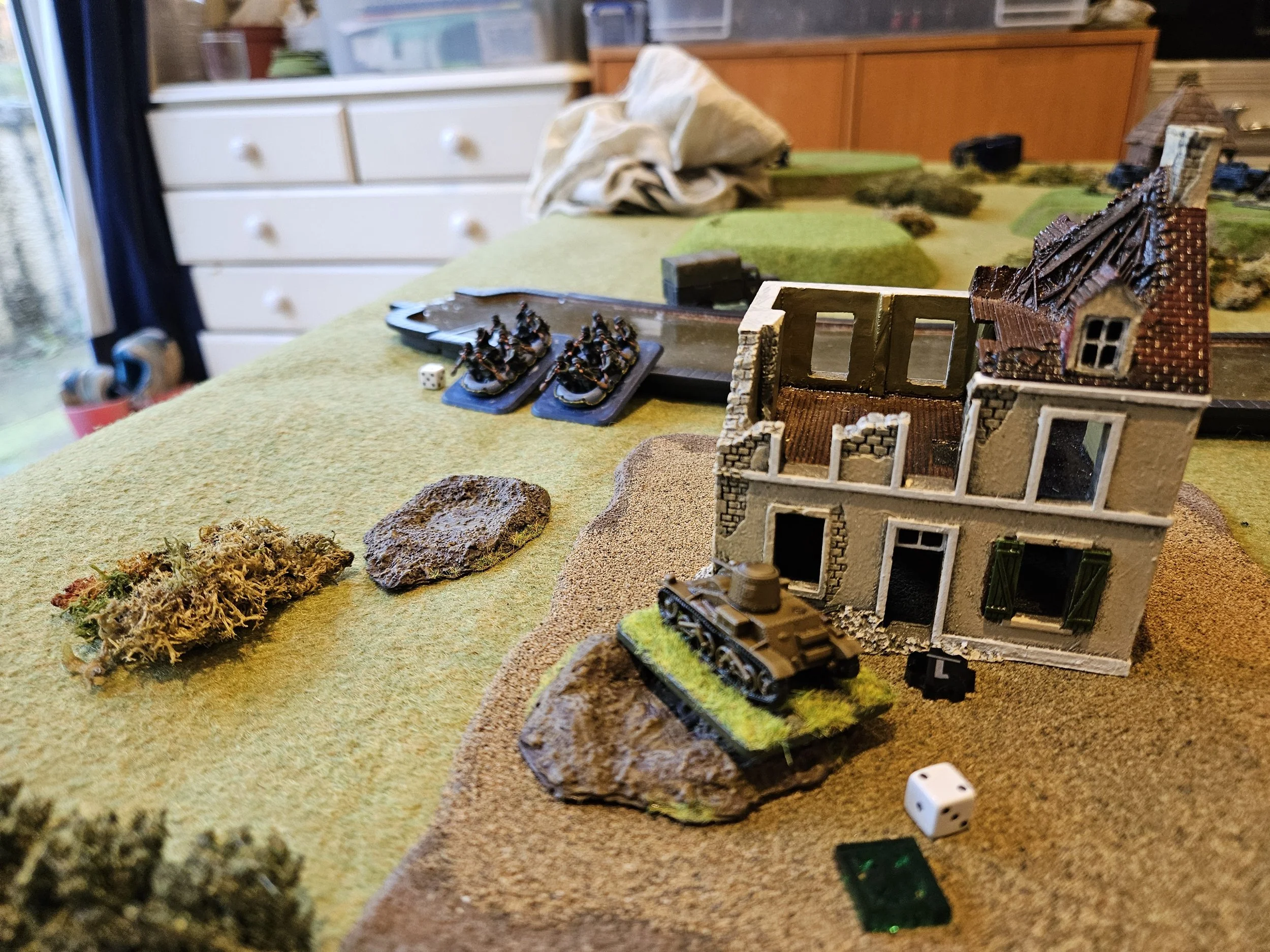
In other news, German engineers tried to sneak over the canal in their rubber dingies.

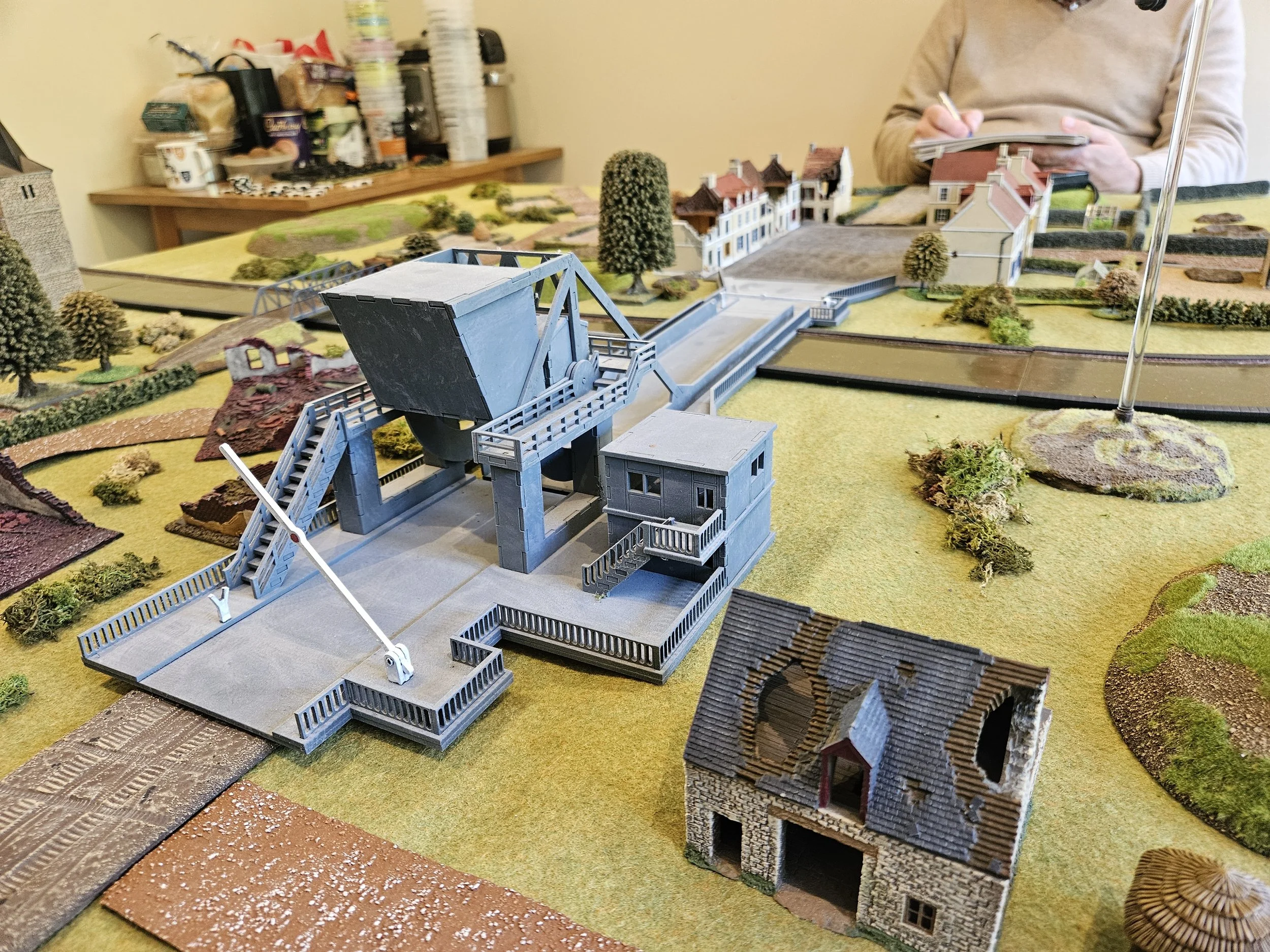
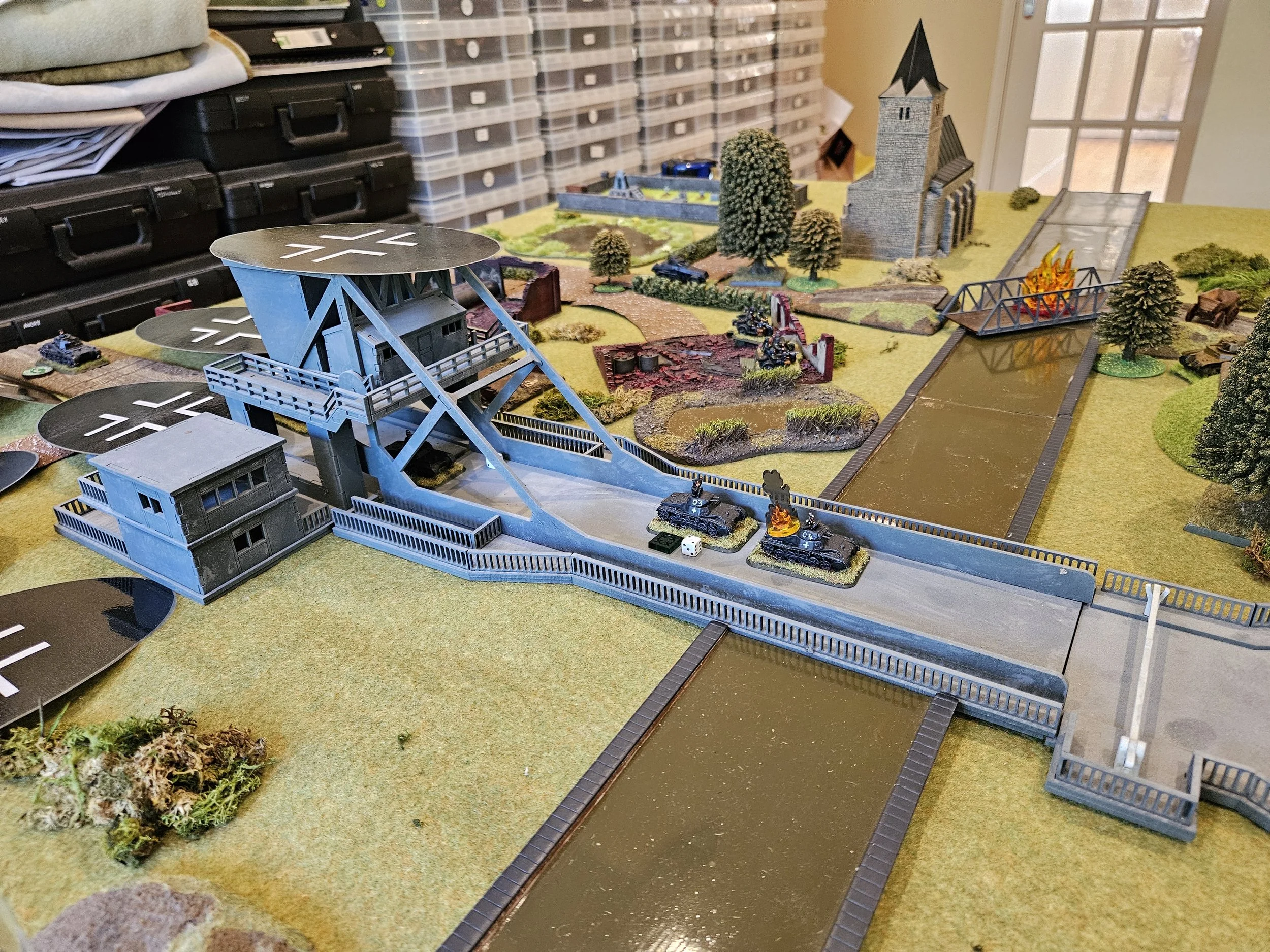
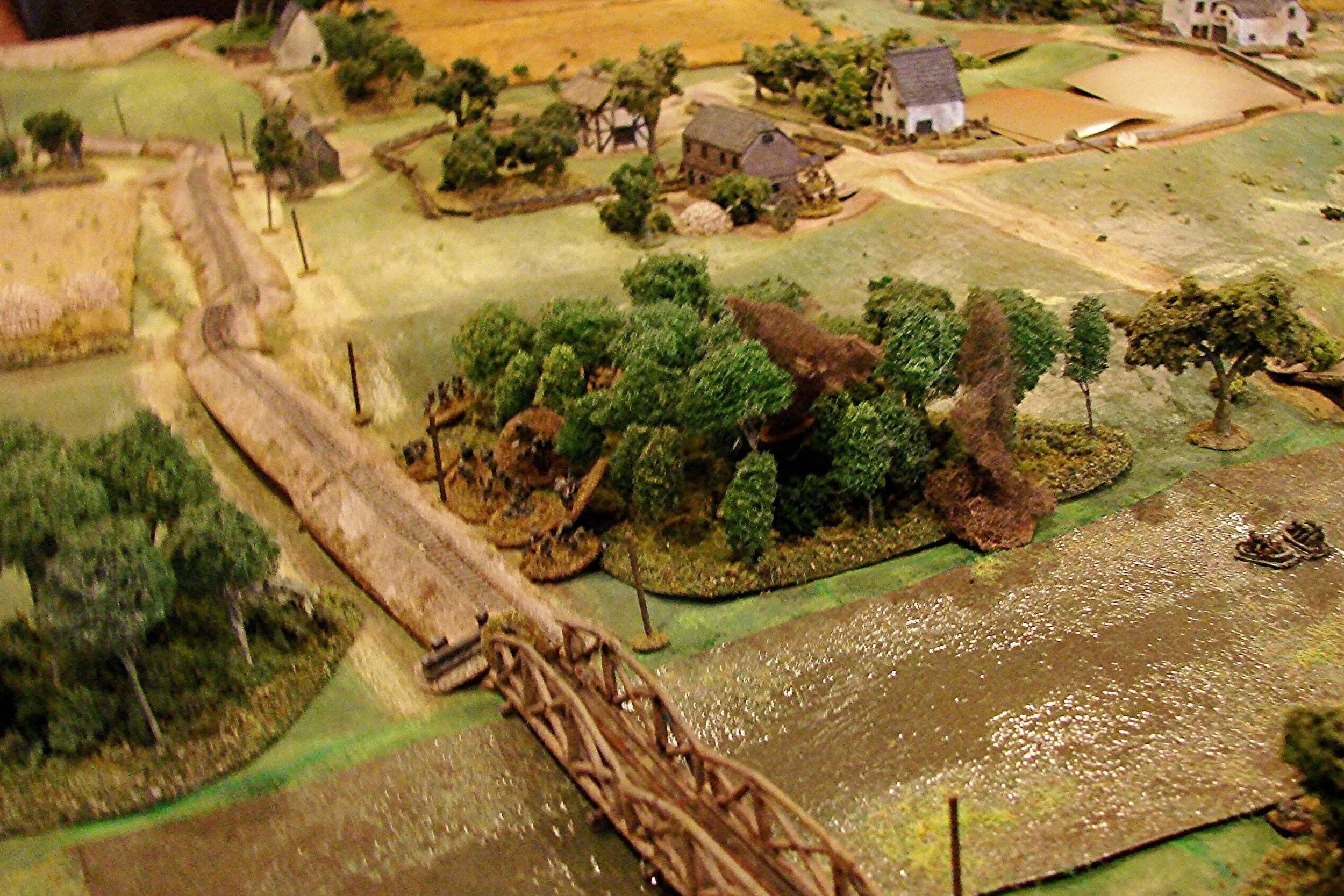
Realising that the only way over the canal was a direct thrust over the main bridge, the 1st Platoon of the German medium panzer company (the Panzer Is) tried to storm over the bridge in an attempt at armed reconnaissance.
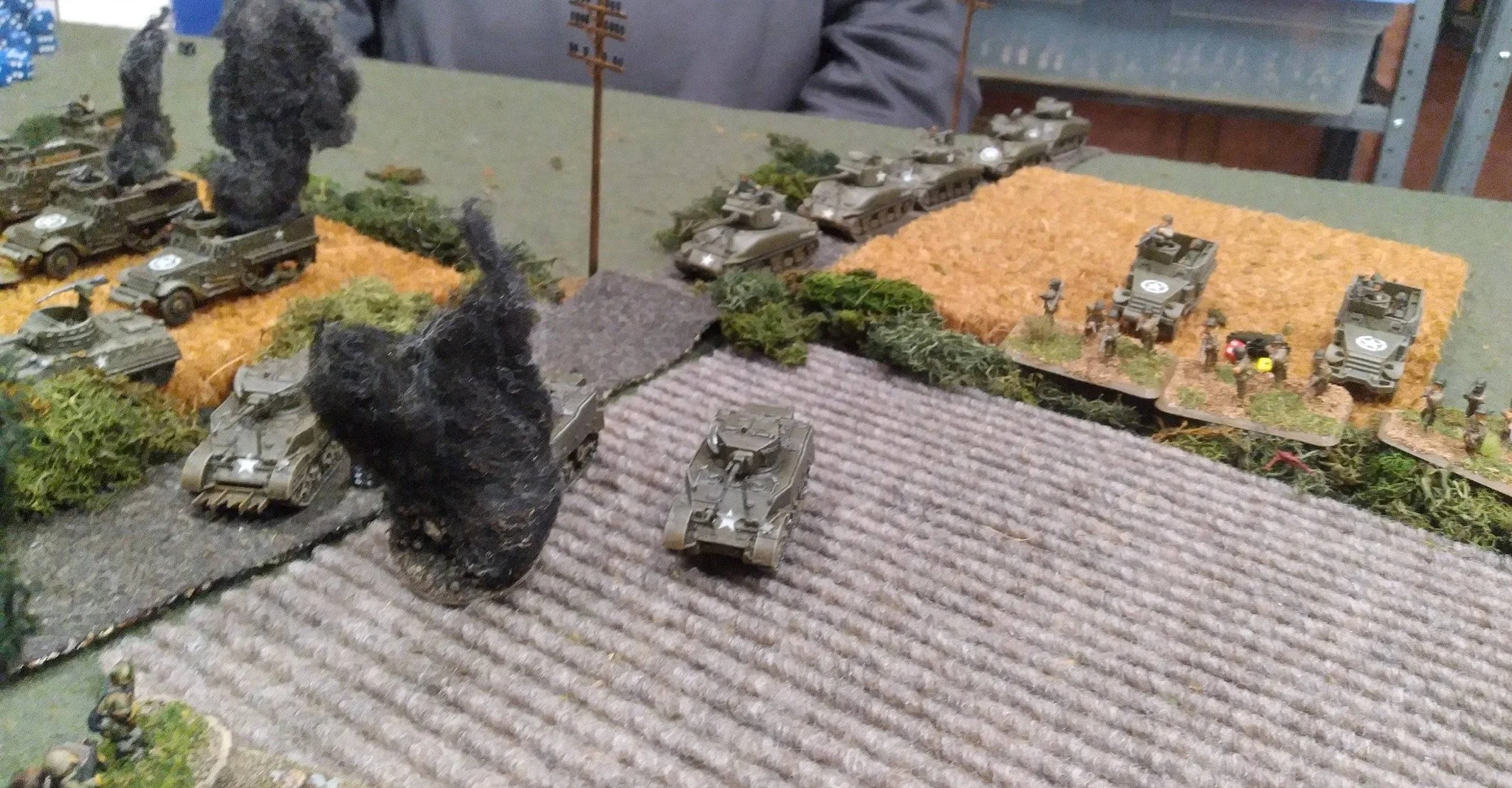
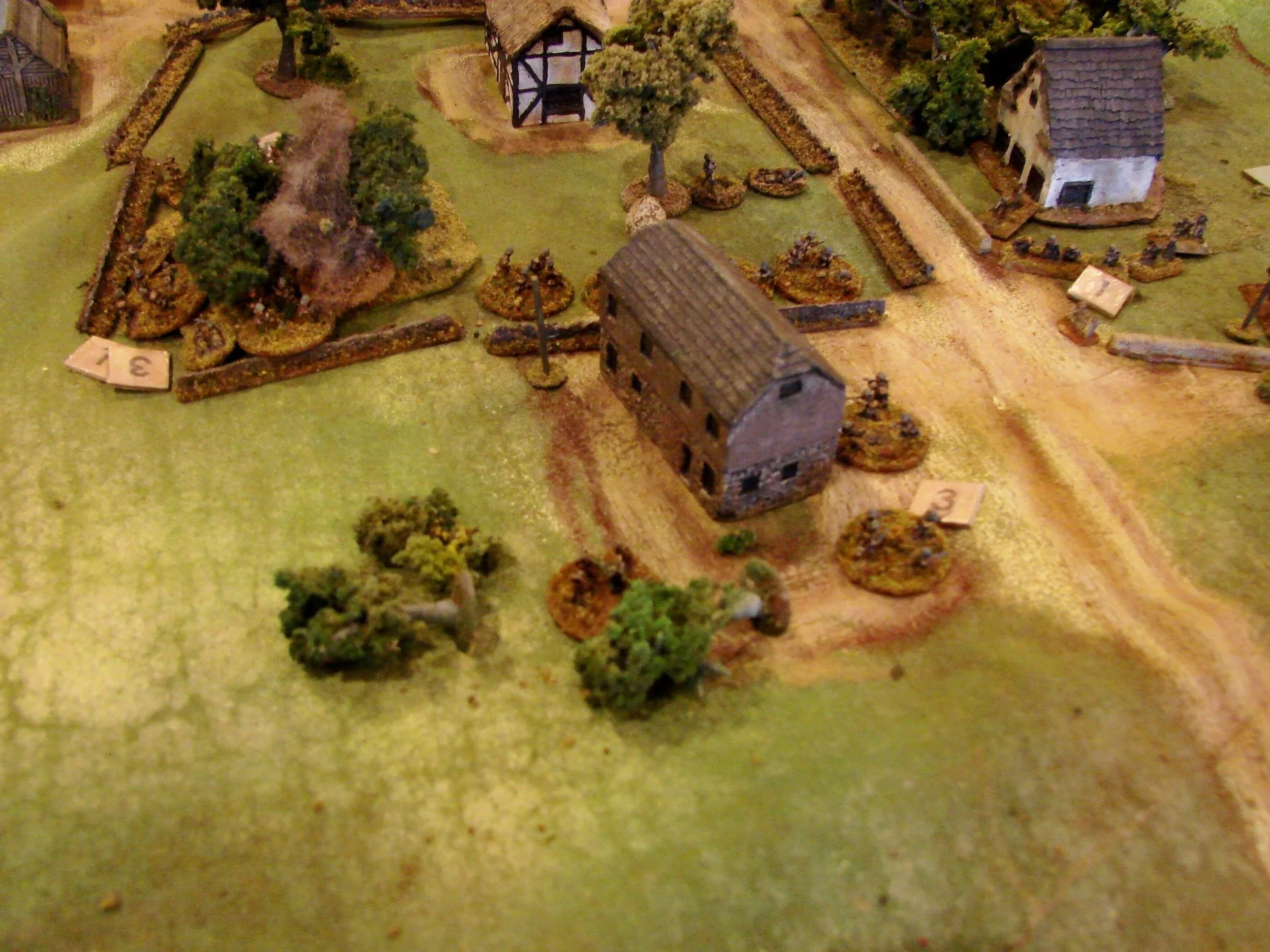
This worked very well: too well, in fact, as Belgian tank was hidden behind one of the townhouses and blew the lead Panzer I to bits. Belgian T-13 tank destroyers were also lurking on the other side of the town square.

A cautious approach wasn’t going to work, so the company commander ordered the 81mm mortars that had just arrived to lay down smoke in the town square, then sent three blinds across the bridge as fast as they could go.

Next followed a sequence of very short turns when the Tea Break card made a rapid appearance. This caused the German 3rd Platoon to get spotted then cut to pieces by infantry in the townhouses around the square: effectively ceasing to exist!

RIP 3rd Platoon!

Automatic spotting also ensured that the other two German blinds and more Belgian troops were revealed: the townhouses were packed with infantry and machine guns, and a massive traffic jam emerged on the bridge.

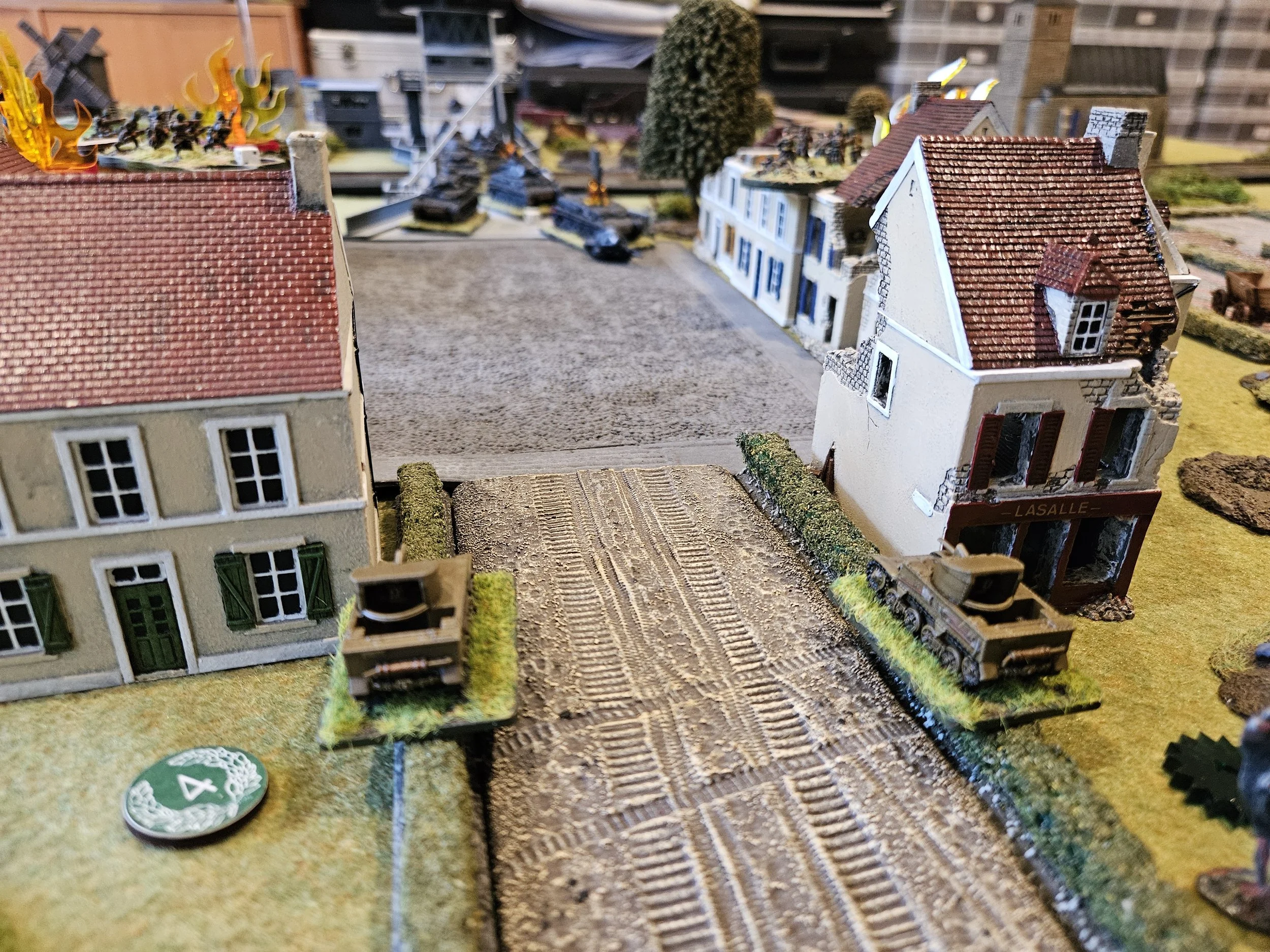
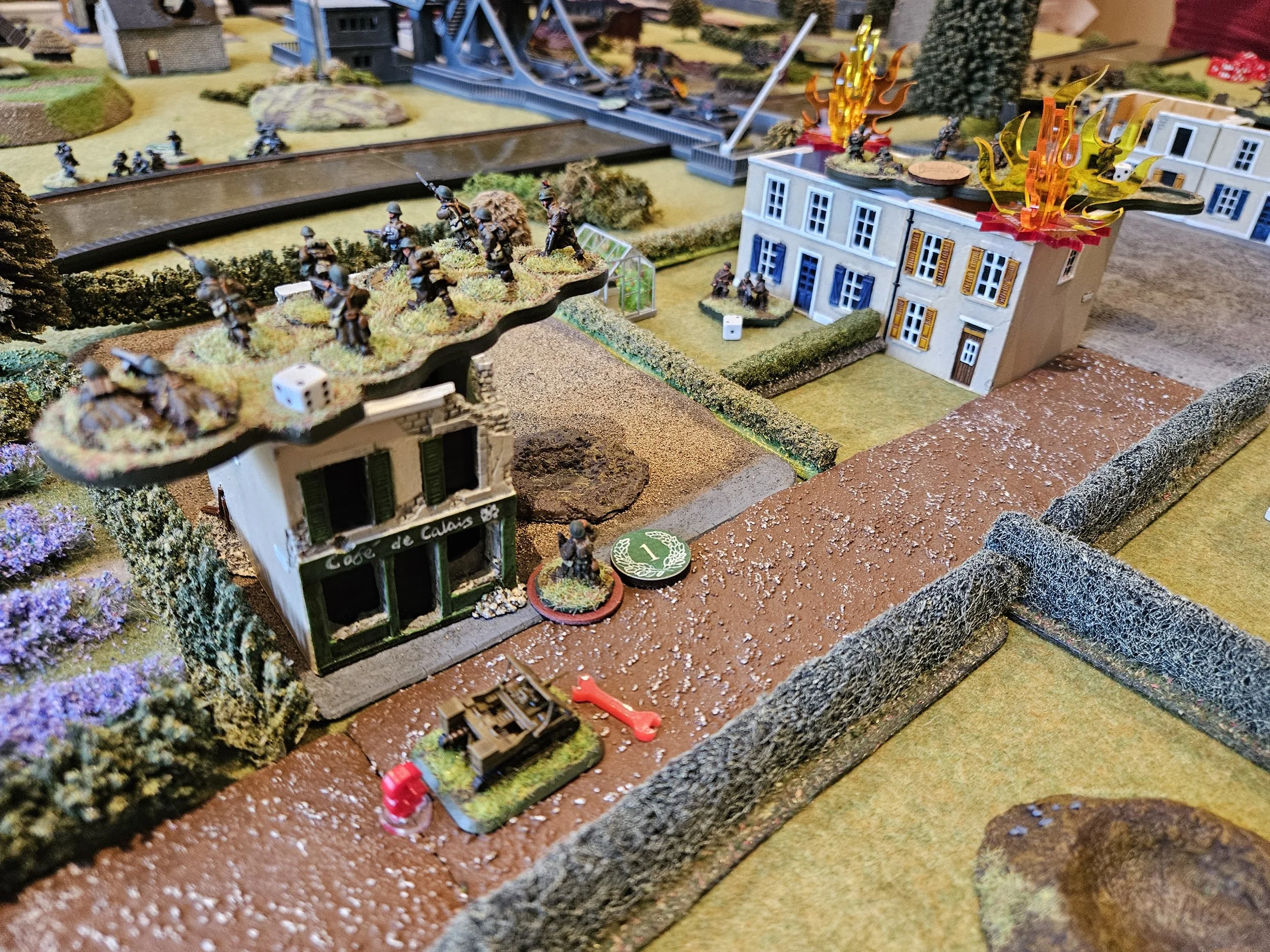
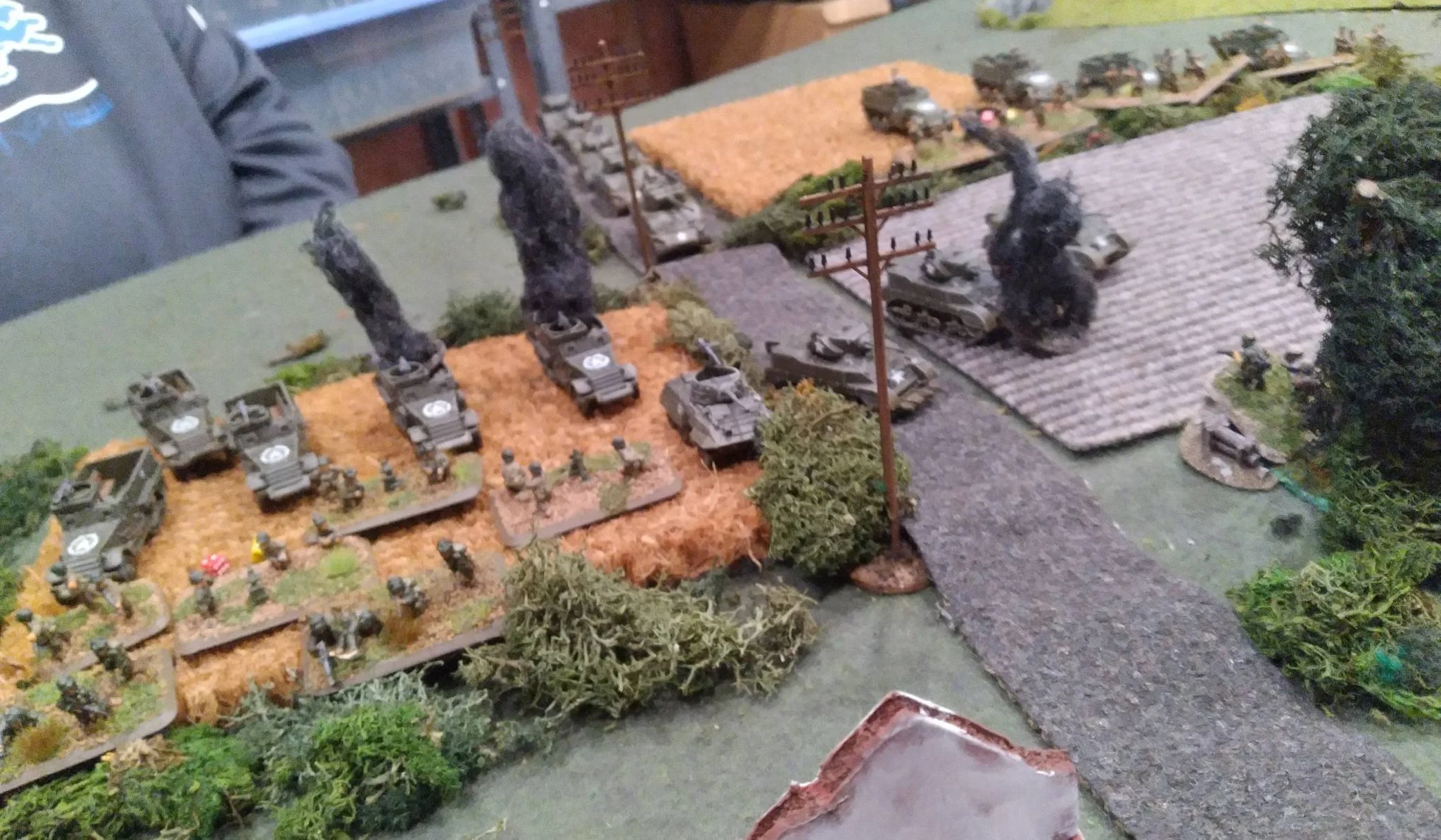
The German Panzer IVs opened fire on the townhouses around the square, and with an incredibly lucky series of dice rolls, set both sides ablaze (well, the summer of 1940 was very, very hot), forcing the Belgian infantry to abandon their positions or face being roasted alive!

Unfortunately for the Germans, the smoke had now cleared, and one Panzer IV was lost to fire from a T-13, although the other T-13 broke down as it changed position.

Meanwhile, both Belgian ACG-1 tanks to the left of the bridge had been neutralised: one blown up by fire from the Panzers, one whose crew abandoned after being hit by cannon fire from the German recon armoured car.

At this point the plucky Belgians decided that their pluck had run out and retreated off the table, ceding the canal crossing to the Germans.

A win for the Germans, but at quite a heavy cost: one platoon of infantry hors de combat, and three to four tanks destroyed. Also, although the engineers had managed to cross the canal, the Belgians had managed to get a T-15 light tank over to face them and they were going nowhere.

Here’s a few final shots from the Belgian side of the table:

A great game of I Ain’t Been Shot Mum!


I’ve been intrigued by I Ain’t Been Shot Mum (IABSM) for a while now. The rules from Too Fat Lardies have clearly got a large online following and are now in their third version, priced at £12 for a PDF, the rules were certainly worth a punt.

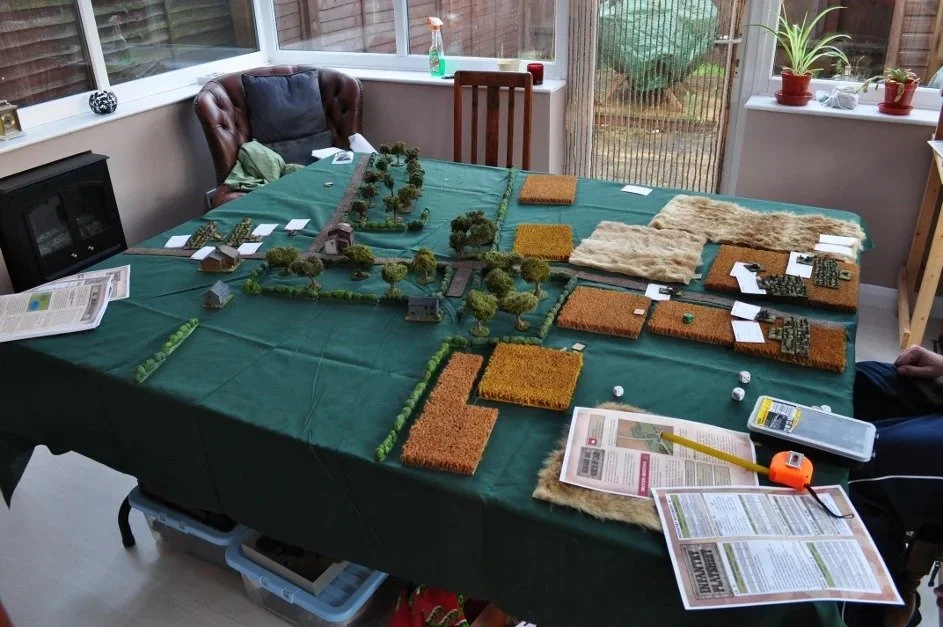
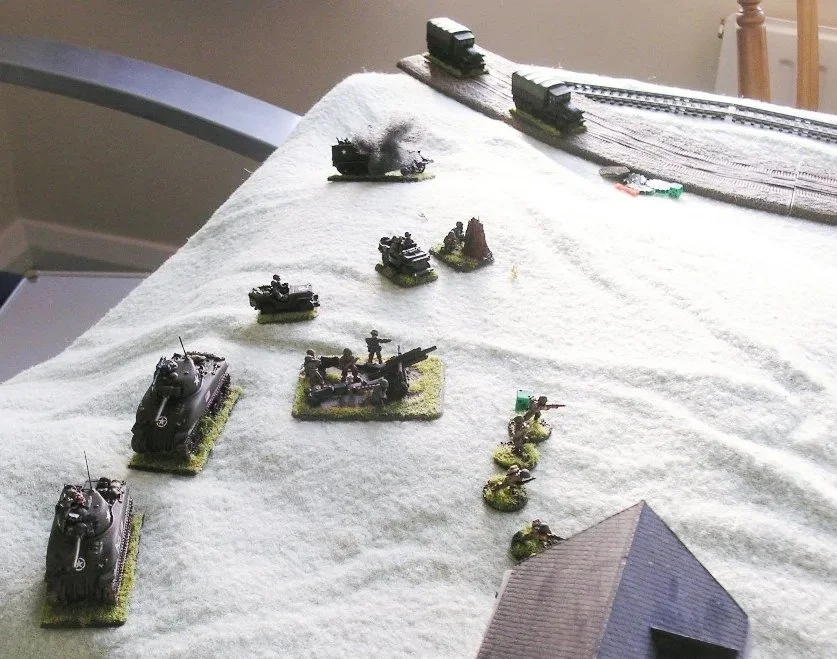
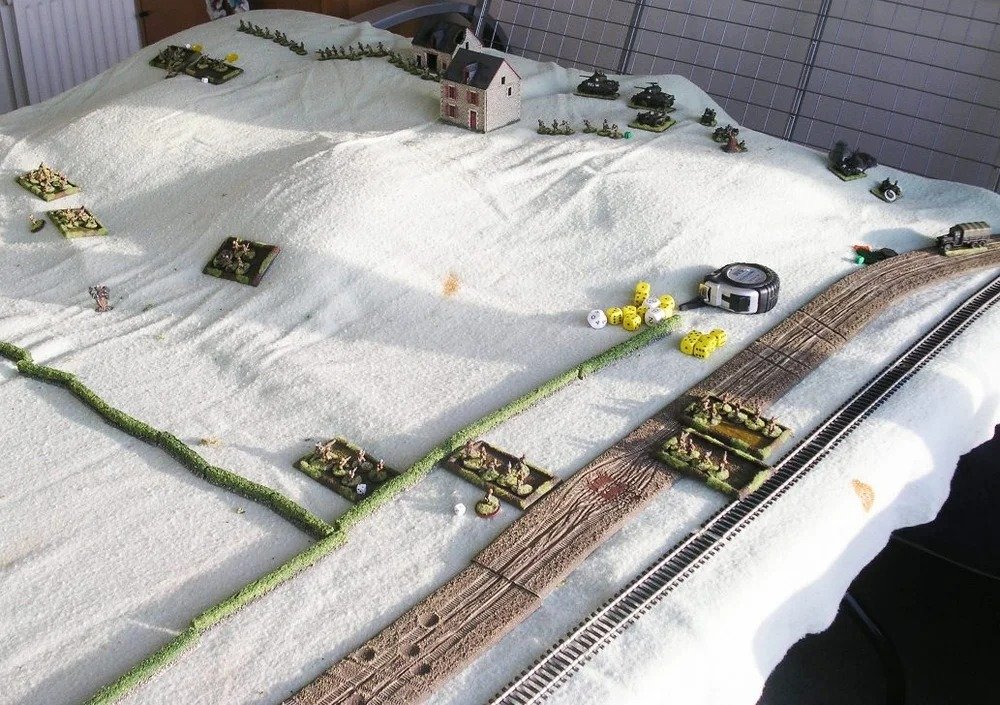
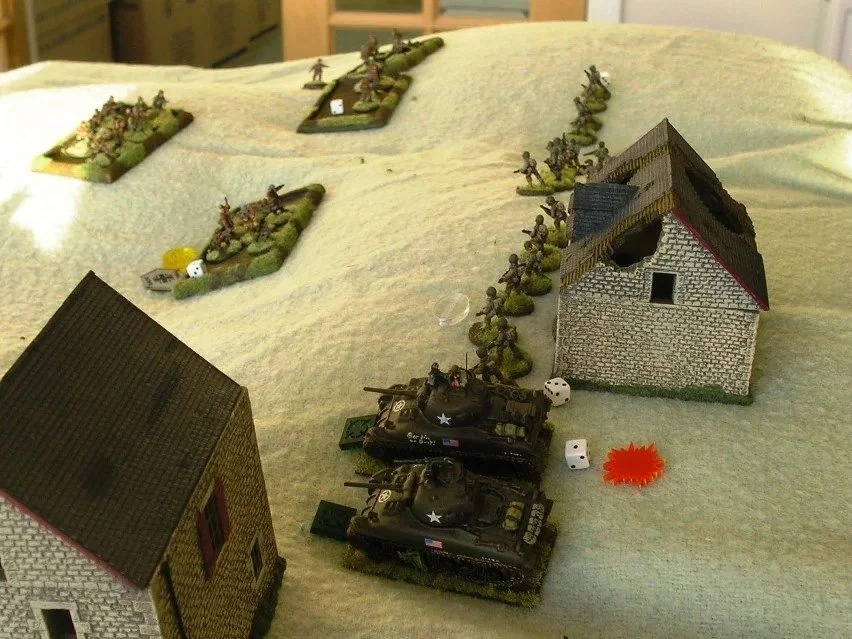
Last night Matt and I tried out one of the scenarios from the rulebook, “North of Caen”, which pits a company of British infantry against a couple of platoons of Germans dug in around a cluster of buildings. I won’t try to do a review of the rules or an explanation of the mechanics as there are already good ones out there. What I will say is that we were both very pleased with our experience and although we had a raft of questions resulting from our game, and although I spent a large amount of time with my head in the rulebook searching for x,y or z so we didn’t finish the scenario, I think we were both pretty impressed and are looking forward to the next game.

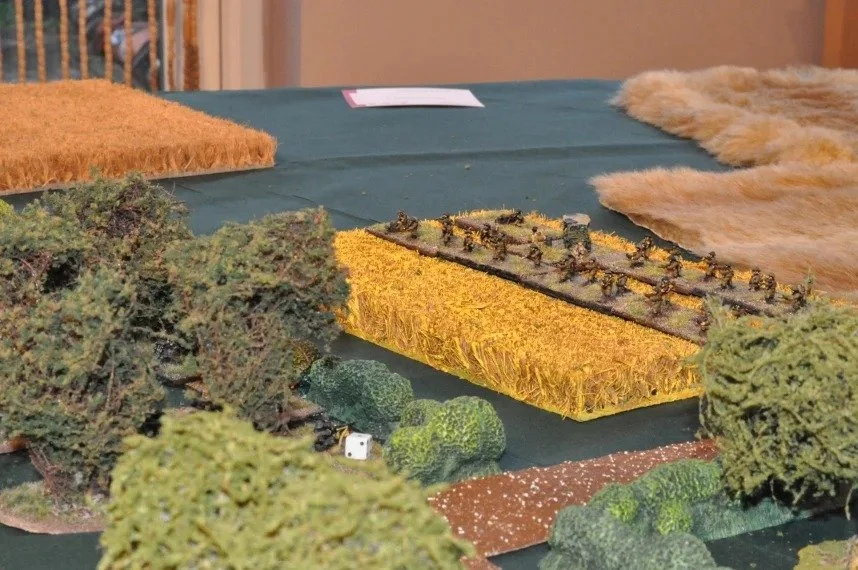
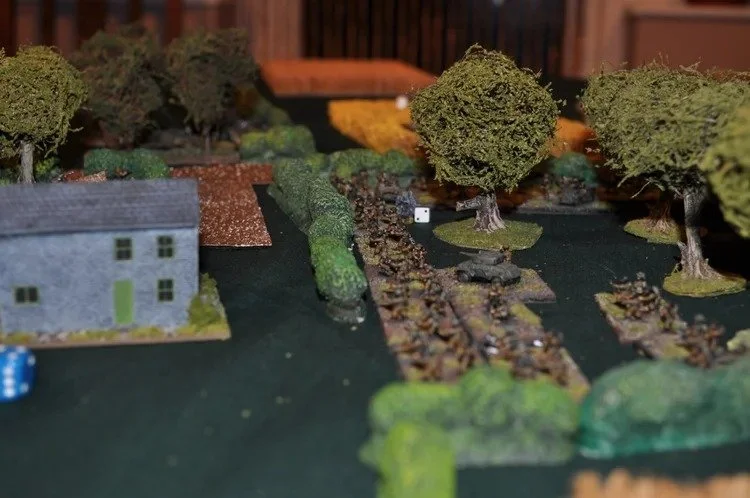
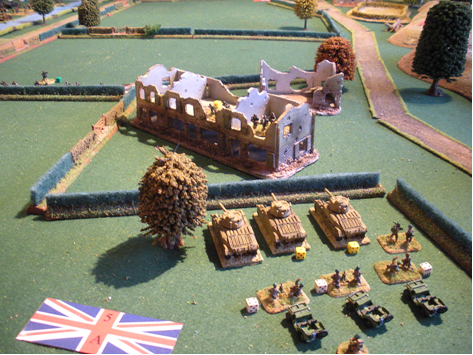
I took only a few pictures as the light was pants due to the whopping big lightning storm we had half an hour before which lingered around for the evening. Small dice recorded casualties and Irregular Miniatures 6mm explosions are used to count Shock points. All miniatures are 10mm Pendraken painted by me, terrain is a mix of resin buildings and hedges from Timecast, doormat and teddy bear fur fields and trees made by myself and bought from The Last Valley.

Porte Royale


Battle Report 2:  26th September 2012

Wednesday night at Gavin's saw a rematch of the previous IABSM scenario, but with the rôles reversed, and me playing the Germans against Pete and Matt, with Gavin umpiring.

Some of the resources at my disposal

I deployed a platoon of infantry along the northern edge of the wood, along with a Pak40 and a tank killer squad with a Panzerschrek and my FOO, and waited. The British opening artillery stonk shook up a few sections and took out a couple of the Pak40 crew - could have been worse.

The advancing British

Fairly early on I spotted a couple of platoons of British (despite a little confusion with how many dummy blinds the British were allowed) but couldn't get the Axis Blinds card to call in some mortar fire - and once I did, couldn't get the Axis Support card for it to arrive.

In the meantime, the British had spotted something in the woods, but weren't sure what, so one of the British Big Men bravely snuck up for a better look and found the Pak40.

"My word, chaps. A Jerry anti-tank gun!"

A couple of infantry sections opened up on it, and despite it being dug in, it took a fair amount of damage. And finally the Axis Support card came up.... and I blew the roll.

The Germans in the woods open fire

One of the British sections came up to the nearer hedge, so I deployed a couple of sections off blinds and opened up. Most gratifying, as the section in question took four casualties and about ten shock, and didn't stick around.

About then, one blind of British tanks deployed and commenced unloading on the Pak40, to surprisingly little effect. And finally! An Axis Support card and a successful roll.

"Incoming!!!" 

Not a bad result: one British section pinned and rather shocked, and one blind, which I suspected was tanks, reduced to zero actions for the turn.

The following turn, they made the smart choice and deployed off blinds. On my Blinds card, I deployed the PanzerKnacker squad and the PanzerSchrek...

"Here, Hans. You did know this is the last round for the PanzerSchrek, yes?"

Just in range of the lead Sherman, too. Which was nice.

The next turn saw the card for the PanzerSchrek come up before the Shermans. Which was, as they say, also nice. Three actions, so fire, reload, fire.

"Ja. It was my lucky round." 

First roll - double 1. Which means (a) I miss, and (b) the next shot is the last because the PanzerSchrek is out of ammo.

Oh well. Better make the most of it. Double six. I get to roll 16 dice (13 for the PanzerSchrek and 3 more for ambush) against the Sherman's 6, and beat it by four hits. Result, a very satisfying KABOOM!

The Pak40 gets in trouble. Under the trees further to the left, things weren't going so well - an infantry section close-assaulted the hapless Pak40 (which had managed one shot on a Sherman and quite convincingly missed), and that, predictably, was that for the crew.

That was followed by the two infantry sections under the trees getting picked on, one being down to zero actions (and only two men).

And sadly, about there, we ran out of time. Hopefully Gavin and the guys can finish this off sometime, in which case, watch his blog for the second half!

Mike Whitaker


Battle Report 1:  24th September 2012

Last night saw me umpire a game of IABSM at the club between Reuben (as the Germans) and Carl (British) - we used the opening scenario from the rulebook.

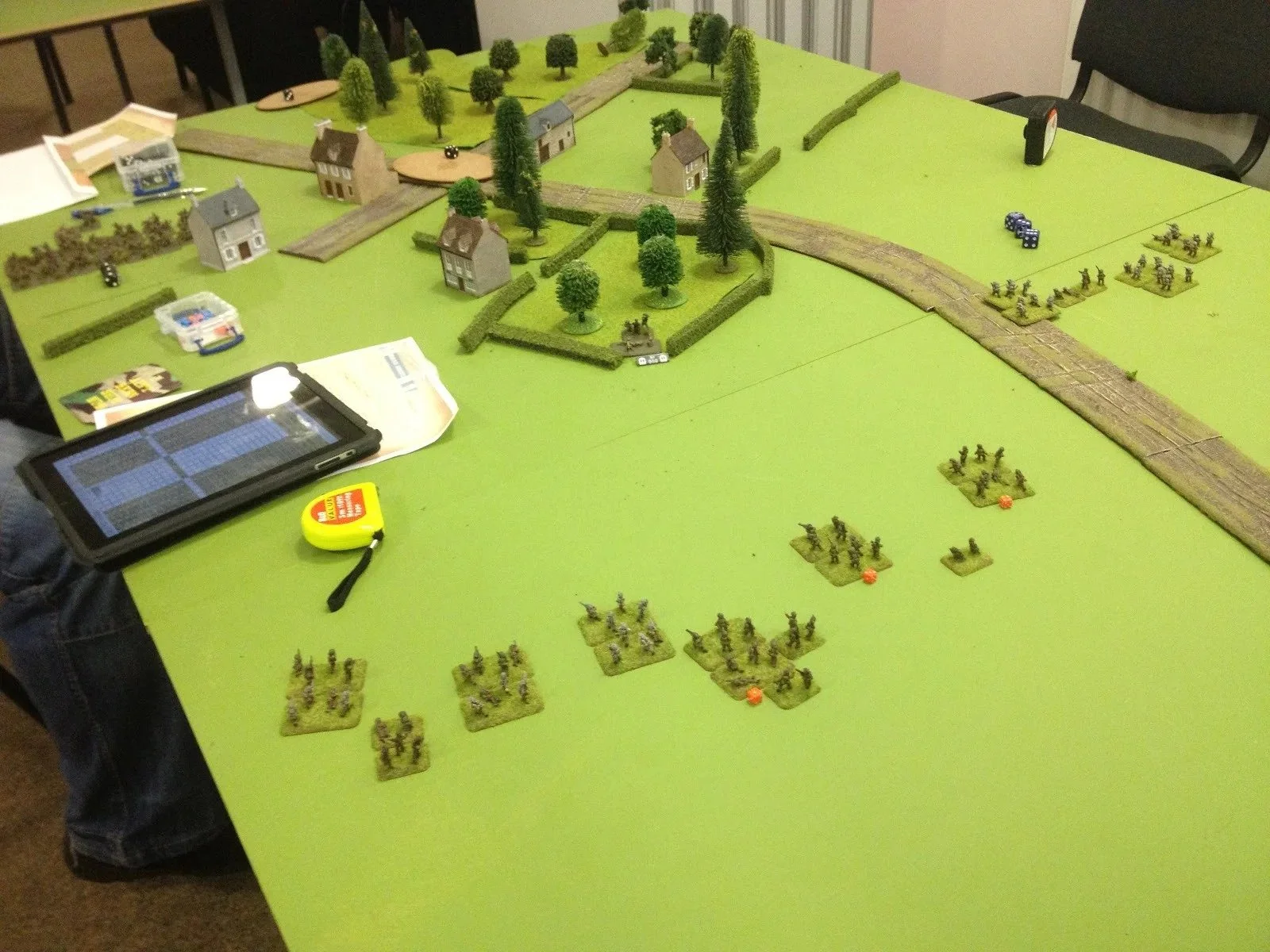
You will note the rules (on my iPad), Rueben's nice 15mm Germans and British (and please ignore the MG42 team's paint job, he says), and some custom made Warbases blinds markers, which I am very pleased with.

As an introduction to IABSM it went pretty well - I completely spaced on a couple of rules, but nothing that I didn't realise and fix (hint, the fire table returns hits not shock!) :D

Carl advanced until he found - the hard way - Reuben's two MMGs, which he'd separated and left one Big Man with each. It took him quite a bit of work to winkle them out of their well dug in positions, but he did, in the end. I suspect that Reuben could have done a little better if he'd supported them with one or both Zugs of infantry rather than left them on their own.
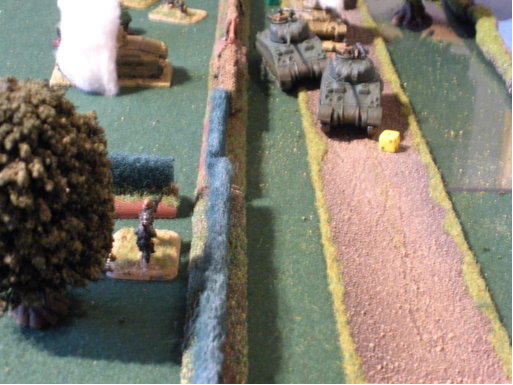

We ran out of time, but it would have been interesting to see if Carl had managed to winkle the two German Zugs out of the buildings.

Above are the very nice Warbases blinds markers - for those curious, the 10 markers (five of each design) plus postage came to £9, and I am as happy as a very happy thing. Debating whether to base a couple of scout-type figures or vehicles on each of the appropriate nationality and base them, or let them be. If you want some the same, I'm sure you can drop Martin from Warbases a line via http://www.warbases.co.uk/ and ask for 'the IABSM blinds like wot Mike 'ad' :D

Mike Whitaker


Background

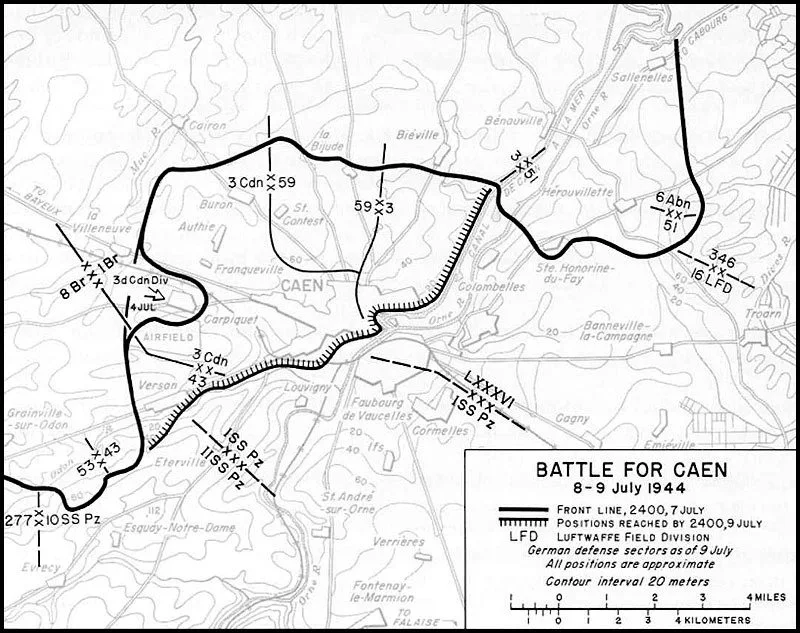
The city of Caen presented a big target during the Allied invasion of Normandy in June 1944. One of the larger cities in the region of the invasion, it also occupied an important series of crossroads straddling the Orne River. Less than ten miles from the British Commonwealth forces landing zone of Sword Beach, Caen was a target for British and Canadians wading ashore on June 6th. Despite a relatively easy landing at the beach, Allies with their eye on Caen were met with a hastily-organized armored counterattack from the German 21st Panzer Division. By the end of the day, the British sat just halfway to their objective and Caen remained in Axis control.

Over the next two months, the area around Caen became a bogged-down front as Anglo-Canadian forces positioned themselves around the city. The eventual capture of the city on August 6th was costly for all involved. The ancient city was nearly leveled with Allied bombing campaigns and much of the French civilian population fled. The British forces suffered around 50,000 casualties, a devastating loss of men and equipment for British commander Bernard Montgomery. With the costly British victory, it had achieved not only the occupation of Caen but had also provided an enormous distraction for German forces which suffered even greater losses than the Allies.

The Game

This past weekend at Metropolitan Wargamers in Brooklyn, NY, a couple of us ran through a non-historical scenario typical of the British-Germany engagements just north of Caen in early July 1944. The “North of Caen” scenario is provided in the basic rule book for I Ain’t Been Shot Mum, the fantastic company-level World War II game that has fast become a favorite for some of us at the club.

British infantry advance under Blinds through an orchard north of Caen

The small infantry engagement is set in the fictional hamlet of Le Moulin on a table of flat, open terrain with fields, orchards, low hedge rows and five stone buildings set at a crossroads. The game begins with three British infantry platoons entering from the north under blinds after an initial off-board artillery bombardment of the Germans dug under in around the farm and crossroads. The objective of the game is for the Germans to eliminate the British advance while the British are tasked with seizing four of the five buildings or otherwise eliminating the German troops.

British rifle platoon takes heavy German MG42 fire and is pinned behind a barn

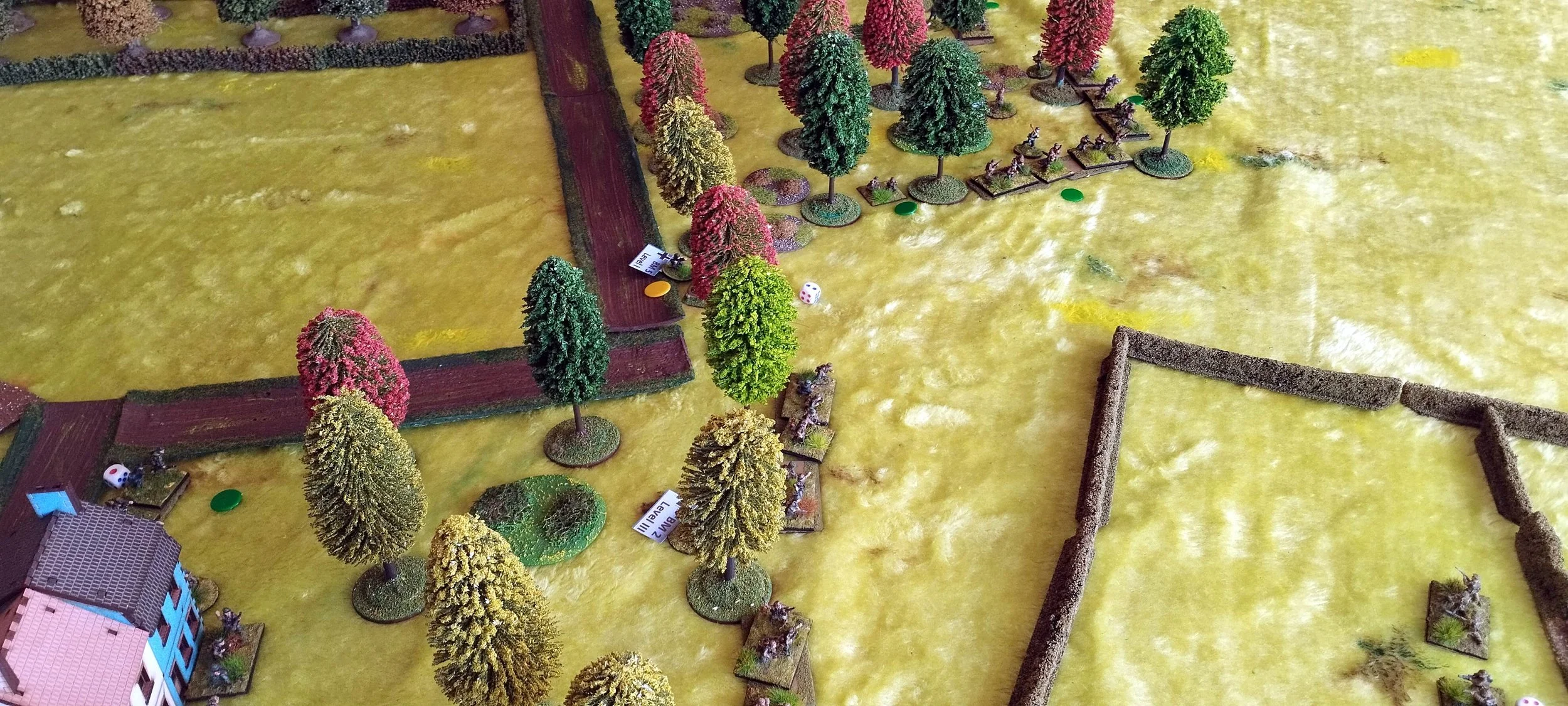
Following my initial bombardment, my British advanced under blinds for a few turns through the orchard northeast of the crossroads. The German blinds positioned themselves in a wood at the crossroads and in a small orchard southwest of the hamlet. Three of my blinds moved toward cover to my left behind a barn while my third false blind moved toward the road. My first blind was spotted behind the barn by a German platoon armed with three rifle sections and a deadly MG42. With the Germans deploying in a nearby barn and within the orchard, they opened up on the British rifles. With not enough cover behind the small barn, one British rifle section was all but eliminated in the first round of fire.

British platoon runs bravely under a Blind across an open field between two barns

The British survivors behind the barn returned fire, firing their rifles and 2″ mortar into the Germans in the orchards and nearby barn. In the meantime, my false blind was revealed as a second British platoon slipped to the hedge to the other side of the barn. Firing at the Germans from each side of the barn, the MG42 was forced to retreat back south of the crossroads. But the damage had been done to my first platoon at the barn, and two fire teams fell back to the orchard leaving one safely inside the barn. Sensing a brief opening, my final blind sprinted across the wide open field between the barn.

The British blind is exposed, take fire and break for hedge in the distance

Midway through the field, the German rifles in the second barn spotted and revealed my blind, slowing their run and forcing them to deploy in the open. The final German blind revealed itself among the buildings west of the crossroads. My fresh British platoon hopped the hedges and likewise crossed to the west of the road, opening fire at the Germans in the building just the other side of a small orchard. Subsequent turns of fire were exchanged and my British losses started to pile up on my right.

Back at the field on the British left, combined rifle and mortar fire poured into the Germans in the barn. Despite shock stocking up on the Germans, their position in the barn allowed great enough cover allowing them to slowly begin wearing down the exposed British platoon which became pinned from movement. With British taking losses to the right and less against well-protected Germans in the heavy stone buildings, it was not working out as a good day for the British who ceded the tiny hamlet to the Germans. More costly days were to come after this day just north of Caen, but a month off there would be victory for the British.

Brooklyn Wargaming


Got some old friends out of the box last night

My FJ company defending a town against American Armored Combat Team.

I chopped up his rifle platoons, but his tanks got around my flanks and pushed in my forward line with heavy casualties.

15mm mix of Battlefront, PSC, Peter Pig, and assorted other figures.

James Manto


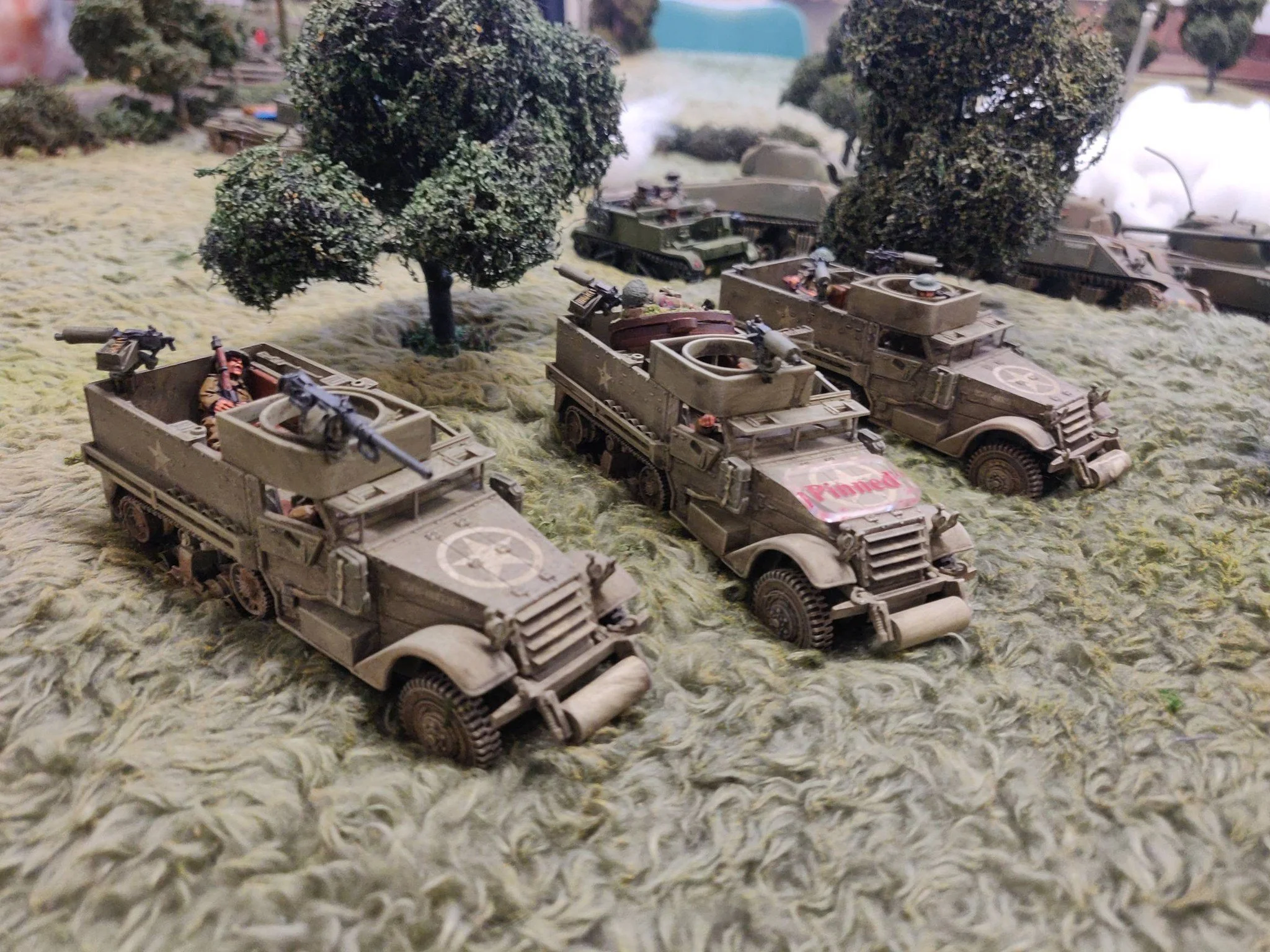
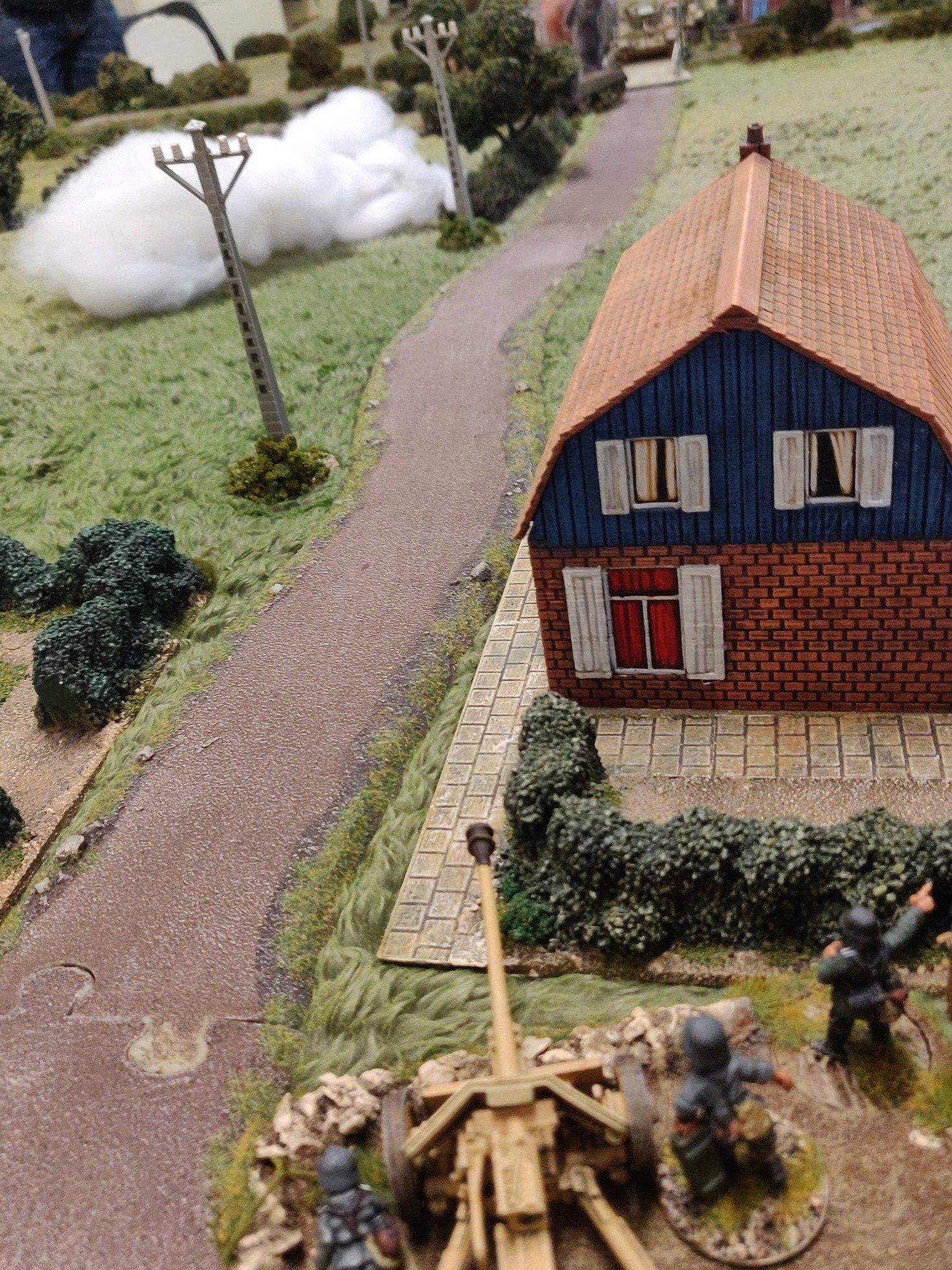
Photos from today's game of I Ain't Been Shot Mum. 18 x 6 ft table using 28mm figures by 1st Corps and an assortment of 1/48 and 1/50 scale vehicle's.

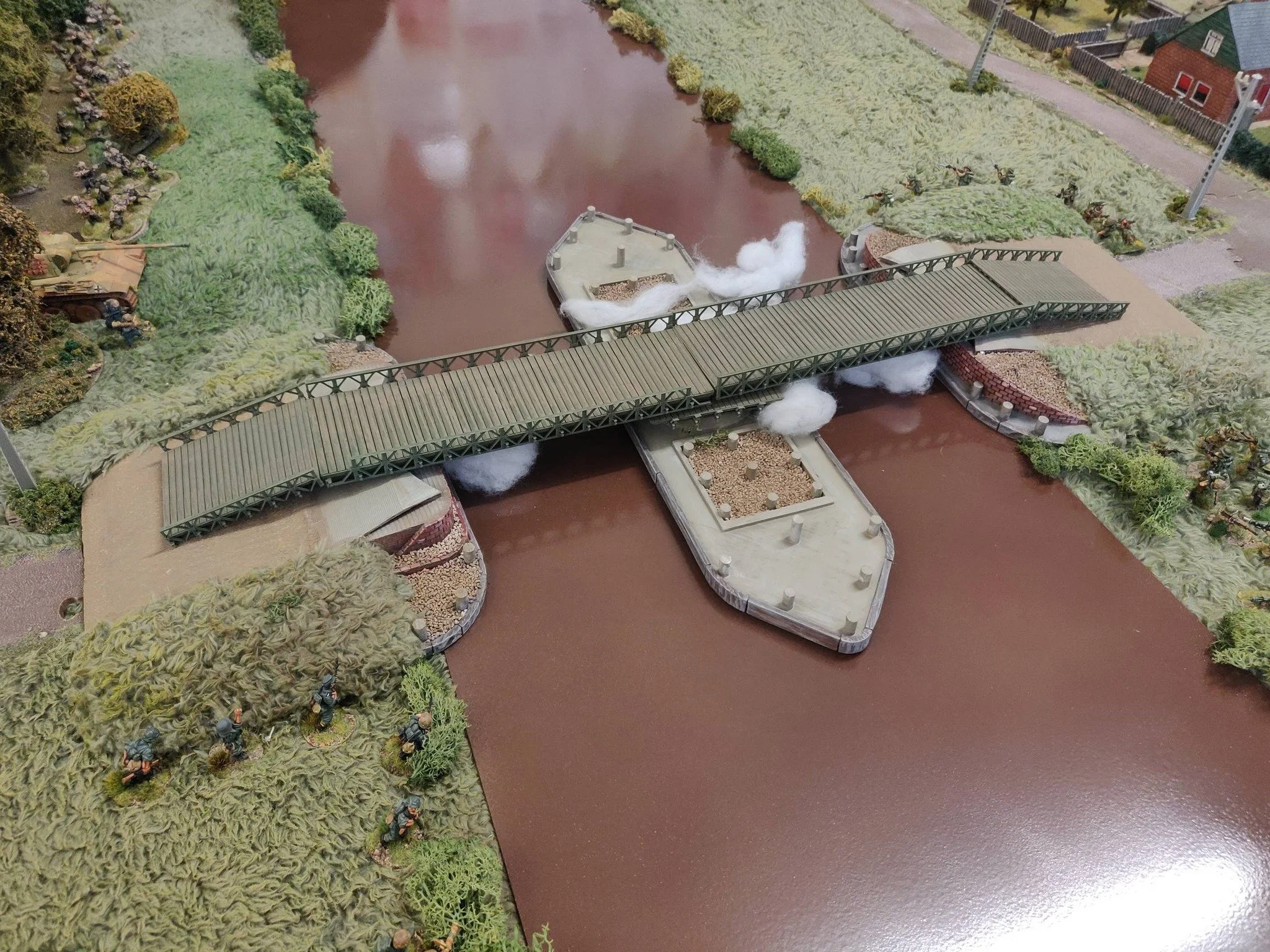
Ended as a British win by crossing the Bailey bridge.

Michael Curtis

And here are some pics of the table set up and ready to play:


“The Monmouths at Mouen” … when the Monmouthshire Regt were accidentally in the line of advance of the Leibstandarte in Normandy, June 1944.

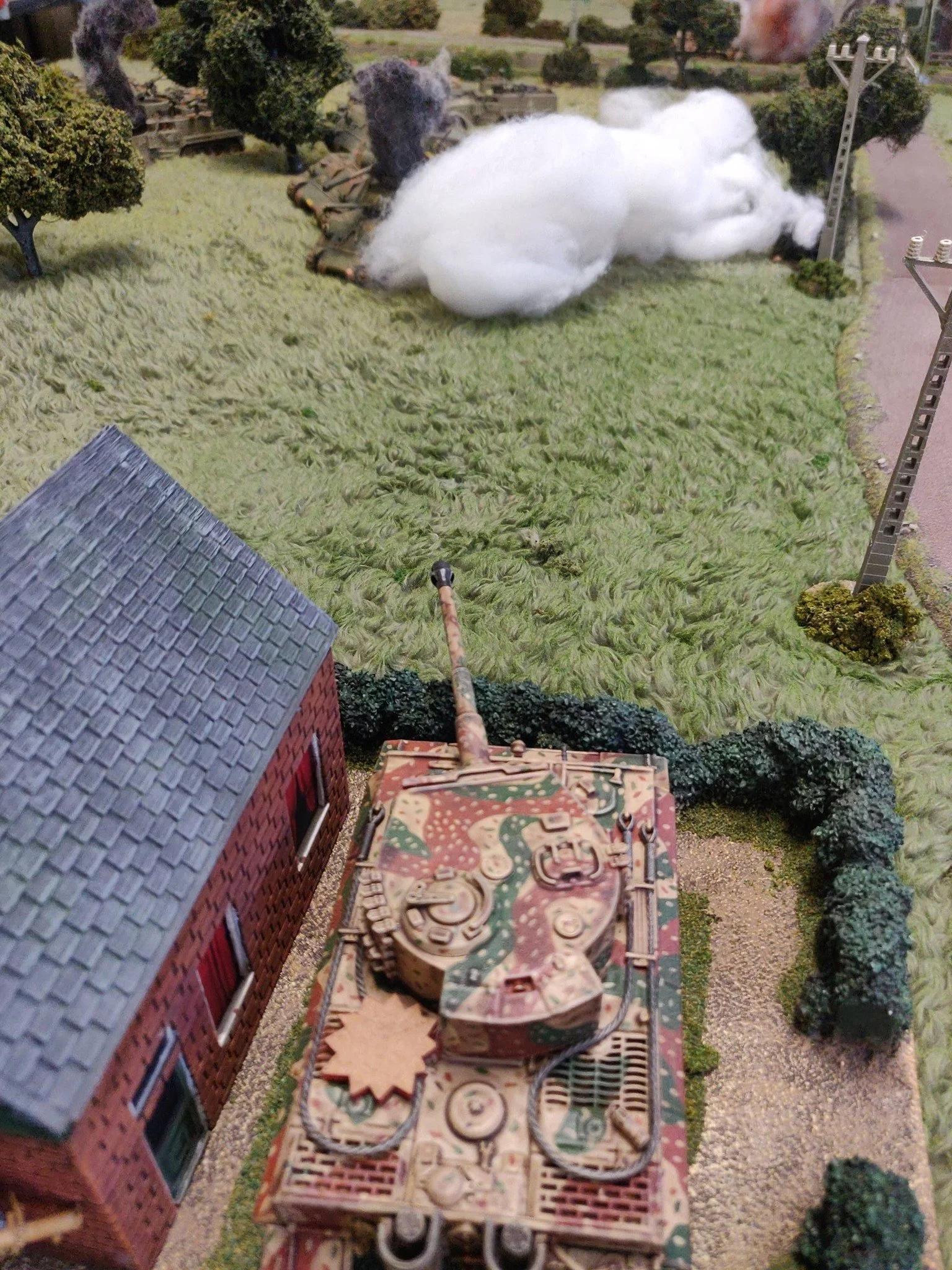
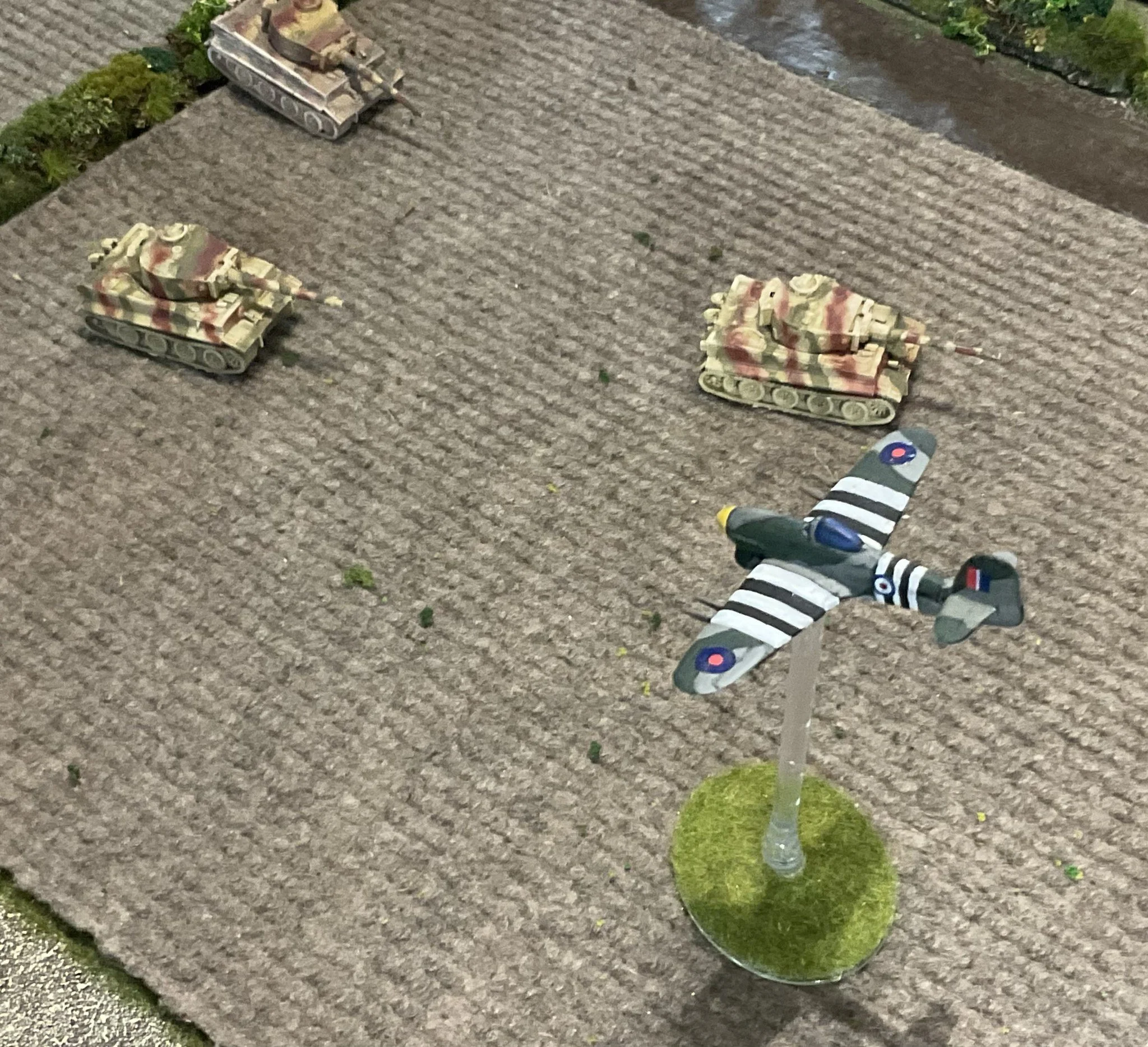
Thanks very much to Lloyd Lewis for helping with the last play test game for “Come and have a go …” at Southampton next weekend. Those Tigers were hard work to stop !!

Phil Turner


Another go at this campaign: after one solo and one face-to-face, I thought I would give it another go solo. So this is my third play of this scenario.

This is the map at the start which was all Major Bob Boston could go on from an RAF photo taken the day before.

The objective was simple: get to the bridge at the far end. Simple enough as he had plenty of M8 Greyhounds and even some Stuart Light Tanks and two M8 Howitzers. In fact they were too many of a lot of units for what I have in stock, so Matildas, Shermans and others were dragooned in as proxies!

Boston ’s plan was to advance his few infantry over the hills to the right and hopefully clear these before pushing towards the bridge. The HQ and 2nd Recon Platoon would follow the road in the shadow of these hills once they had cleared the building near the jump-off point. The Cavalry Sections would advance to this building and the 1stRecon Platoon would advance south down the river road, to be followed by the Stuarts.

Hauptmann Heigel Heffwehen was tasked with holding the bridge and on no account to allow the American to get over it. His plan after much thought was to hold the bridge and nearby buildings with his 2nd Zug and have the 1st Zug in the building and hedges to the north. The HQ was placed in the centre behind the second line of bocage, with Panzerschrecks on both corners by the road, and the MMG on the hill for overhead firing. The AT section was placed in the area north of the bridge covering the western road, whilst the Armoured Cars were placed by the river bend to guard the eastern road.

The centre was the first to get some action as the Greyhounds (proxied by Matildas) of 1st Recon opened fire and, combined with the mortars, caused numerous shock from which this German section never really recovered. Those American mortars are very useful and can do some real damage, and both squads certainly earned their coin.

In the east, 1st Recon happily set off down the road and, despite being a recon unit, managed to miss spotting any enemy, and only saw the 2nd Section of Germans when almost upon them.

Meanwhile, the position for the German 1st Zug was getting critical, suffering from the fire of the Greyhound and mortars, and it was soon decided that the position was untenable and that the building should be left as soon as possible.

Luckily here for the Germans, their Armoured Cars moved to the south of the road and began a brilliant defence that would last all day. The firepower and armour of the combatants here don’t allow for a quick finish, although several brilliant shots certainly did some real damage. This is the long view up the river and at the moment the view is clear!

As mentioned the 2nd Recon were upon the Germans before they realised it. One fell to the Pumas, with the other hit by a Panzerfaust whilst trying to get into a field: all in two shots. This was the best shooting all day.

Unfortunately for this unit, Oberleutnant Ars Apfelwein was then hit immediately by a stray shot...and that was the end of him.

The RAF then joined in and finished that section off!

This is the position at the middle of the day looking from the German position as on the right the Pumas and infantry stop the 2nd Recon and one can see both the Mortars and M8 Howitzer deployed in a long drawn out battle which ended with no mortars and some very ineffectual Howitzers.

To the west one can see the American infantry advancing over the hills. The MMG here was easily destroyed without managing to get a shot off: a great triumph for the Intelligence section. You can also see the HQ and 1st Recon on the road now. Although not seen here, the AT section of the Germans was fighting both these units in the climatic fight of the whole battle as the winner here would either have an almost clear run to the bridge or have held the position.

Now to see the trial and triumphs of being a Tank Killer unit. The following picture was taken just after the eastern positioned Panzershreck had totally surprised first the Stuart Tank then itself as it managed to only get equal hits on it, and was then immediately destroyed by the tank’s MG.

This photo on the other wing was taken at the same time but this was just before the western positioned Tank Killers managed to throw double 6 and hit the flank of the tanks with strike 16 attack. It was messy, but of course it was also its last shot with a double. Brilliant and one of those moments!

As all this excitement was going on, the American infantry had pushed everything before it and looked to be about the clear the field on its own. First they Shocked the infantry in the same field as the German AT section, and then one US section charged it. It looked easy, but the Germans had other ideas: for three dead they managed to get leave seven Americans on the field. A great show, and one that would have got Leutnant Erik Wierlikor an Iron Cross if only a loose mortar shell hadn’t got him almost immediately afterwards. The second Zug commander killed in his moment of glory!

With stalemate in the east and in the centre it was the US 1st Recon and HQ that finally knocked out the Anti Tank Section and opened the way to victory. The mortars and air force hit the enemy units in the building guarding the bridge and this allowed the 1st Recon to send their last mobile Greyhound onto the bridge and so win the game.

Here is the triumphant Greyhound in place.

A truly excellent game was had by me, and the result was only decided in the last few minutes and in a way that seems almost Pyrrhic for the Americans. The Germans had caused great losses on their enemy, although the German infantry also suffered horrific casualties.

I am not sure it is a good idea to split the German forces to hold the northern buildings, but thought it would be a good delaying tactic and it nearly worked. The American infantry normally likes the centre, but in this case did its task brilliantly.

The two stars of the show are US Captain Martin Minnesota for both his destruction of two positions and then also having one of his Greyhounds sitting on the bridge; and,for the Germans, it had to be Leutnant Siggi Spaten for, again, two excellent reasons: the first for the brilliant defence of the east road, and second due to the fact he was the only German officer left alive at the end!

Now let’s see how the British do at Avaux!

Craig Ambler


Gave IABSM 3 a solo try out today using the included 'Action At Galmanche' scenario (which I last played during 2020 lock down) as possible contender for club game but feel system not really multi-player friendly with unit card activation system.

But its certainly works well as a low level 'not quite skirmish' game (although sadly somewhat overshadowed now by Chain of Command in Lardy world).

Plenty of Big Men in this one (8 on British side and 6 Germans) so lots of options (once their cards and associated Platoon cards get into deck) although the Allied Blinds card seemed to take ages to appear.

Had forgotten that quite a lot of markers needed in game but system overall fits its level well (of course solo not optimal for blinds/hidden stuff).

German Pak 40 opened up on a Sherman early on (Blinds in open easily revealed) but failed to achieve any damage or shock despite using aimed shots and was then pummeled by return HE fire by Sherman and mates whose card appeared immediately with result that 3 crew died and 3 shock inflicted.

British infantry however up against it with Germans dug in along wood edge and Brits in open or light cover (hedges).

Did not complete game (other things planned for table) but must revisit this set again for 2 player as it has a lot to offer and we did play quite a few games with set several years ago (time really does fly !)

Sergeant Steiner


However, I do find the time to play through the I Ain’t Been Shot, Mum! campaign book Operation Compass by Too Fat Lardies.

We (Petrus Regulus and I) have managed two scenarios so far. It has been a rather one sided affair as the only opposition to the British has been Libyans with hardly any weapons at all.

Dr. The Viking


However, I do find the time to play through the I Ain’t Been Shot, Mum! campaign book Operation Compass by Too Fat Lardies.

We (Petrus Regulus and I) have managed two scenarios so far. It has been a rather one sided affair as the only opposition to the British has been Libyans with hardly any weapons at all.

Dr. The Viking


In a blast from the past I managed to arrange a game with my old gaming buddy Steen. We have played all kinds of games over the years, but especially I Ain’t Been Shot, Mum! by Too Fat Lardies, has been a recurring favourite. A bit of moving countries, and some pandemic stuff has kept us from connecting recently, but now we finally had the chance.

We decided to catch up where we left – in the middle of the campaign supplement Operation Compass. This campaign is set in the Western Desert and most of the fighting is between Libyans/Italians and British/colonials. So far in the campaign it has been a disaster for the Italians, and it is very difficult to see a way forward.

The Battle

Without giving out the whole TFL supplement, I will say that this game was sort of a meeting engagement where two forces encounter each other on the way to various other destinations. The brief was simply – both sides had to stop the other from exiting the opposing narrow table edge. Many of the scenarios we have played so far, have been hopeless if not impossible for the Italians, and have left us with a sense that maybe it doesn’t make for the best gaming material. This scenario, however, I could actually see giving some sort of game.

IABSM has a “fog of war phase” where you move around blinds to position your troops. This works really well… at least until the deck gets too many cards, then it starts to bog down a bit. My plan was to head up the road with my main force and cut off the Italians with my bren carriers.

This proved to be a super effective tactic. The bren carriers annihilated the Italians as they were coming down the road, and stood overwatch whenever there wasn’t a clear target.

Having taken care of the Italians trying to exit the board, I turned my attention towards the Italians trying to stop me from exiting the board… Actually they were Libyan colonial troops.

I dismounted a platoon of Indians colonial troops and ordered them to hog the ground. Then a slow firefight started. The Italians had green troops, which meant that they could either move or shoot.. not both, when they got their turn. They also didn’t have many leaders, and therefore couldn’t get to order their troops on the ground efficiently.

The only real danger I faced was the small tankettes with twin barreled LMGs. The anti tank rifles I had, couldn’t really make a dent in them. My only AT rifle team was gunned down in fact. Hence, on a “Heroic Leader” card my big man “Havilder Tin” picked up the Boys AT rifle and charged forward trying to put holes in the Italian tank. He was unfortunately very unlucky, and the LMGs dispatched him quickly afterwards.

The Libyan infantry’s unit card never came up before they were under fire, and thus too poorly to start moving about before removing shock. The casualties also racking up, meant that they lost their dice also, and were down to just 1 die of movement pretty quickly. The green rule, meant that as soon as they lost a couple of men they could no longer shoot, as they lose one die to fire.

I managed to get my MMG platoon into a very good spot on a ridge next to the road. The game was effectively over at this point as the combined fire from the Indian infantry and the MMGs was going to rip apart the Libyans.

We decided to end it here. I’ve included an overview shot here to show how the Italians were cut off:

The truth is that the bren carrier platoon could probably have finished off the whole Libyan/Italian force single handedly. I know that this probably leaning towards “playing the rules” but I really think that for a game to be interesting it needs to offer a bit more than what the Italian player is dealt here.

One solution might be to bump the Italians up a notch quality wise, just to give them a bit more to do. Having just 2 dice is not a lot, and coupled with “green” where you have to forfeit a die to shoot makes it really really difficult. Also 1 die of shooting rarely leads to even a point of shock.

All this being said and rationalised in hindsight, I will say that playing a game of IABSM was still super good very enjoyable and meeting up with Steen again was also super good.

Dr. The Viking


We continued our play through Operation Husky and the invasion of Sicily in July 1943 this past weekend at Metropolitan Wargamers in Brooklyn, NY. We’re working our way through the events of July 11th in the Sicilian Weekend book by the Too Fat Lardies for their I Ain’t Been Shot, Mum rules for 15mm World War II play.

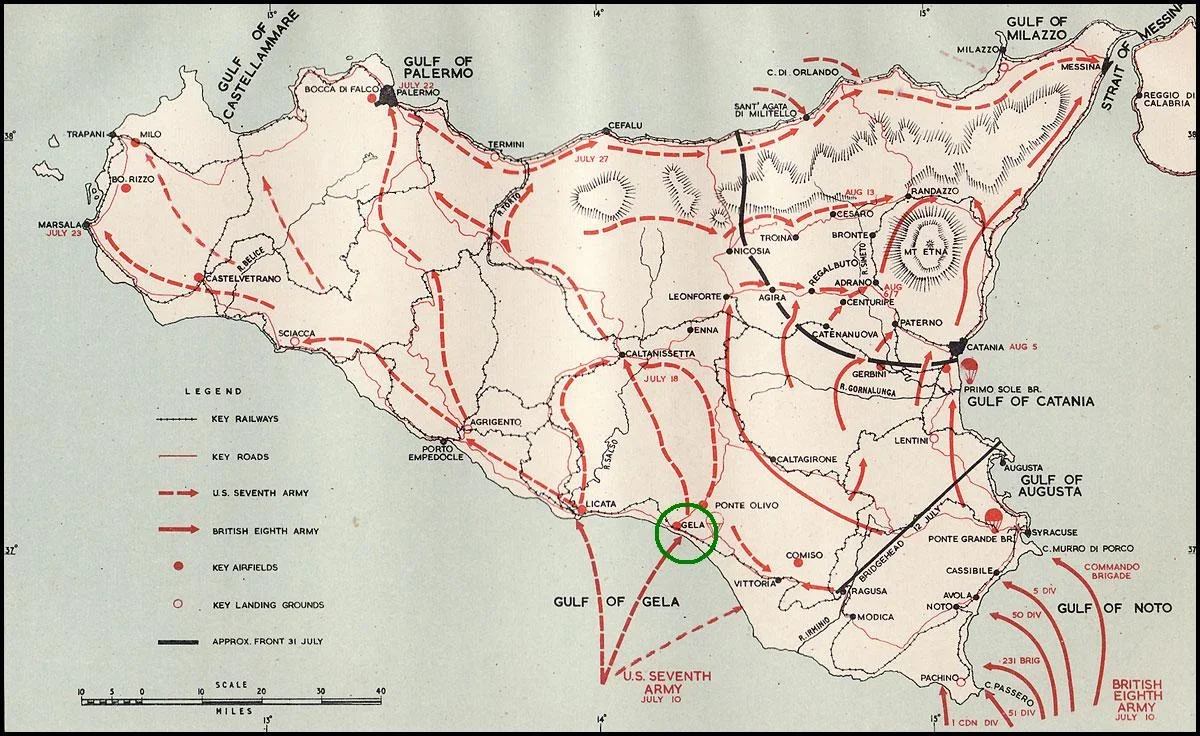
Operation Husky, July-August 1943 (Gela in green)

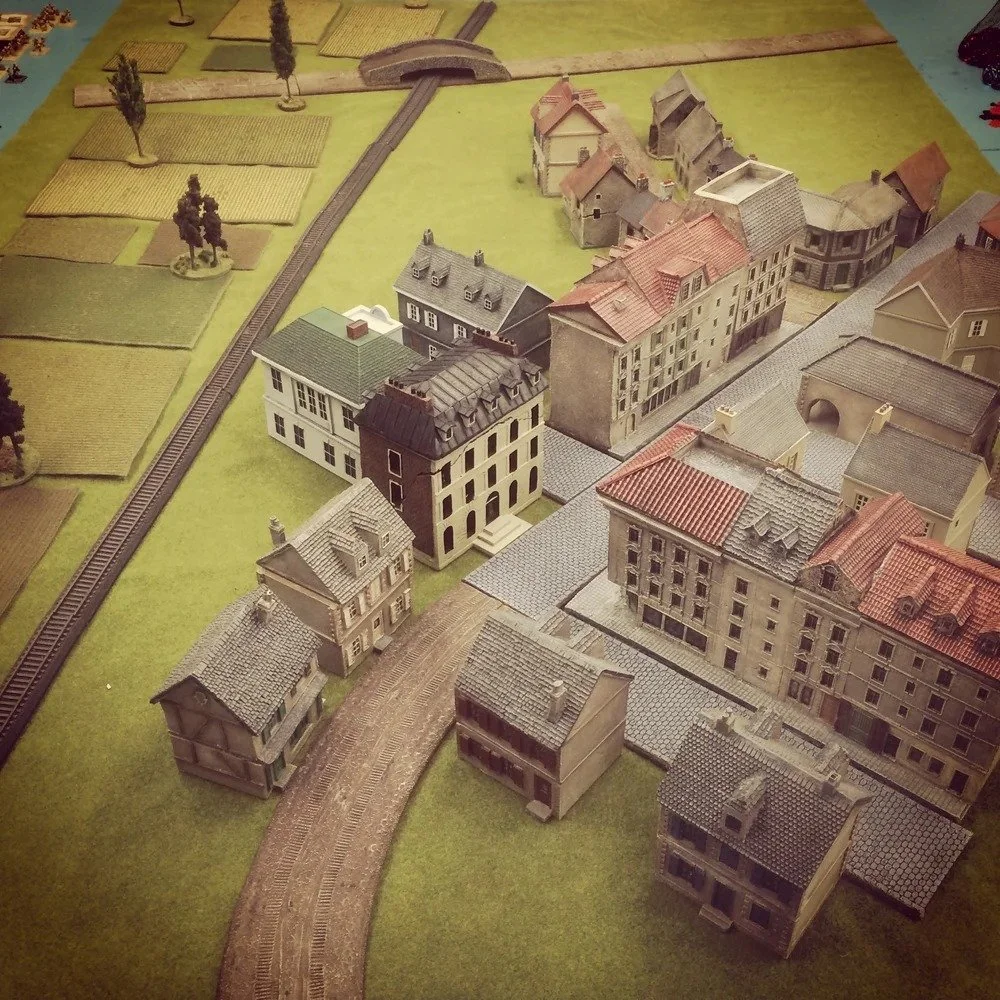
The scenario represents the northeast section of the town of Gela where ferocious fighting had taken place the day before in the early actions of the Allied invasion of Sicily. The table was set up with a couple dozen buildings from a variety of manufacturers, including JR Miniatures, Battlefront, Mark IV Miniatures, Miniature Building Authority and Games of War. The occupying US troops all began hidden in Gela with the Italians arriving on blinds at the opposite end of the table over a small railroad cut, bridge and road surrounded by open farm fields dotted with trees. The objective was simple: the Italians had to take back this corner of Gela and the Americans had to hold what they had fought so hard for the previous day.

The Americans deployed in well-defended positions in the town with two platoons of rifles and light machine gun squads perched in buildings. A combat engineer platoon armed with a 37mm M3 anti-tank gun in tow sat hidden along the main street through town. Off board, 4.2 inch M2 mortars and 105 mm M2A1 howitzers from the 33rd Field Artillery Battalion were available as support to be called in by the captain from the company HQ perched in the tall building at the center of town. Tough and dug into great positions, the Americans looked to have a clear advantage.

The tabletop battlefield for Gela

As in the previous scenario southeast of Butera, the Italians again represented a massing of manpower from the Livorno Division with six small rifle platoons and a machine gun support platoon. Accompanying them this time was Mobile Group E compromised of light French Renault R35 tanks and pre-war Italian CV33 Tankettes. What the Italians lacked in a starting position on the field and quality of equipment and troops, they certainly made up for in volume as they began the game arriving on three blinds per turn.

Italians arrive northeast of Gela

As the Italians neared the town, the Americans bided their time and sought not to reveal their positions until the approaching forces were nearly on top of their positions. Approaching in the open, the Italian blinds were spotted in the open to reveal tanks and infantry closing in at the center and edge of town. With IABSM’s randomly card-activated units mechanic, my US commander was perhaps overly cautious in waiting a turn or two too long to start getting the American cards into the deck. This all but negated off-board US artillery support for the game and allowed the Italian attackers to get dangerously close to seizing a quick victory with nary a shot fired.

Italians swarm the edge of the town and the hidden American positions

On the Italian left, one of their early shots fired down the street took out a crew member of the M3 anti-tank gun, forcing the remaining American crew to haul it back around a corner to safety. In answer, the US engineers opened fire at close range and threw back the initial push by the Italians on the American right. At the center of town, US rifles, machine guns and bazookas firing from within a massive central building ripped into the Italians marching forward in the open. Under heavy fire at their center, the Italians fled for cover to either side as their approach was slowed and their returned rifle and tank shots had little effect on the Americans.

Italians encounter fire from US engineers defending from buildings

Italians encounter fire from US engineers defending from buildings

Italian armor repositions away from American fire

With nowhere to go but forward, an Italian rifle platoon at their left assaulted the US engineers holding down the American right from a building. The Americans took heavy casualties and were thrown backward from their position into the open street to the rear. In response, returned fire from engineers in a nearby building flung the Italians back from their brief victory.

Italian rifles push a US engineer platoon from the building position

Back at the center, another round of combined arms fire from the Americans in the large central building continued to feed shots into the Italians, forcing them to continue to slide into cover to either side of the open field outside town. While pushing the Italians back with casualties and shocking fire provided a short-term positive for the US, it also allowed the Italians the chance to redeploy and set themselves for a move into town on the American left.

Italians slide from the center toward the American left

Meanwhile on the US right, the surviving engineers were chewed up by additional fire in the street which stalled them out of the action. With the main street into town wide open, the first Italian tank positioned itself to roll down the cobblestones. Waiting in the distance was the American anti-tank gun with a clear field of fire down the street looking to stave off an armored assault into the heart of Gela.

Italian armor sneaks around the American right as the US 37mm M3 anti-tank gun waits in the distance

With the Italians abandoning the center, the fight moved to the flanks. One US rifle platoon moved to reposition into buildings further to the edge of town on the American left as two Italian platoons, one already having suffered heavy casualties, snuck between buildings for cover. The American engineers on their right sought to hold down the approaching Italian tanks and three rifle platoons, and the US anti-tank gun crew had yet to fire a shot. The American rifles, machine guns and bazooka crews who had caused so much damage at the center were facing a choice of redeployment as their Italian targets skirted to either side.

Italians mass for an attack on the US engineers

Several hours in, we called the game. The small-scale tactical nature of IABSM is highly contingent on when a platoon or command ‘big man’ card activates. With so many Italian cards in the deck, a run of activated Italian unit cards may have provided the push they needed to get to the main street and victory. That said, each US card drawn was continuing to have devastating results on the somewhat weaker Italians, causing casualties and flinging them into reconsidering different routes. The large number of Italian on the field were still poised to match up with the higher quality American troops, although the US had clearly blown an early opportunity to use their off-board artillery effectively. Good and bad command choices had left Gela contested for the day.

Brooklyn Wargaming


Today Neil, my regular gaming opponent, and I played Scenario 12 from the Sicilian Weekend scenario pack: The Biazza Ridge. A German kampfgruppe is heading for the Operation Husky landing site when it is hit in the rear by a small number of marauding paratroops led by the indefatigable Colonel James M. Gavin. Some of the Germans turn back to deal with this menace...but the Airborne troops prove such a pain that eventually the whole German column has to turn around to deal with them. This scenario covers the German assault on where the paratroopers are dug in: the Biazza Ridge.

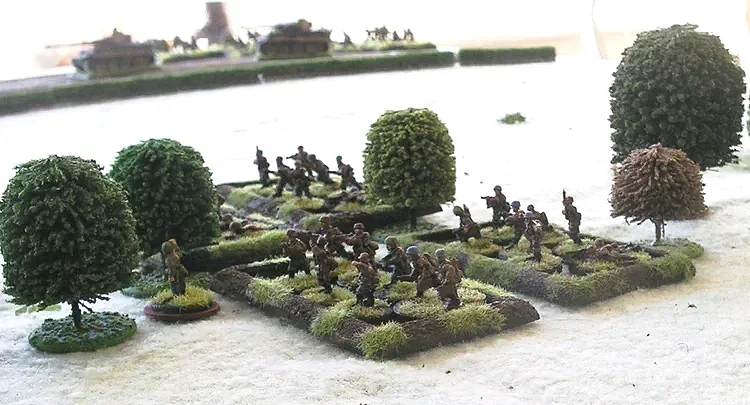
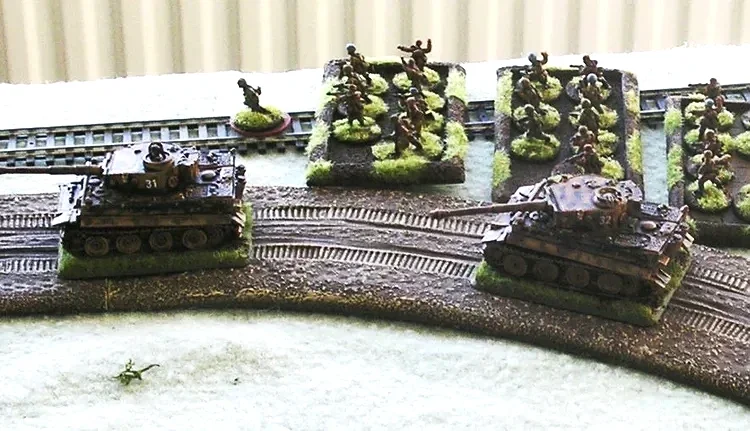
The tabletop was largely empty, with only a narrow trip of dense wood on the left, and a thin salient of light wood in the middle interrupting what would prove to be a very open field of fire. A road and railway track ran up the right of the battlefield. The ridge itself was surmounted by two farmhouses. The initial force of US troops [a platoon of Airborne infantry with two pack howitzers] was lightly dug in on the ridge's crest, the Germans would advance from the opposite end of the table. The Americans could expect reinforcements, the Germans had a company of average infantry, two Tiger tanks and a single Hummel SP 150mm gun.

The Germans entered the table under Blinds but were soon spotted by the Americans, who enjoyed the advantage of high ground. The Tigers and one platoon of infantry were advancing down the road on the US left; the Company HQ on the right; with the other two platoons of infantry coming up the centre.

On the German right, the lead Tiger was struck by shells from the US 75mm howitzers, and was shaken, but not stirred. The panzers advanced slowly up the road, pausing to fire HE back, killing one crewman. The infantry advanced along with the tanks.

On the German left, the Company HQ fought its way through the dense woods, with its two squads bursting from the woods and up the final stretch of slope leaving two MMGs behind as fire support. They took some casualties from the Airborne troops who popped up from behind the ridge to fire at them, but the concentrated fire from the MMGs kept the US infantry from doing too much damage.

In the centre, the two infantry platoons also reached the end of the woods and headed up the slope, also taking a couple of casualties, this time from the howitzers who had decided to pretend the Tigers weren't really there!

The Germans kept creeping their men forward, but crossing the open ground and equally open lower slopes of the ridge was proving very difficult and time-consuming. The six foot tables seemed very long indeed! Meanwhile, on the right, the Americans had received reinforcements in the shape of an anti-tank gun, which promptly slammed several shots into the lead Tiger, eventually forcing its crew to bail out after its main gun was destroyed. The anti-tank gun then became the target for every German that could shoot at it (1st Platoon, the other Tiger, the Hummel) and was eventually knocked out, along with one of the pack howitzers that had been doing sterling service hammering the German 1st Platoon. Colonel Gavin had unfortunately been killed shortly before: he was manning the .50 cal on the half-track that had pulled the anti-tank gun into position when it was critically hit by one of the Tigers and blown to atoms!

American reinforcements were now arriving thick and fast. Next up were two FOO teams: one from a battery of four 105s, and a naval liaison party in touch with the cruiser Boise and its six-inch guns. The Boise had almost single handed stopped a major German panzer attack on the beachhead in a previous scenario from the same supplement, so I was very wary of its firepower! The FOO teams and US Big Men quickly called in the off-table assets available, and the German advance slowed even more as squads became pinned under the blasts.

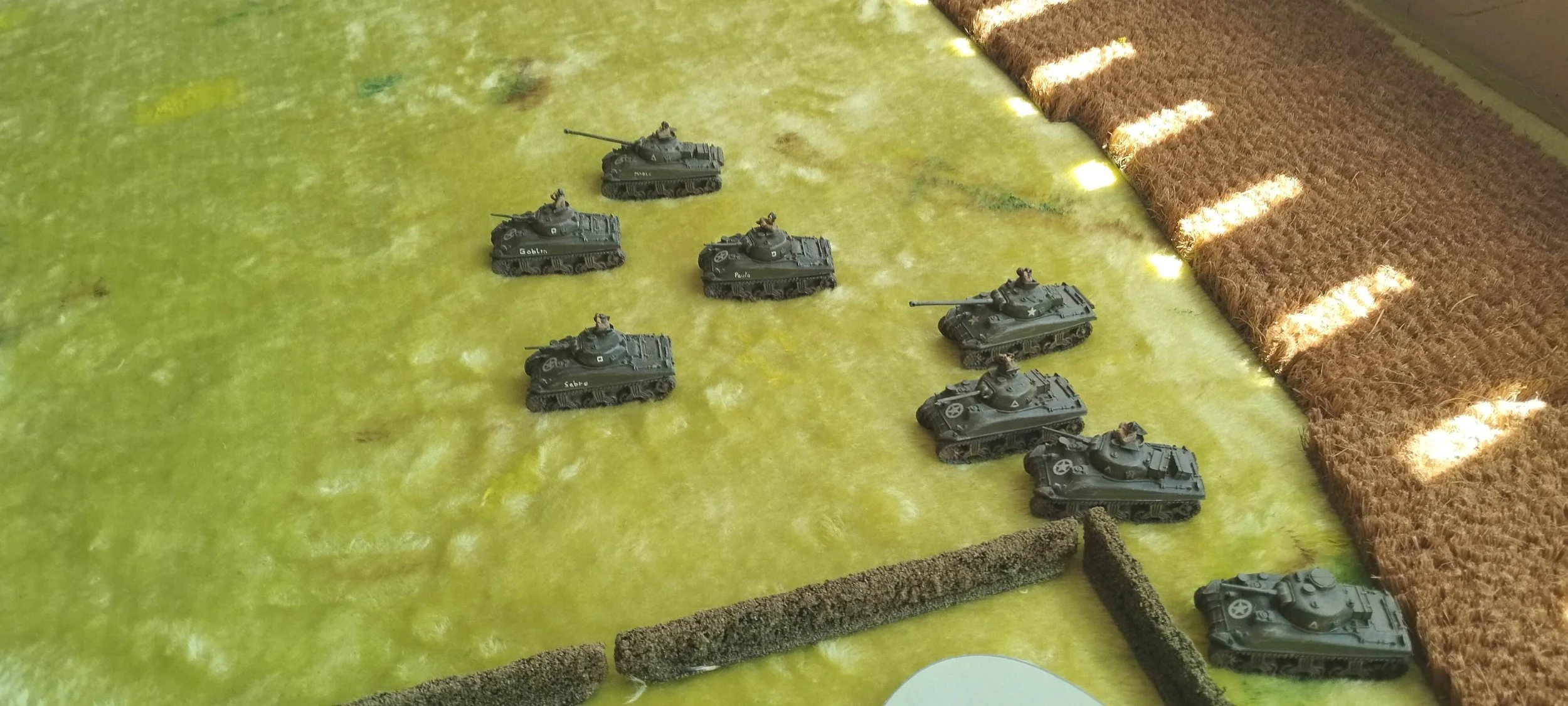
Two Shermans arrived next. Rather than challenging the Tiger to a stand up fight, they headed up onto the ridge to support the infantry there. Finally, two trucks arrived with another two platoons of US paratroopers. These set up shop opposite where the Tiger was still crawling forward, and started exchanging fire with the German 1st Platoon.

Meanwhile, the German Company HQ squads, protected by the suppressing fire of the MMGs and other two platoons had crept up to ridge line and given the Airborne troops there a taste of their own medicine: popping up to blast them before popping back down under cover. Several turns went by with either one side or the other popping up to shoot, but the other two German platoons were still creeping ever closer, even if they were still losing men to artillery fire.

The battle continued in the same vein right up to when we had to call time because the 'real world' beckoned! At the end of the game, the Germans still hadn't quite taken the ridge, but were still moving forwards despite the tender ministrations of the US off-table guns. The Tiger was now seriously threatening the US left flank, and although both Shermans were now in position to support the infantry, they had taken several barrages from the Hummel, whose 150mm shells had managed to knock out the alignment of both tanks' main guns. The final position is shown below:

We called the battle as a draw: the game was still balanced on a knife edge. Although the Germans hadn't achieved their victory conditions yet, with a bit of luck they could have done so. Historically, Gavin and his men fought their enemy to a standstill and, likewise, could have done so here. A really good game, despite the (relatively!) small number of men deployed.

What was really good was the way that IABSM 3rd edition played on this, our second game. Big Men were rushing here and there on the battlefield, using their command initiatives in a much more "command-y" way than the more rudimentary system of 1st and 2nd editions. The modified artillery rules worked brilliantly (far too brilliantly if you happened to be German!) and, once again, everything just seemed a bit tidier, more logical, and neater. We are already planning our next game: perhaps a return to the Far East and Bloody Burma...

Robert Avery


Great game yesterday as we fought the Lille action from the TFL Dunkirk Day. This was actually the only battle from the day I hadn't fought, and having enjoyed the other two I was keen to give it a go.

I played the French: defending a spread out town (loads of gardens and fields and hedges and houses and passages and alleys) against a German attack. It was also a good excuse to field my newly-painted petrol station from Timecast: a lovely model that, despite being for modern warfare, looks the part and comes with half a 2CV sticking out of the garage!

The game begins with only infantry on each side but, after a few turns, both forces get a healthy injection of armour. The French were defending across the long side of the table so, perhaps unwisely, decided to spread their two platoons out: one on the right, one on the left, placing a section in each key building. The left was further bolstered by a 75mm gun (dated 1897!) emplaced on a hill towards the rear of the table. There was another 75 hidden behind a hedge on the right, ready to be wheeled into the road that led straight towards the Germans.

The Germans, headed by Major Lardich von Skinner, slammed on with a full armoured platoon on the French left. This advanced quickly and soon destroyed the French squad holding the key building there, and hunkered down to begin exchanging fire with the French squad in the next key building towards the centre of the town. On the French right, the only Germans seen was a platoon of AT guns and their horse- drawn limbers. This was too good an opportunity target to miss, so one keen French squad, still under a Blind, left its house and headed forward to fetch Capitaine Legume's lunch of horse-meat sarnies.

Unfortunately the next turn saw another German platoon appear behind the guns (bloody card based initiative system) and despite taking cover in (not behind, in) a hedge, the keen French squad were quickly reduced to a few distinctly unkeen gibbering idiots (3 figures, 14 wounds!).

The rest of the French on the right - two squads led by Legume himself and an MMG - opened up on the Germans crowded forward to see all these dead Frenchmen, and did four or five casualties. Not a lot, but this was enough to halt the Germans in the building they were occupying and lay down smoke from their light mortars rather than advancing forward. A firefight developed, through the smoke, which did few casualties on either side, but bought the French time for their armour to arrive.

Meanwhile, on the French left, the Germans were preparing to move forward again. Sergeant-Chef Aubergine, seeing the danger, ran to the 75 gun on the hill and took personal charge. Up to then th gun had failed to hit anything it had fired at, especially buildings! Laying the gun himself, however, two rounds slammed into the house where the Germans were, doing horrible casualties and forcing them to abandon the building as soon as possible! Fine shooting!

The Germans, seemingly angered by this, sent two squads forward to silence the gun, and used the other two squads to assault the next building in line, also with a French squad within in. Aubergine's men had time to fire a round into the Germans coming towards them, seriously damaging one German squad, before being close assaulted by 12 German figures. Twelve Germans verses Aubergine and two gunners. Aubergine, however, is a d6+1 Big Man! The Germans were repulsed and sent 4" down the hill, where they took up firing positions and prepared to shoot the 6ft 7" mad Frenchman with the massive ramrod and his gun crew.

Things looked bad for Aubergine, but the next chip out of the bag was the French Heroic Leader card! Down the hill went Aubergine and his two gunners and smashed the Germans from the table!

The other two German squads, meanwhile, had successfully taken the next building, but were somewhat surprised when Aubergine, on the next turn, slammed another couple of shells into the house. In effect Sergeante-Chef Aubergine had defeated an entire 4-squad German platoon with nothing more than a 75mm gun from the last century and his massive ramrod!

Meanwhile, on the rest of the table, both sides armour had arrived. The French had six tanks: 3 H-39's and 3 Char B1's. The Germans had four PzII's and three PzIV's.

With their quick movement (Rapid Deployment, Blitzkrieg) the Germans managed to zoom their PzIV's up the board and catch the French armour in the flank. Shots rang out, but the Char B1's were made of stern stuff. No damage was done to any Char's, although one H-39 finally secumbed to engine damage after taking five hits! The Char's then ponderously turned towards the PzIV's and, despite having shells clanging off their armour, took two of them out in one turn.

The final PzIV, Big Man (Oberleutnant Willi Kaiser) on board, retreated rapidly, and one Char, a bit over keen, chased after him. The PzIV then stopped, shot forward again, passing the Char B1, stopped just behind it, whipped his turret round, and slammed two shells into the Char's rear at point blank range! A superb bit of tactical manouevre that resulted in one brewed up Char!

Meanwhile, another Char had advanced to the centre of the table right into the advance of the PzII's. One PzII was blown to bits, and the other three scattered into cover. It looked as if this Char was unstopable, especially as it had Lt Epinace on board, even if he was dressed as a nun! [I use one of PP's excellent French nuns as Big Man 4]

Then, however, the drone of Stuka's was heard and the German player nominated Lt Epinace's Char as their target. Deviation dice were rolled - a direct hit would have meant the end of Epinace! - no...a miss...deviation behind Epinace's Char by five inches. Phew! Safe!

Hang on! What's that building that the bombs have landed on? The one that Epinace's Char is using to protect its flank?

Yes, you guessed it: it's my new petrol station!

A quick check of the rules failed to discover effect of Stuka bombs on a petrol station ;) so the German player, Neil, claimed that the kriegspiel approach means that the station should blow up, taking the Char with it! I, however, pointed out that the French Fuel Shortage chip was in the pack, and so there obviously wasn't any fuel to blow up. Neil then pointed out that my Char's ran on diesel, so the station could be full of petrol. This was a fair gendarme, so we decided to compromise and have the Char brew up as the petrol station exploded, but with Epinace emerging from the smoke, untouched but with his Nun's costume blackened and in shreds!

The battle continued for one more turn, but it was obvious that the Germans couldn't take the town. His PzII's and other PzIV were all damaged or destroyed in the next turn by French MMG fire or the three surviving French tanks, and although the French infantry was sadly depleted, the Germans were down to a third of a platoon of effectives.

A heroic victory for the French, although as Legume had died earlier it was left to the newly promoted Capitaine Aubergine to organise the celebrations!

A great game which really seemed to capture the difference between the French and German forces. Although not specifically mentioned above, one key feature of the game was the German rapid movement and the French decidedly stationary approach to things. Legume kept getting the Hesitant French Commander chip, so culdn't move from his exposed position, and several times the French could neither advance nor retreat because of the Hesitant Troops chip.

Lardies may be interested to know that Aubergine's gun is now in a small display cabinet on my shelf, along with Epinace's soot- blackened wimple and a diagram showing how to take out a Char B1 with a PzIV!

Robert Avery


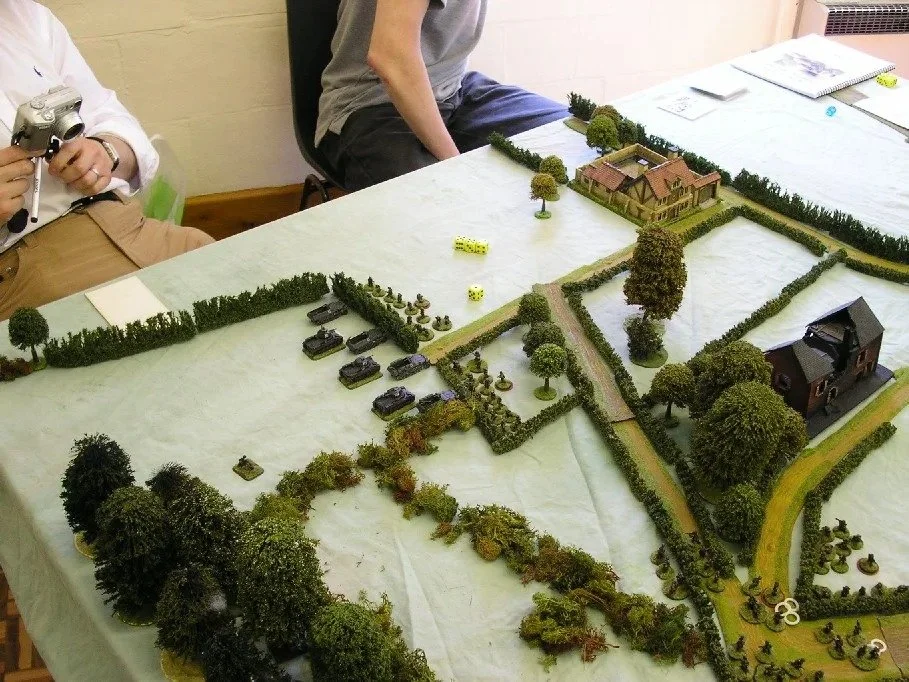
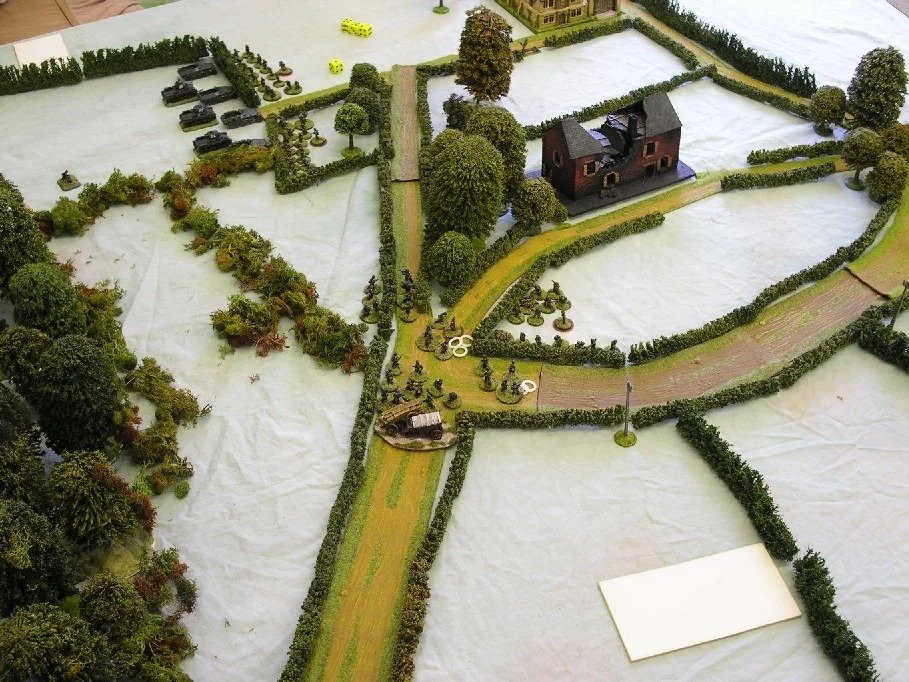
Unfortunately for Kev he wasn't able to get to our game last night. We played the first of Rich's Dunkirk scenarios from the Summer Special 2004: Cassel. I was British, Clive German (as ever).

We had played "Oi, get orf my truck" last week, and Clive had got so engrossed in attacking my forces that he lost his objectives and was forced off by the British infantry tanks with a bloody nose.

He was determined to get his revenge this week. Clive, aggressive as you get in LFS, is a tad more cautious in IABSM, and slowly trickled forward trying to identify the British position. When he did, his two flanking forces were hit in a lovely ambush on the British left that pinned one section with 5 wounds and killed three in another. These troops were grounded for the rest of the game despite having four half tracks, one their number had its mg blown off by a 2lbr, the others skulked trying to pin the ambushers, fearing a closer move.

On the right, the Brits were defending a small copse against the MG platoon. Amazing shooting from the Aldershot rifle display team saw one MG team wiped, another decimated for only 1 man down. These guns were then kept out of the game by the HQ light mortar plastering them with smoke for long enough for the supporting infantry platoon to get the same treatment. I rarely missed and we got kill after kill! (I can tell you that that isn't my normal luck!)

Clive did ,move a group of panzers (mk1's) through the centre. 1 section was caught on the wrong side of a hedge and badly hit. This forced me into dramatic action as Clive's tanks had shot up the Boys rifle earlier on. A Vickers at a roadblock held them back until it too was KO'd.

His second platoon finally moved forward, close enough to get into a vicious fight with the weakened section, killing or capturing all of them. They followed up into the MMG and Anti Tank position on the crossroads. despite a heroic defence, the crews left the stricken guns to the Germans and retreated onto the HQ section in a farmhouse on the corner.

A section close assaulted a tank, forcing it back. Then Captain Chulmondley grabbed a bag of bombs and heroically legged it to the tank shedding its track and then even survived the hail of fire to escape back to his platoon. A VC recommendation by any one's standards!

With the Germans on both flanks, Chulmondley realised that his work was done. The Brits retreated back through the funnel left by the decimated Germans to form another stop line, it would be unlikely with fighting like this that Hitler would want to send more tanks into the close country around Dunkirk.

A great game and Clive's second bloody nose in a fortnight. The British are losing but doing so by extracting a heavy price on the Teutonic hordes.

Max


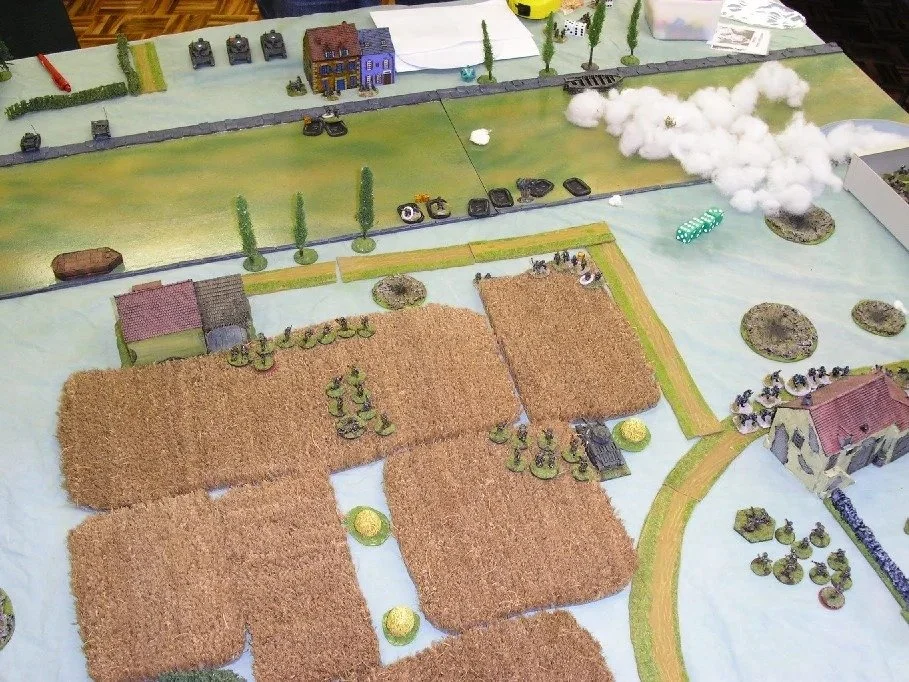
I played  in two games at the TFL 2004 Dunkirk Games Day. In the morning I fought and won the Cassell battle, defending a vital road junction against the advancing Germans. In the afternoon, I defended a canal against a German attempt to cross by rubber raft: another victory.

Here are some shots of the games:

Robert Avery


IABSM game played in Oct 2012 at Gigabites Cafe. Doug & Greg had the Poles, and Dennis and Brian attempted to get across the river. The Germans had a Company of Grenadiers, a platoon of motorcyle troops, several MMGs, a group of armoured cars and some pre game stonks. The poles defended with a company of infantry, a troop of tankettes, a battery of 75s and a couple of 37mm Bofors anti-tank guns.

Mark Luther