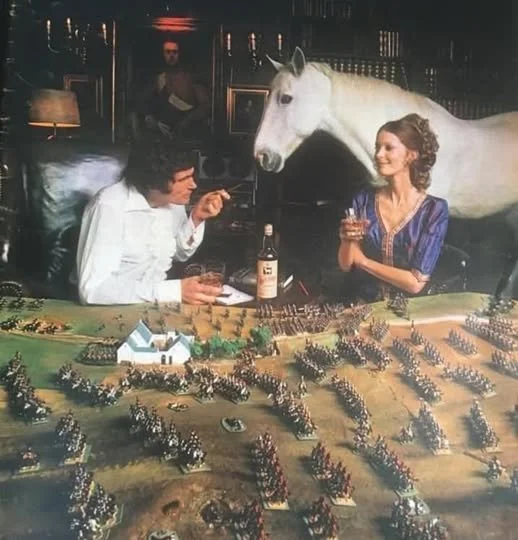
FK&P AAR: Return to Whyteladyes Lane

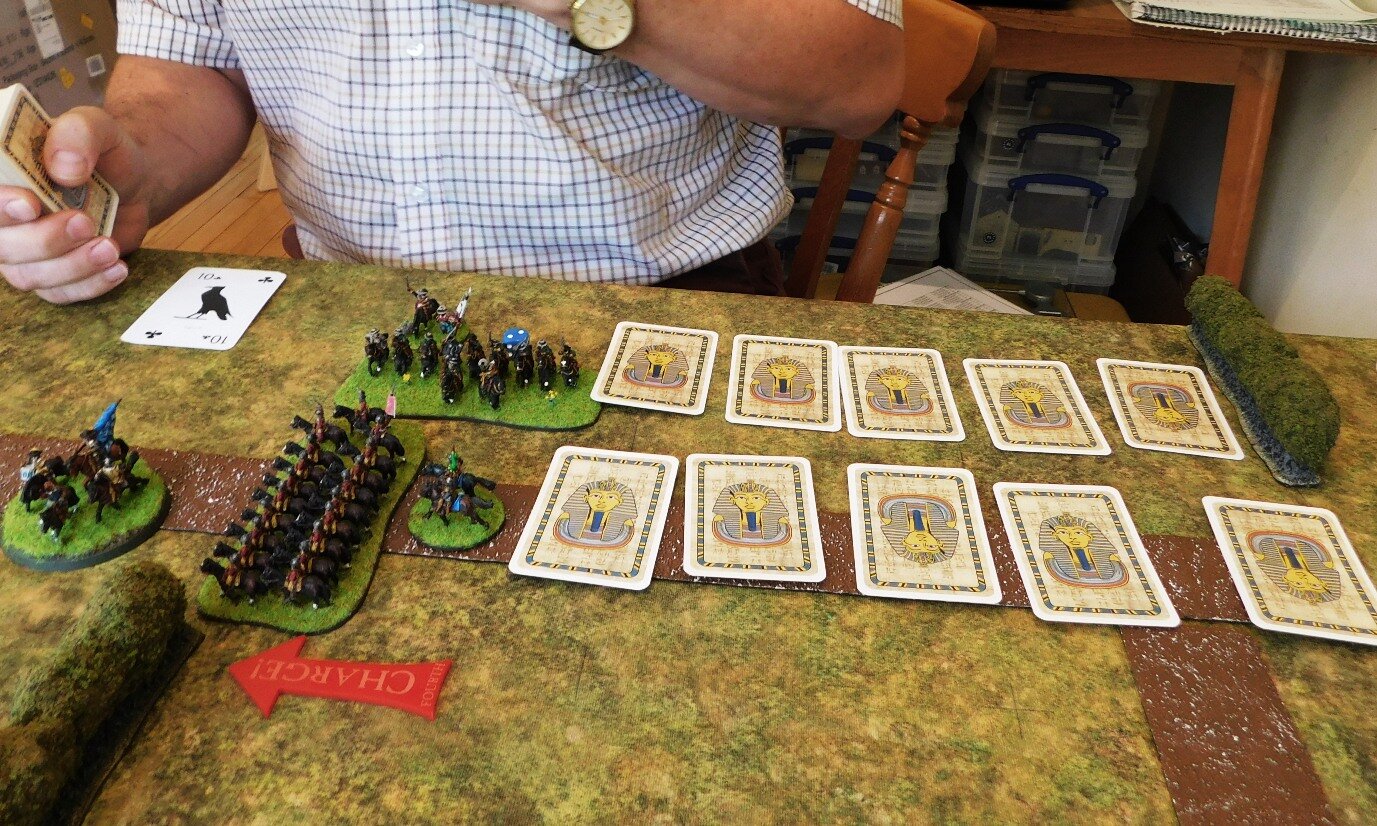
I had another play through of the Whyteladyes Lane scenario last weekend, hoping to put my previous defeat (to John) behind me as I sent Bevan’s Royalists running from the field. As is now usual, the game was played over Zoom, with markers showing the number of each unit so that Bevan could more easily work out which of his troops were where.

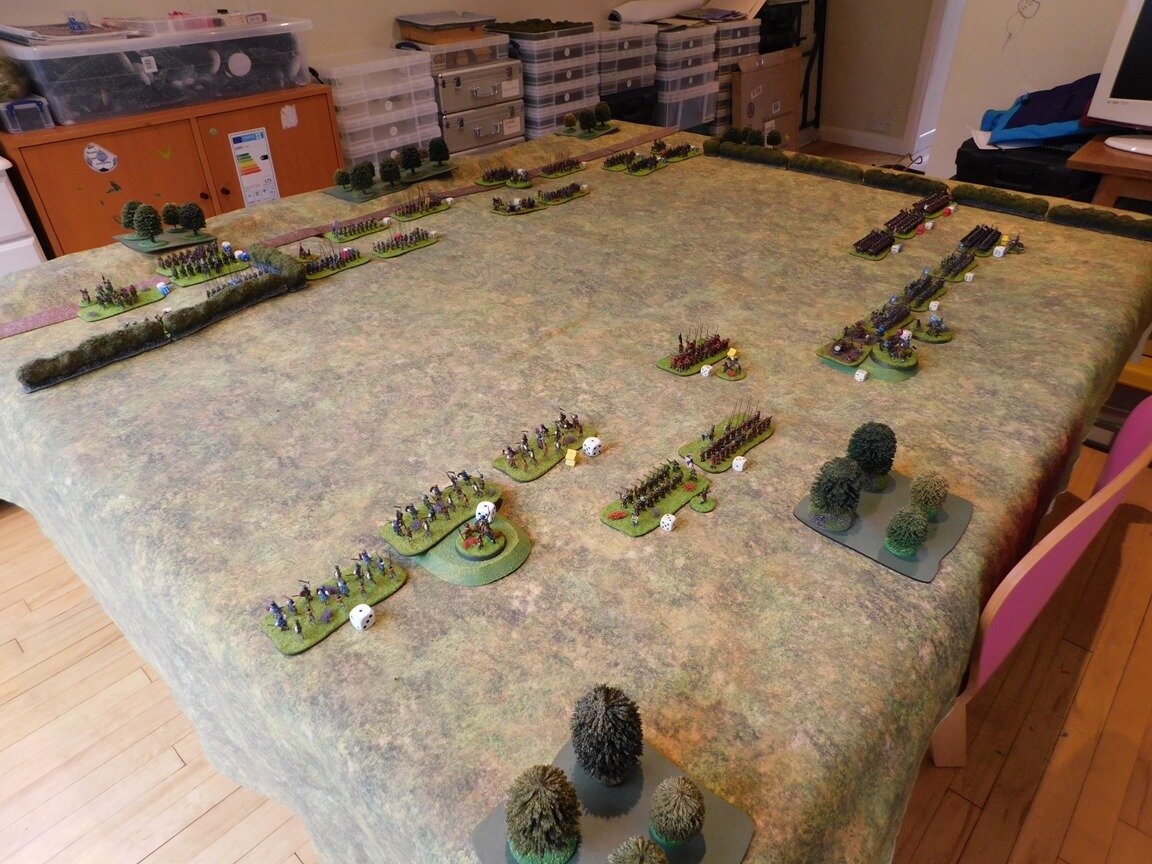
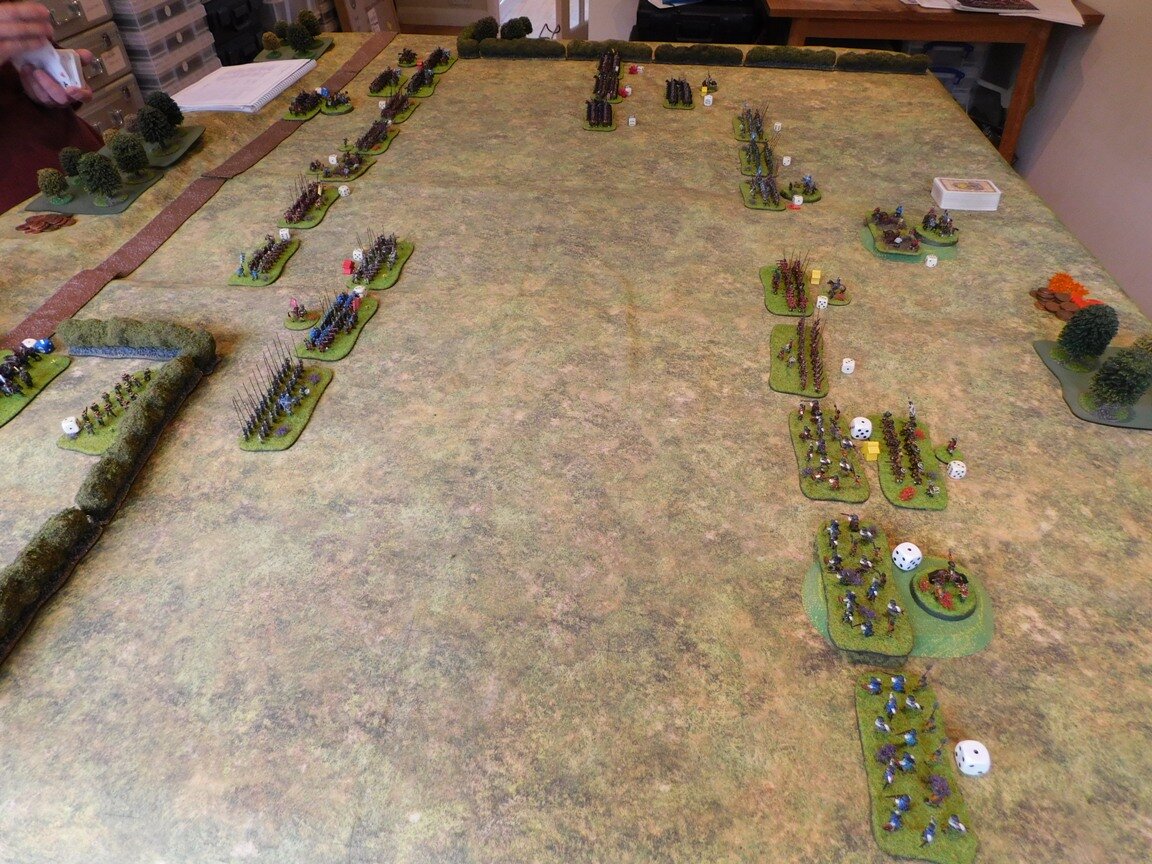
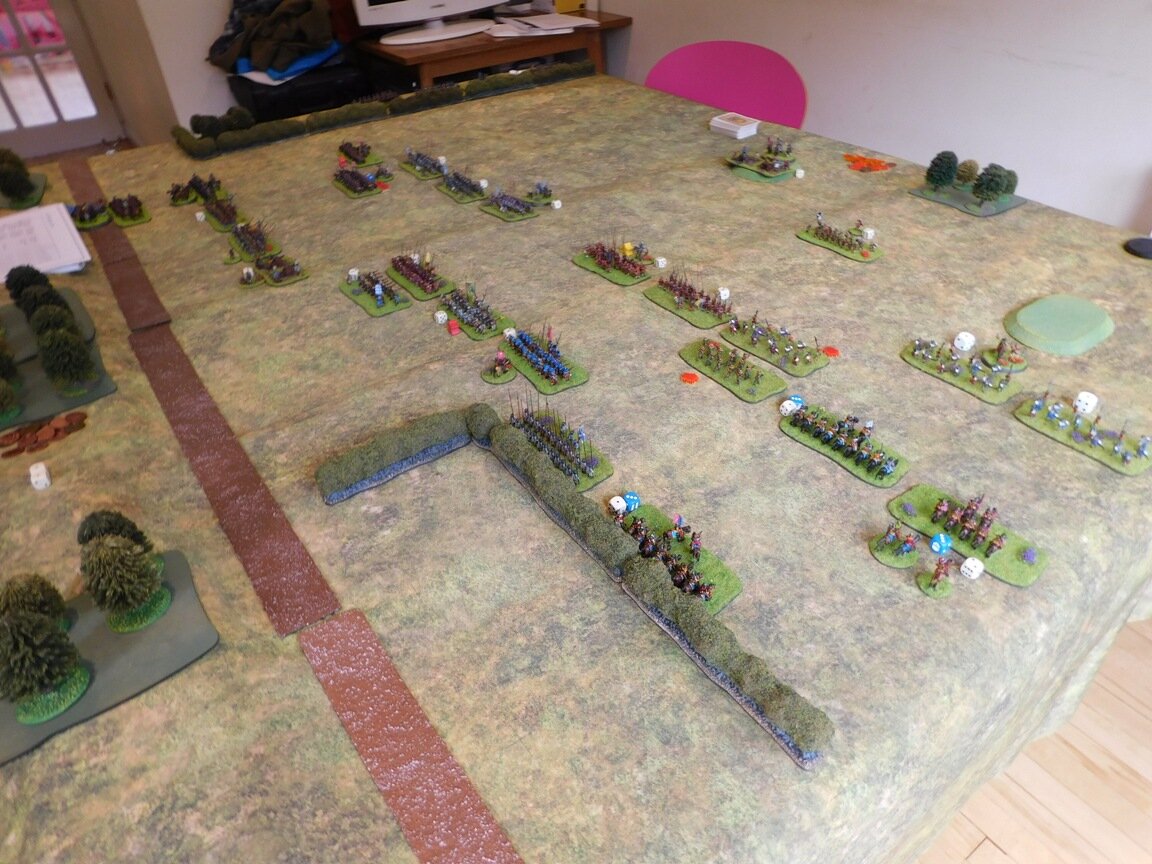
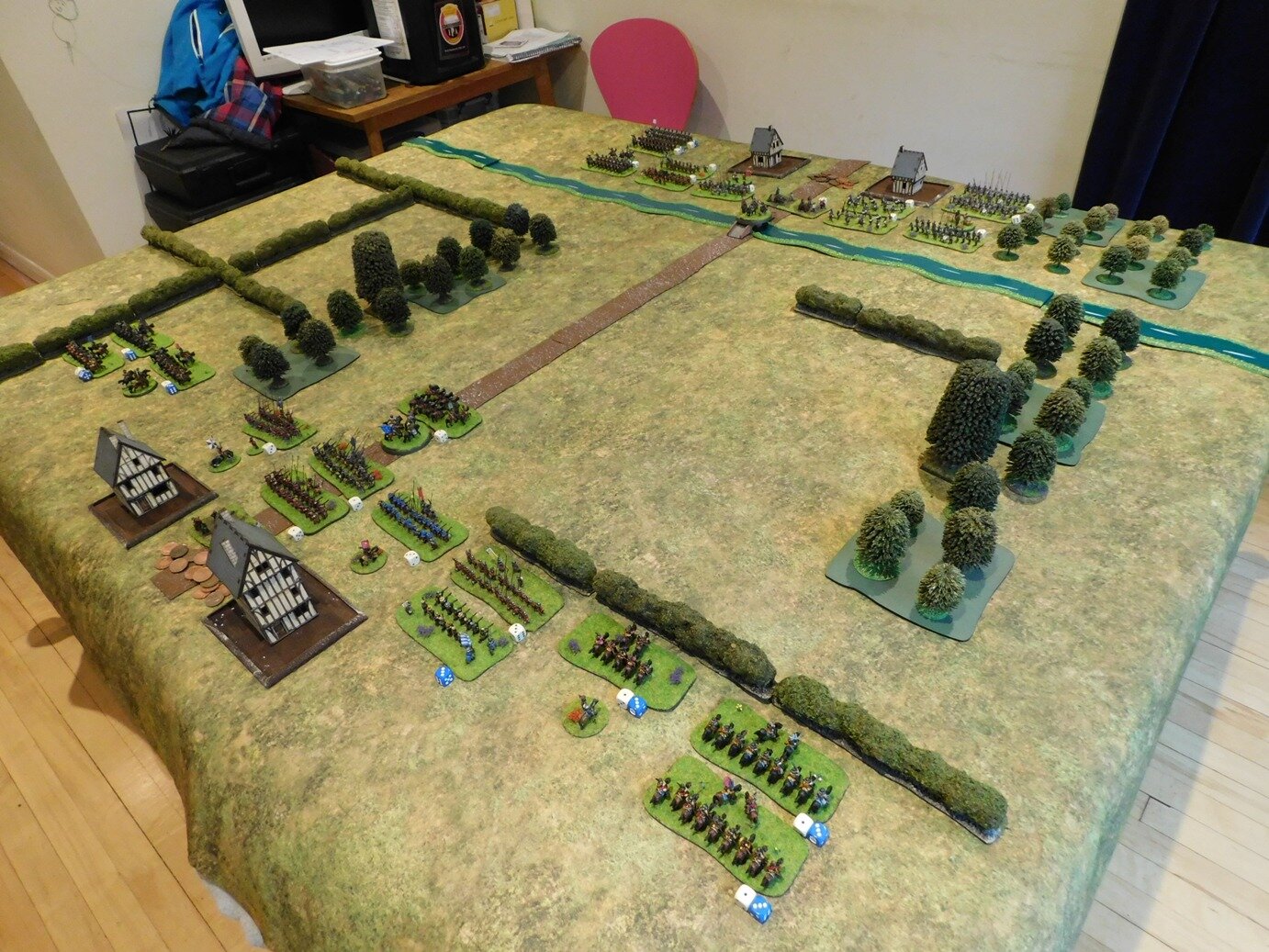
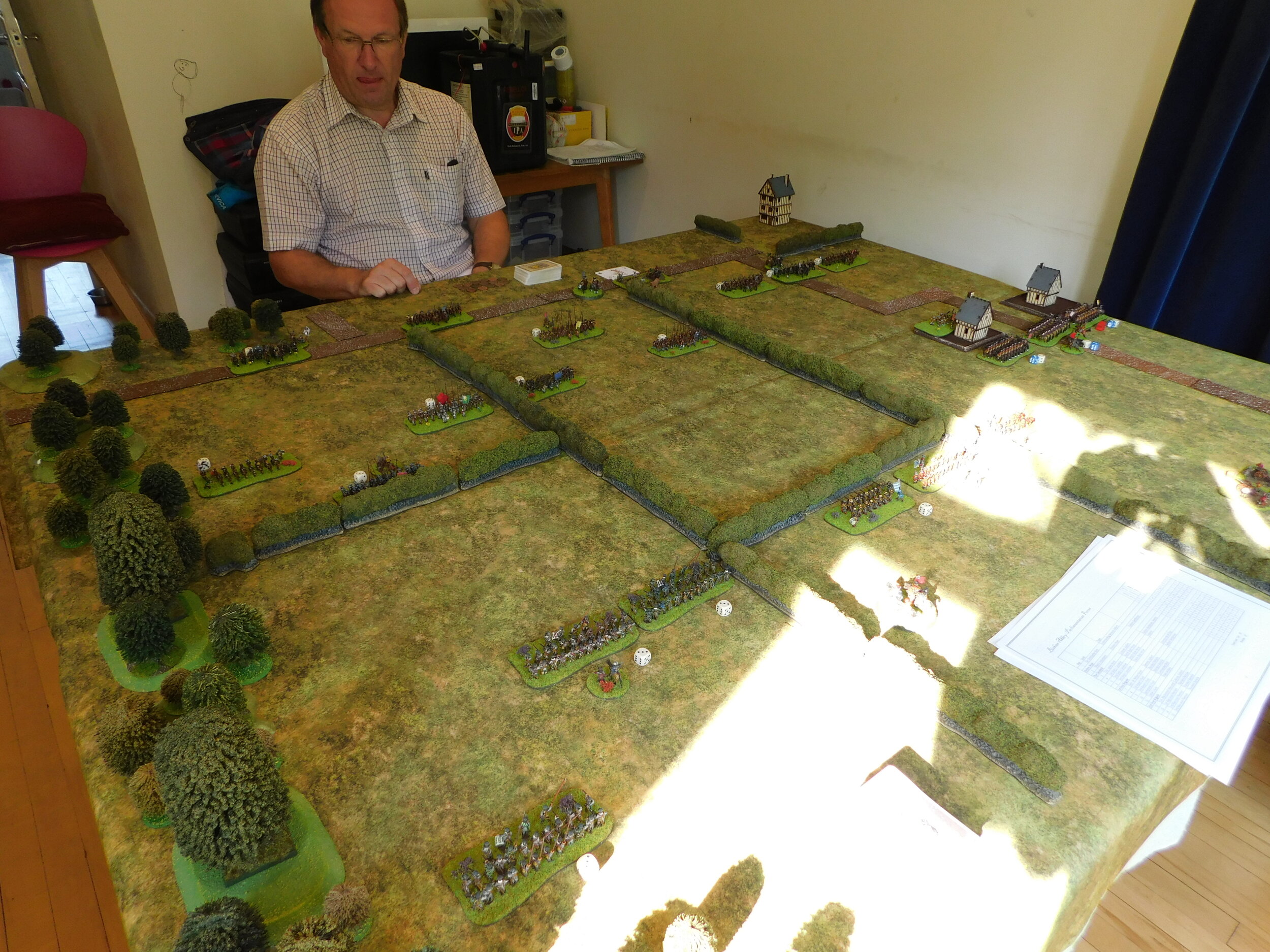
The game is a tough one for the Roundheads, as they begin the game in an extended column against ready-for-them Cavaliers in a more sensible formation.

Last time, I had pushed forward right from the start, and been chewed up piecemeal. This time I decided that I would form approximately on the head of my column and work from there.

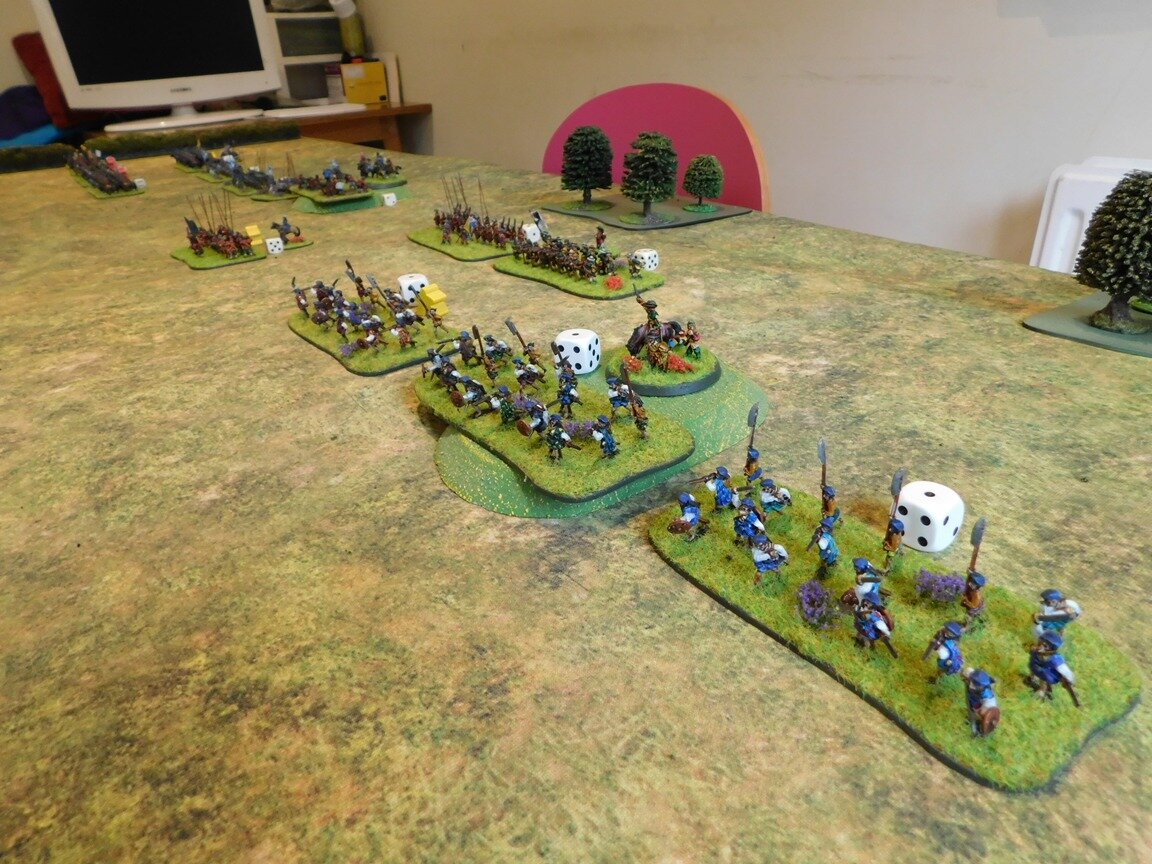
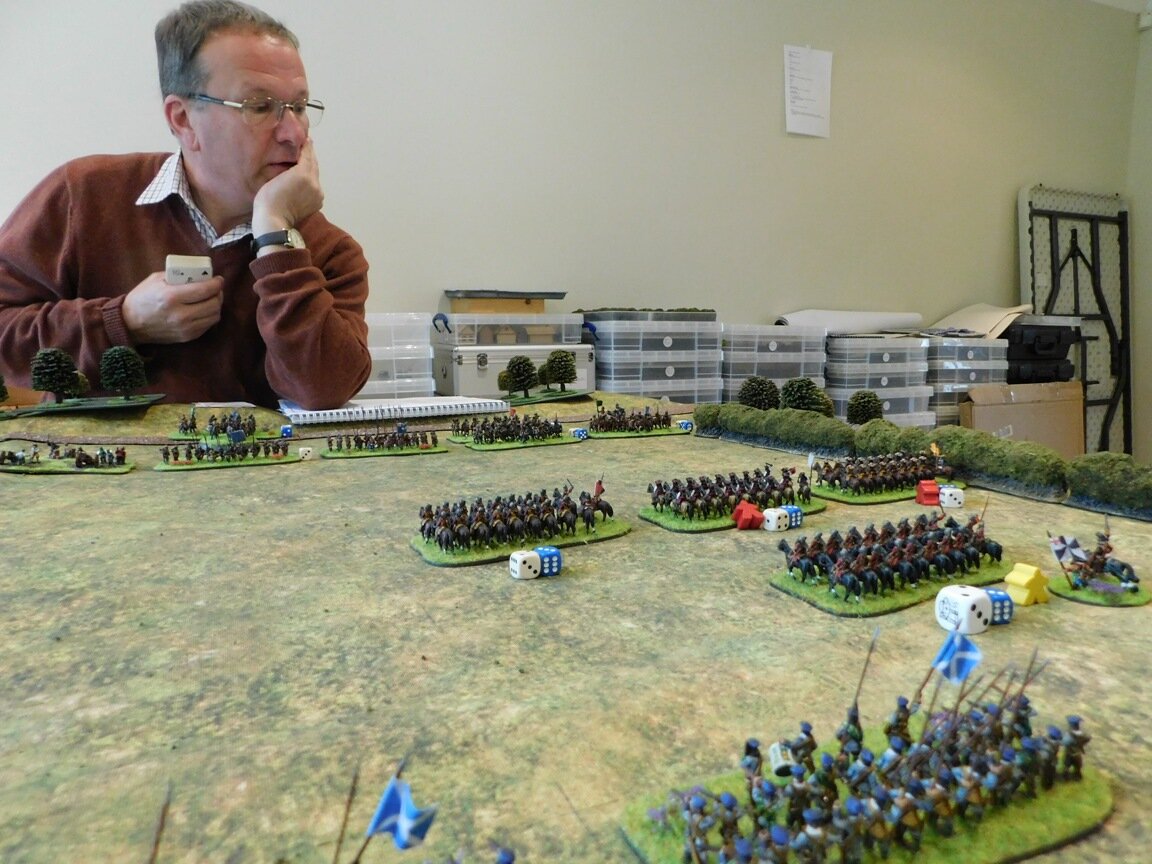
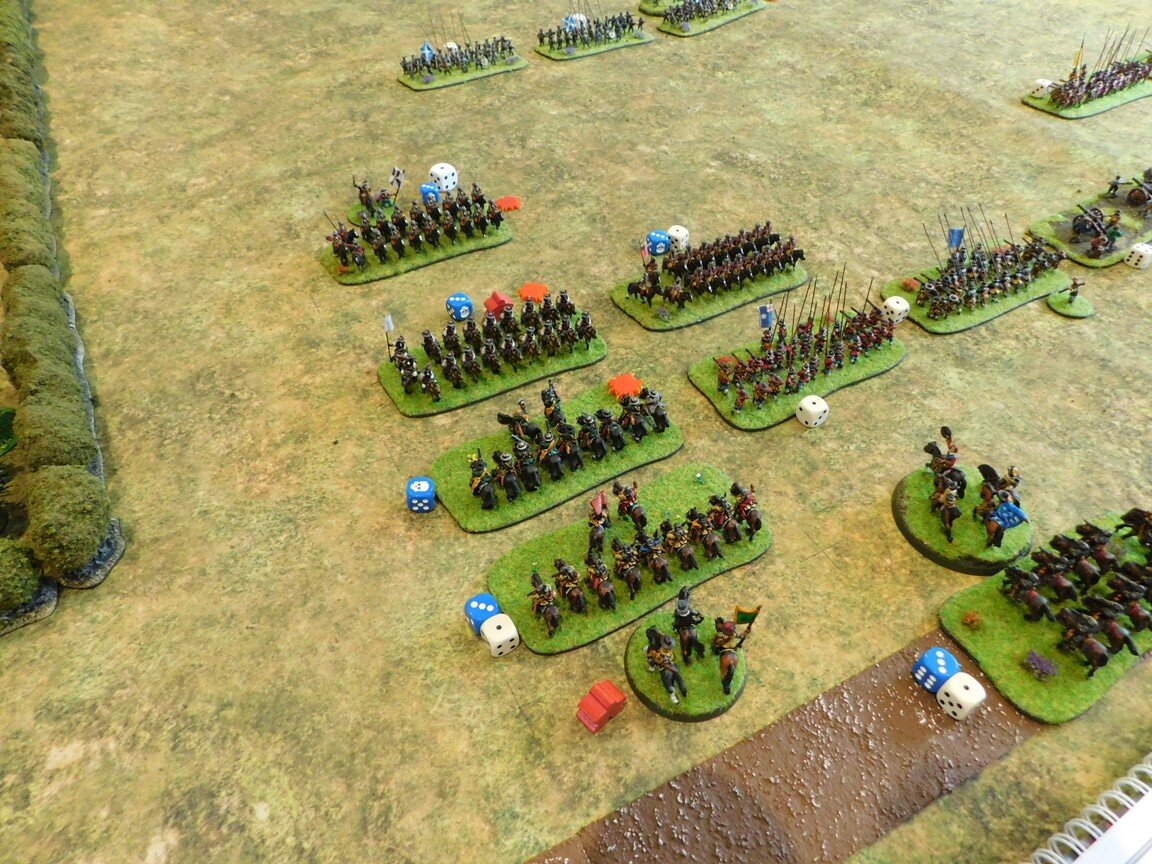
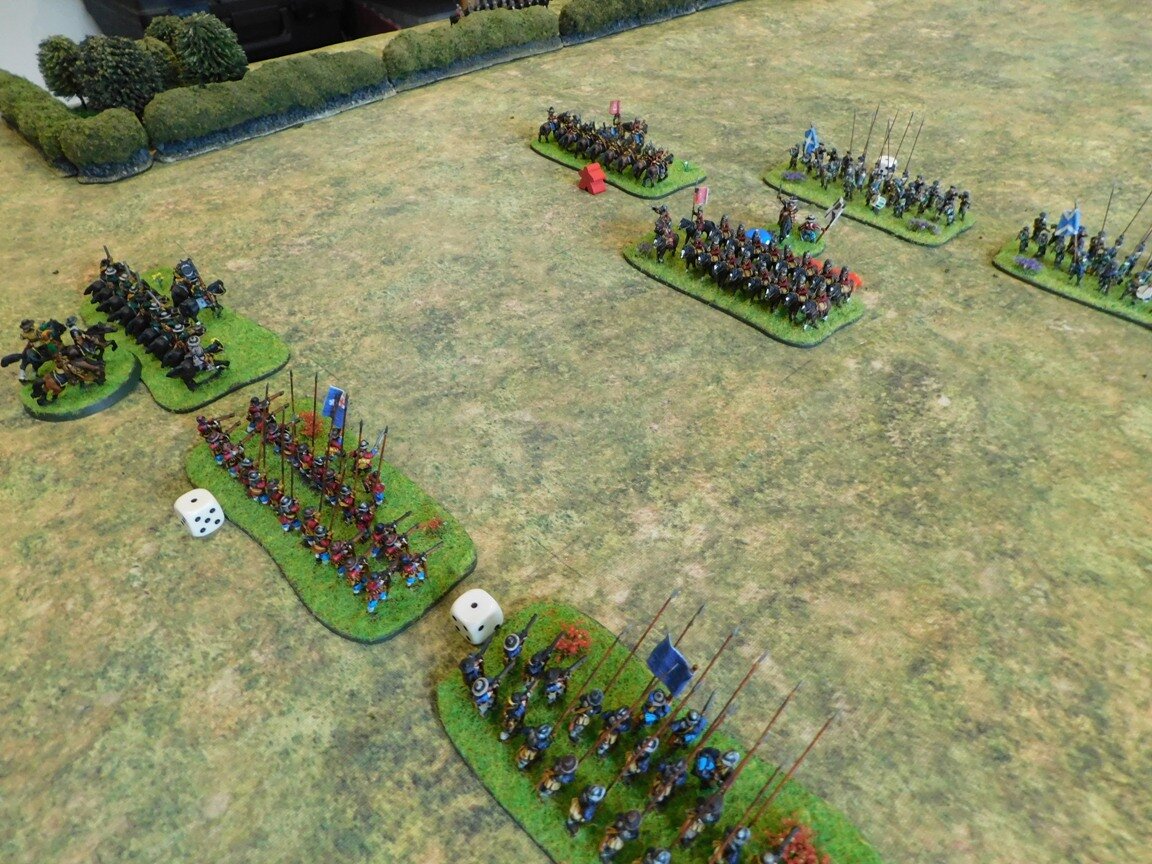
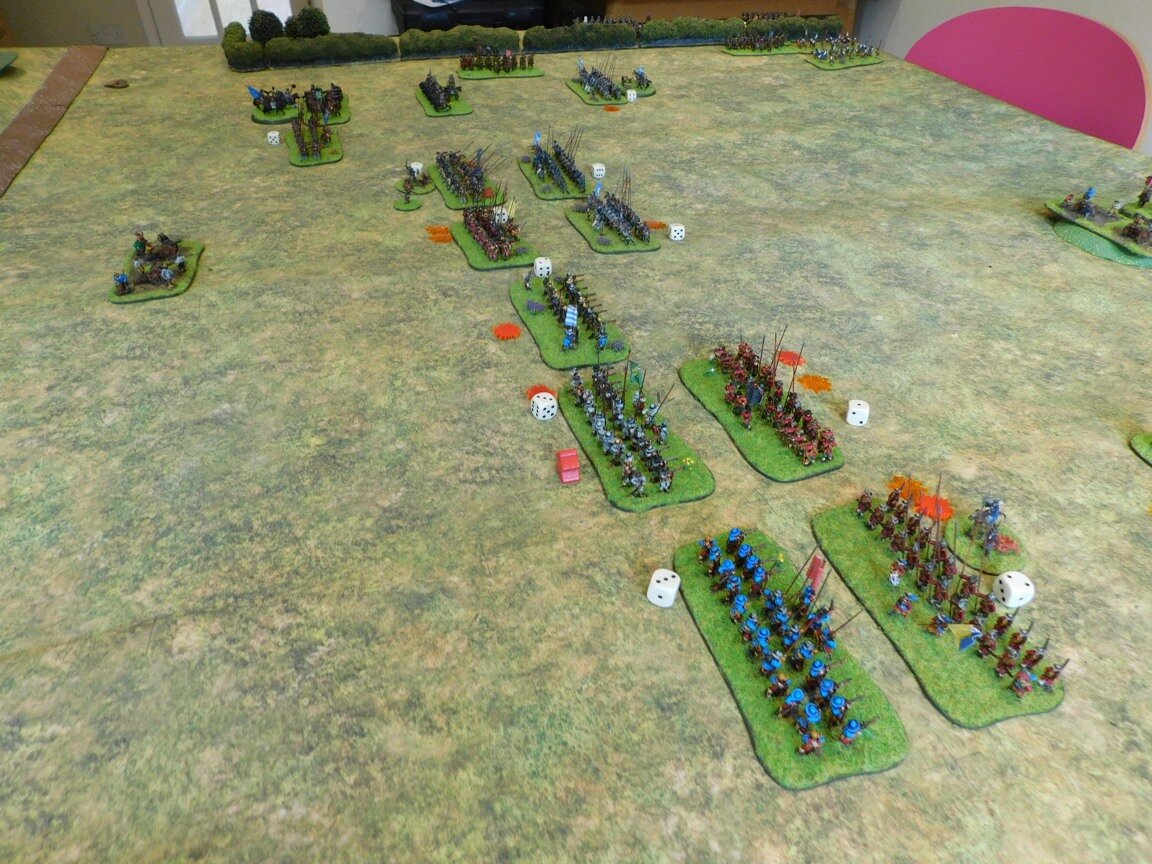
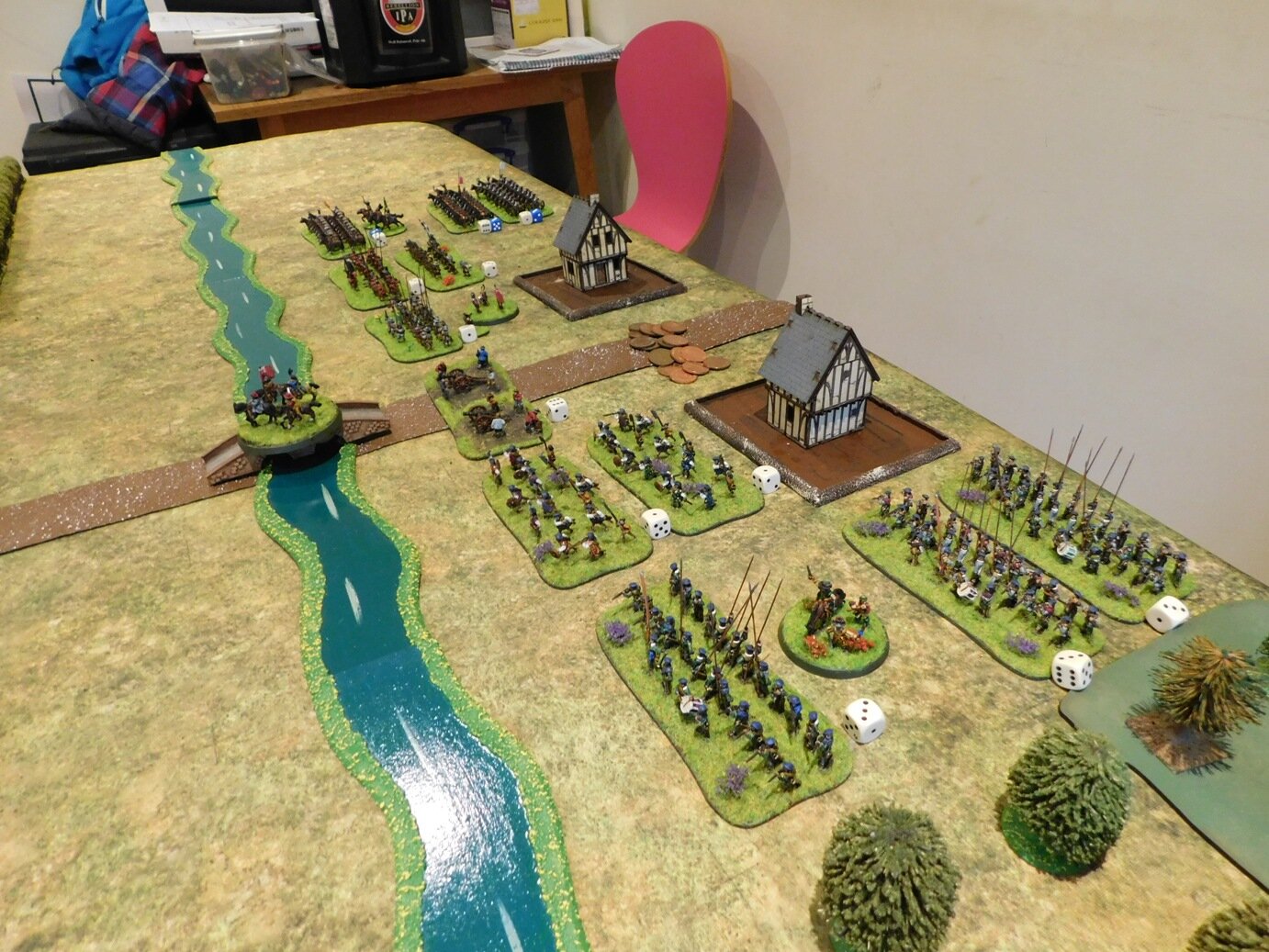
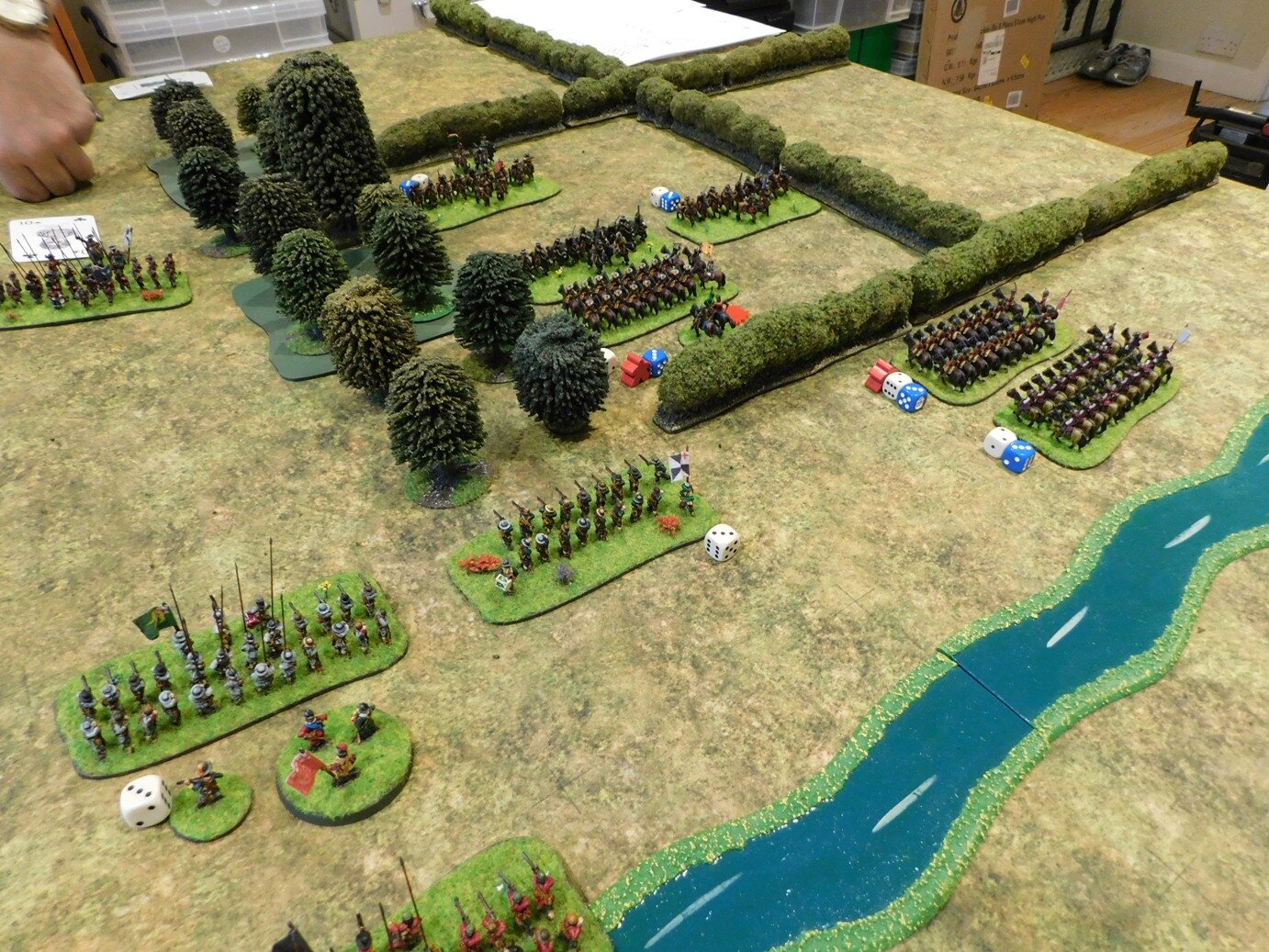
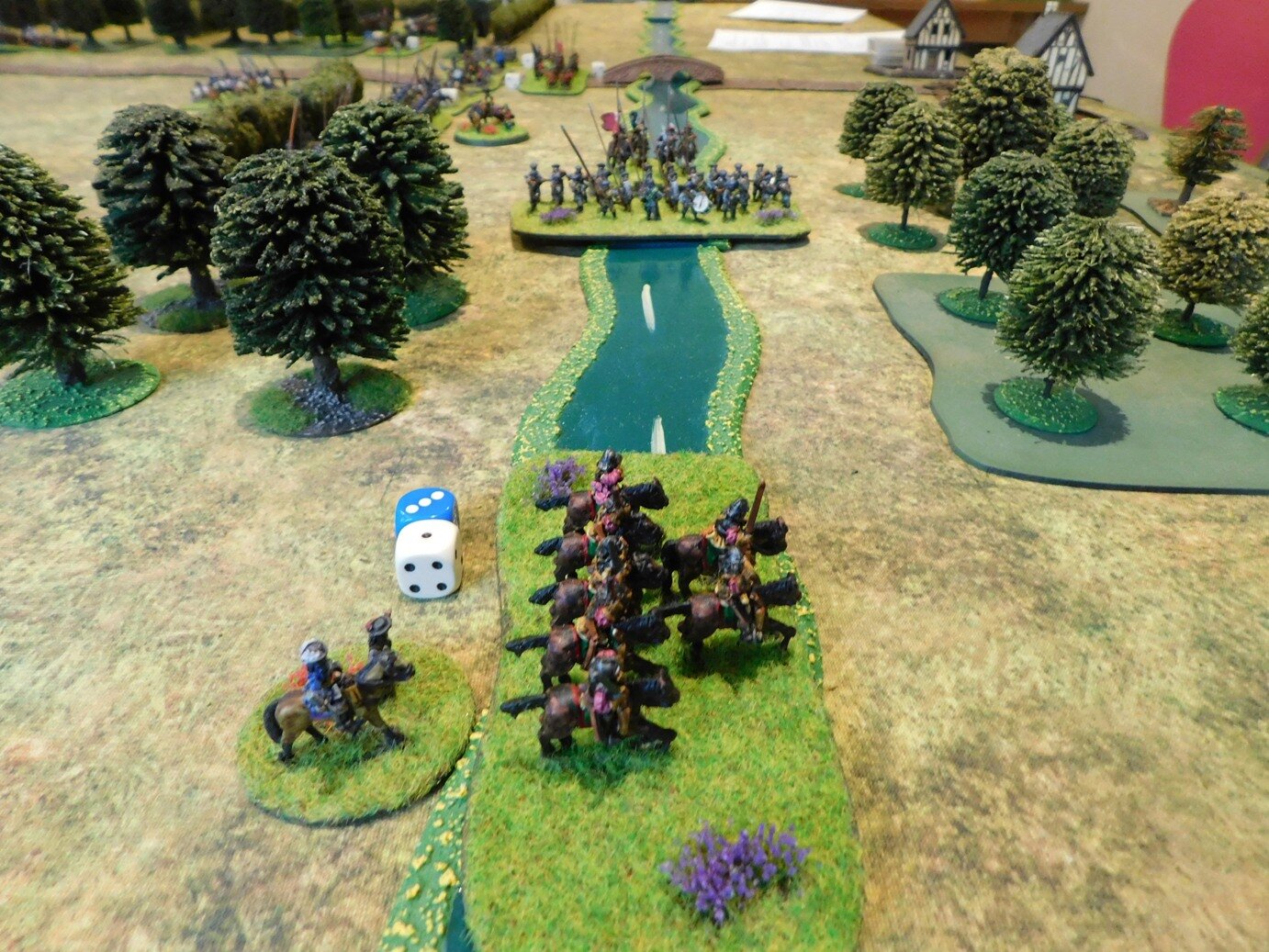
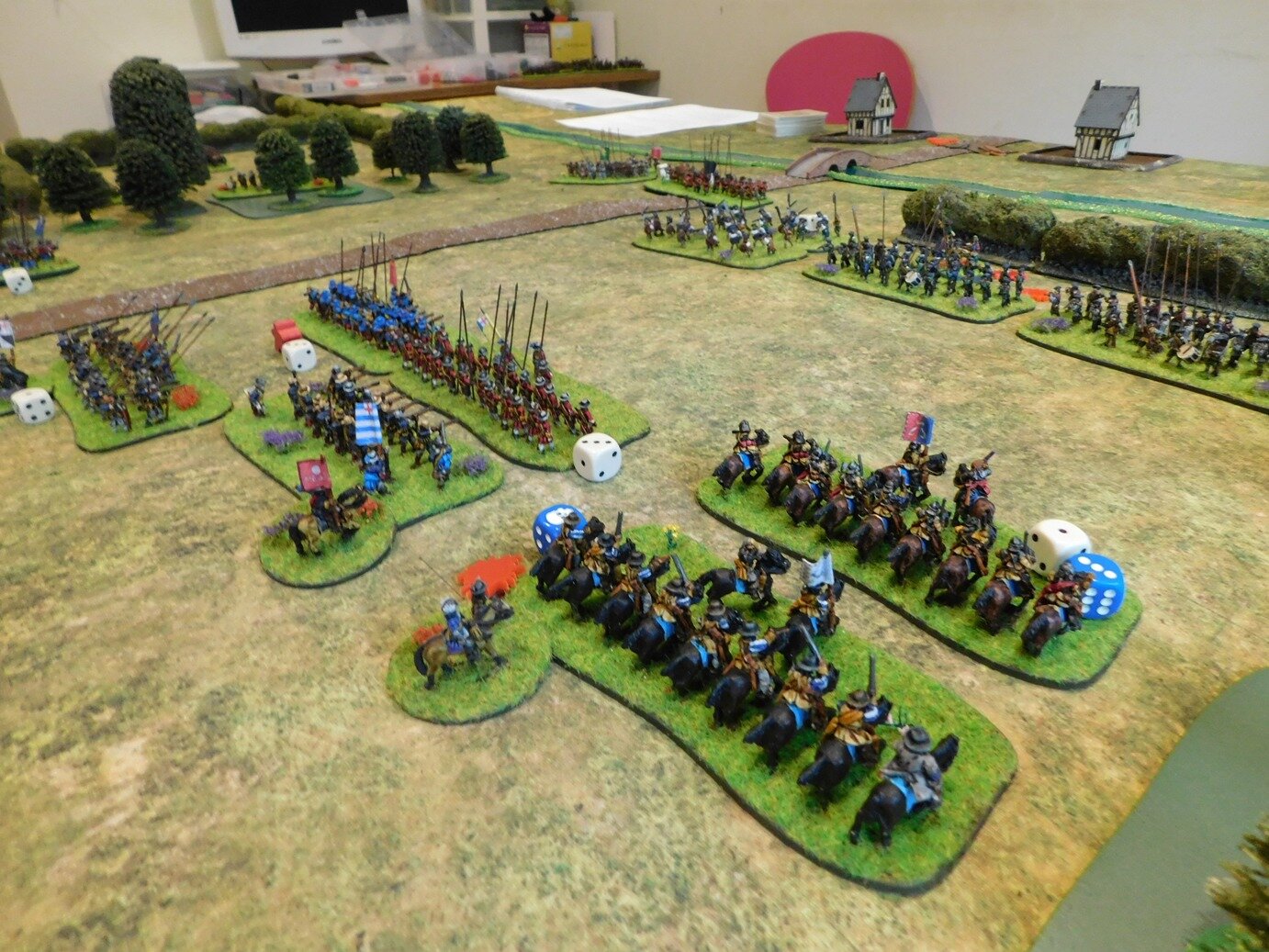
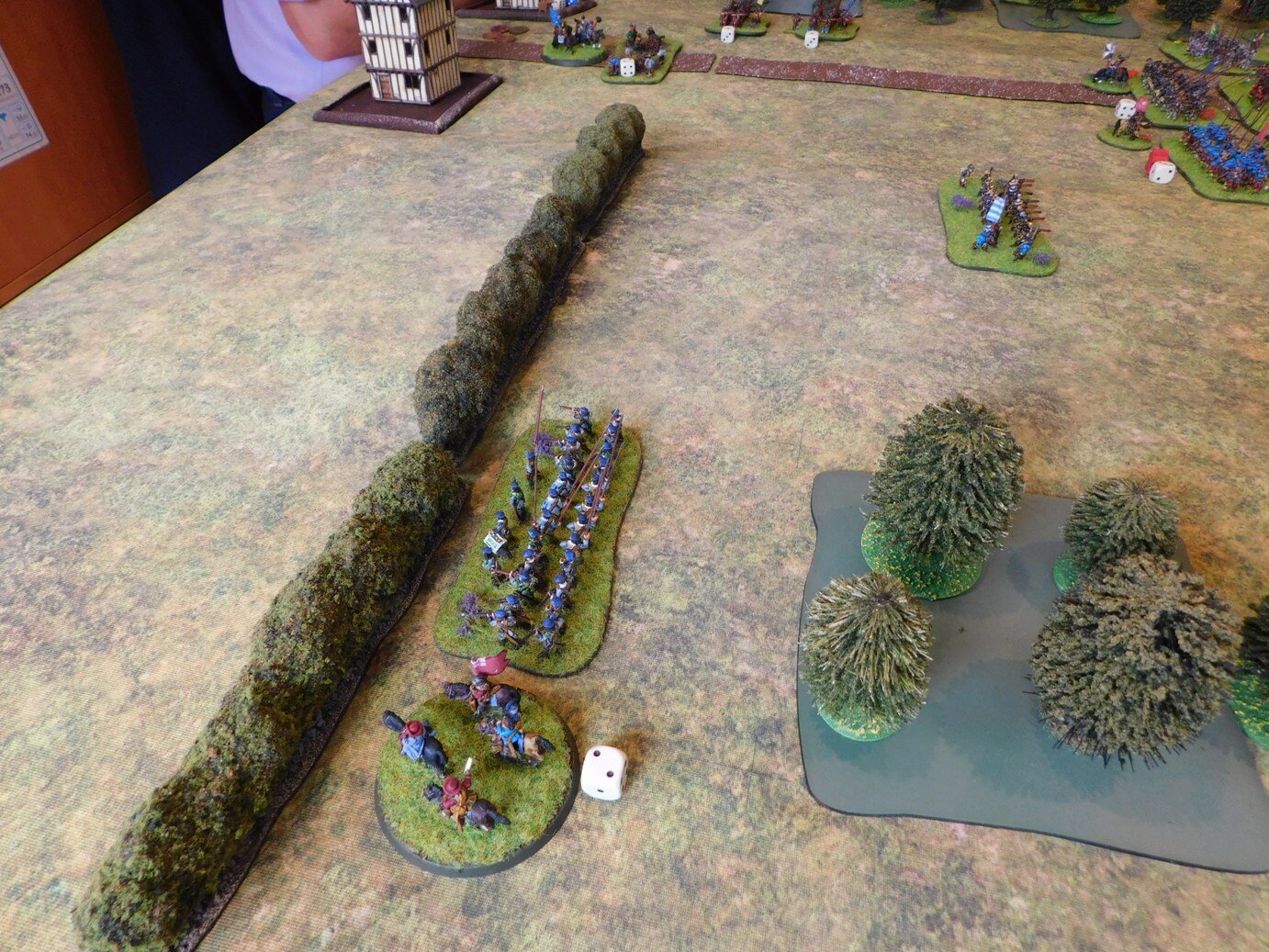
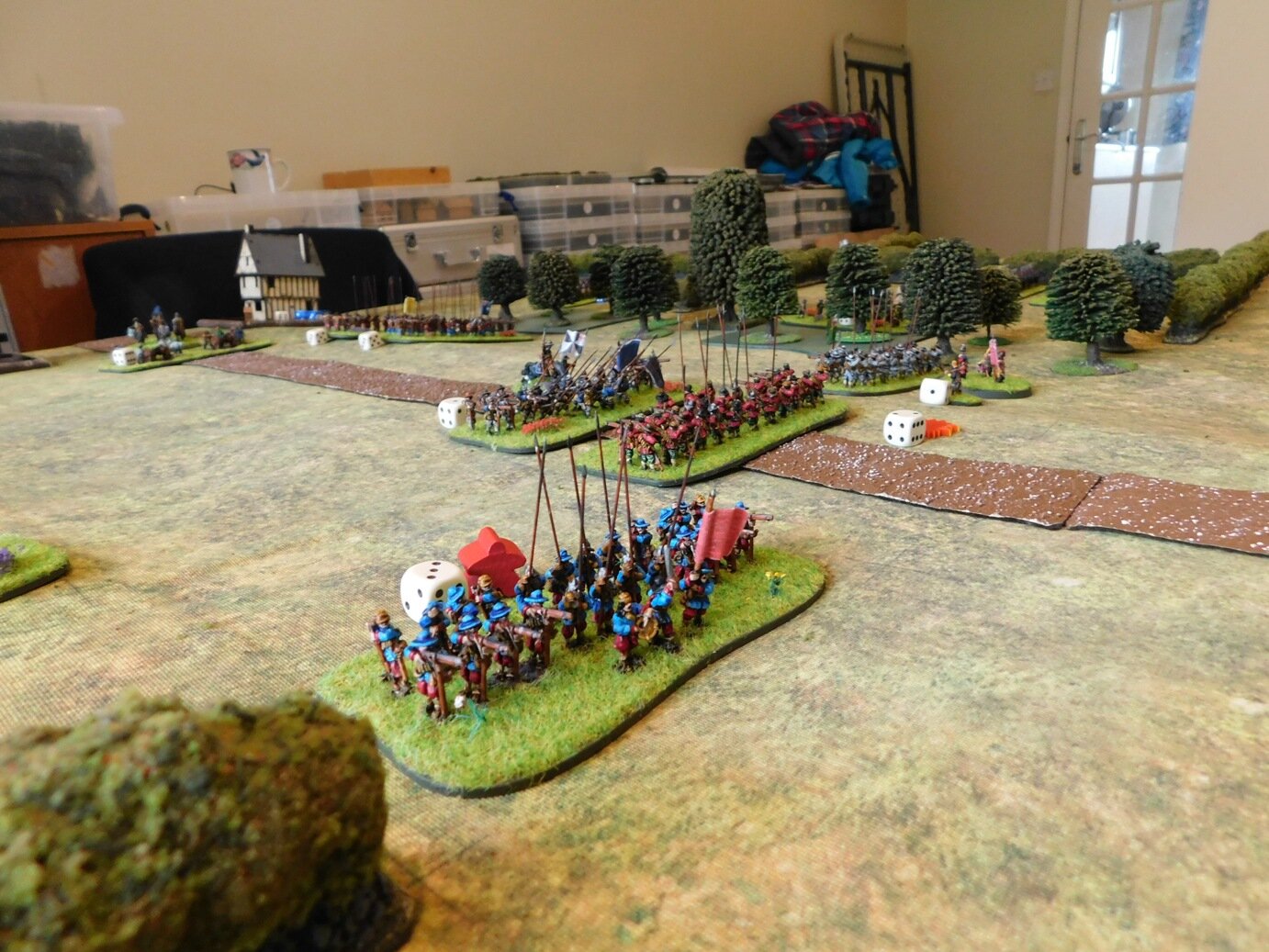
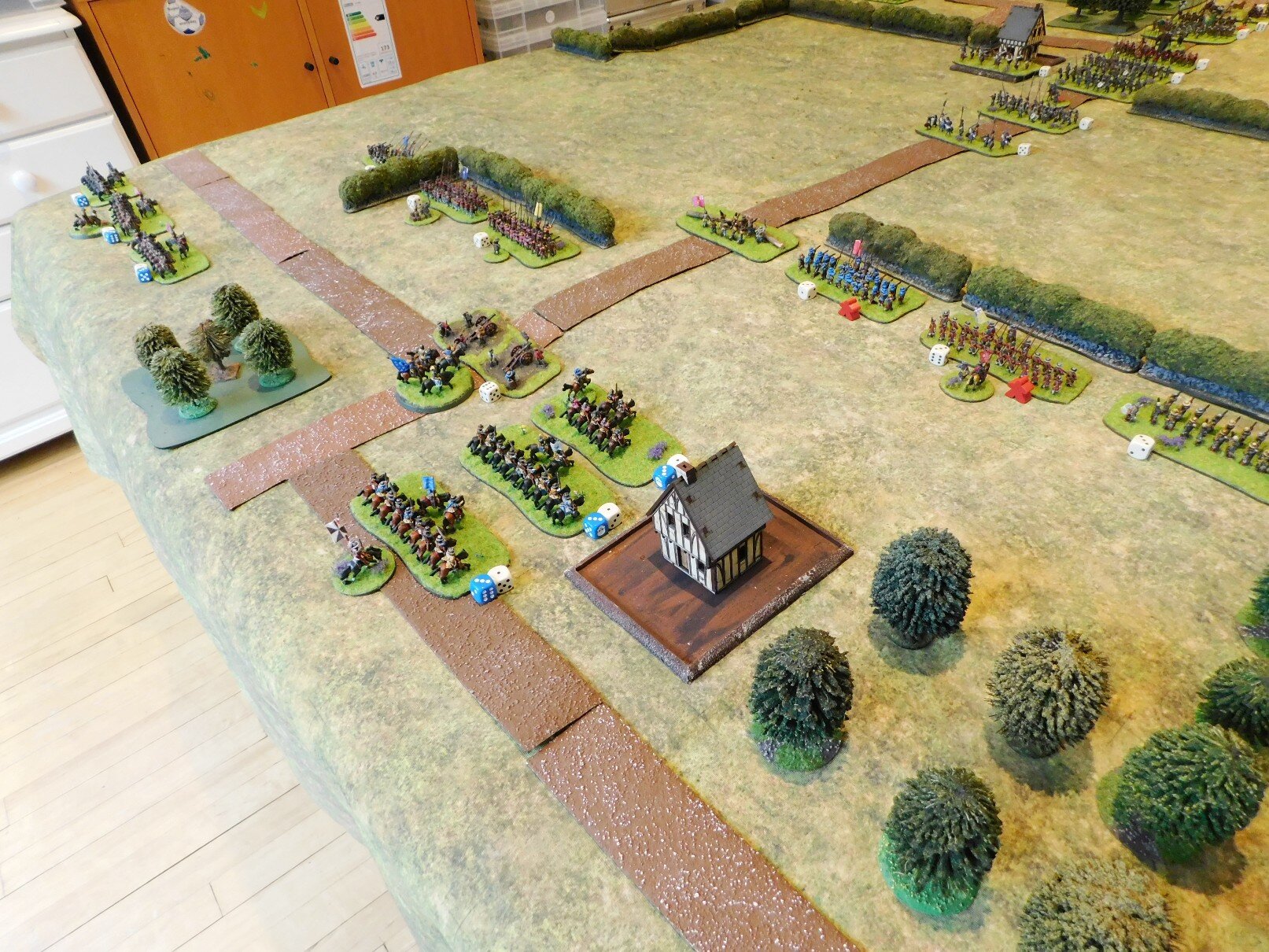
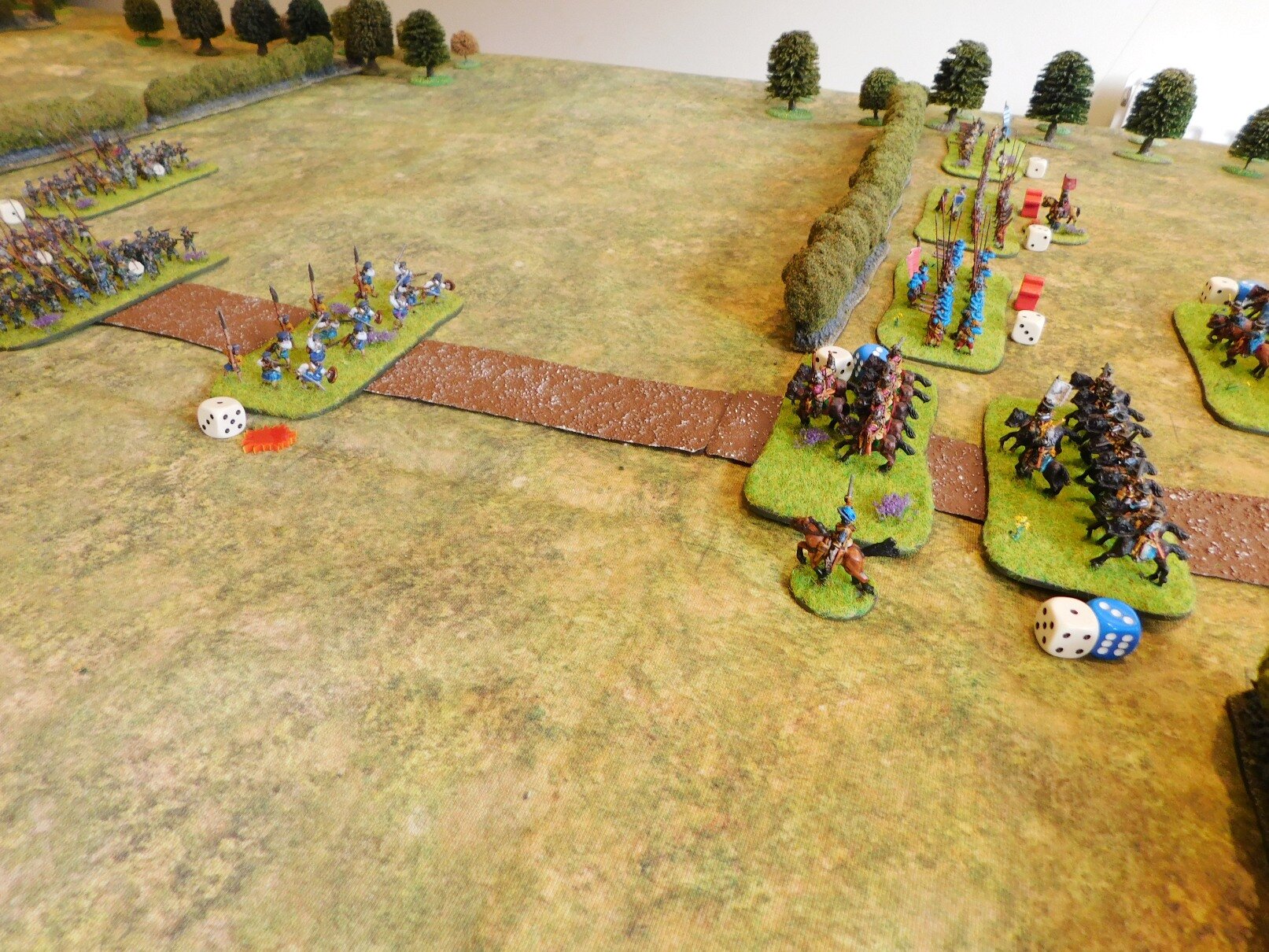
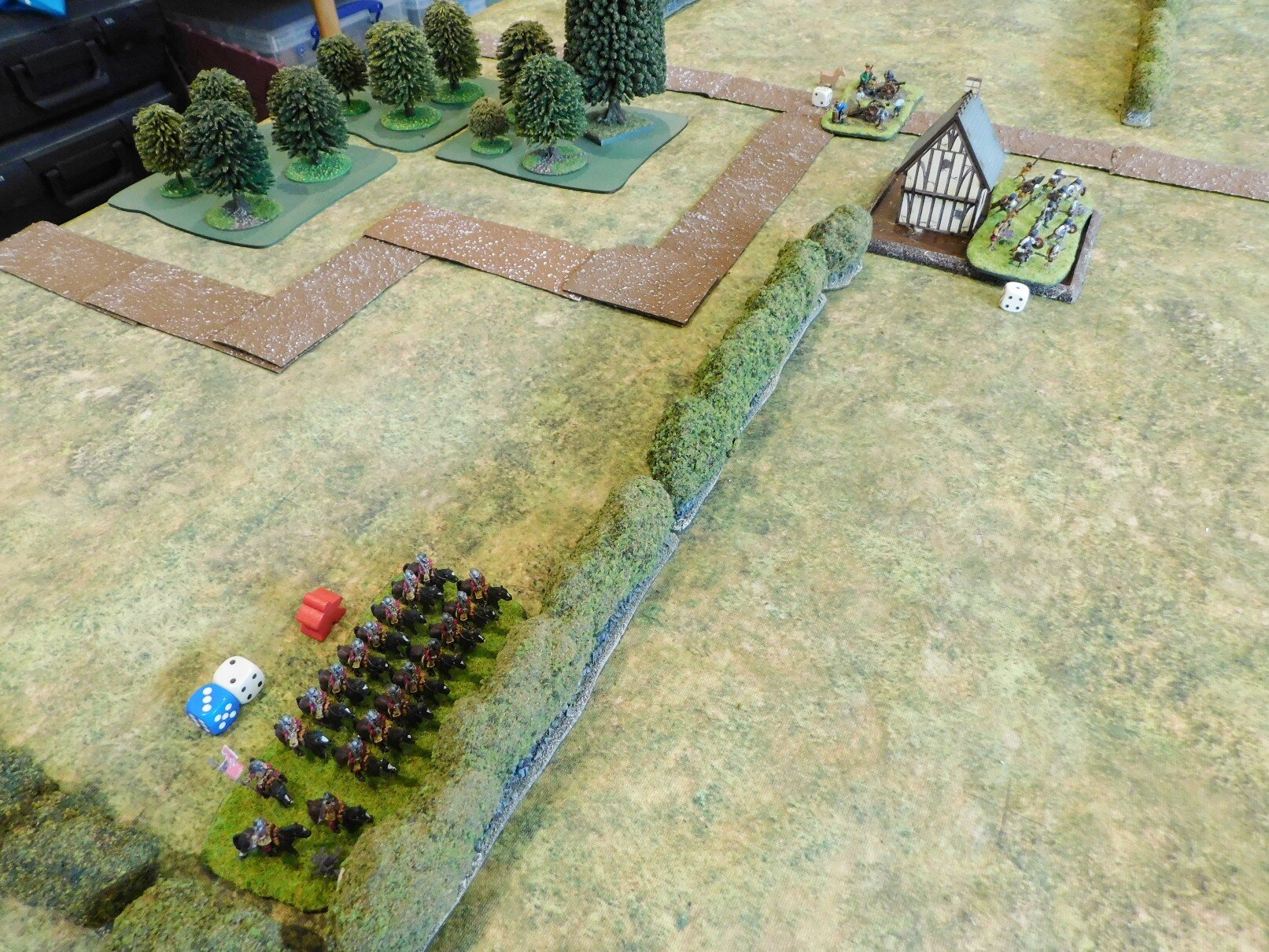
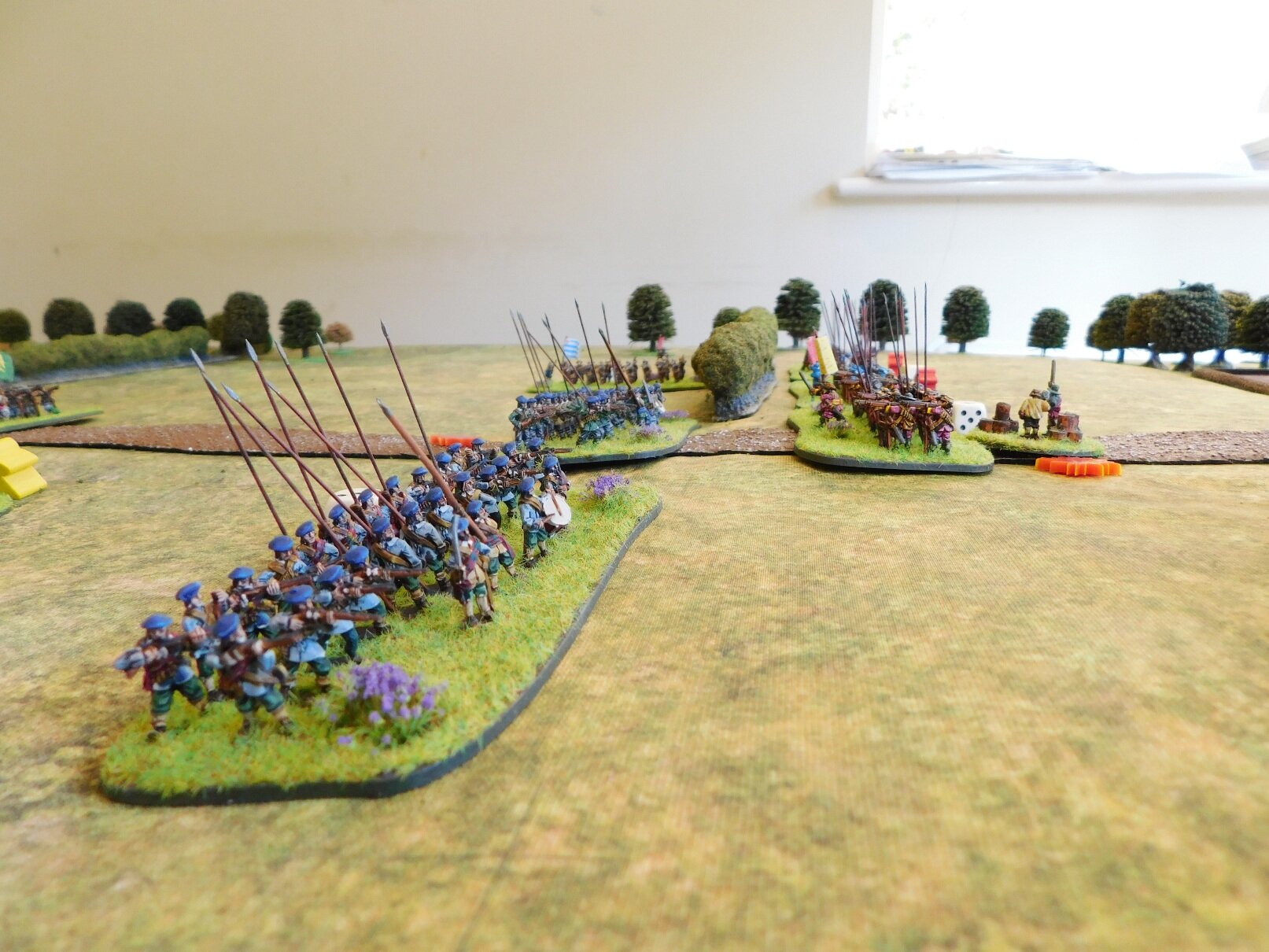
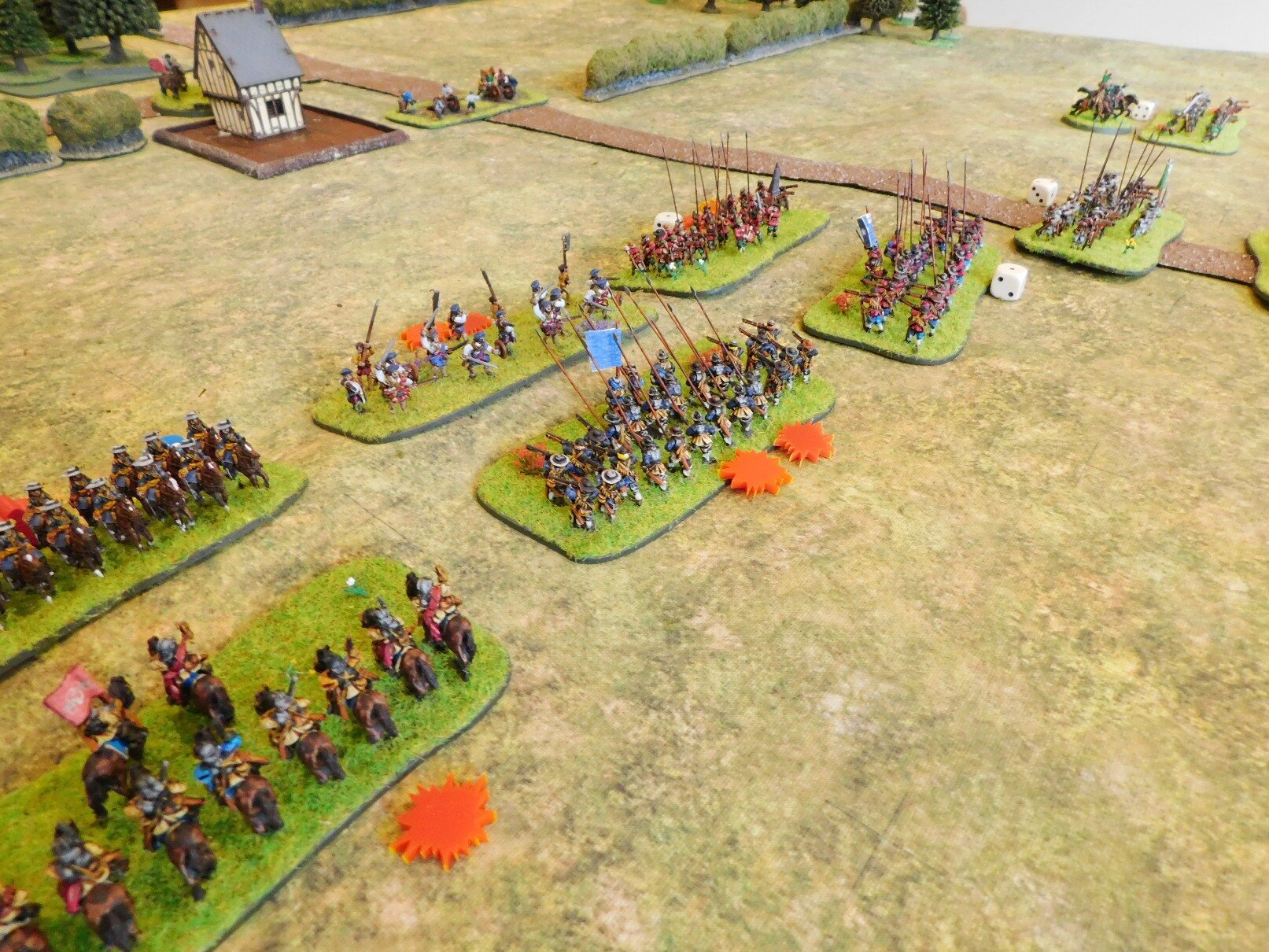
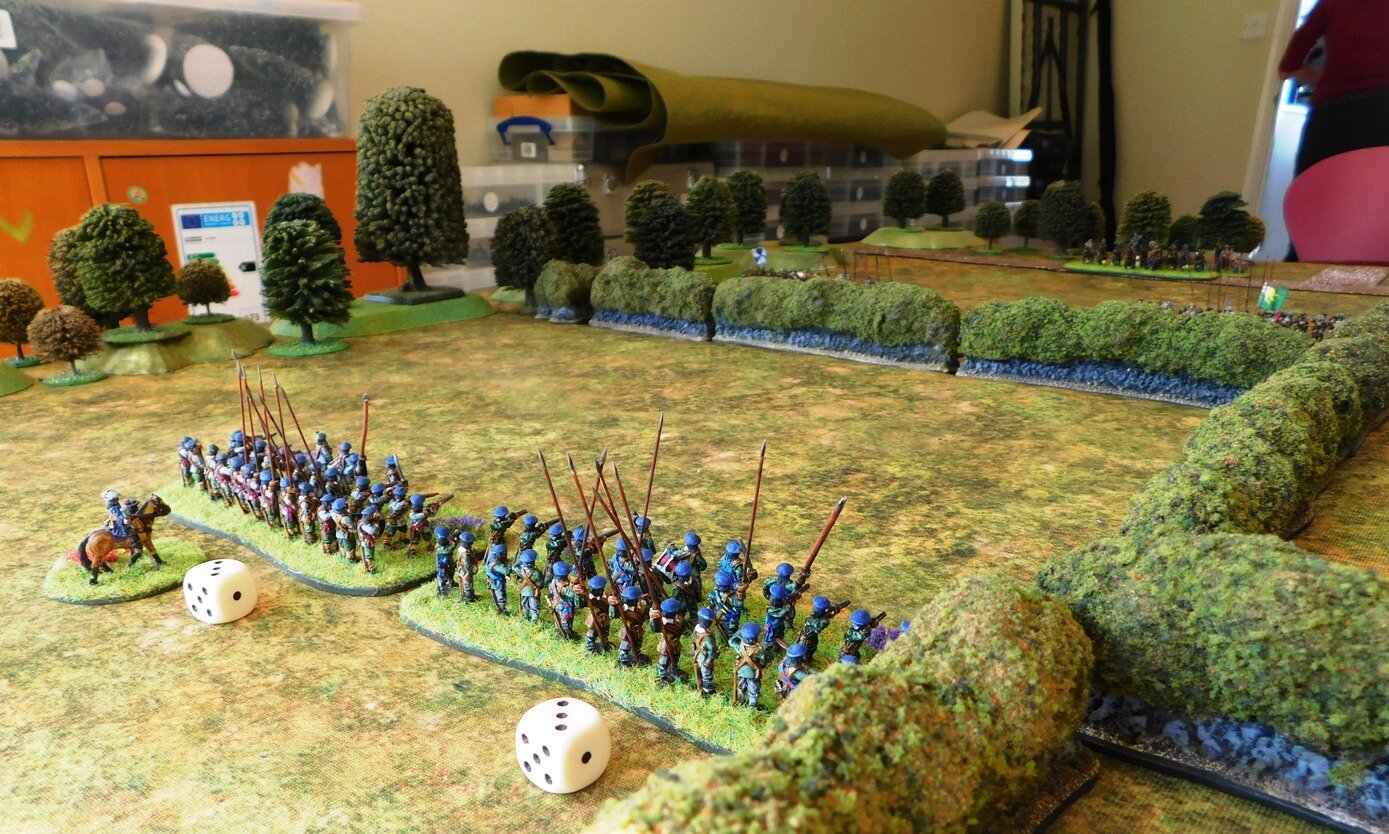
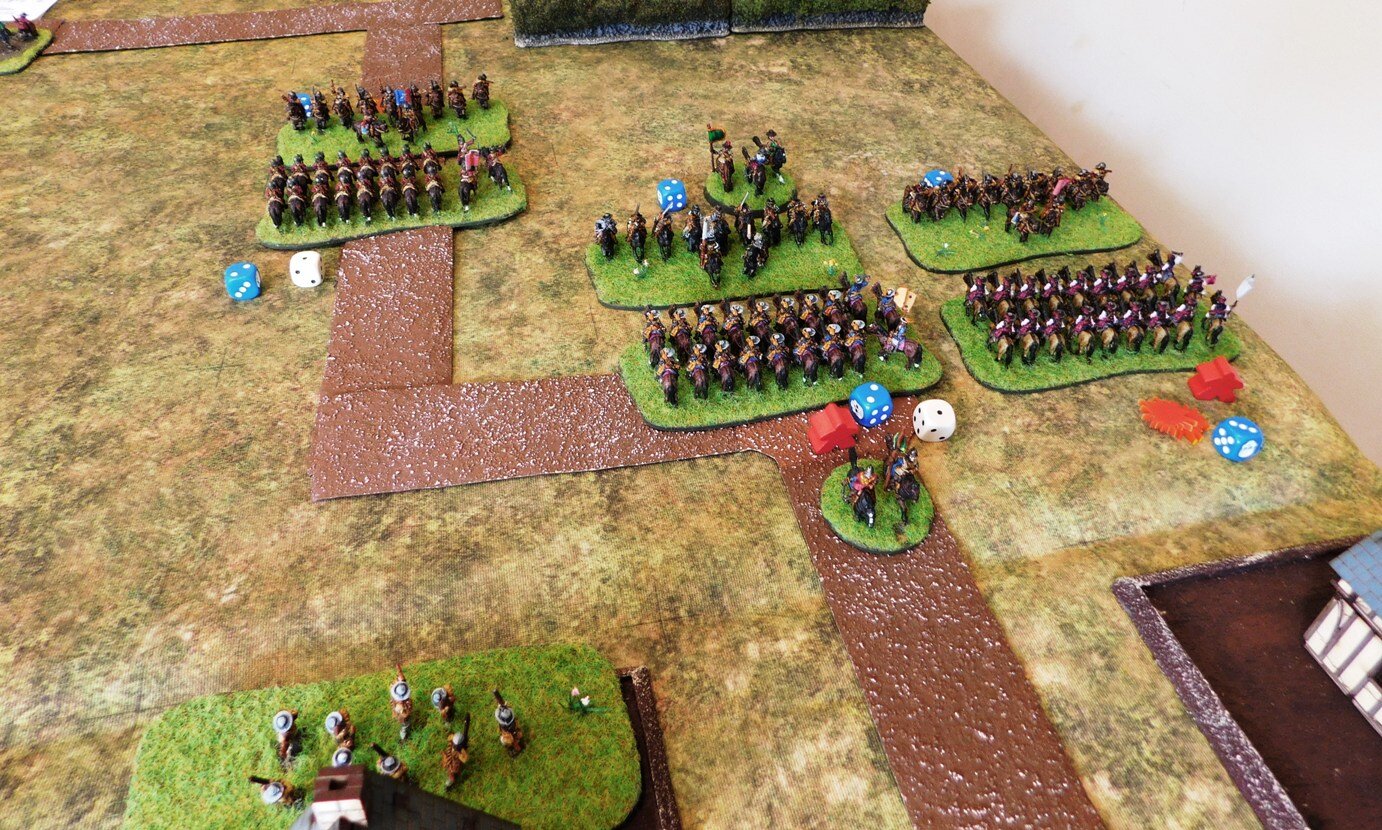
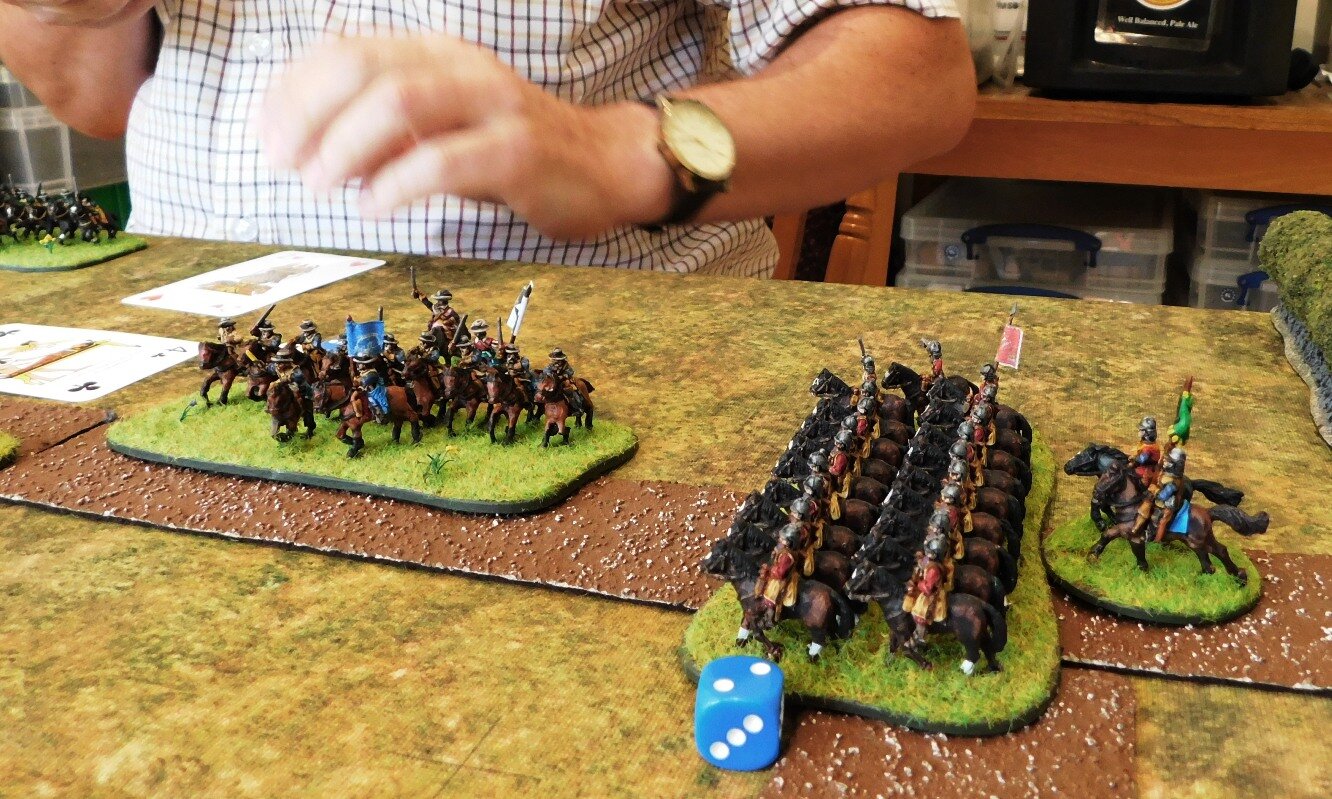
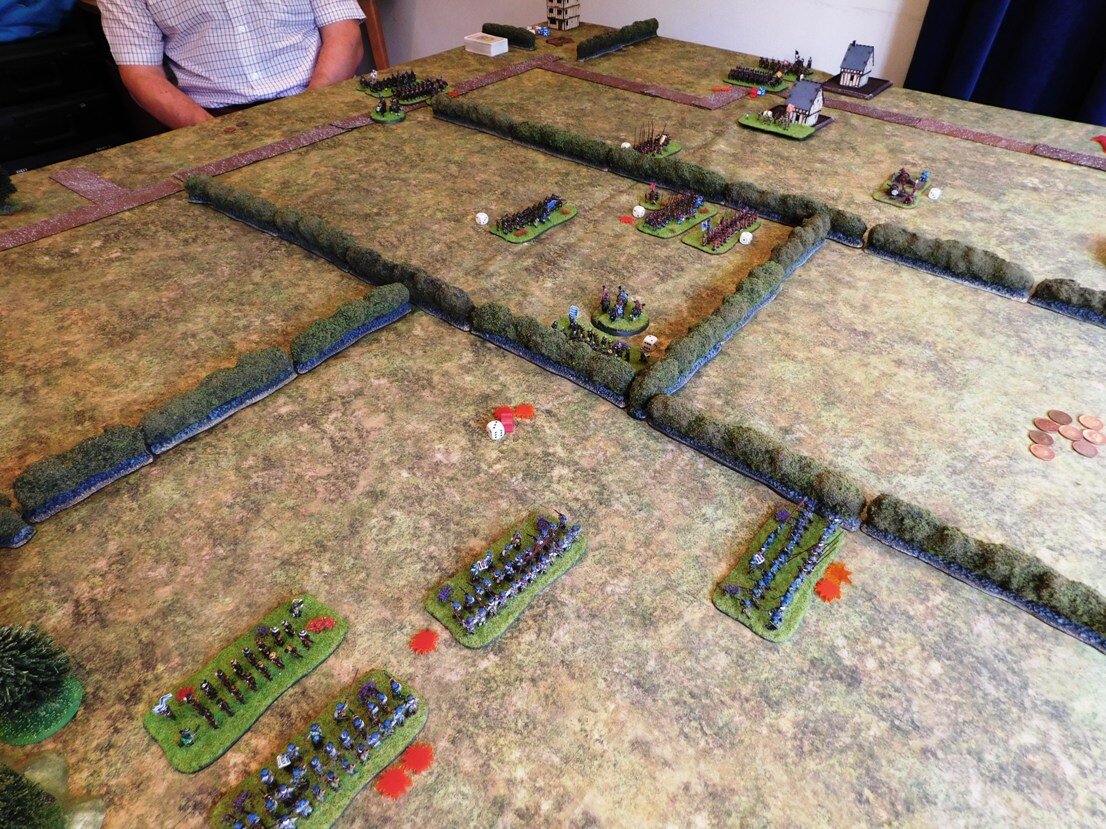
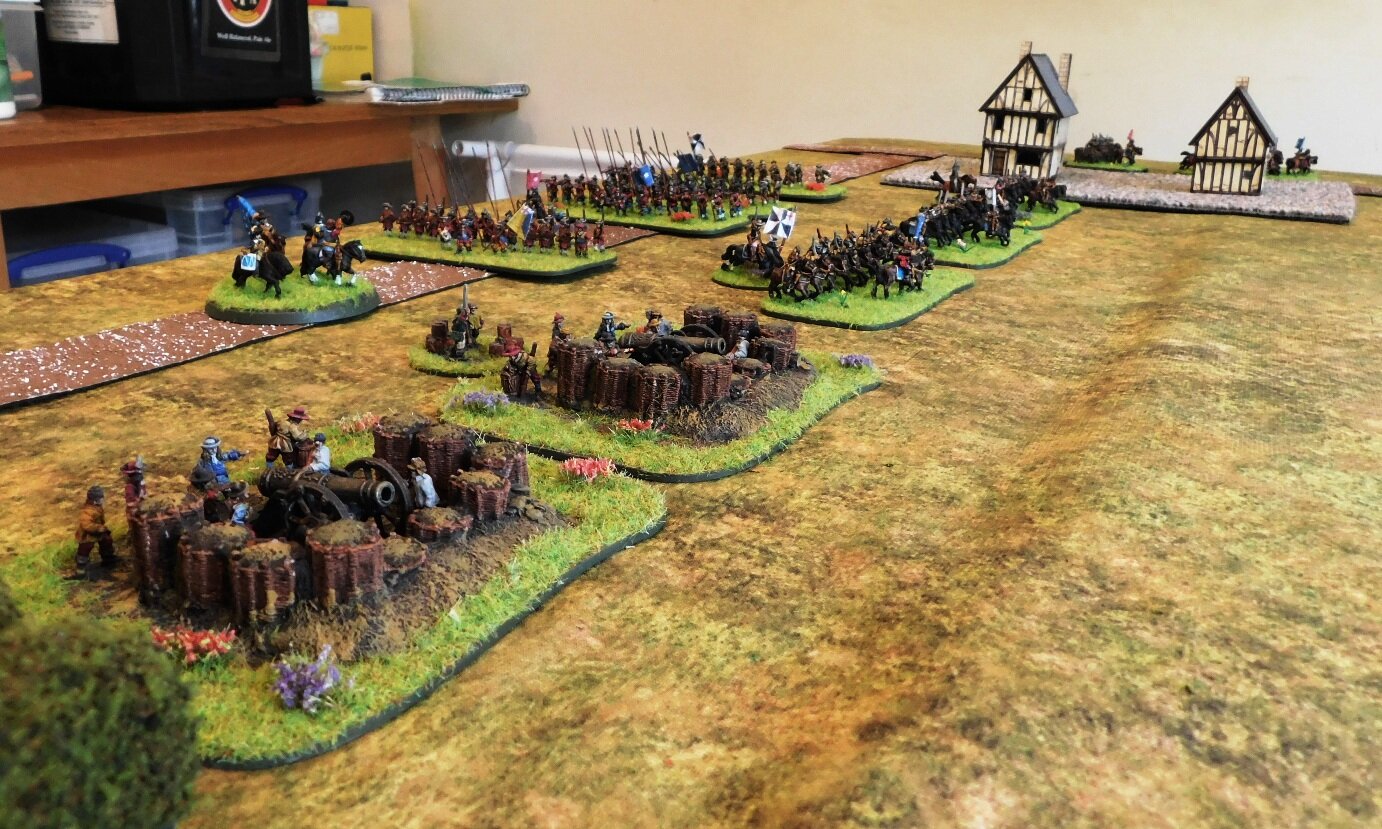
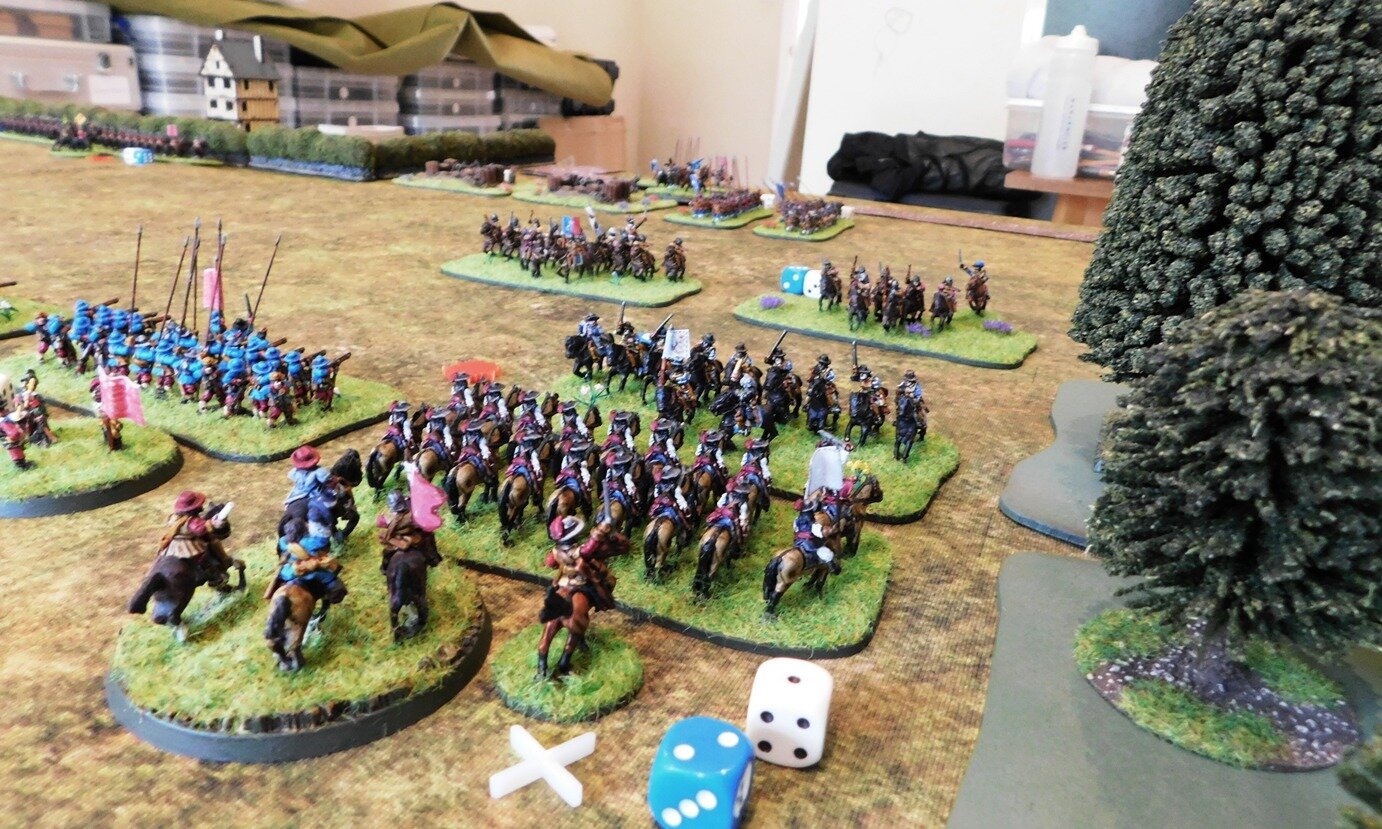
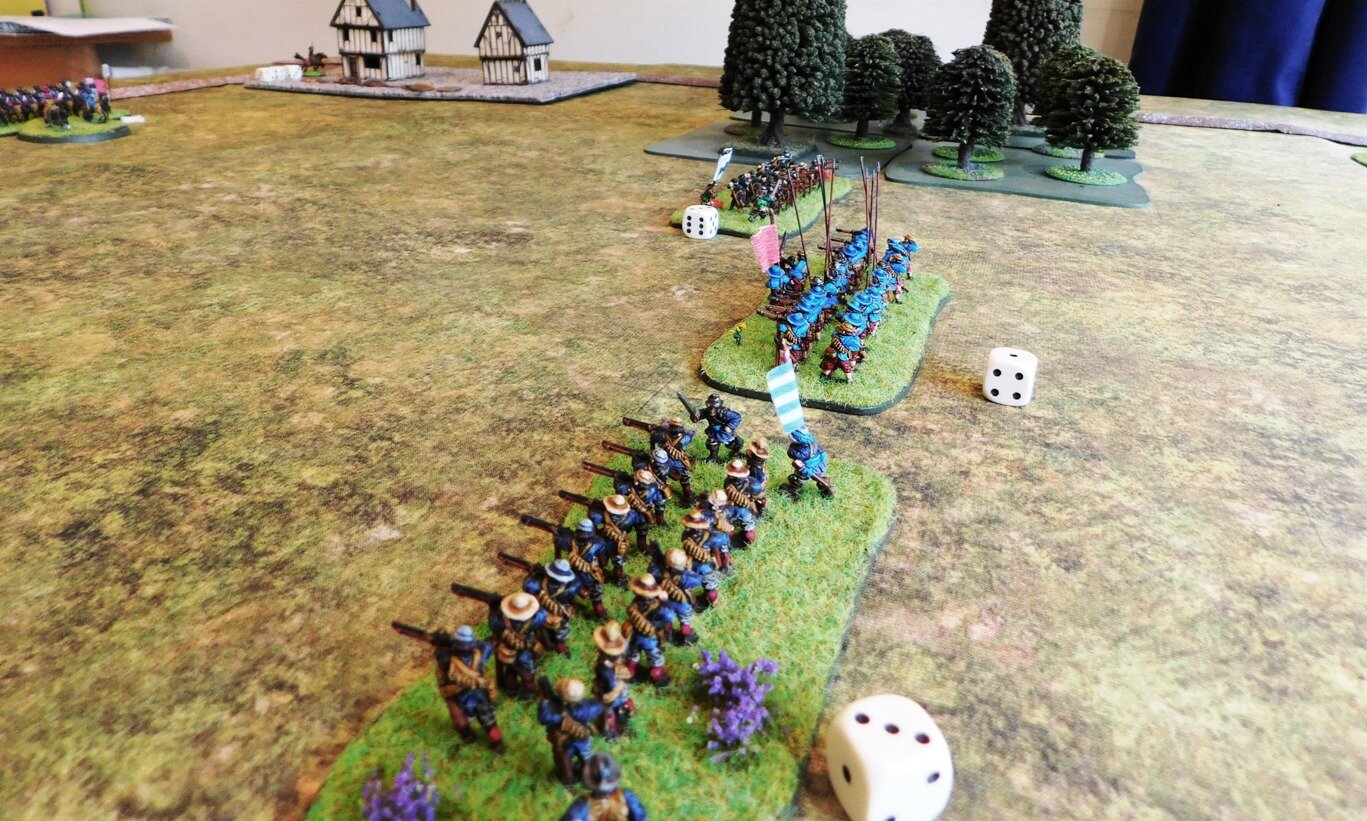
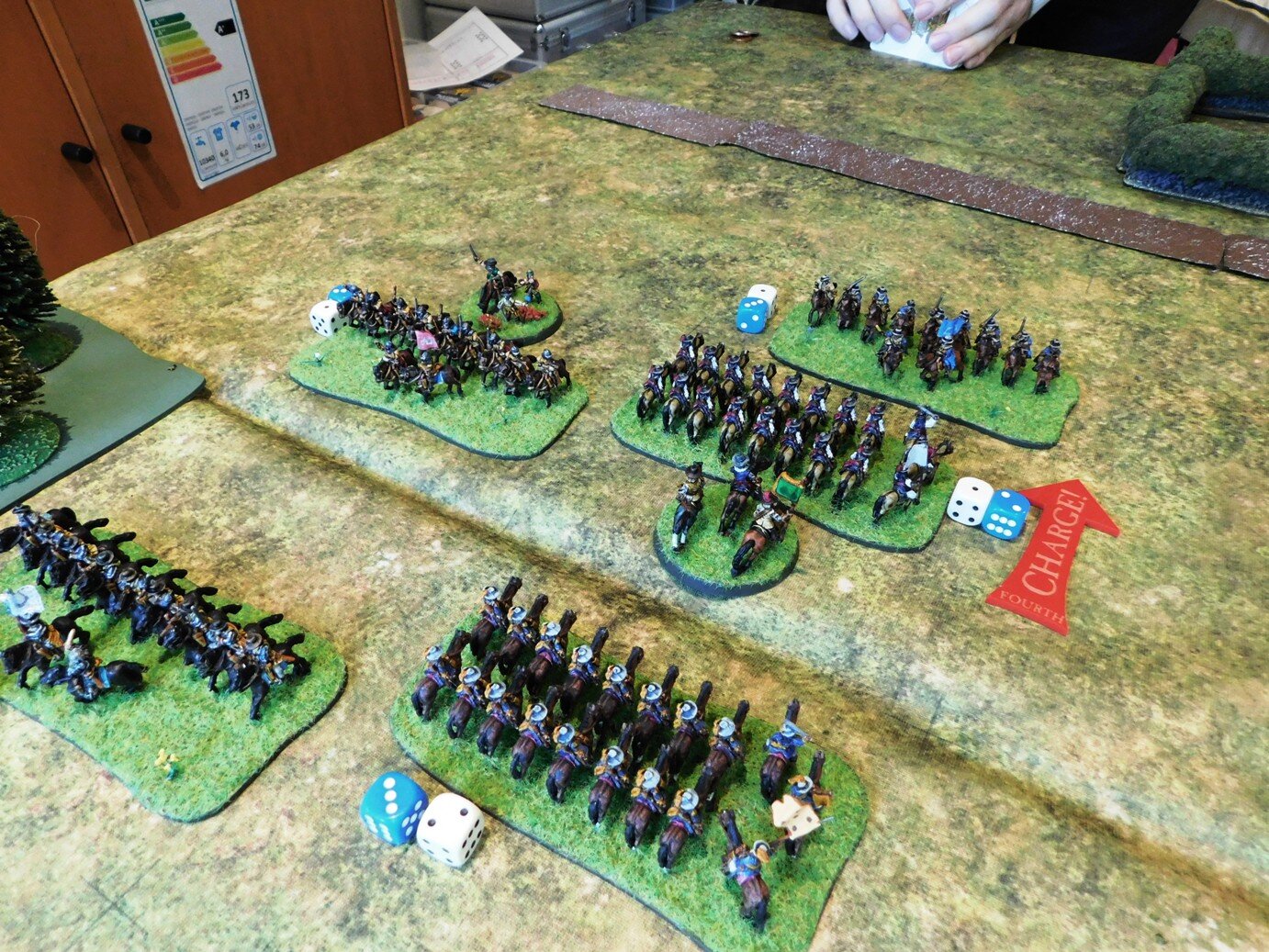
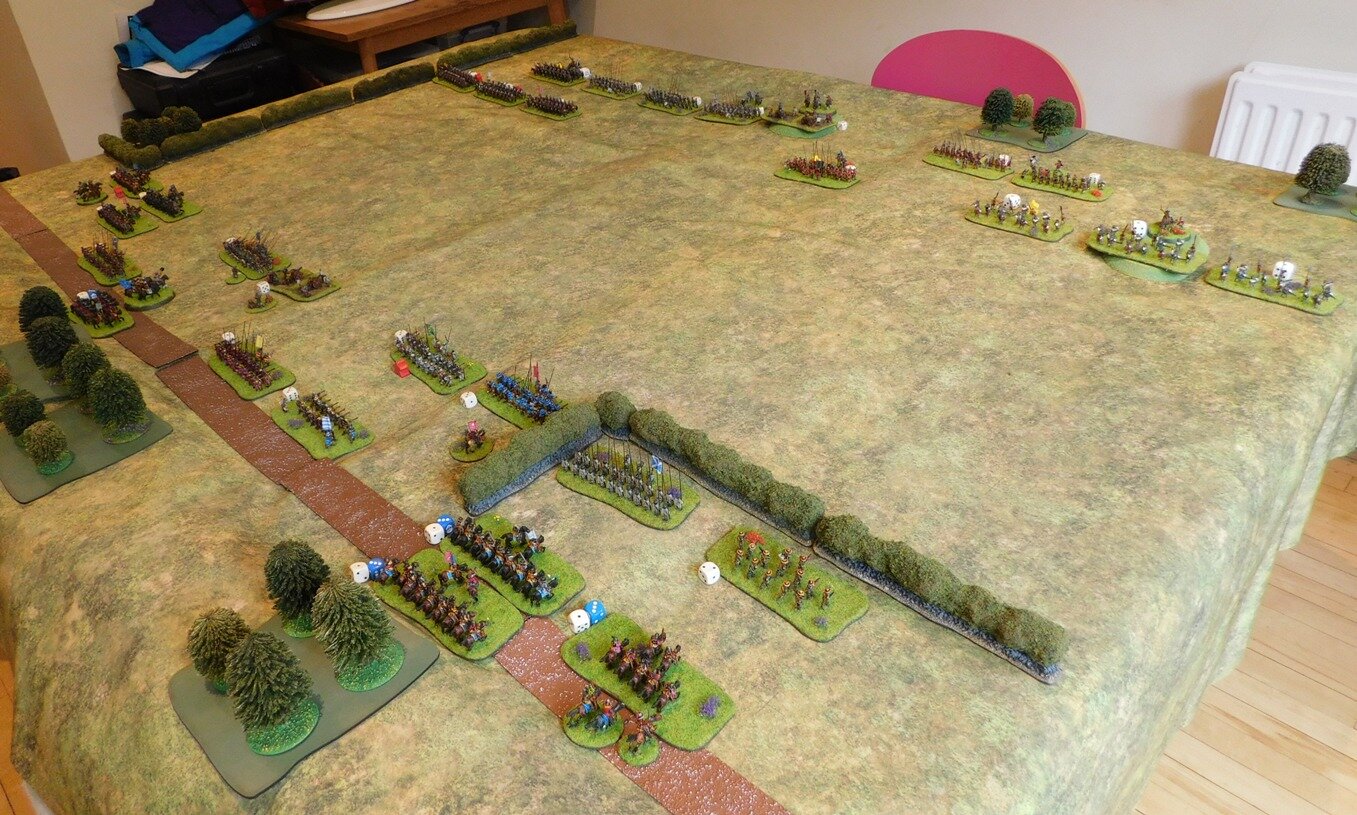
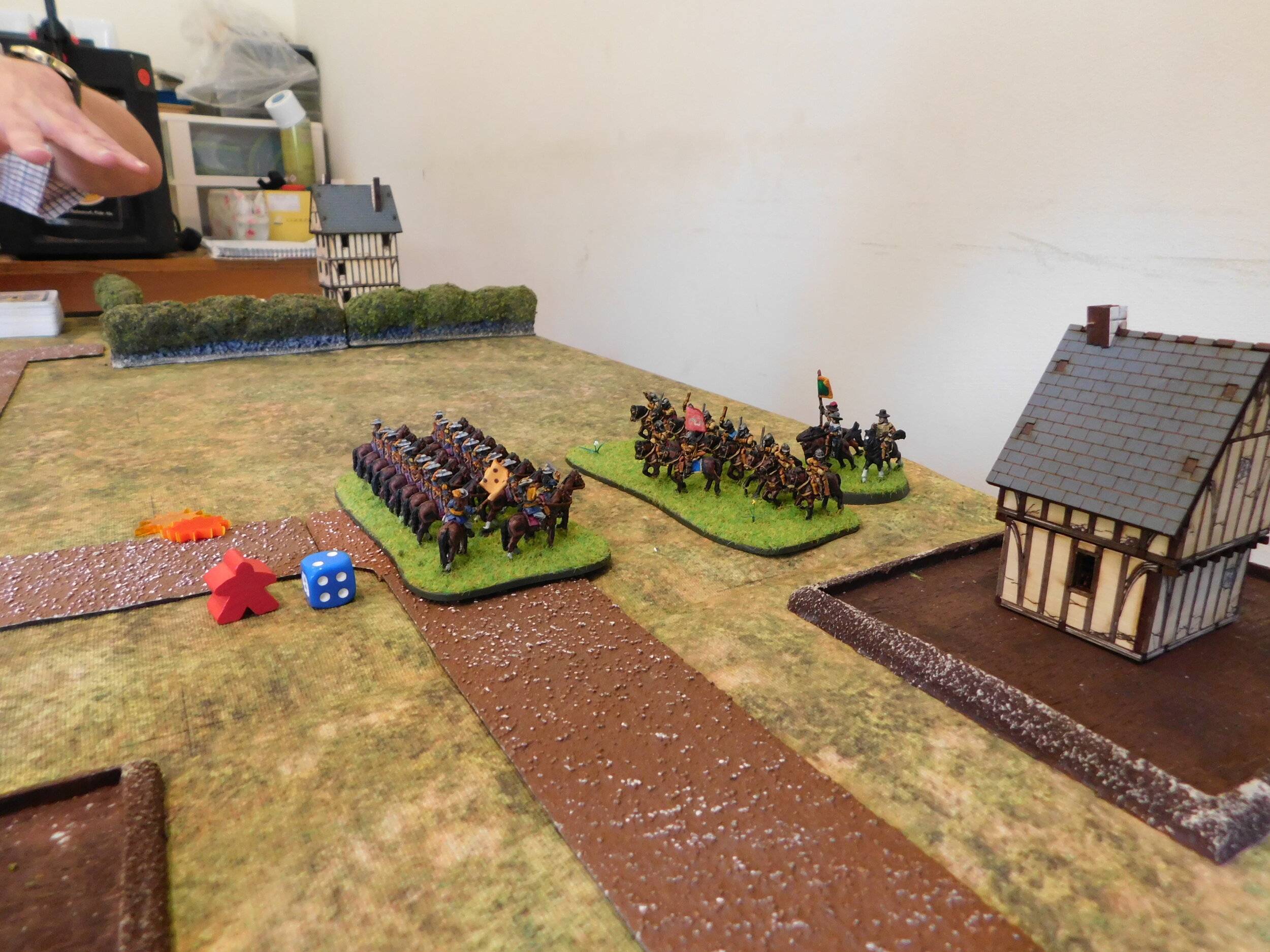
This definitely seemed to work much better, and although I still had one unit (the one at the head of the column) isolated, I now had a bit of a battle line formed to hold the front whilst the rest of my troops deployed. As you can see in the photo below, the Royalists spotted my isolated Highlanders and charged them with a small unit of “bodyguard” Cuirassiers.

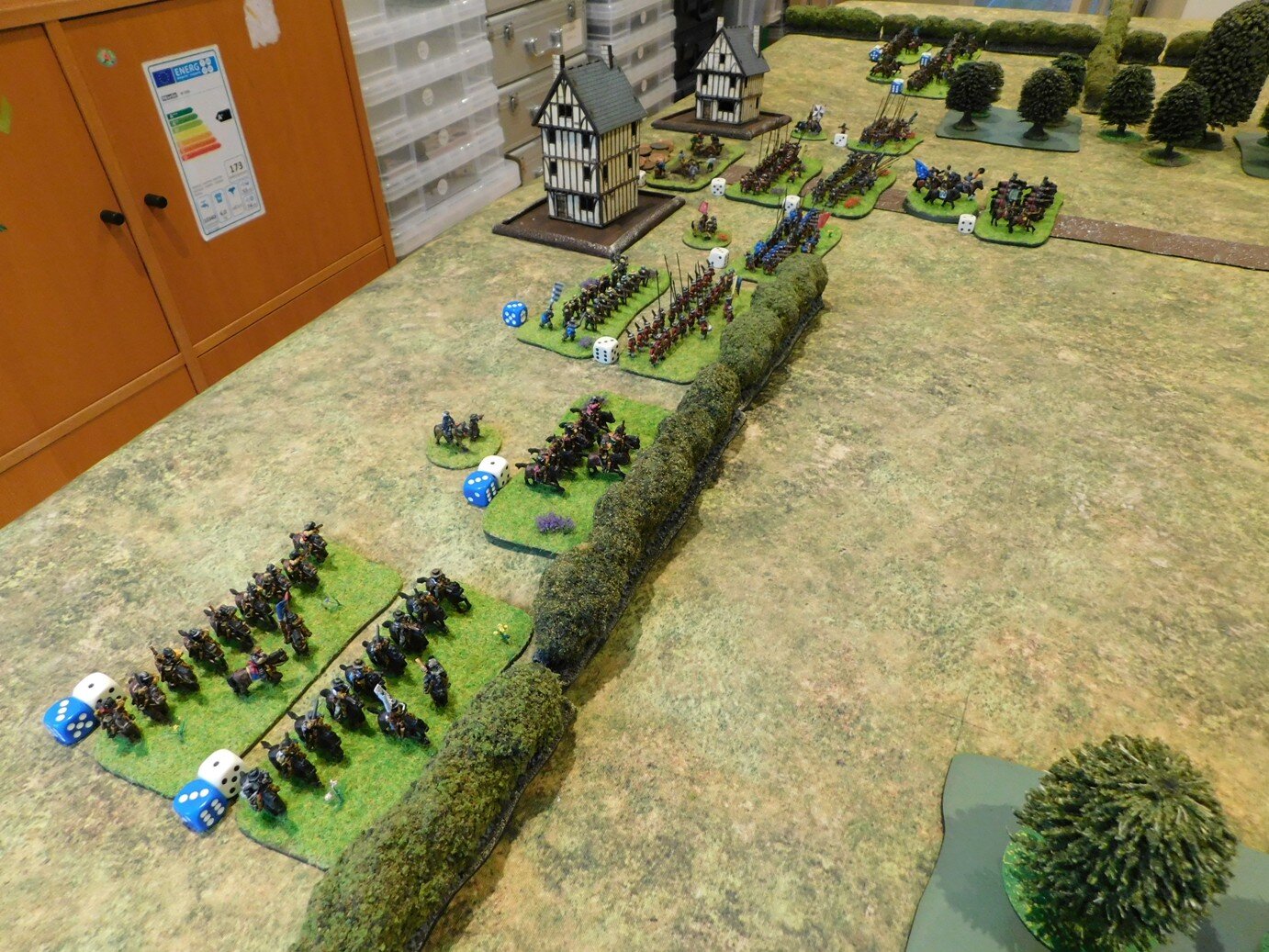
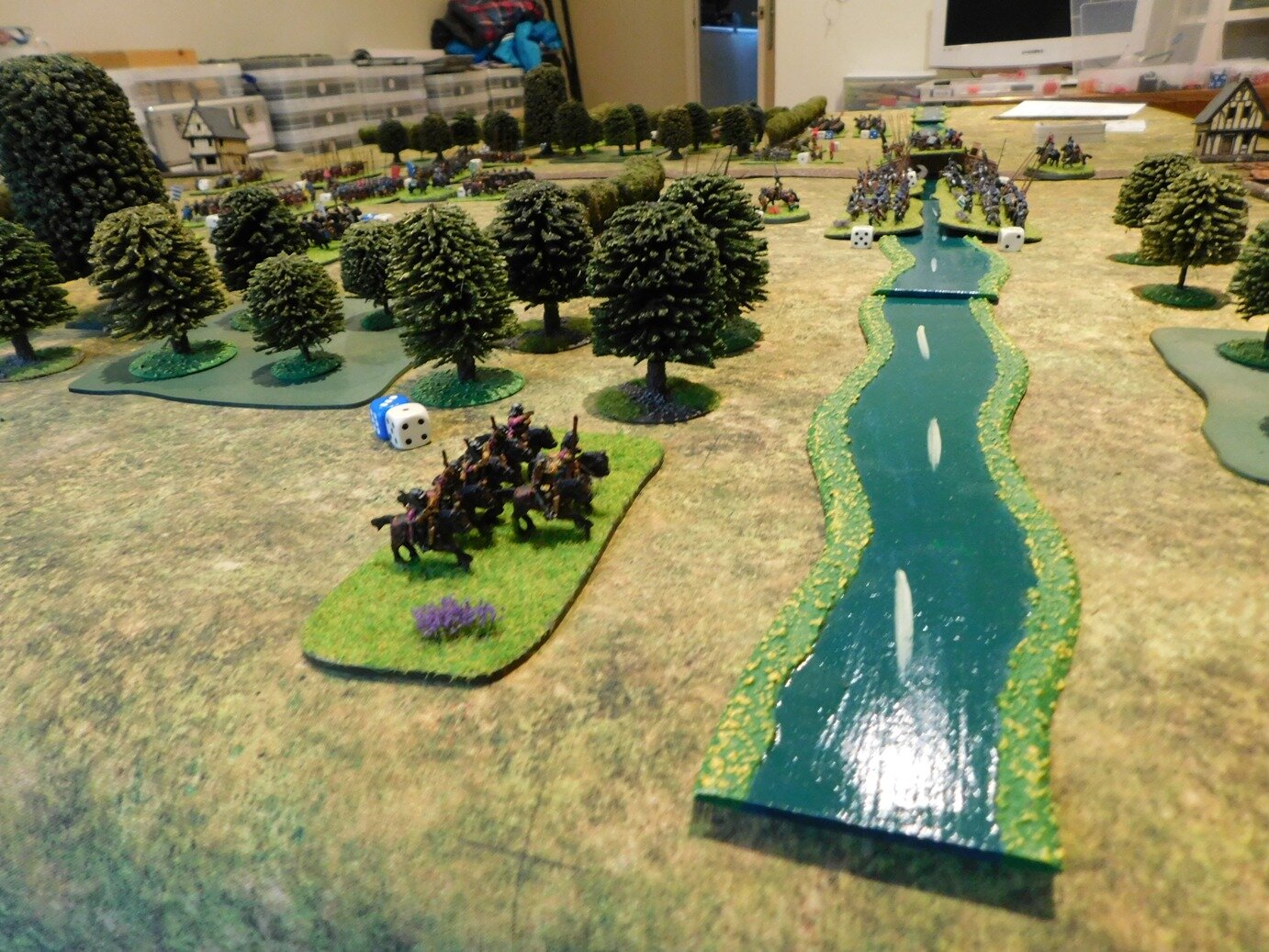
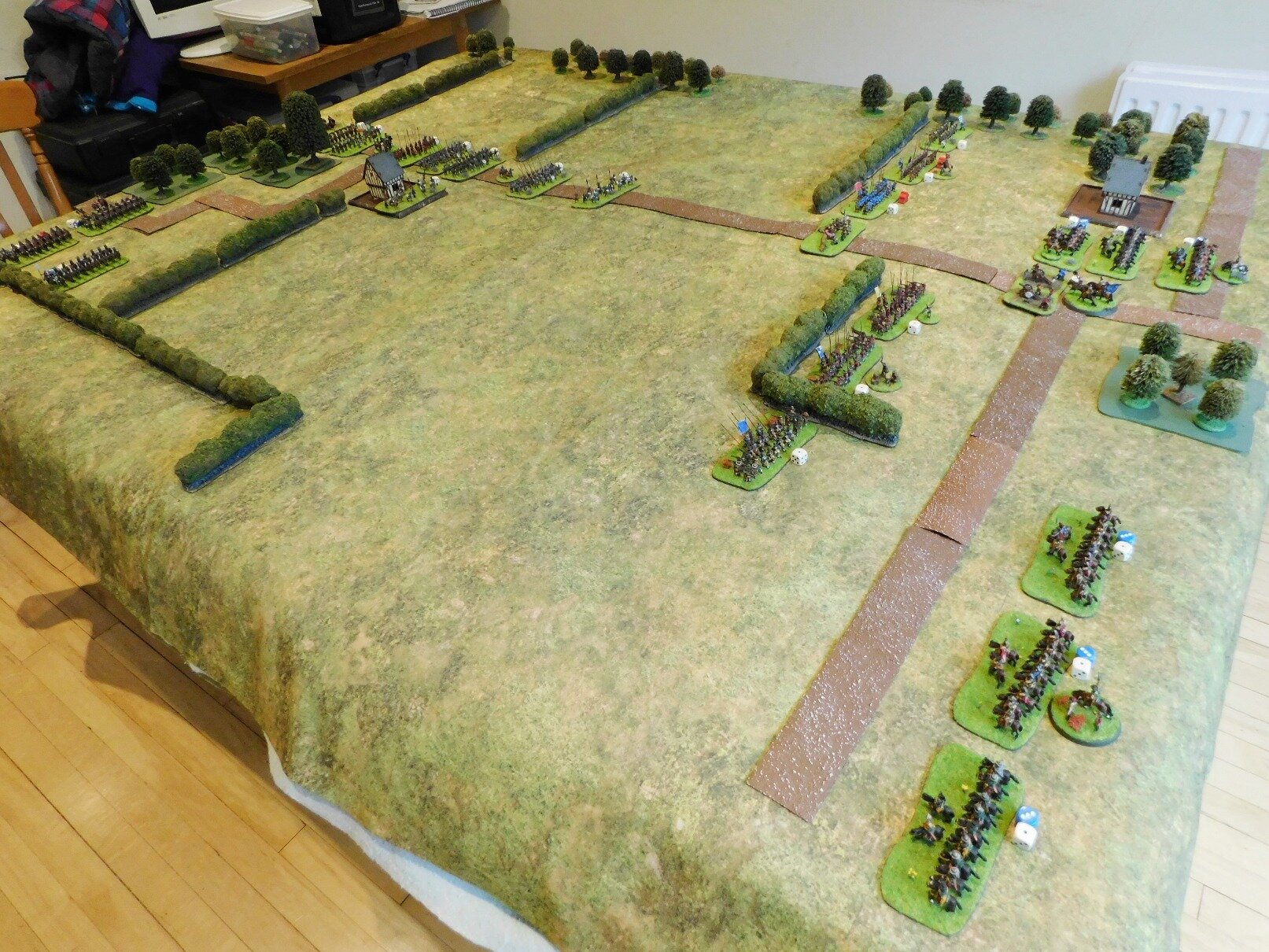
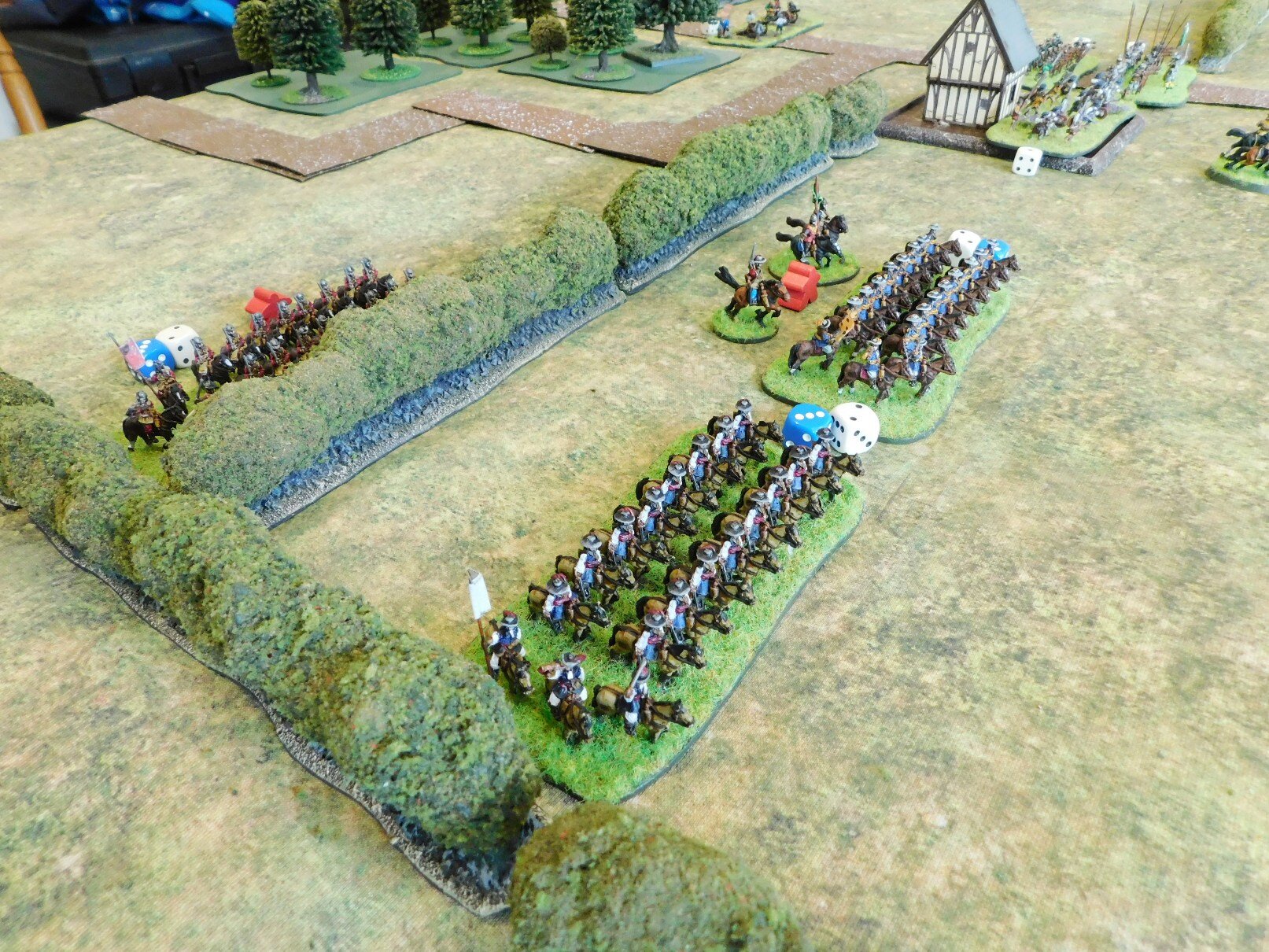
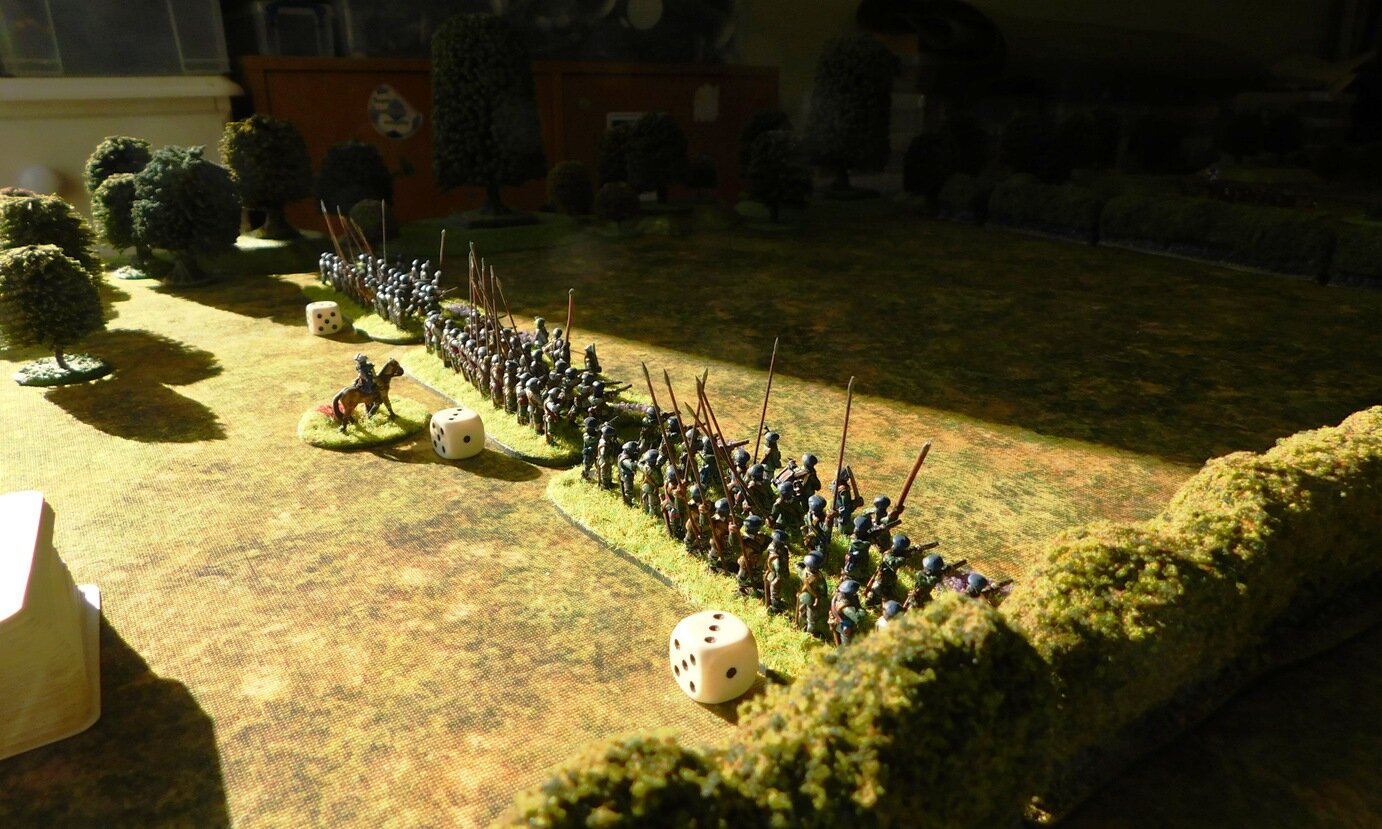
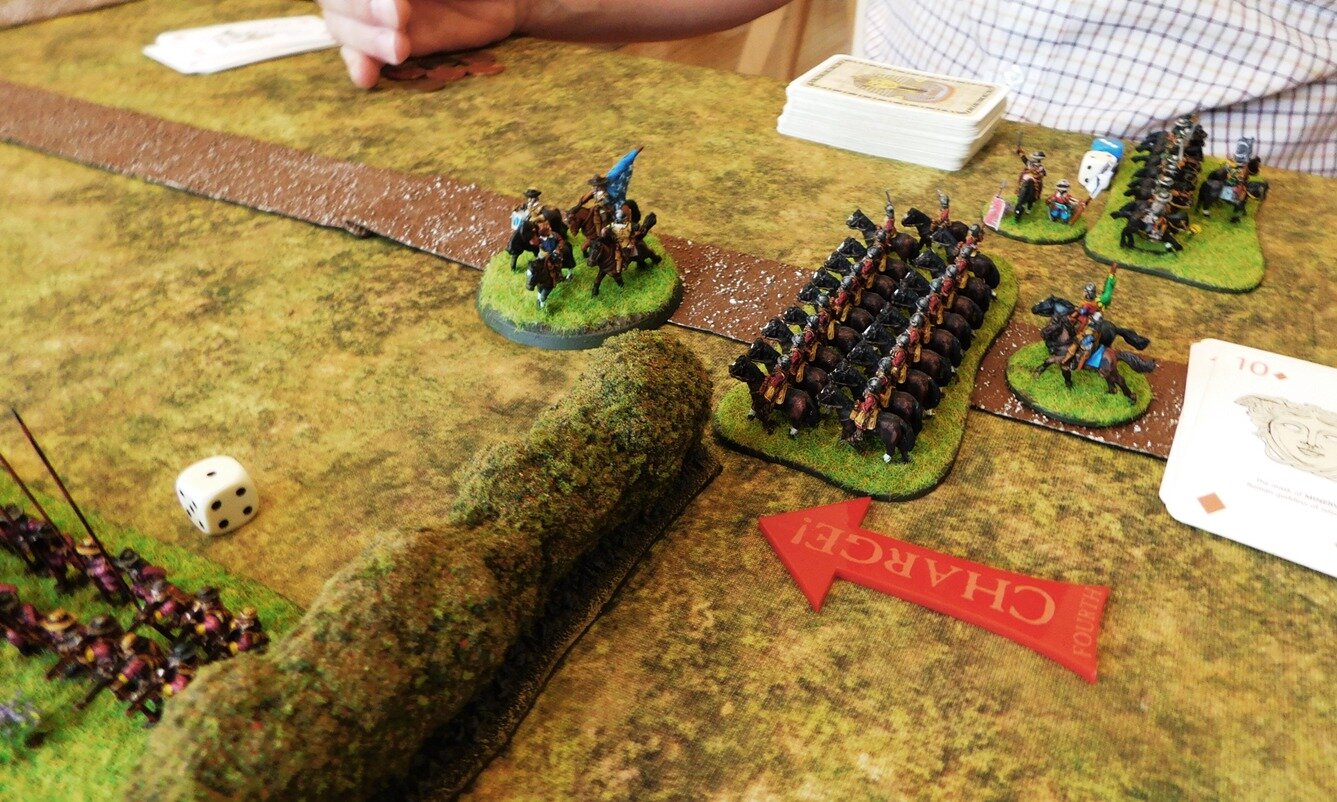
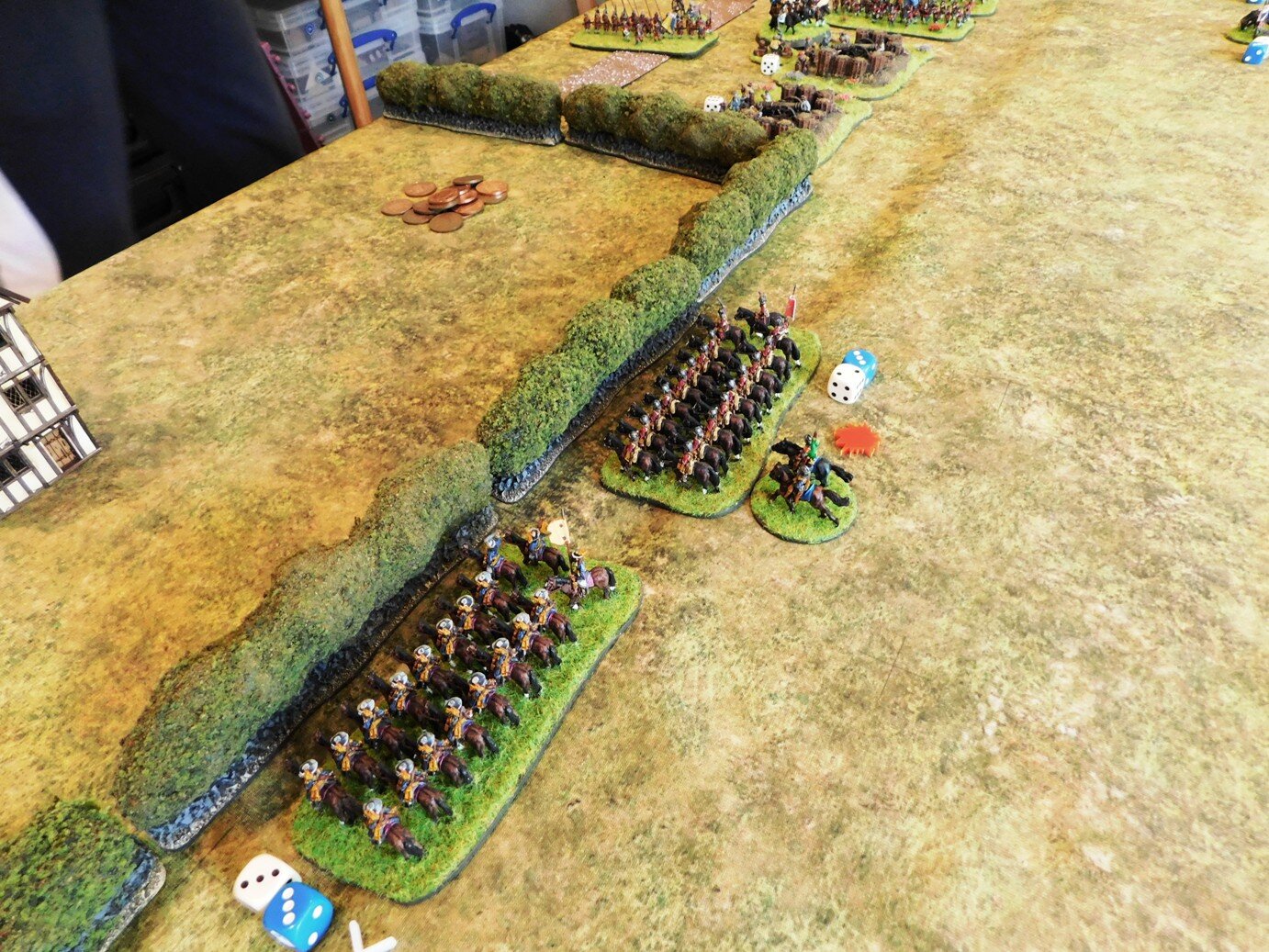
All my cavalry were on my right flank, so I advanced them forward to block his cavalry moving down behind a hedge and into my rear.

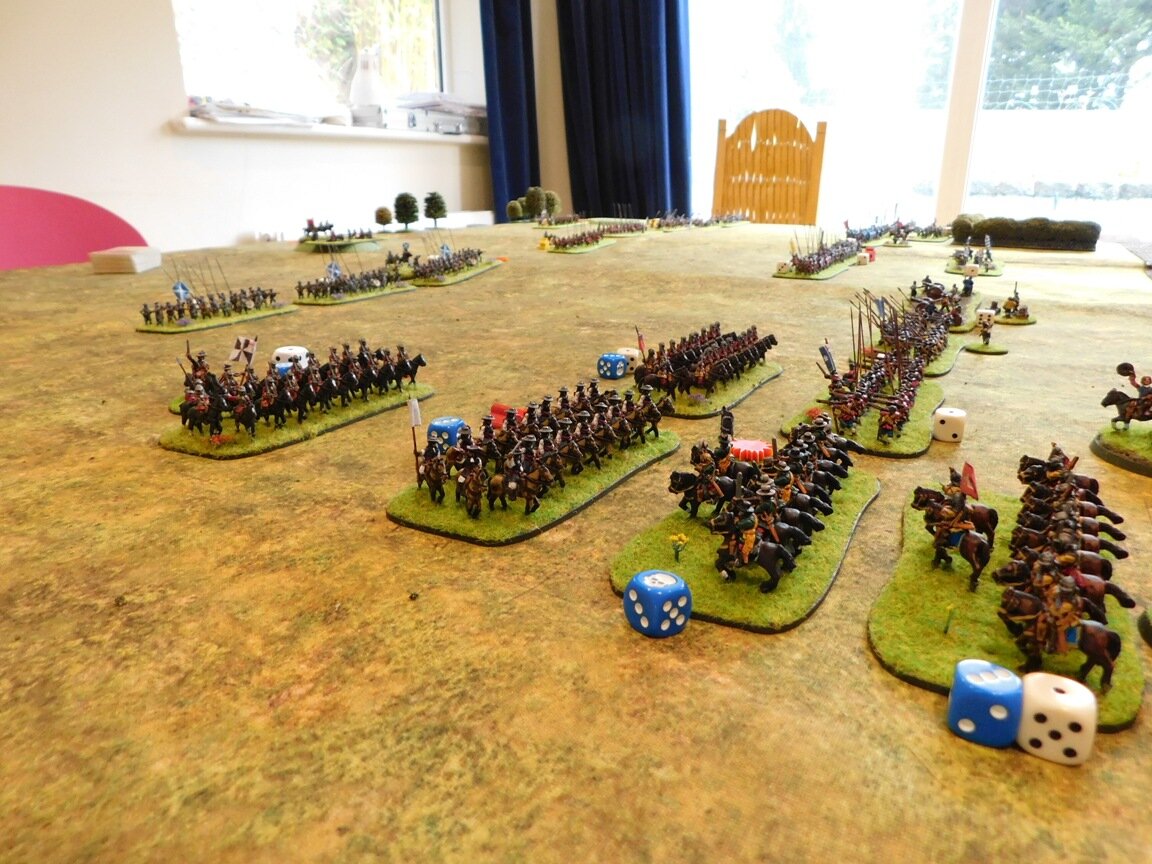
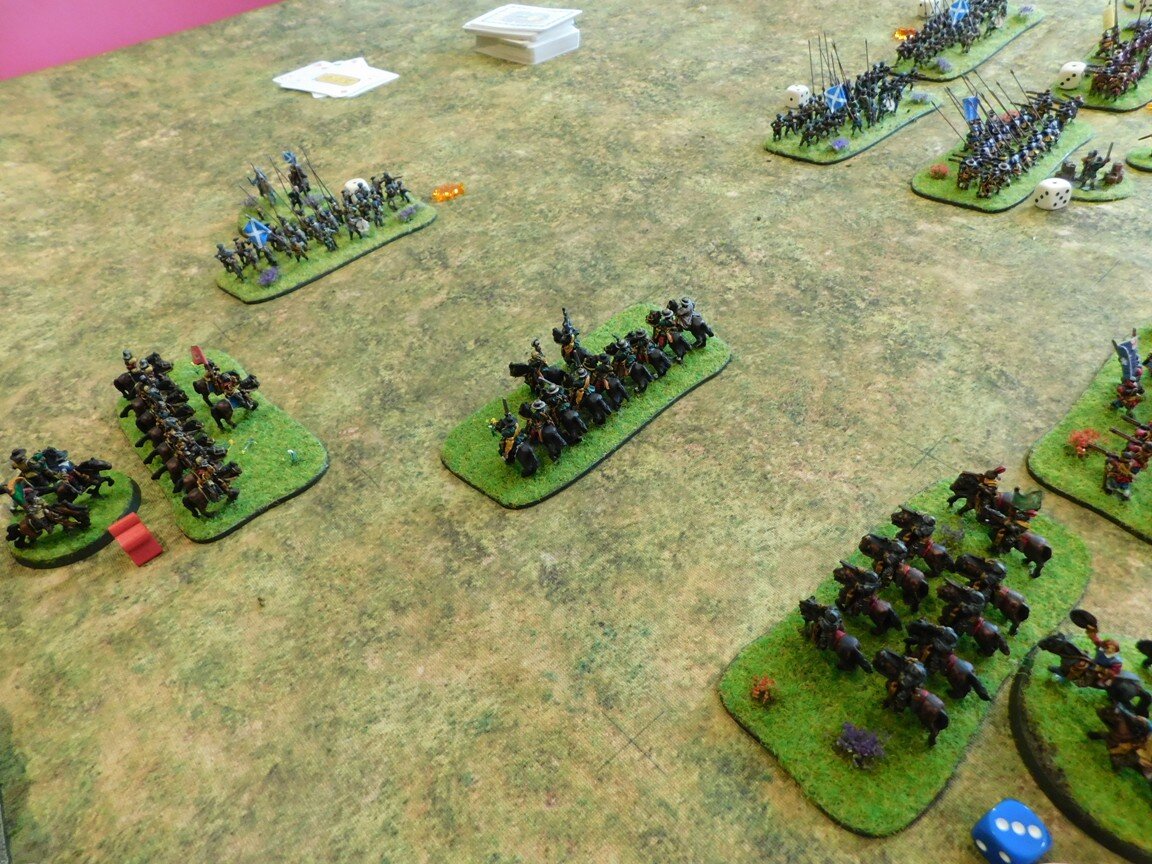
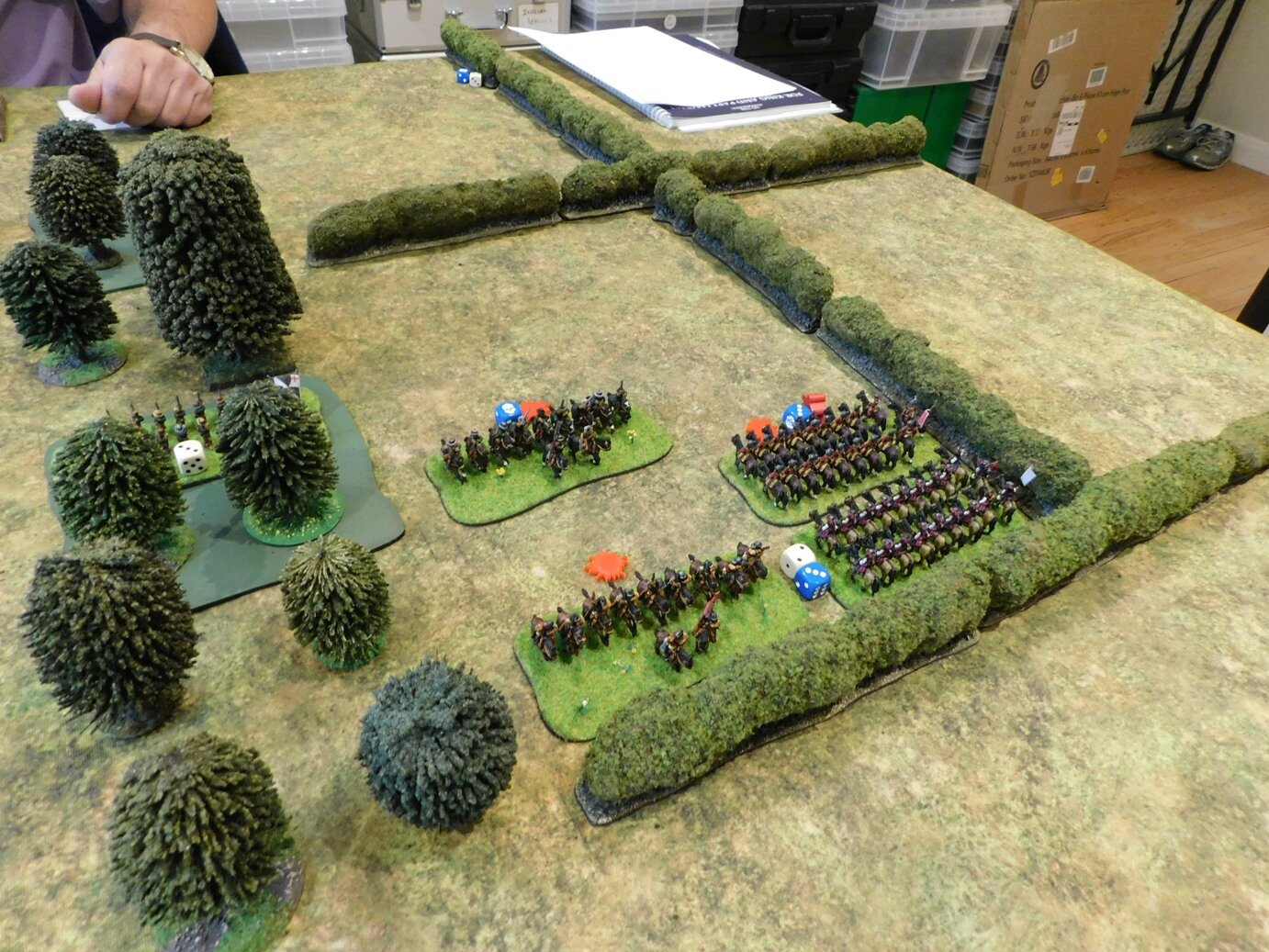
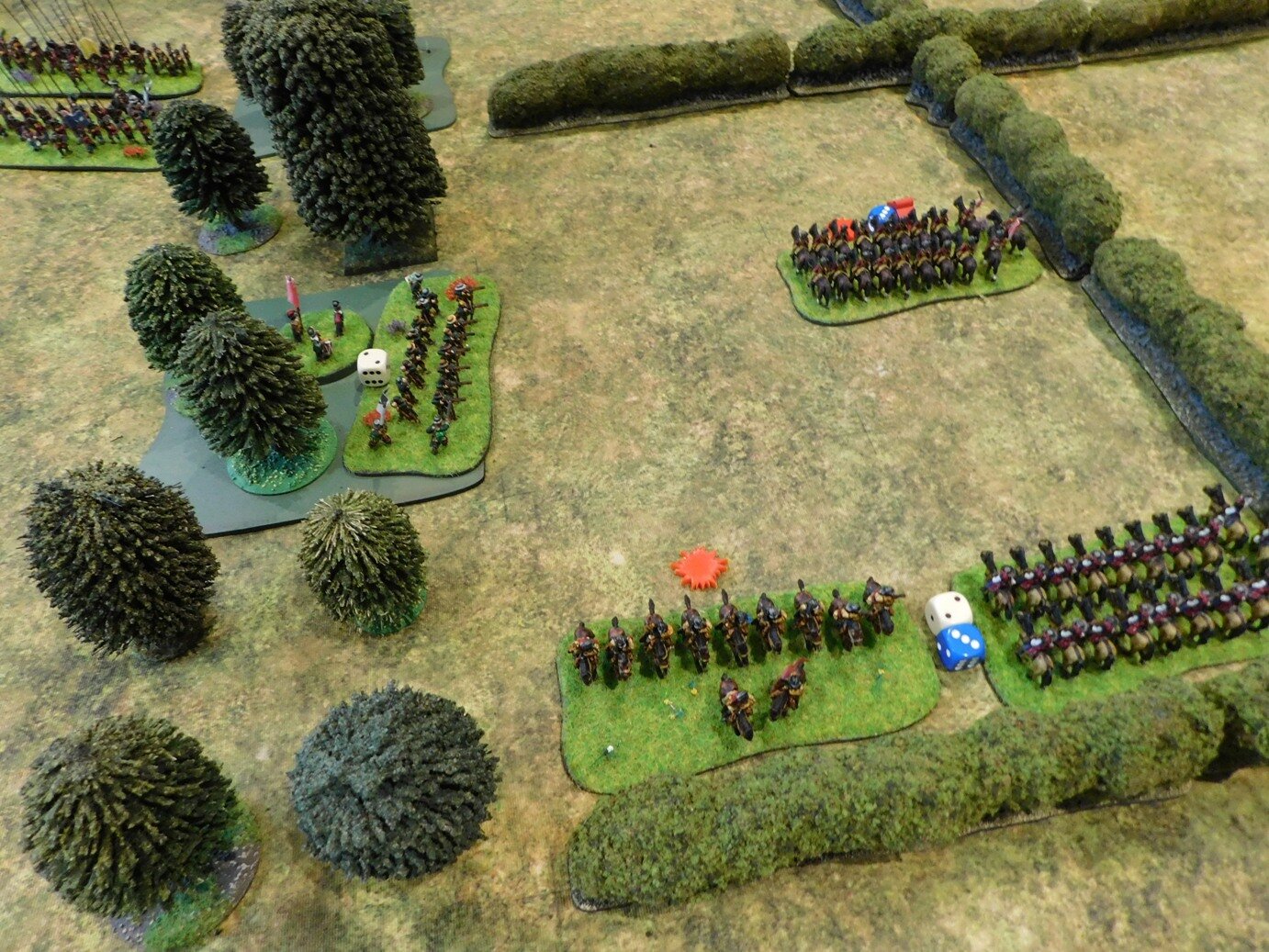
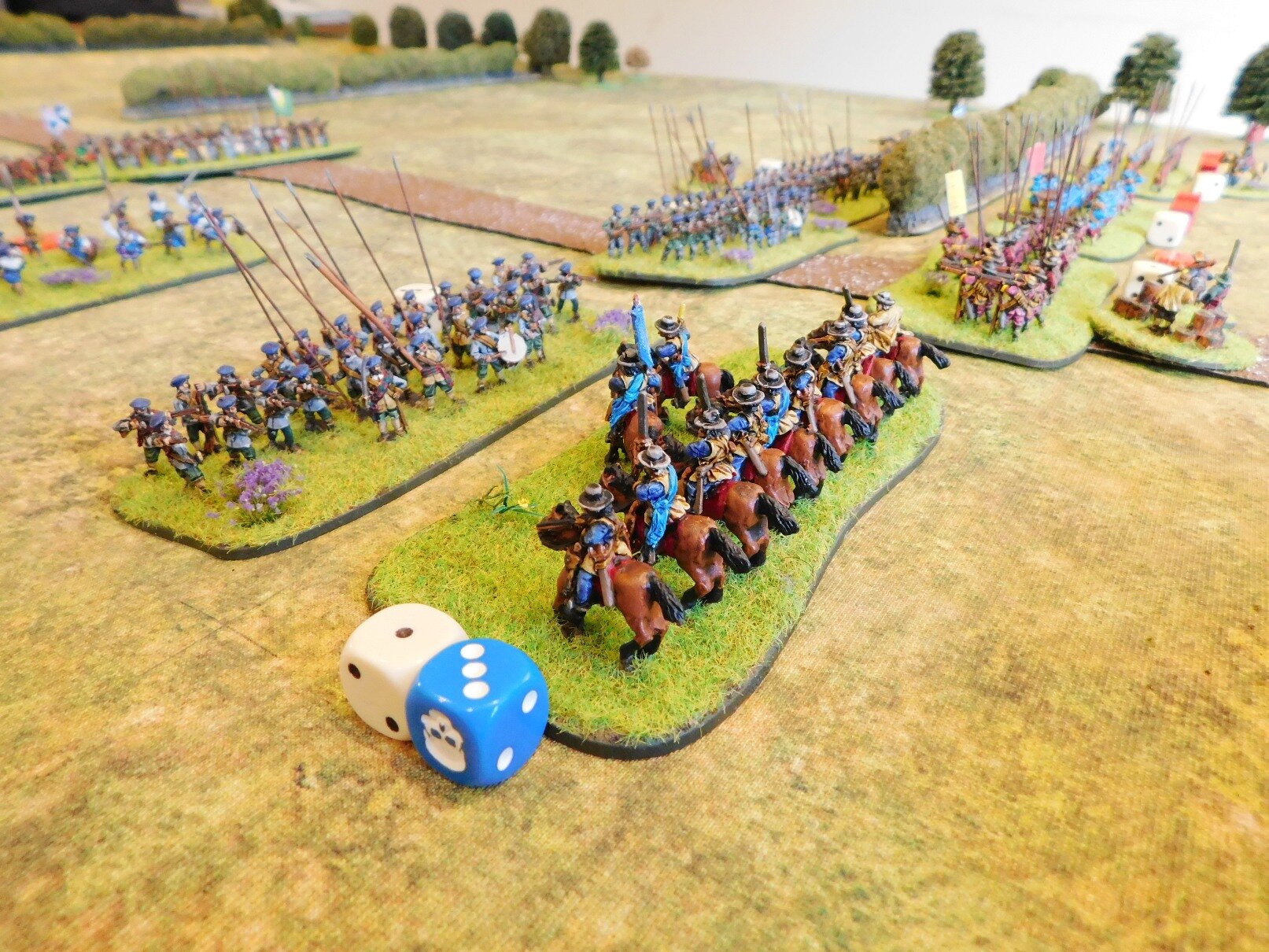
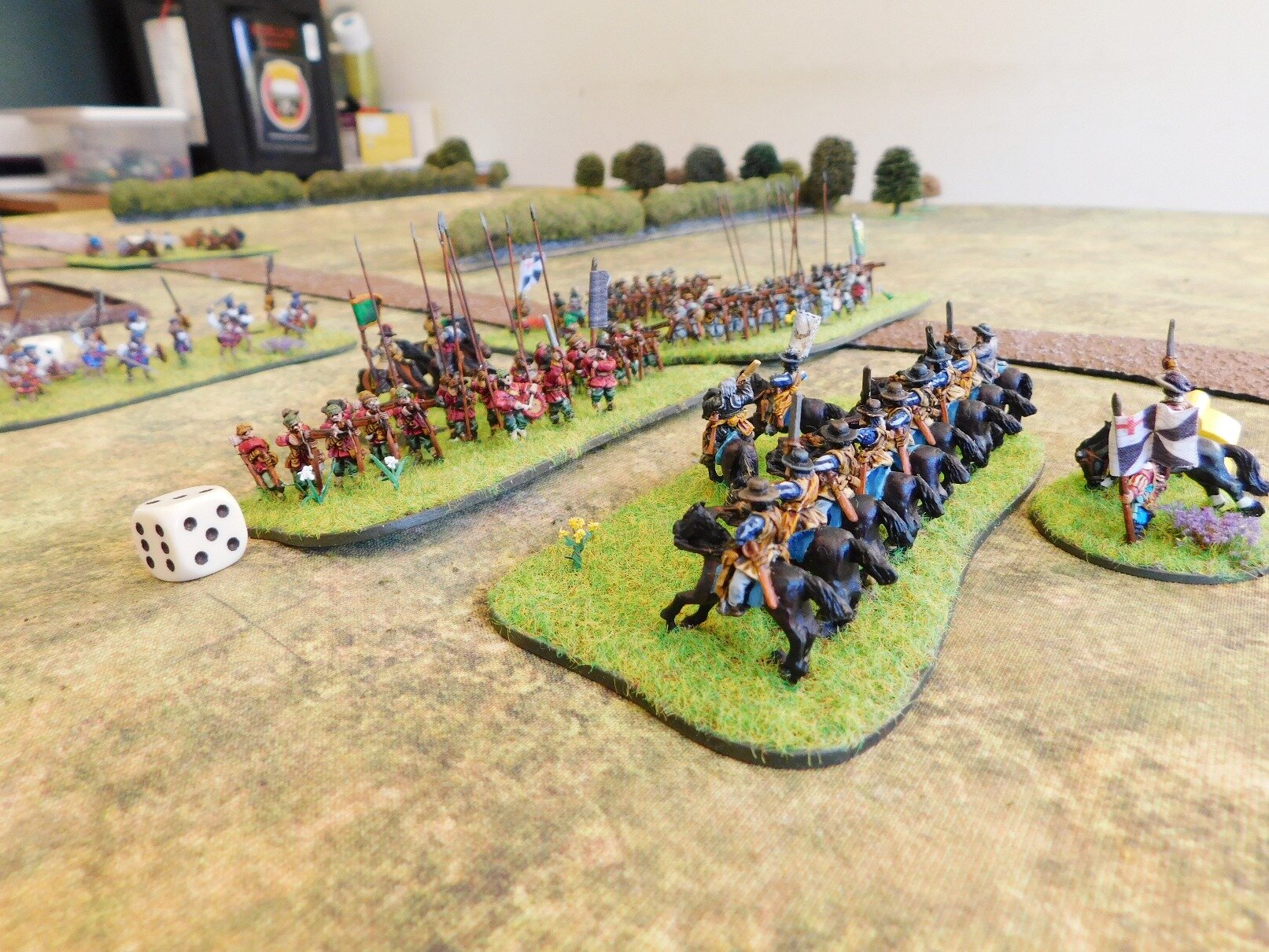
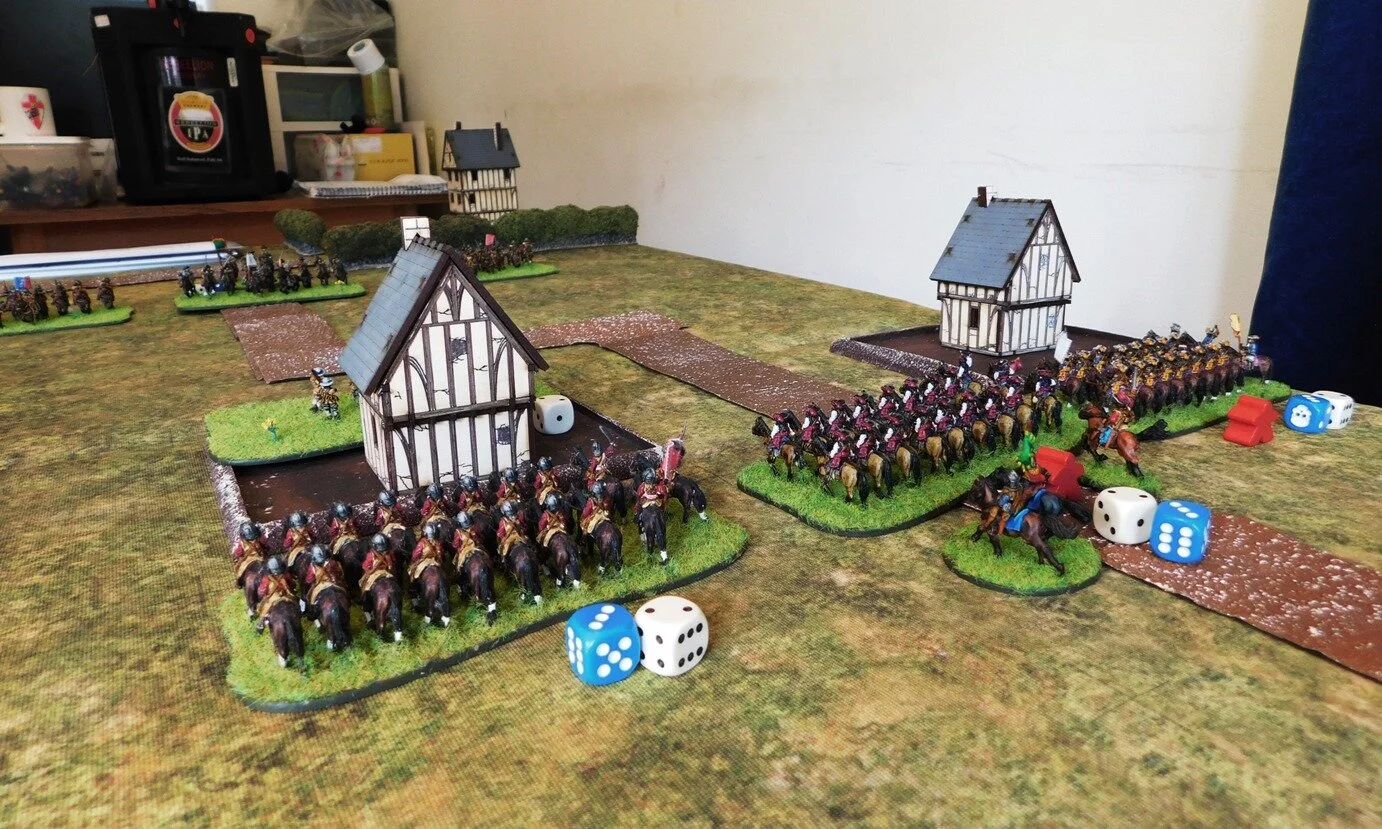
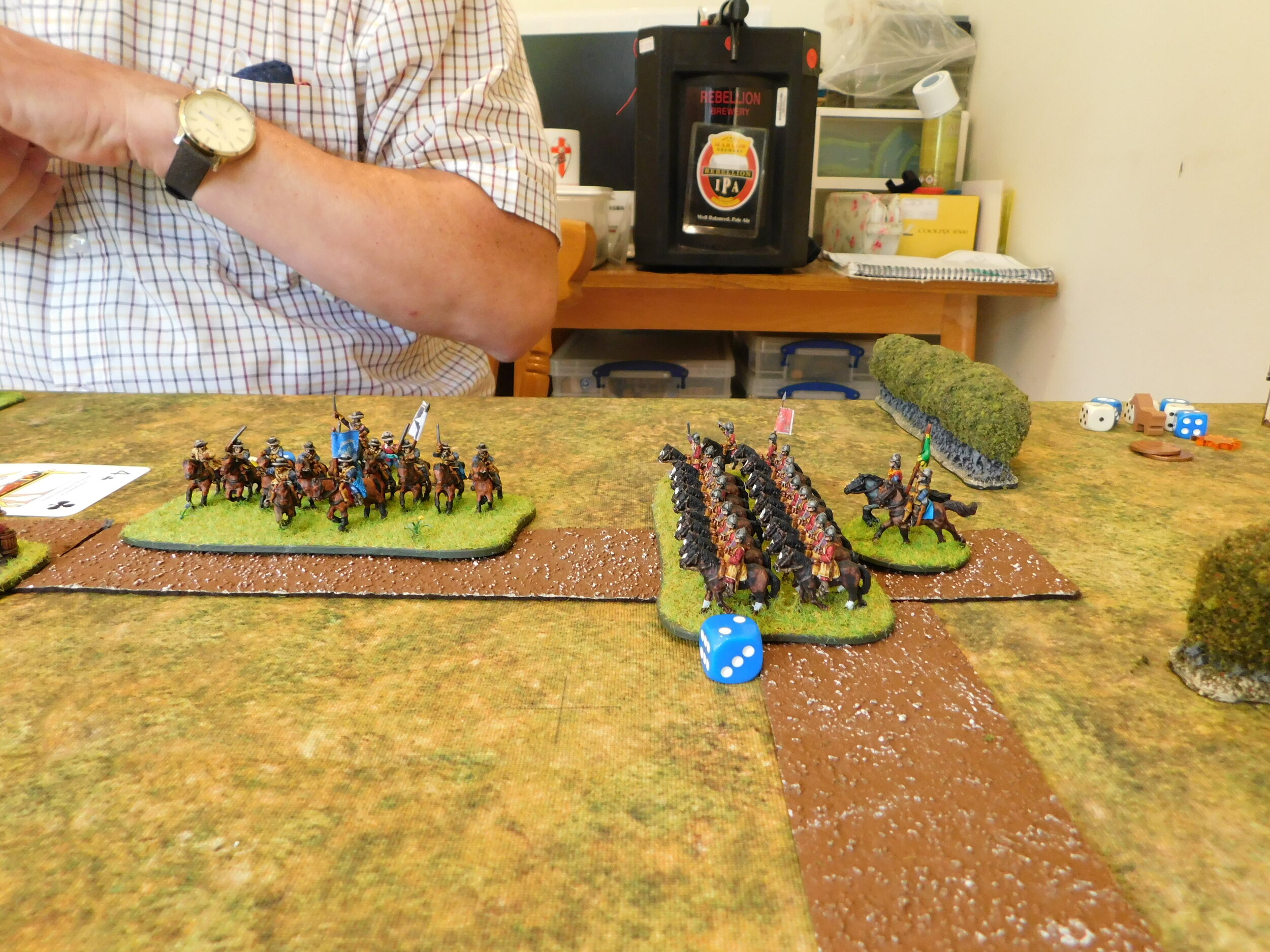
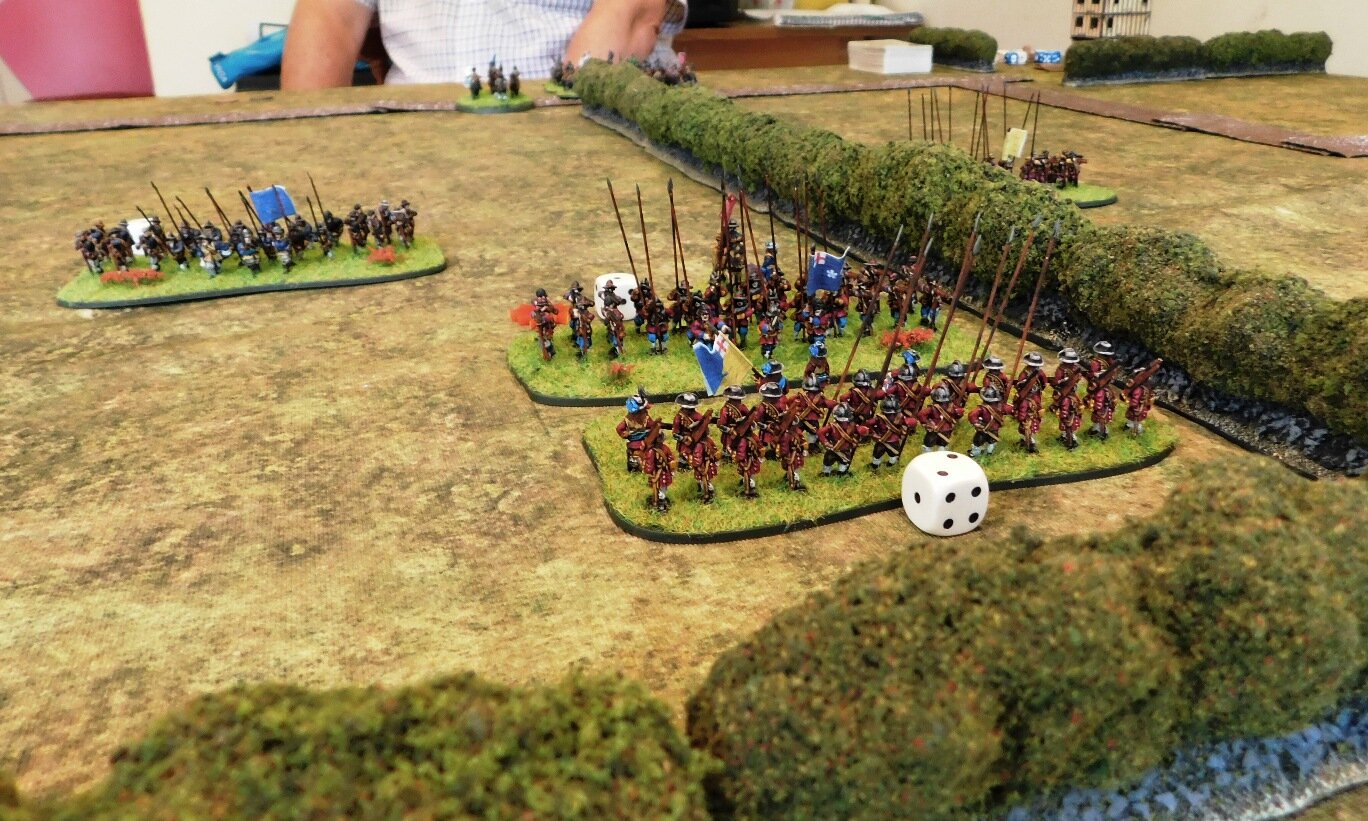
Usually I charge my Dutch-style horse in as soon as possible but, this time, knowing that the enemy Swedish-style horse would then take the initiative through a counter-charge (something my more ponderous units cannot do) I decided to employ more historical tactics and halt just beyond charge range and discharge my pistols into the advancing enemy.

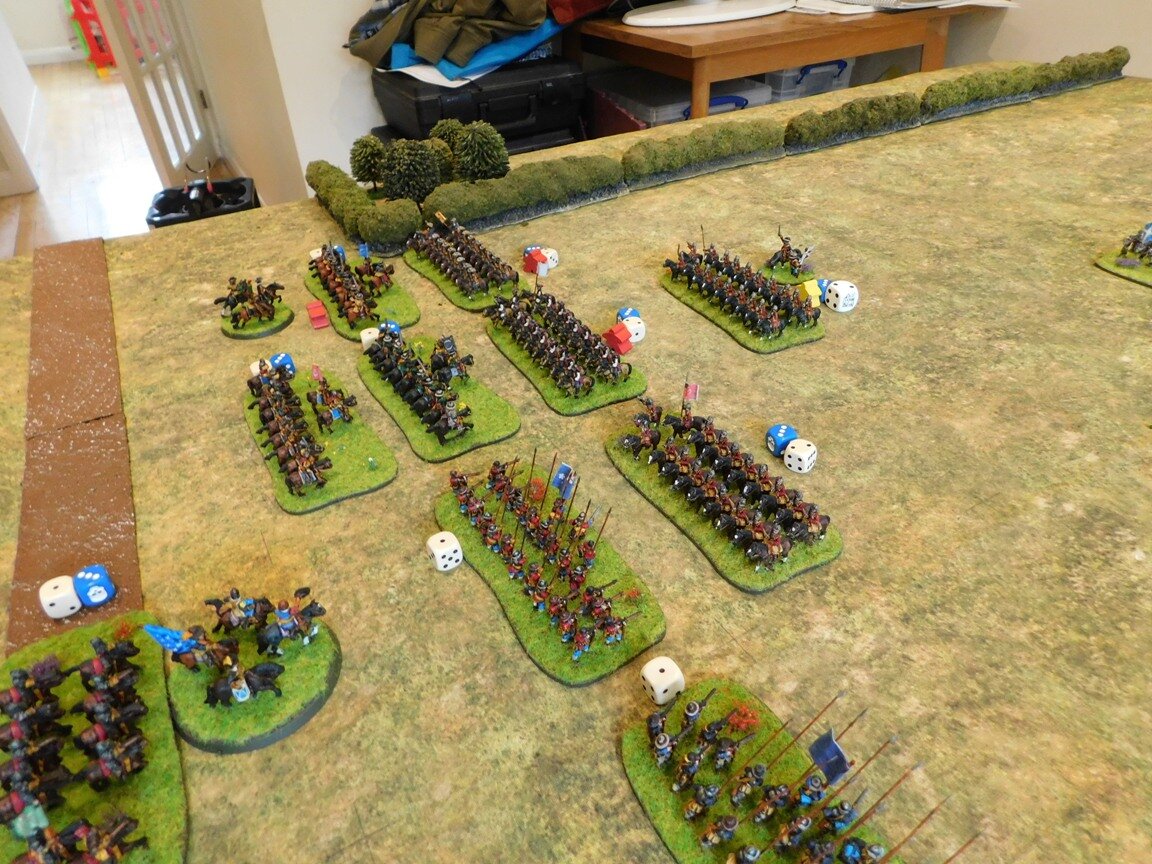
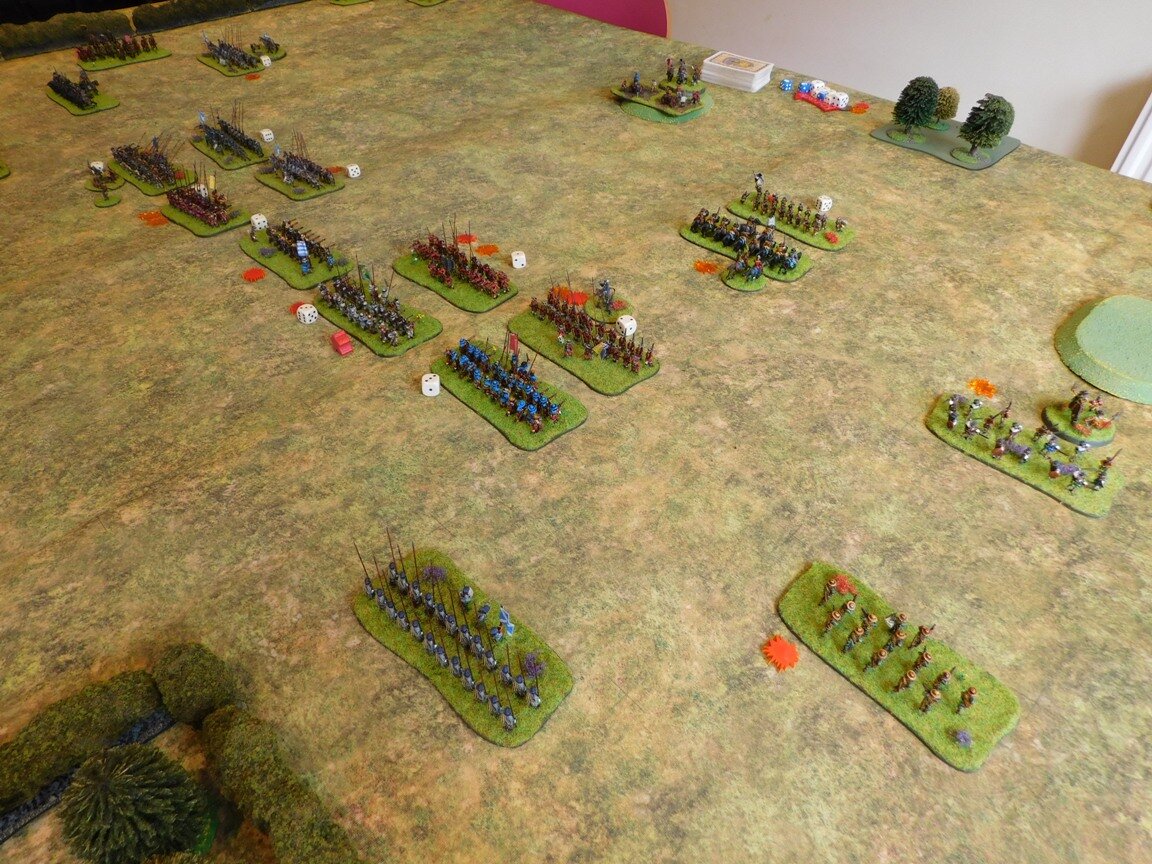
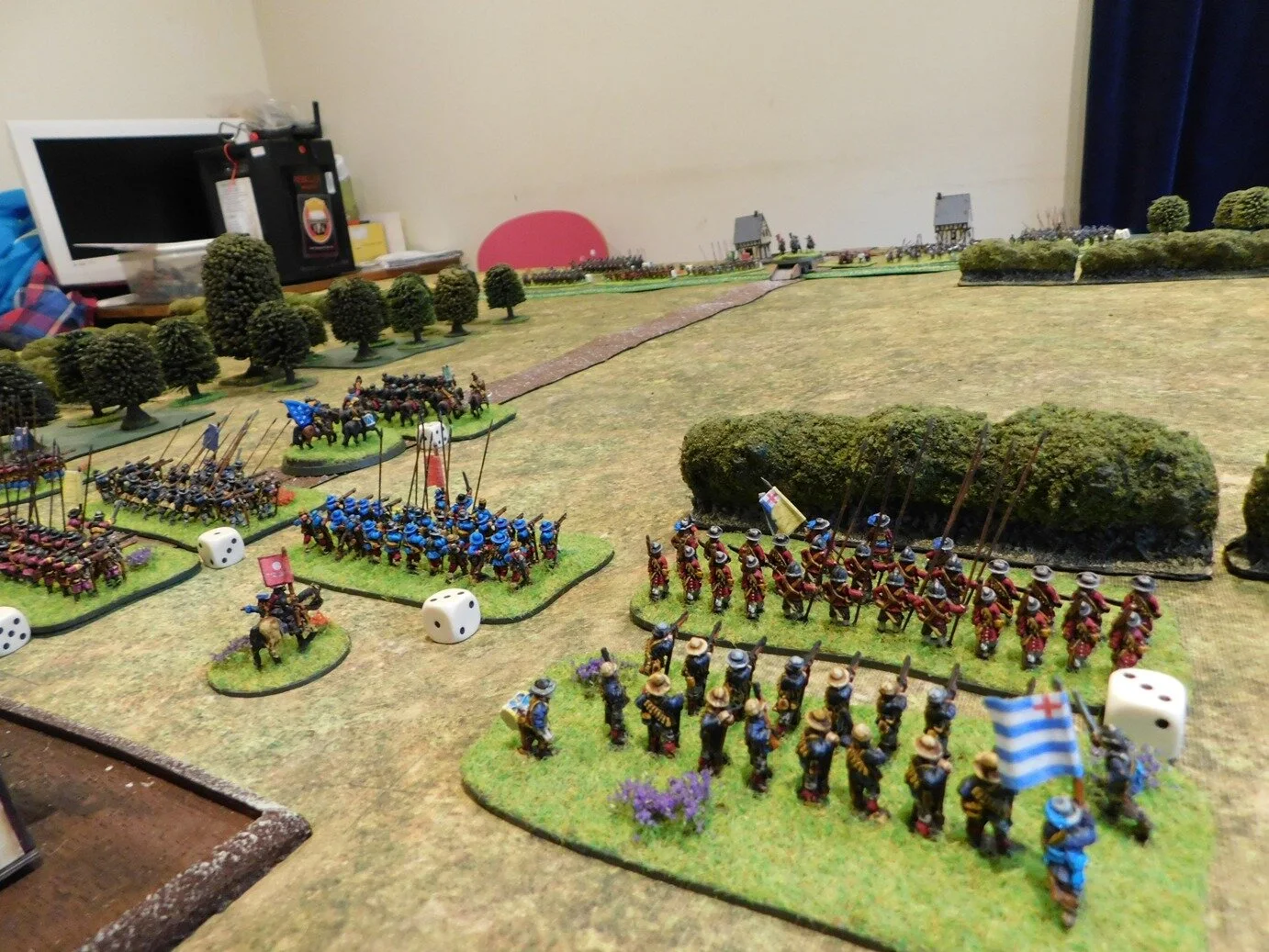
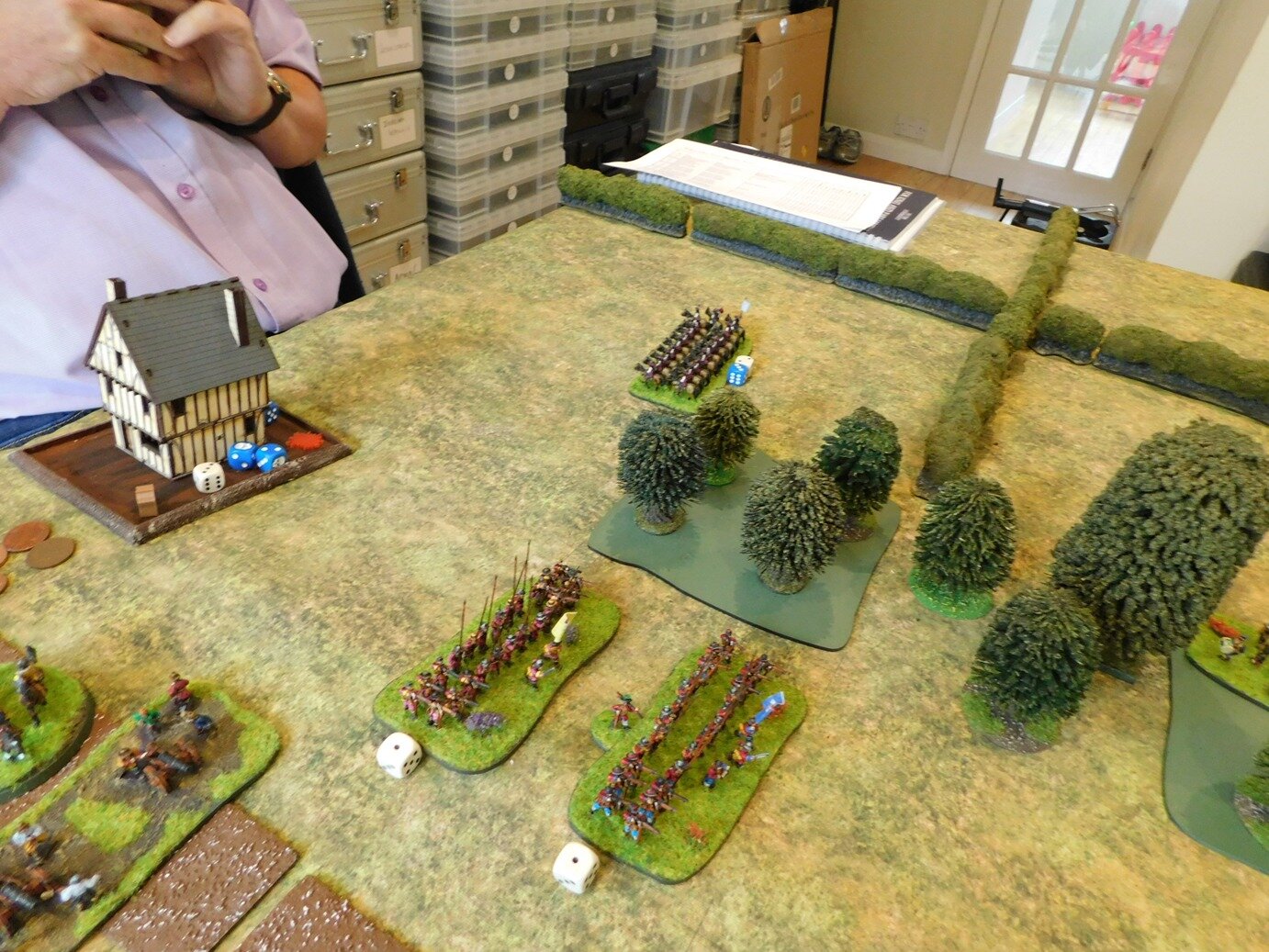
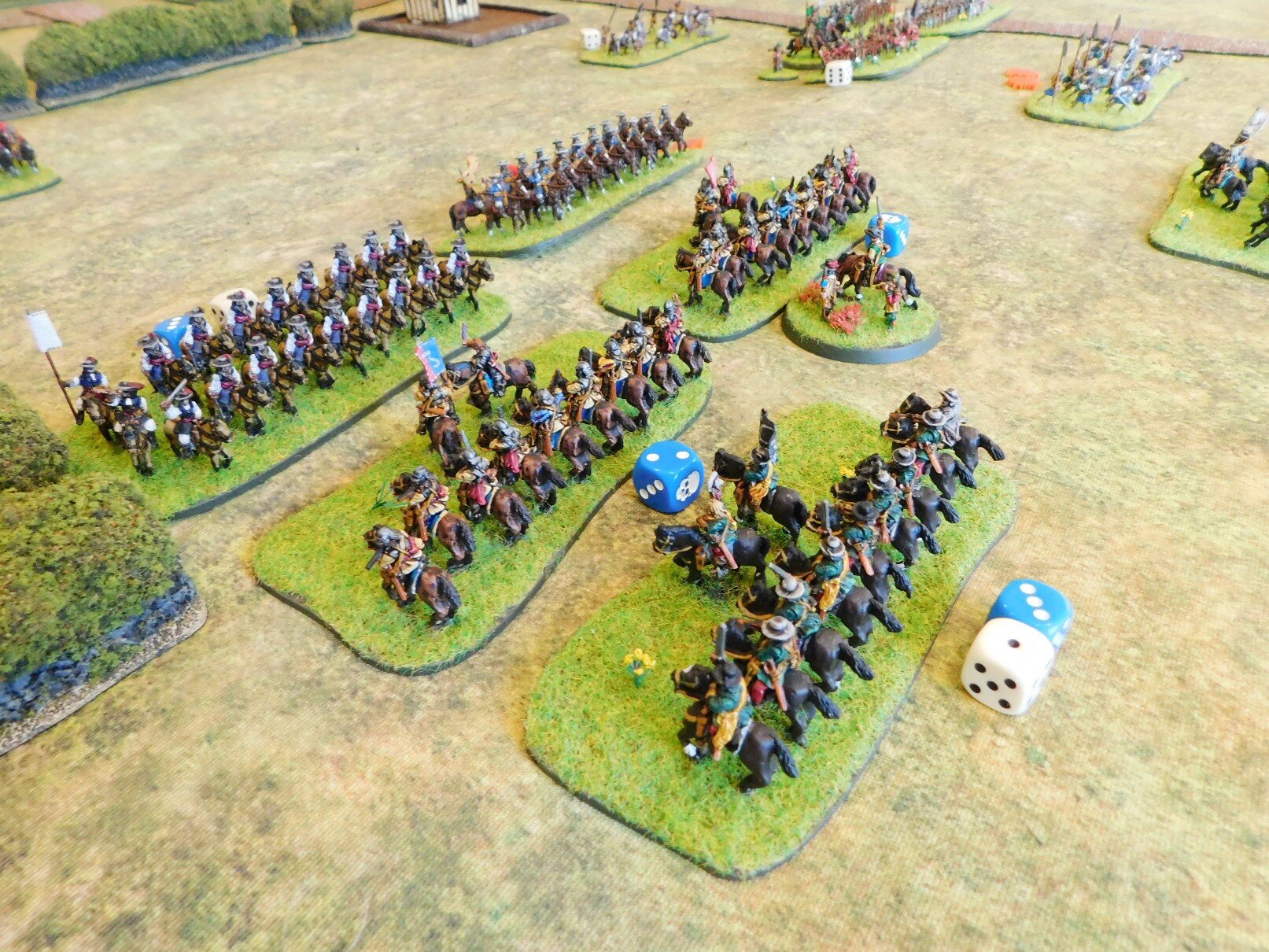
This worked a treat, as you’ll see in the picture below. All three units to the right are disordered, but it will only take one more hit to break either of the enemy horse units, whereas my greater numbers mean that I can survive another two hits.

All now seemed to be going well, and even Bevan confessed later that he felt that, at this stage, I had the advantage. That was, unfortunately, about to change!

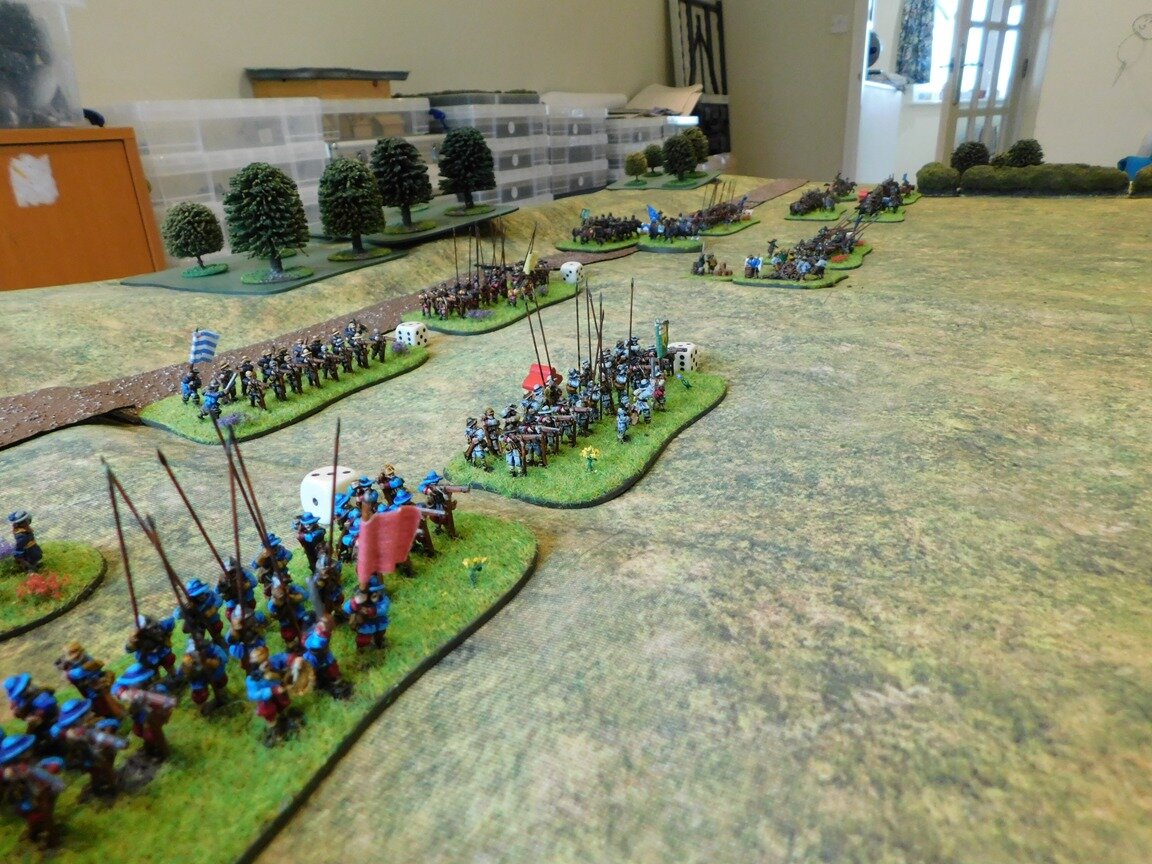
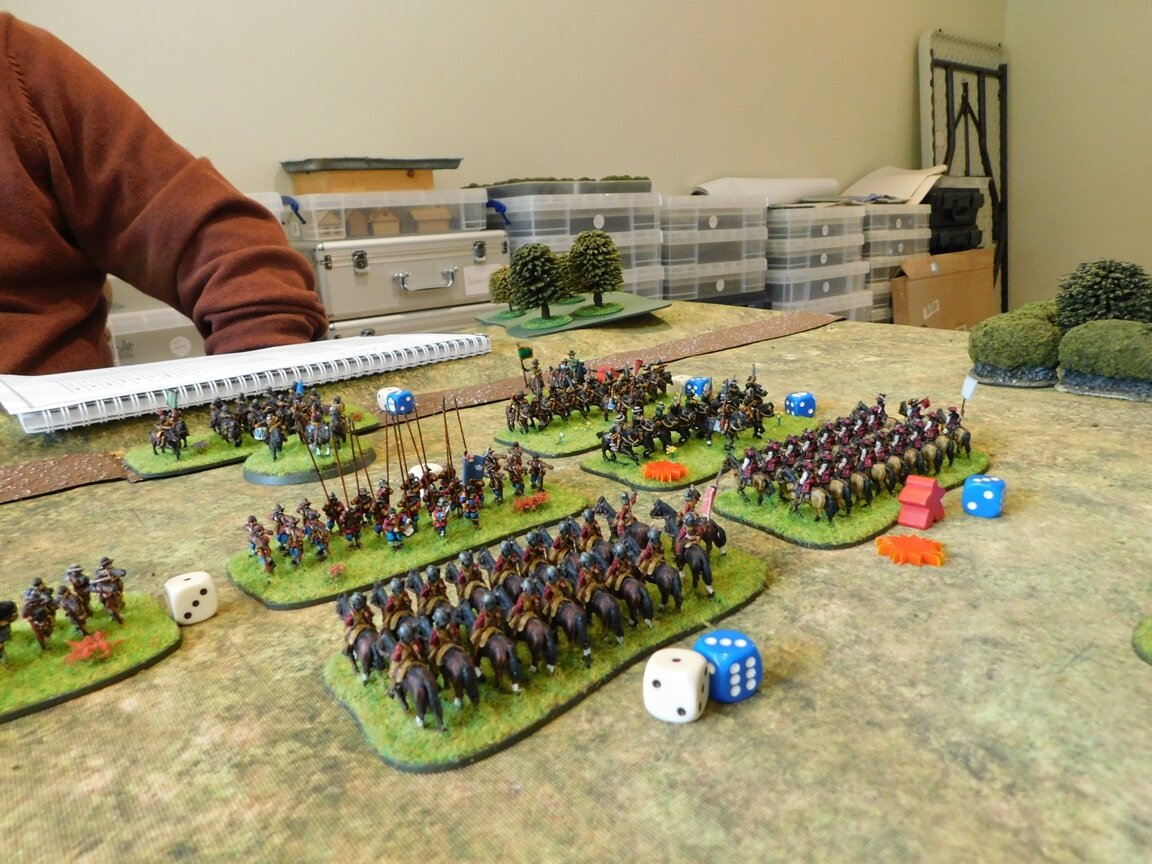
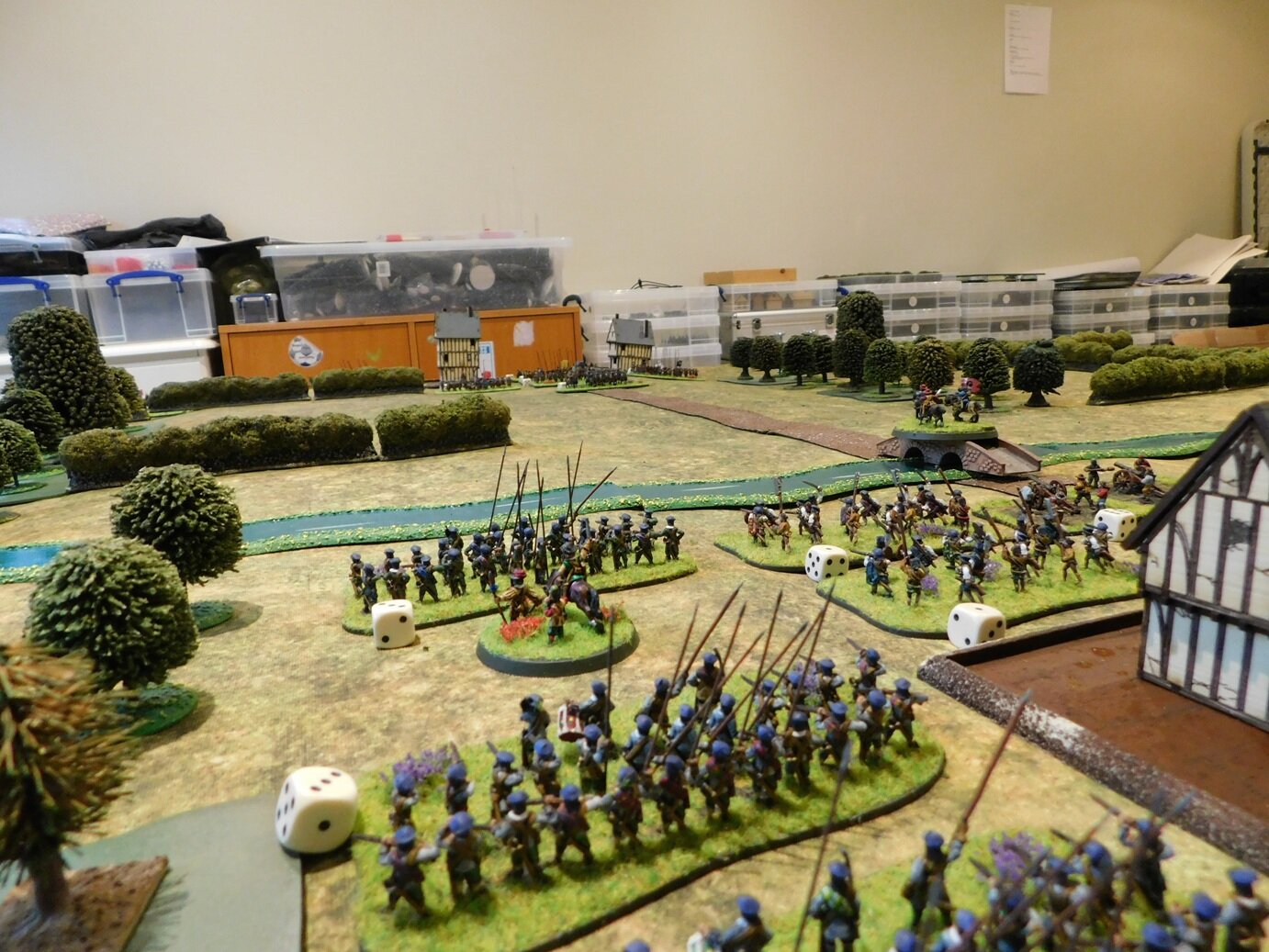
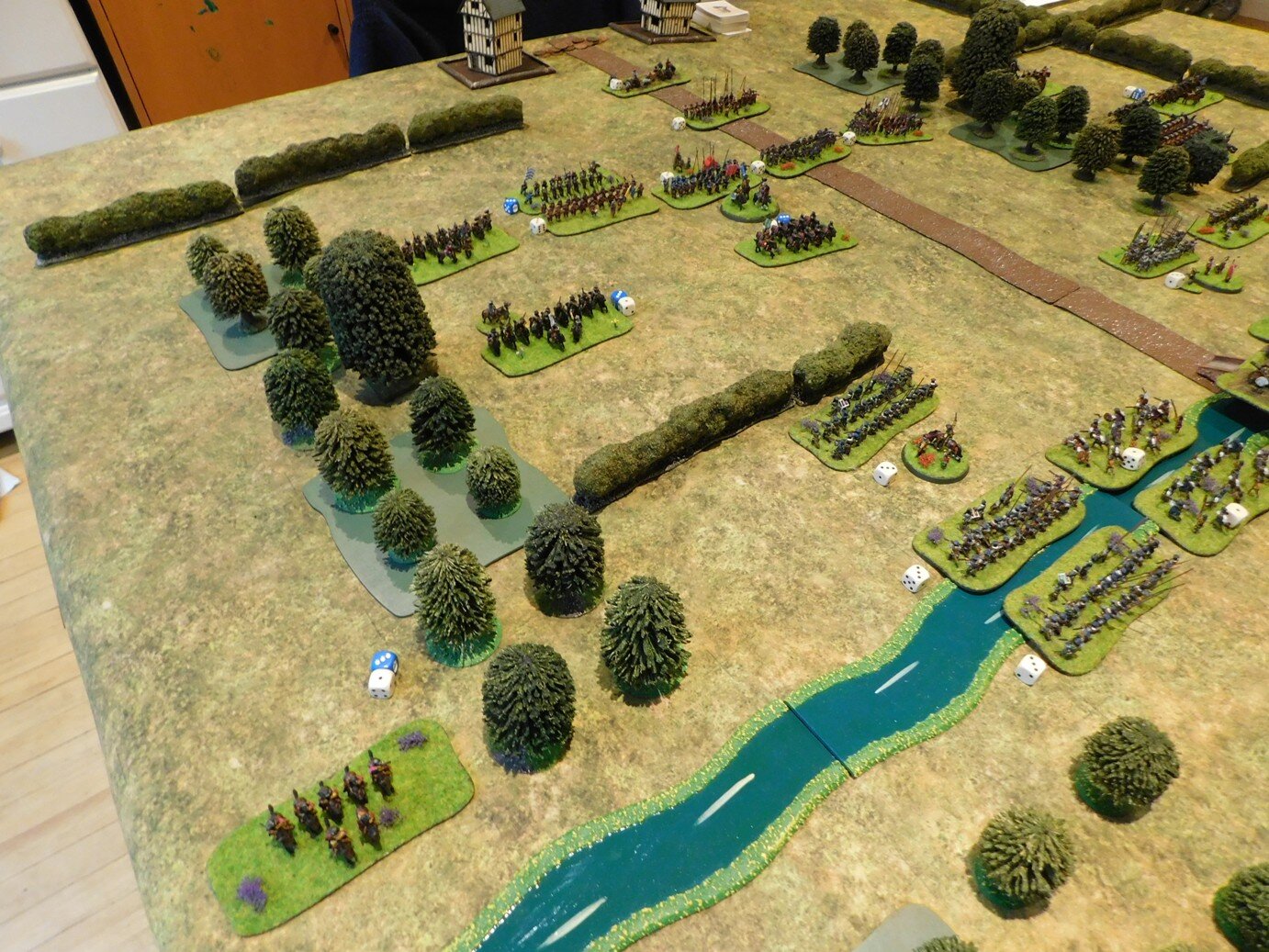
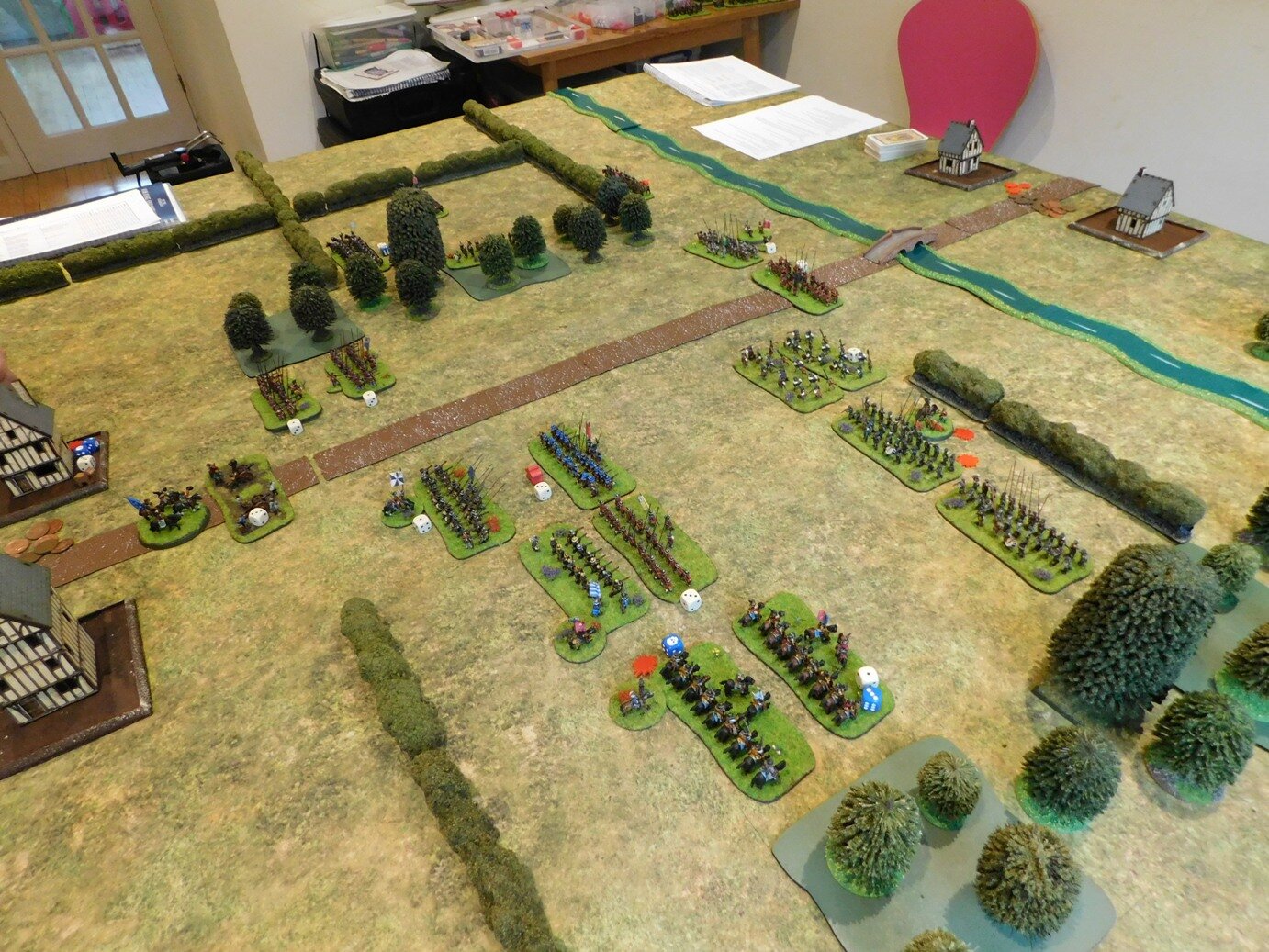
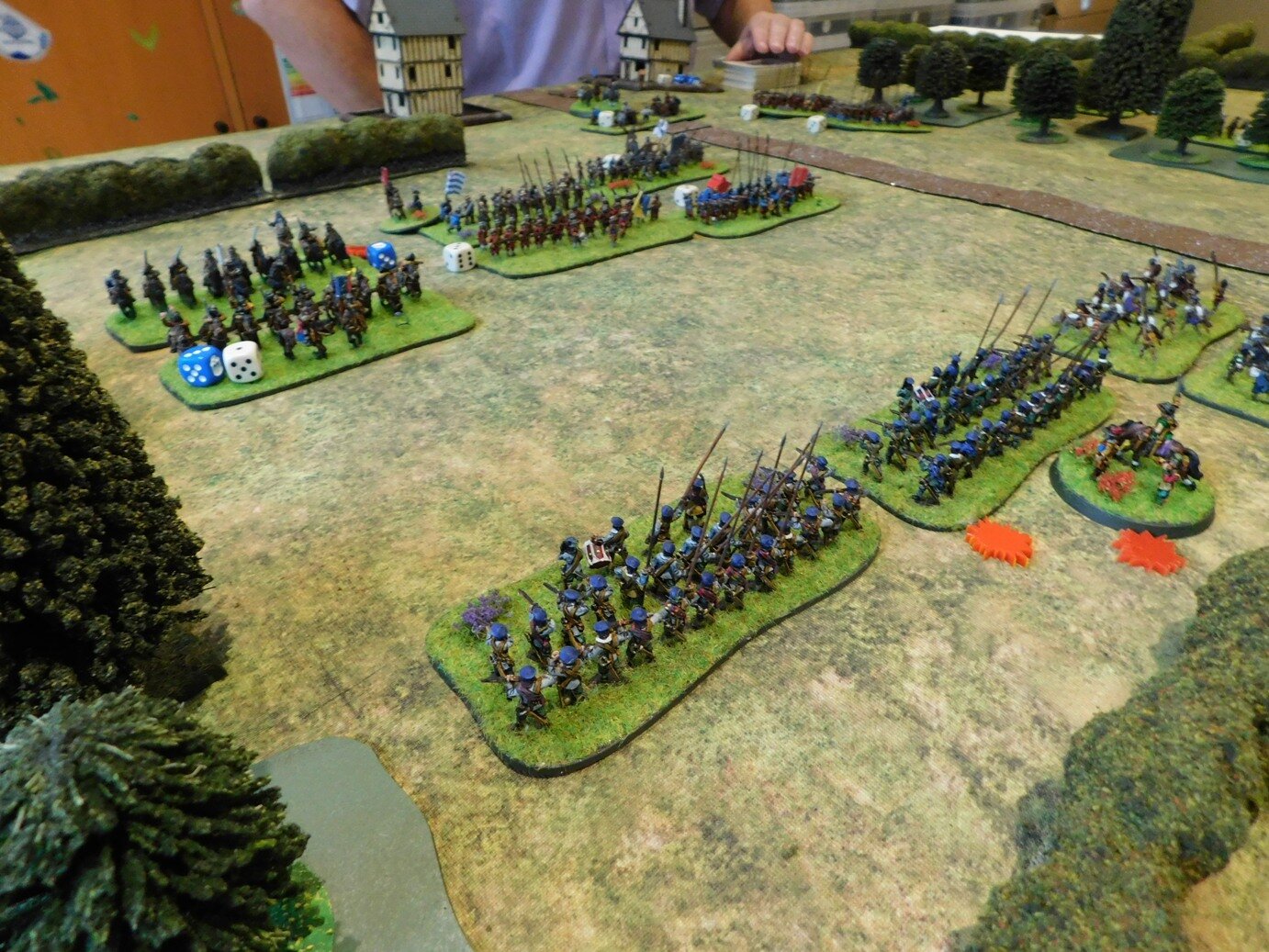
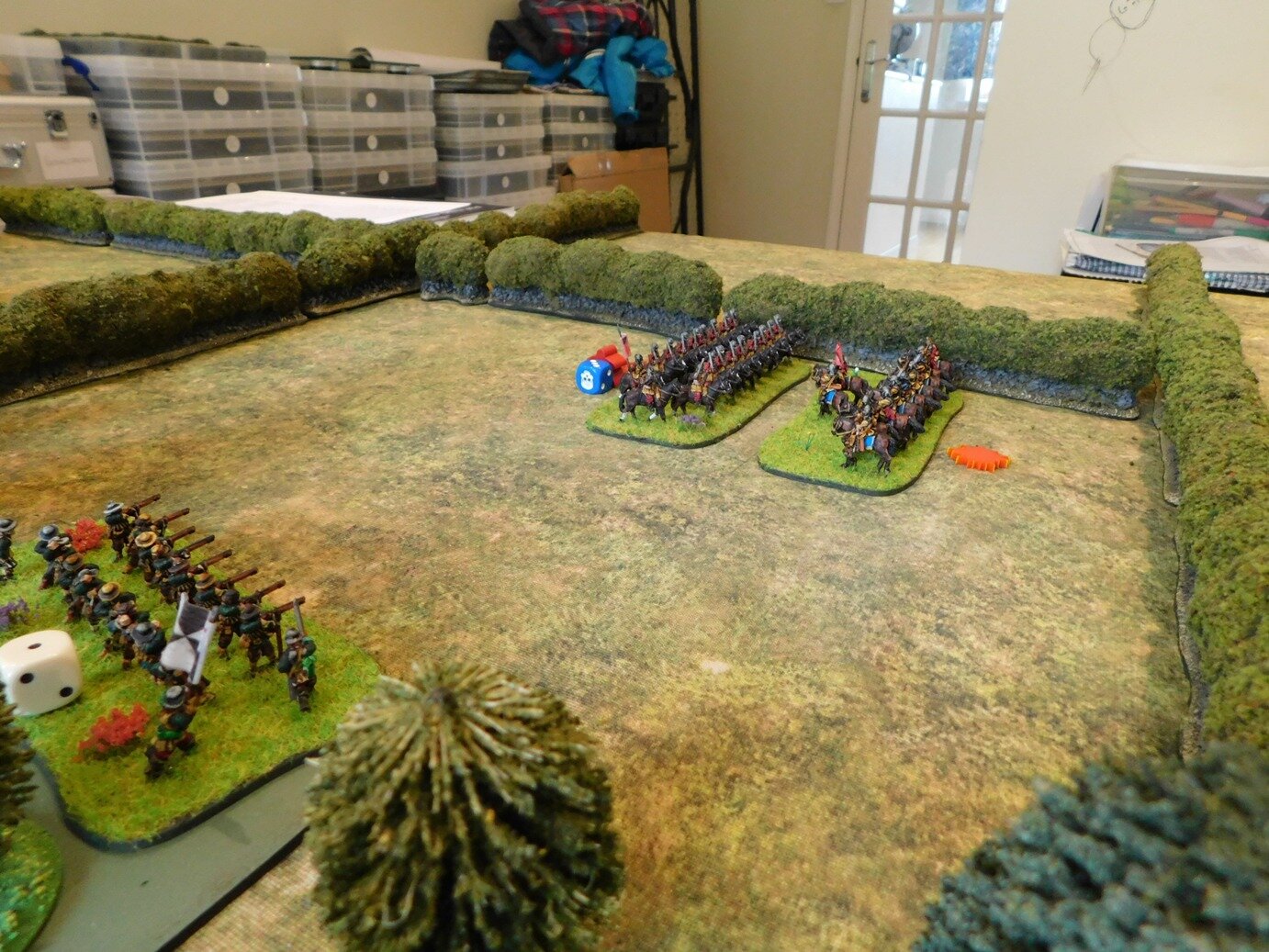
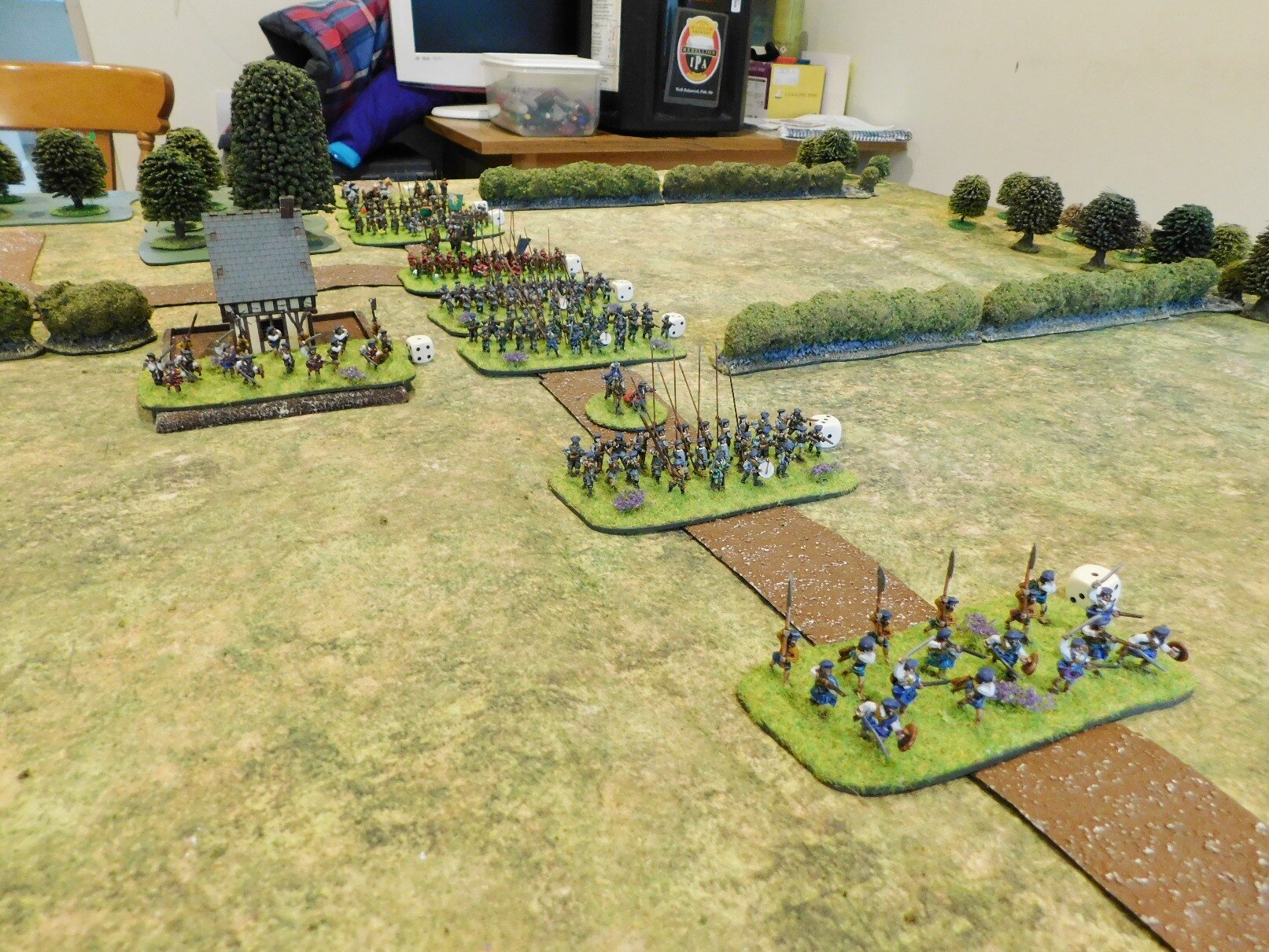
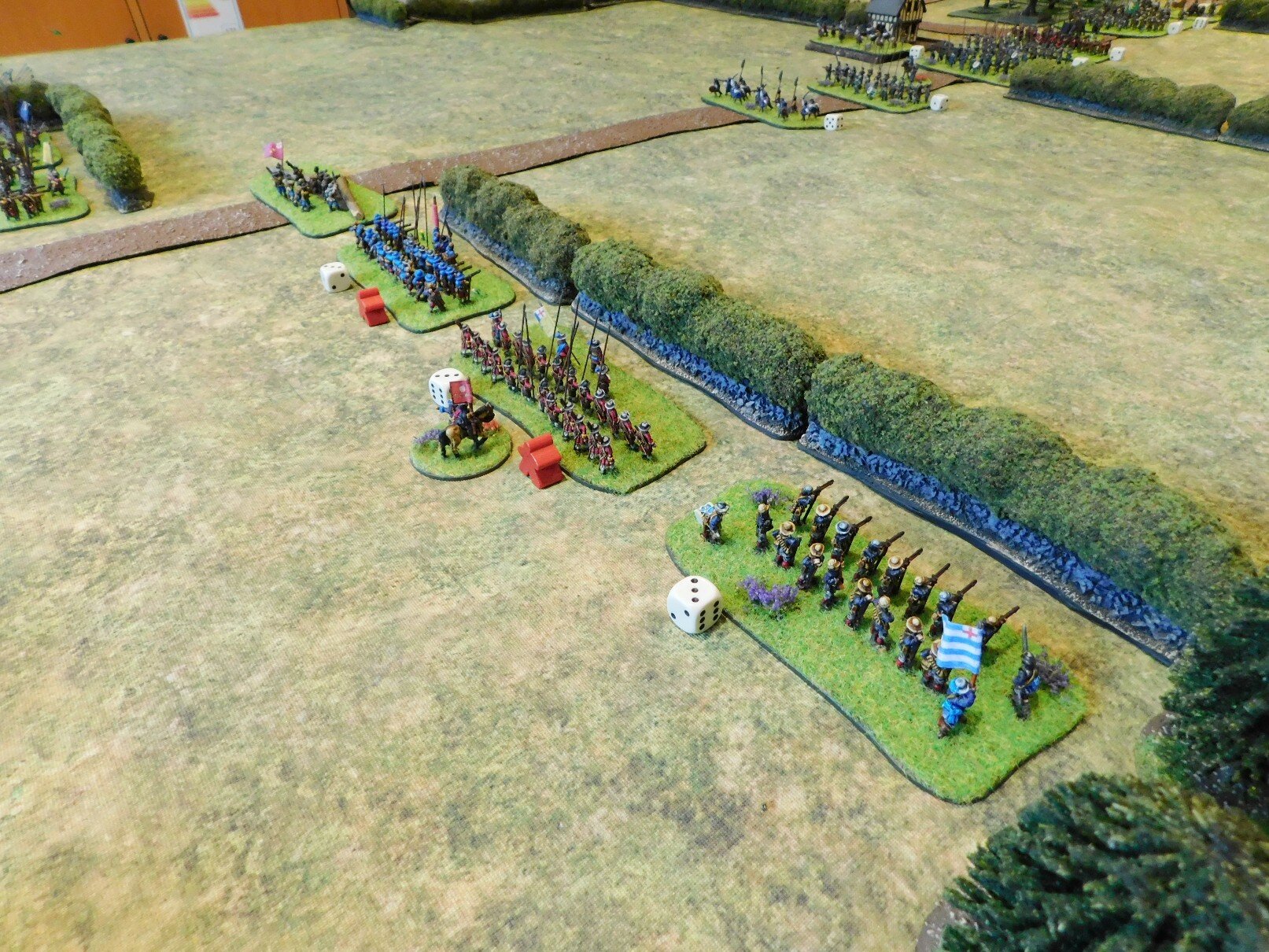
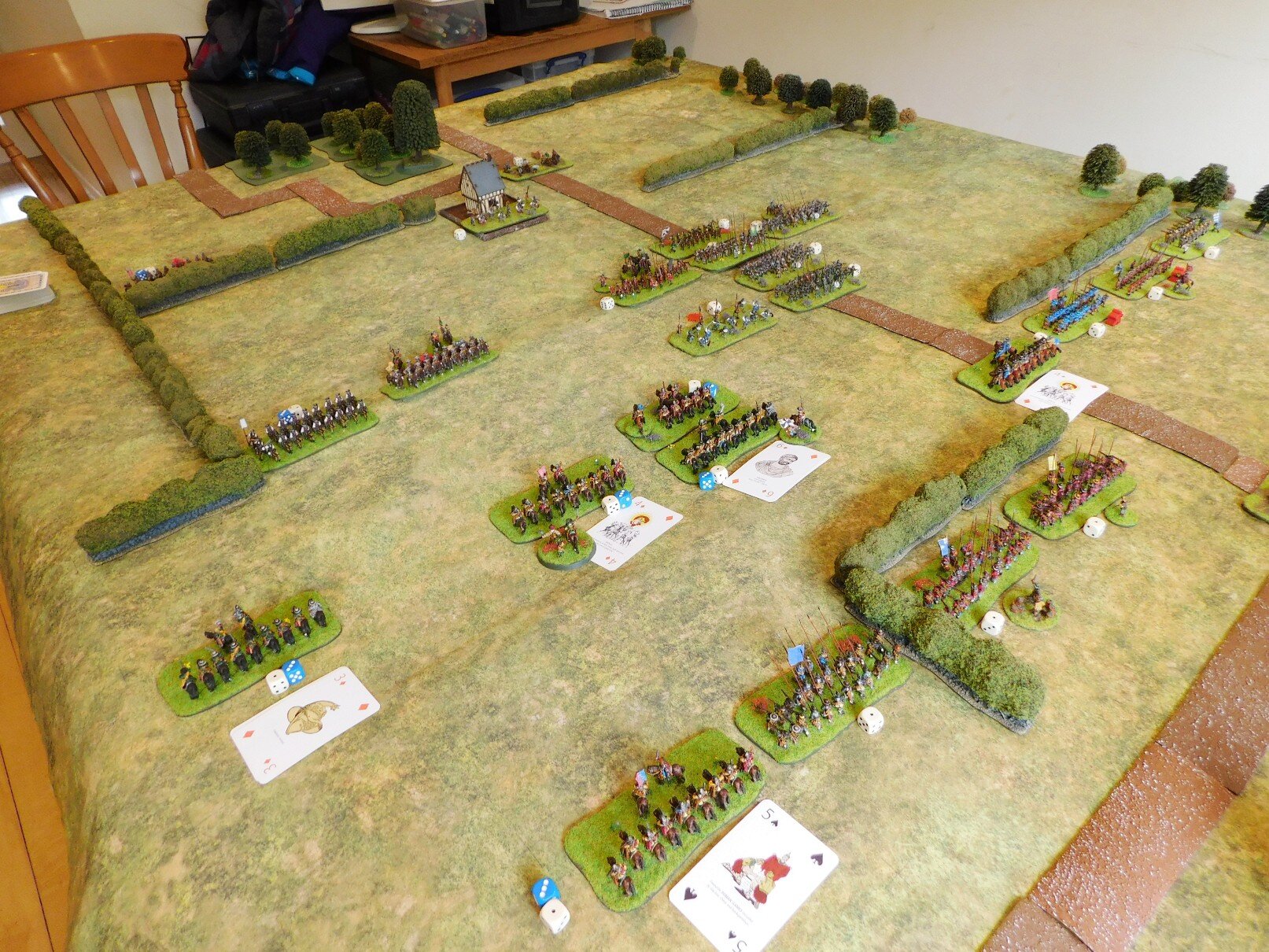
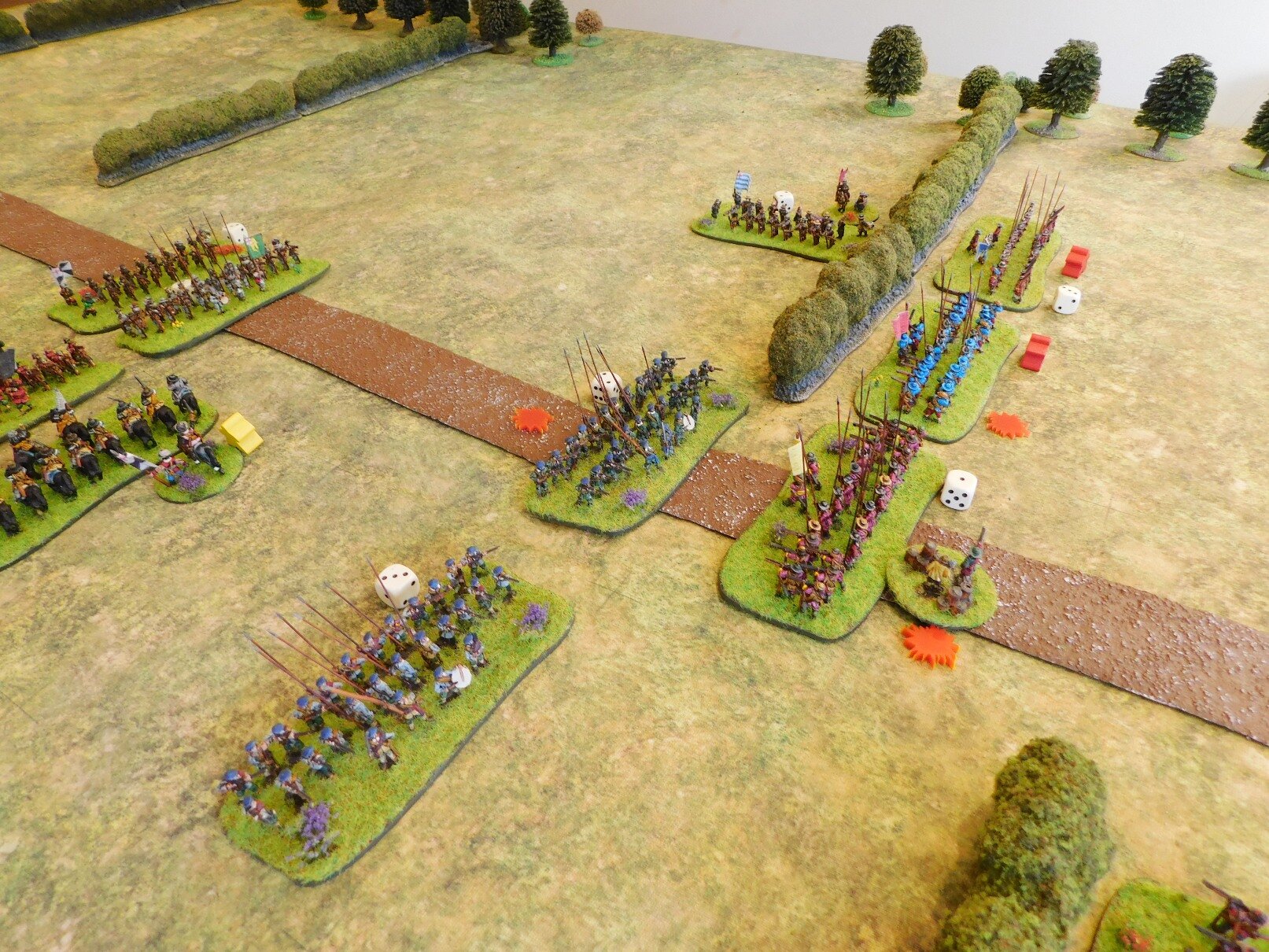
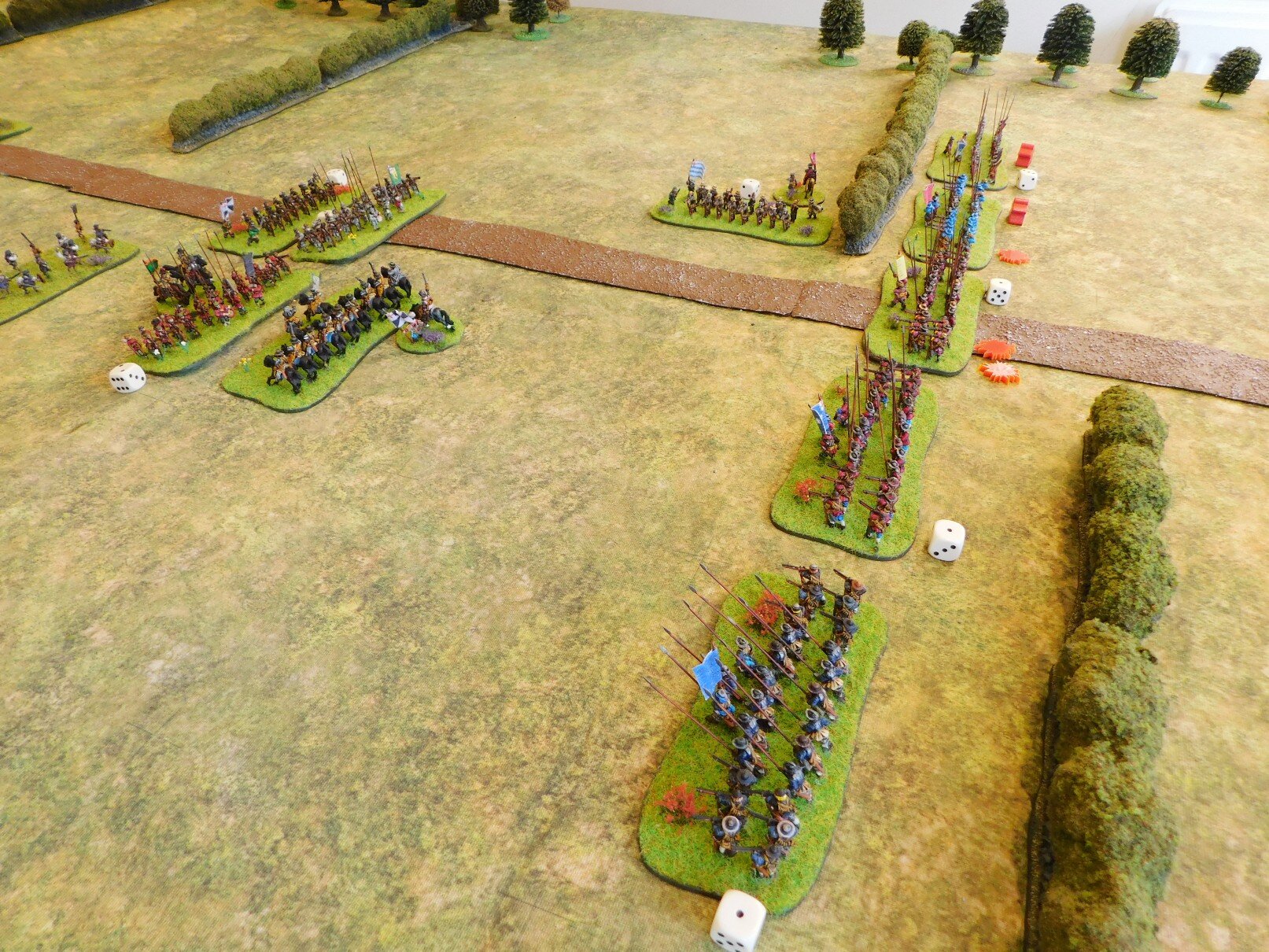
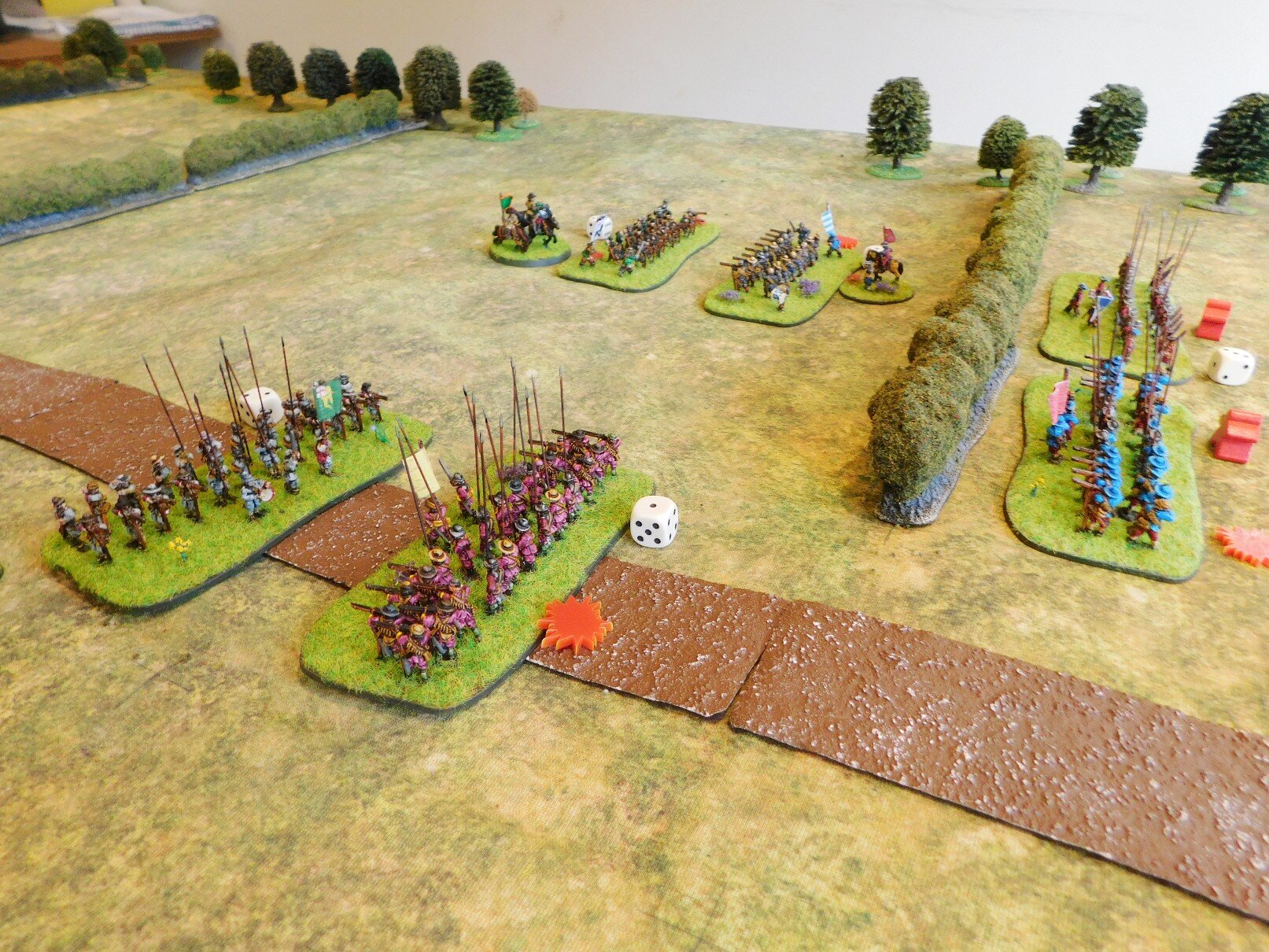
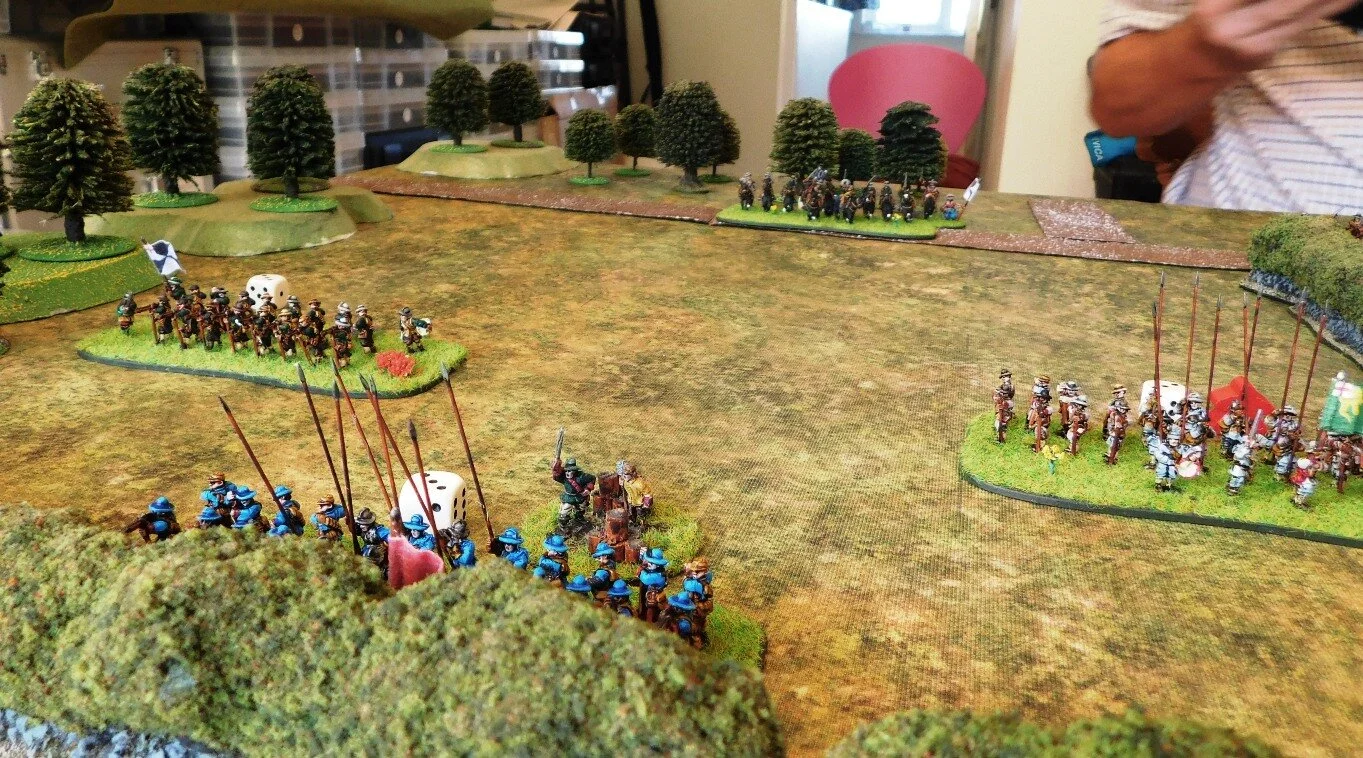
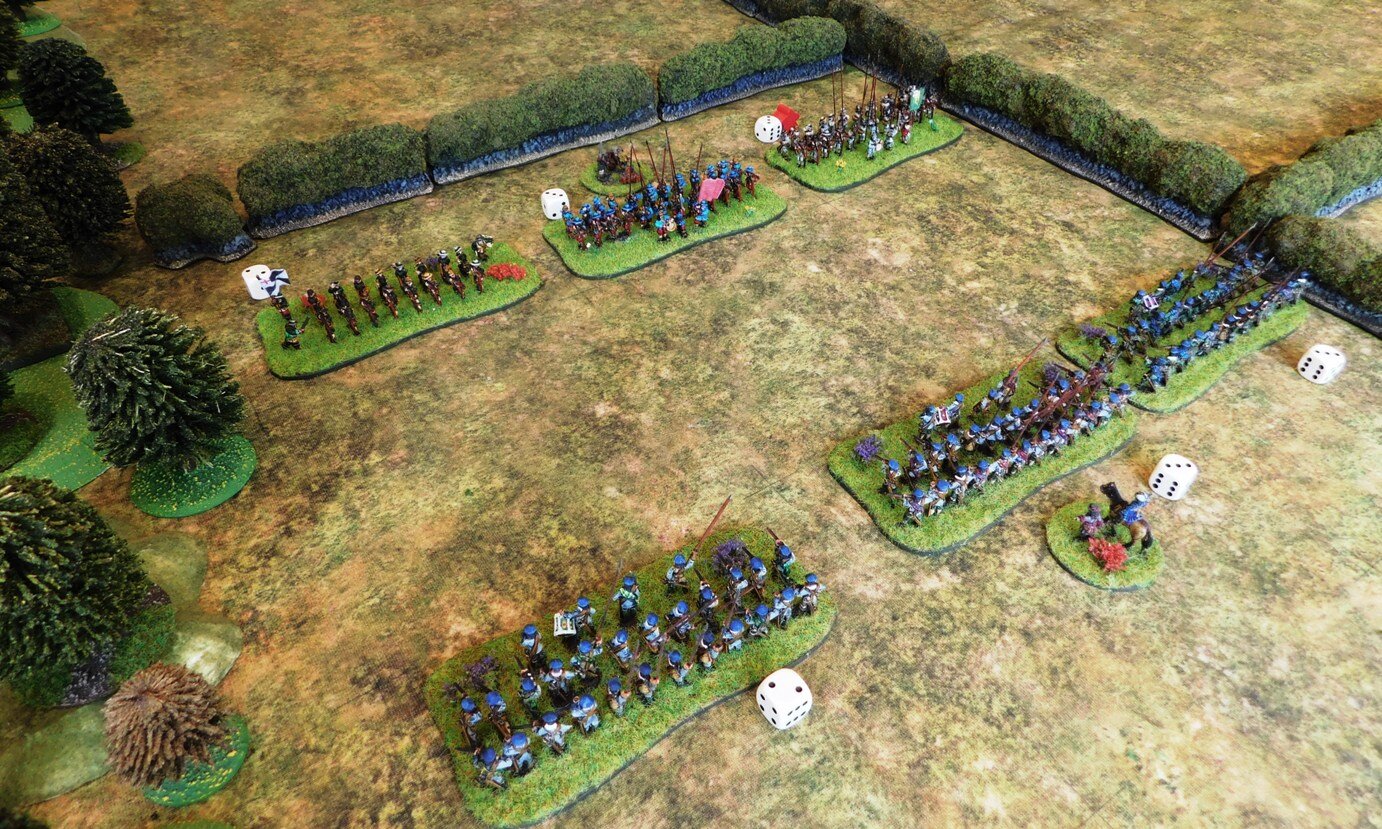
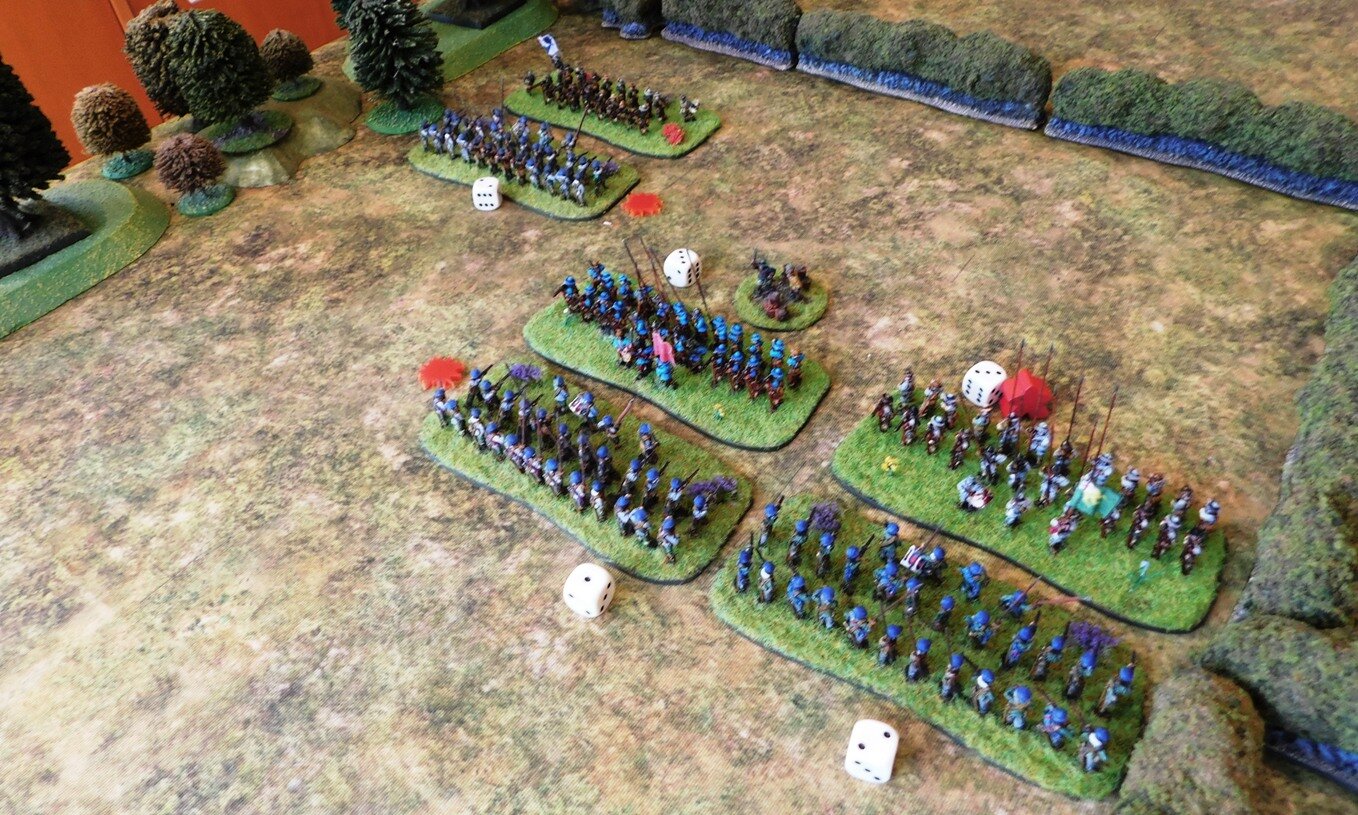
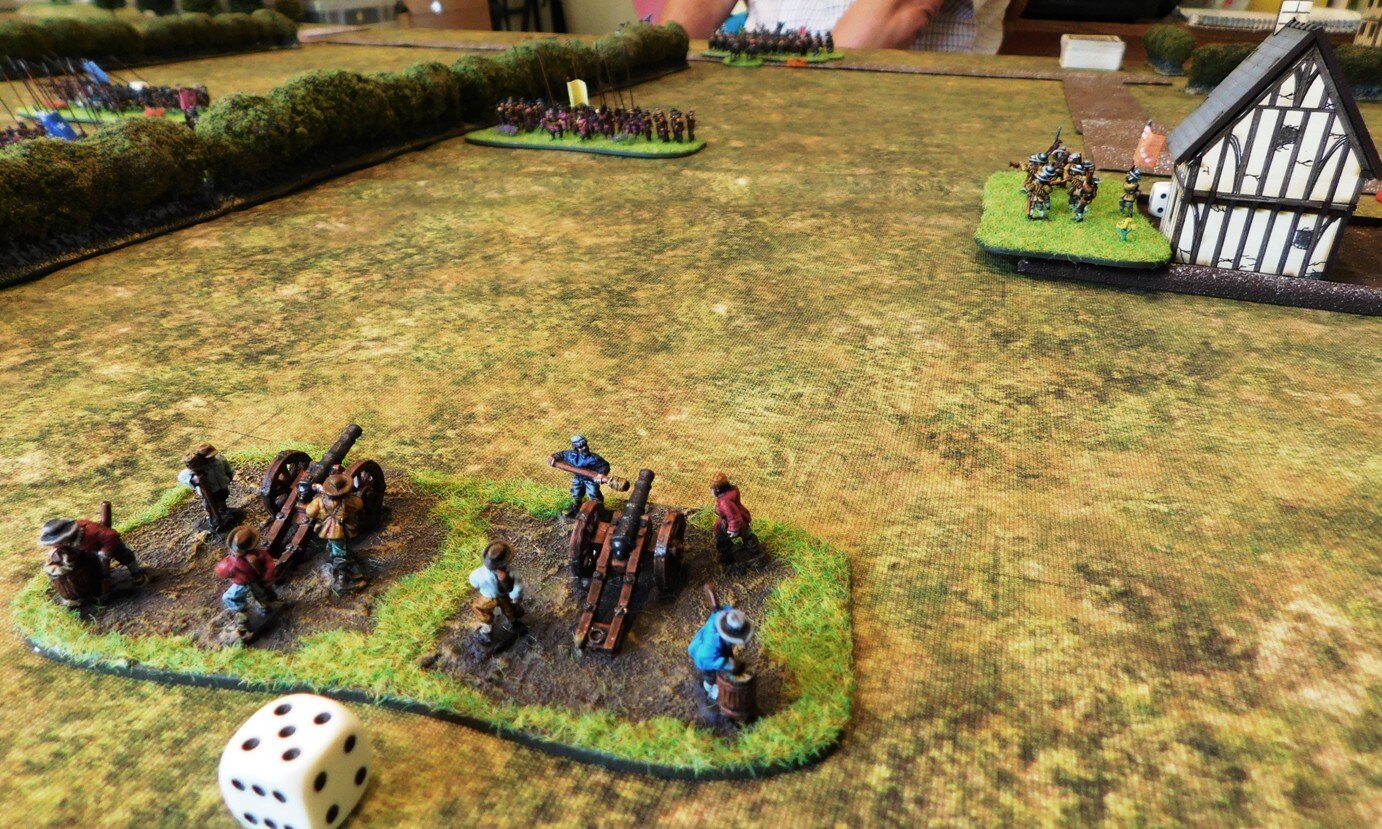
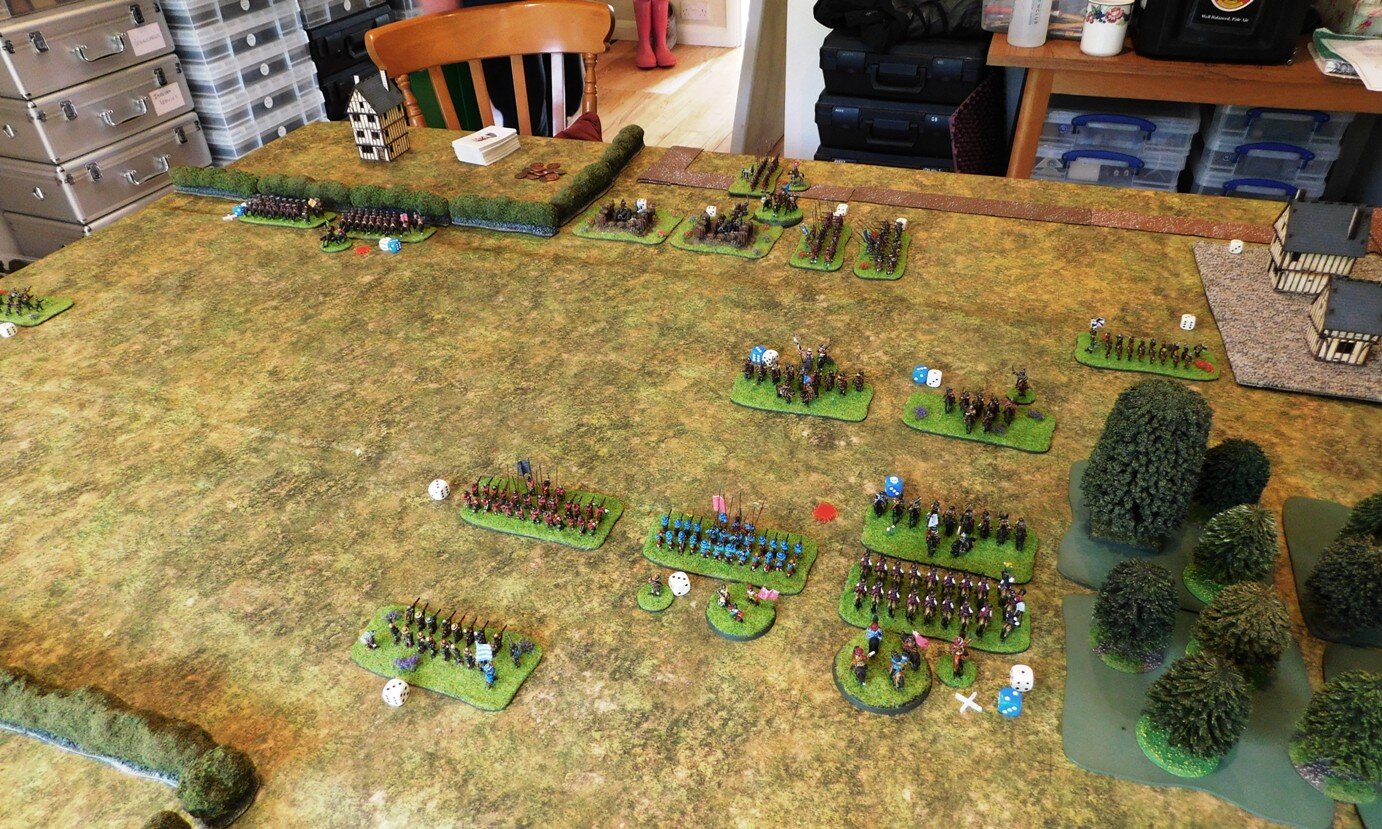
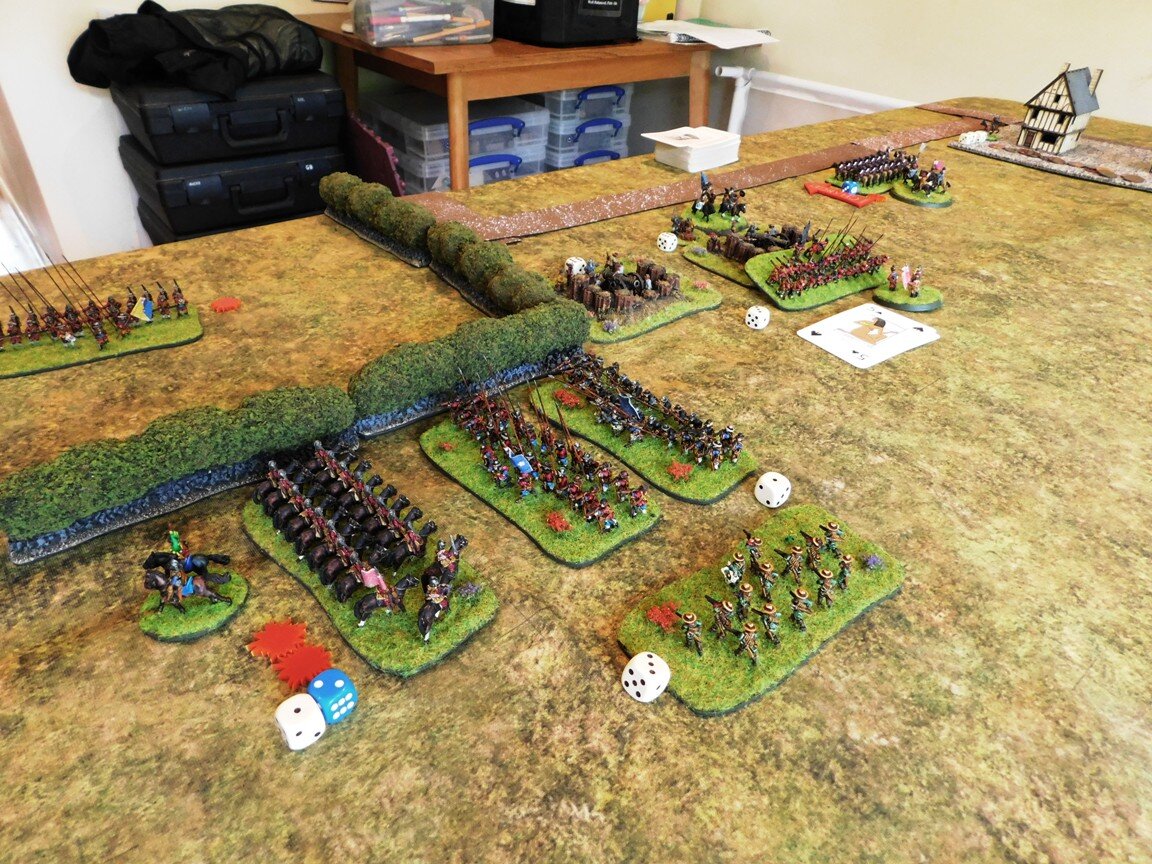
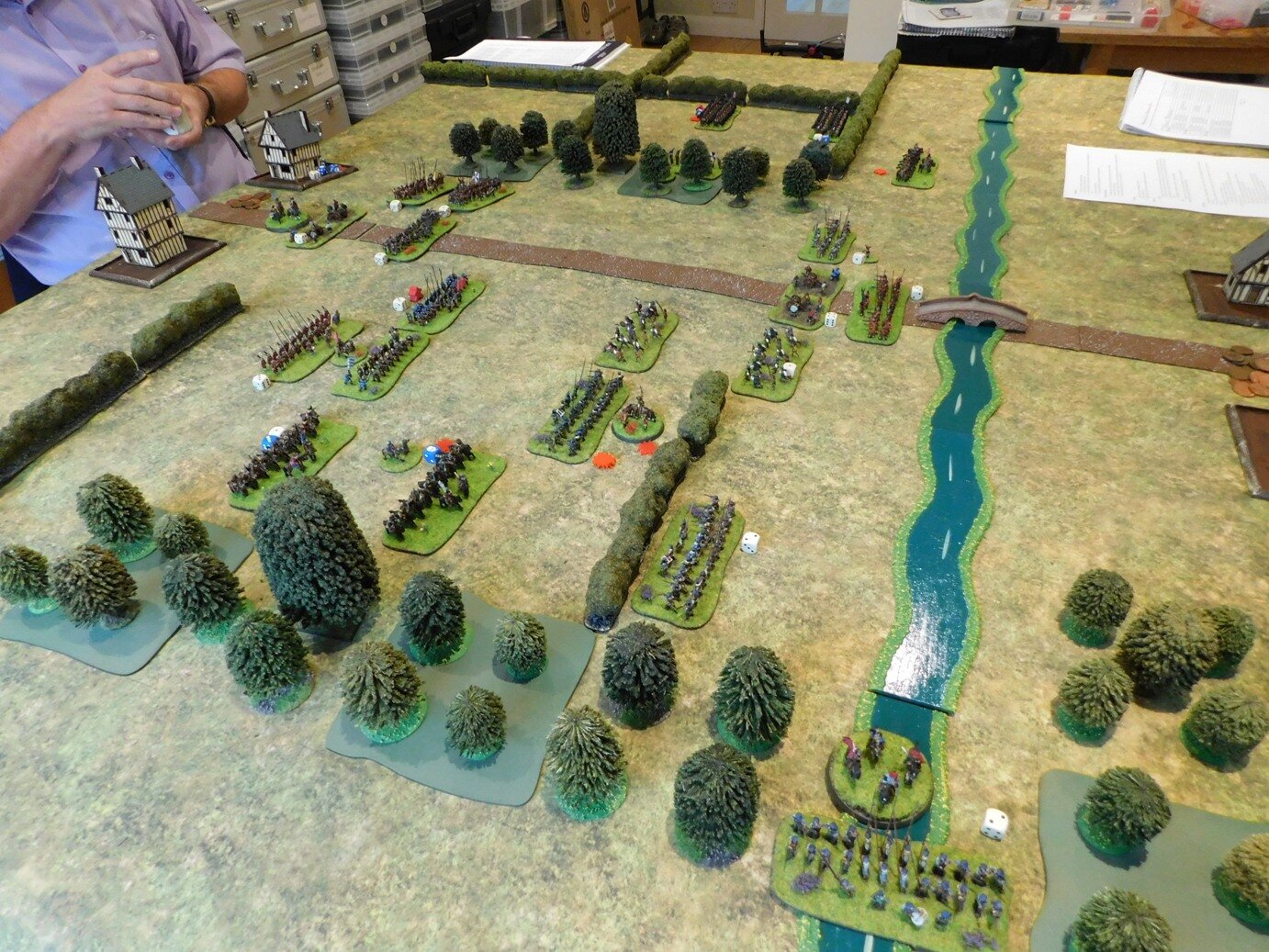
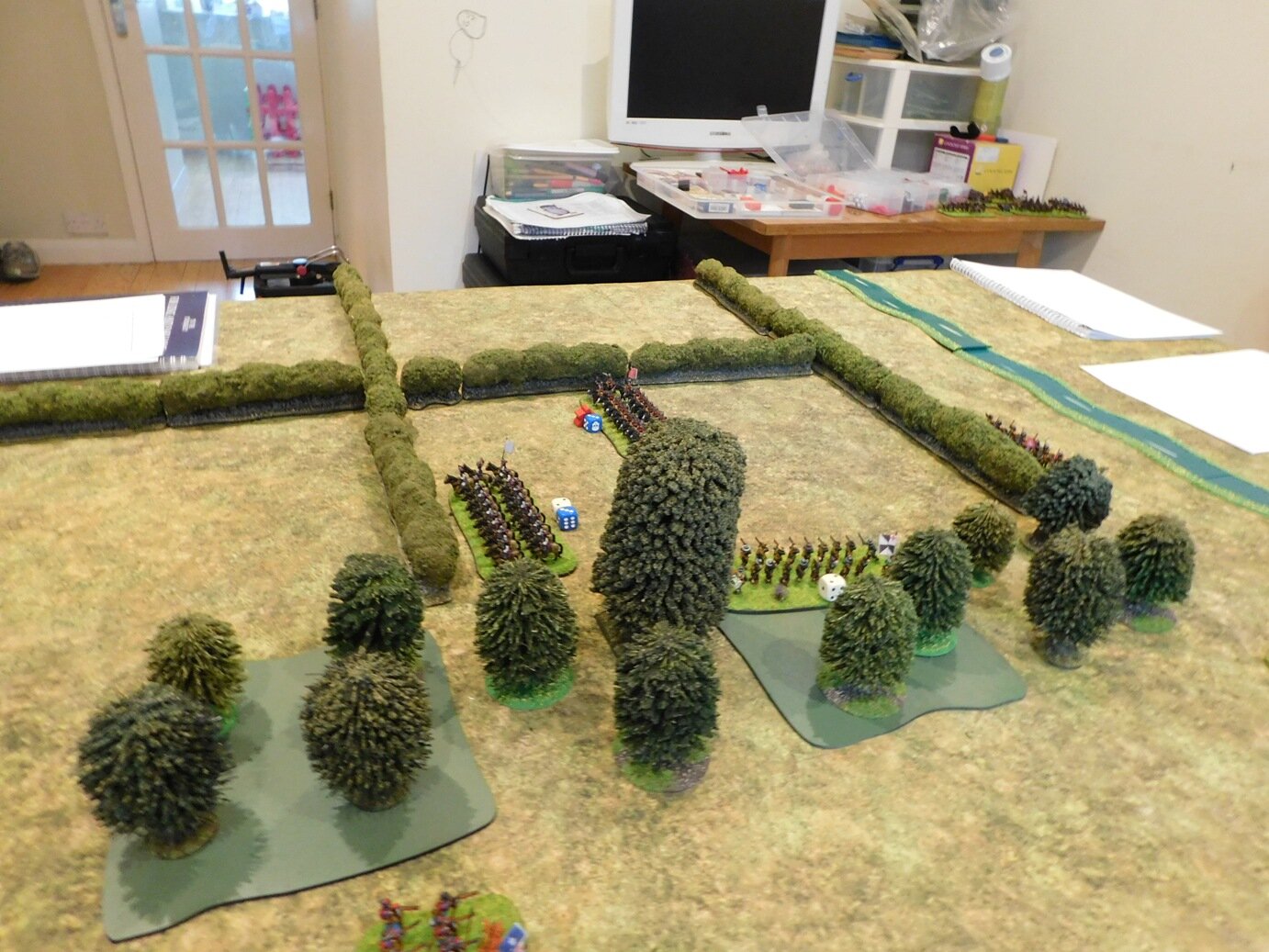
If you look at the picture, below, you’ll see that out at the top of the screen two Royalist units are overlapping my line. I should have taken steps to deal with these immediately, probably by withdrawing back over the hedge or by moving sideways…but I didn’t, not seeing how much of a threat these would turn out to be.

This was a bad mistake, compounded by my response: I thought I move forwards out of danger by breaking through the enemy line.

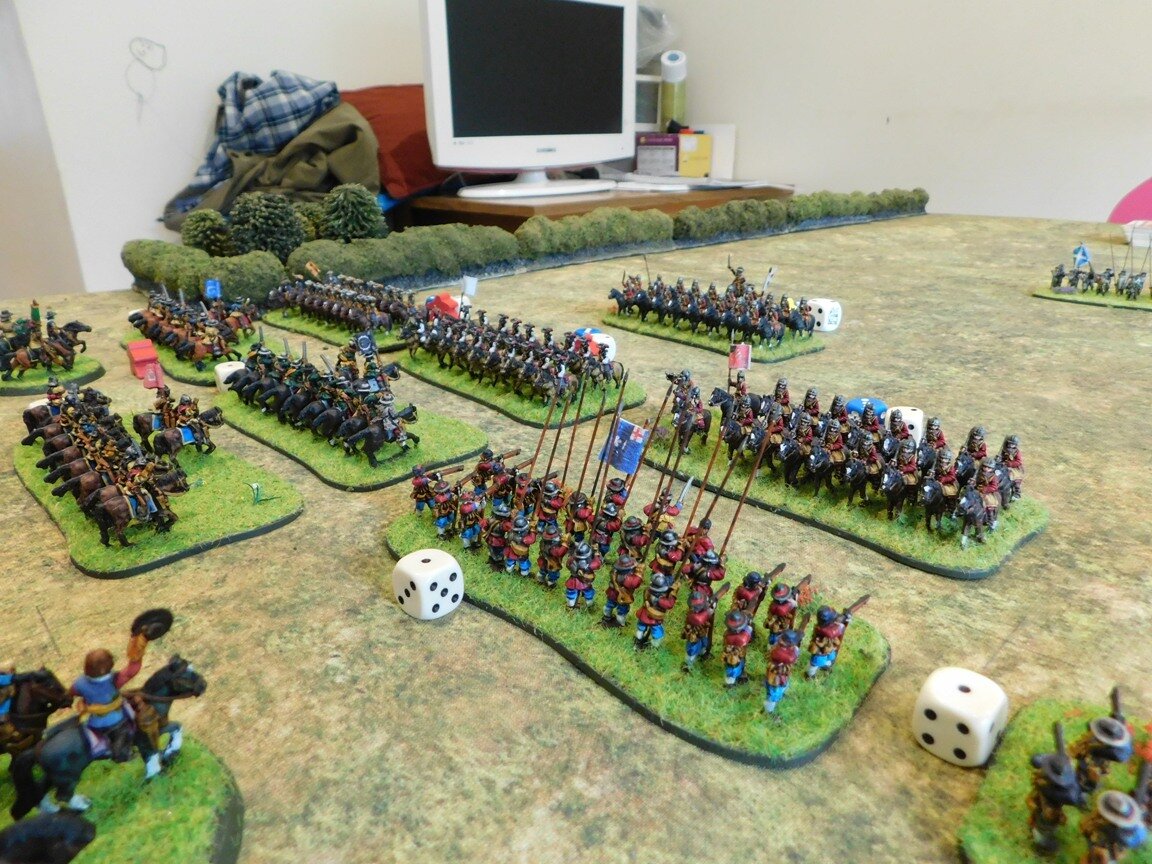
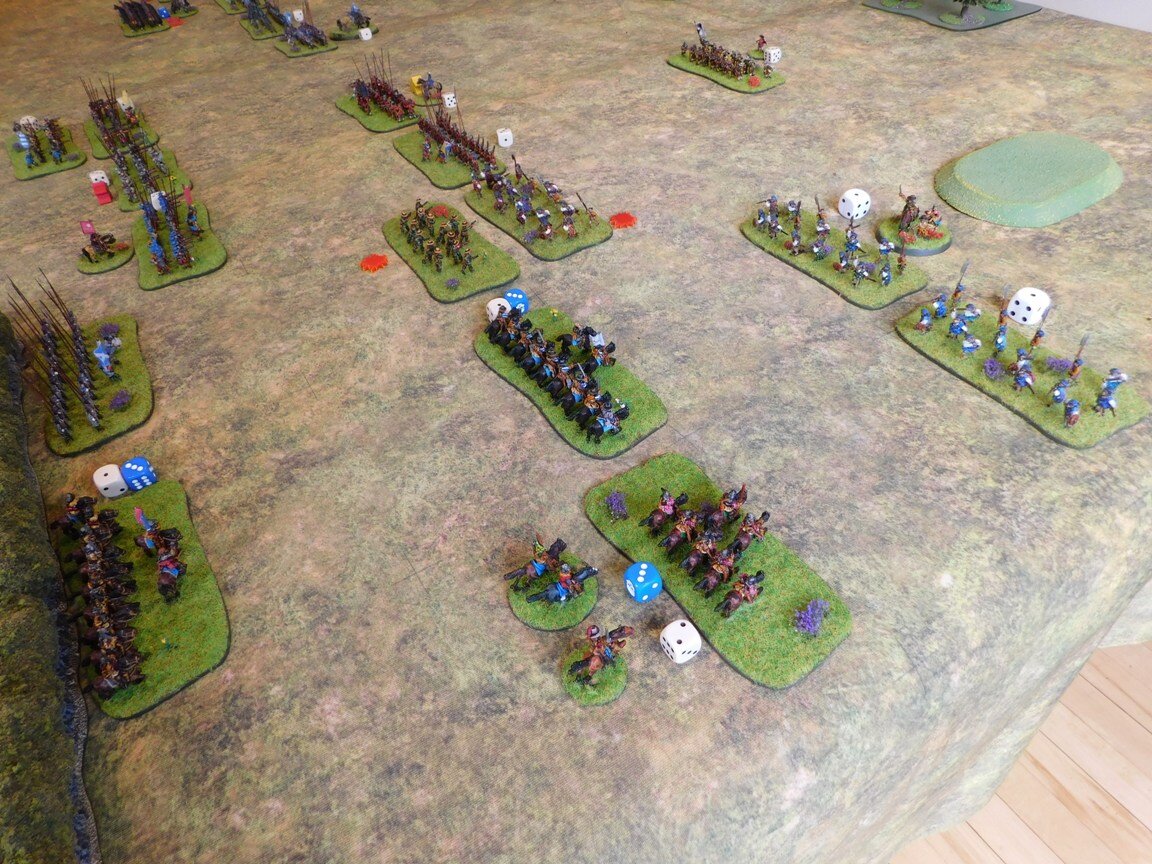
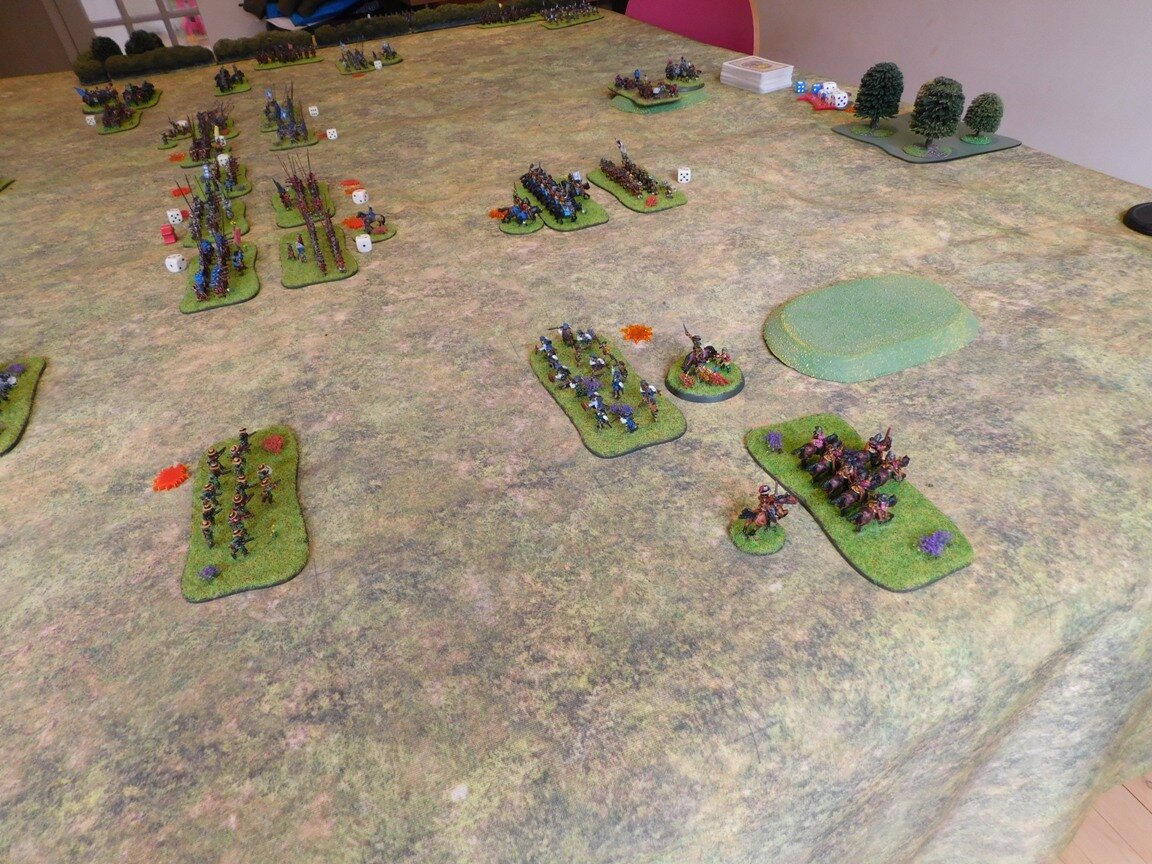
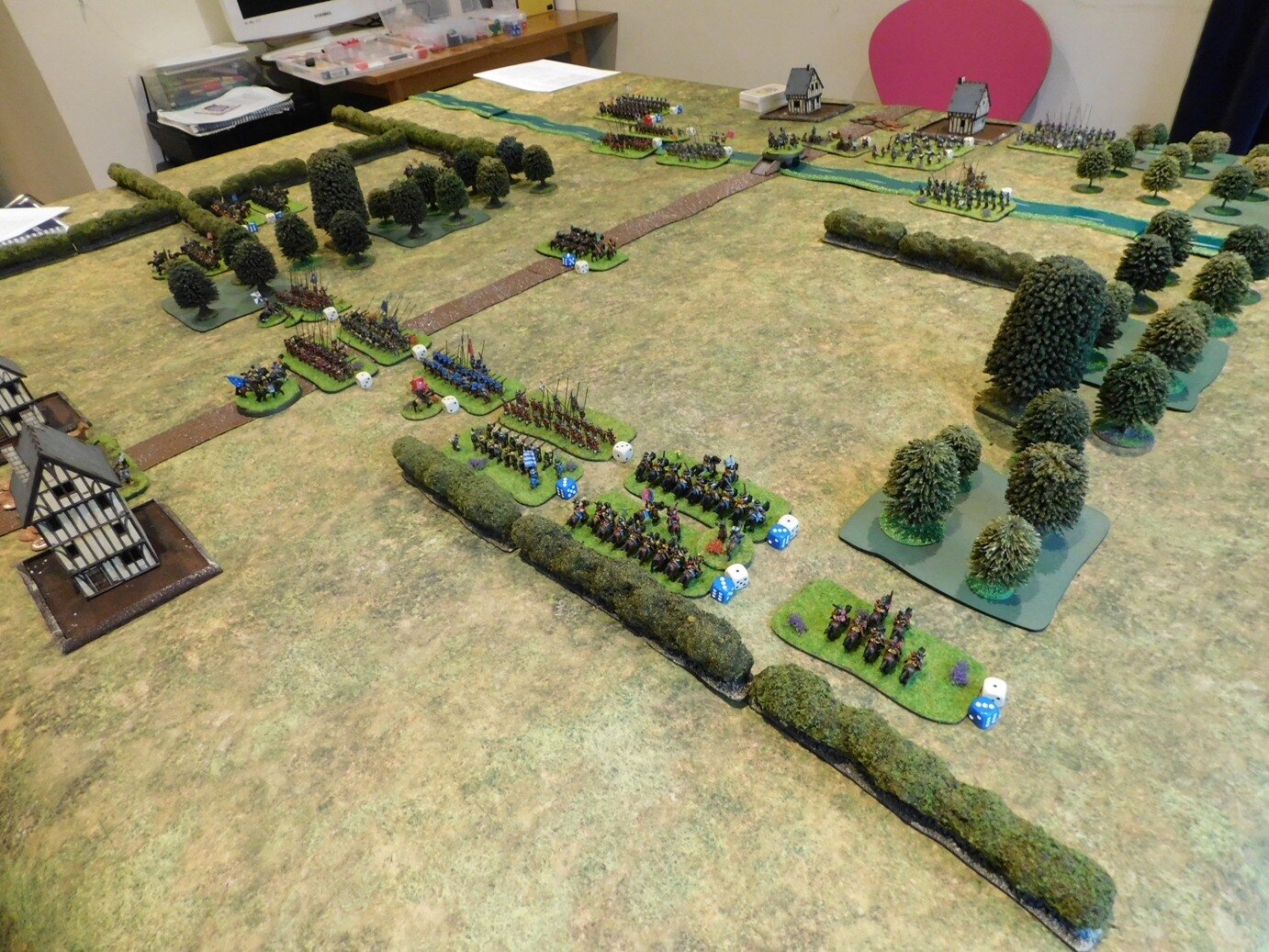
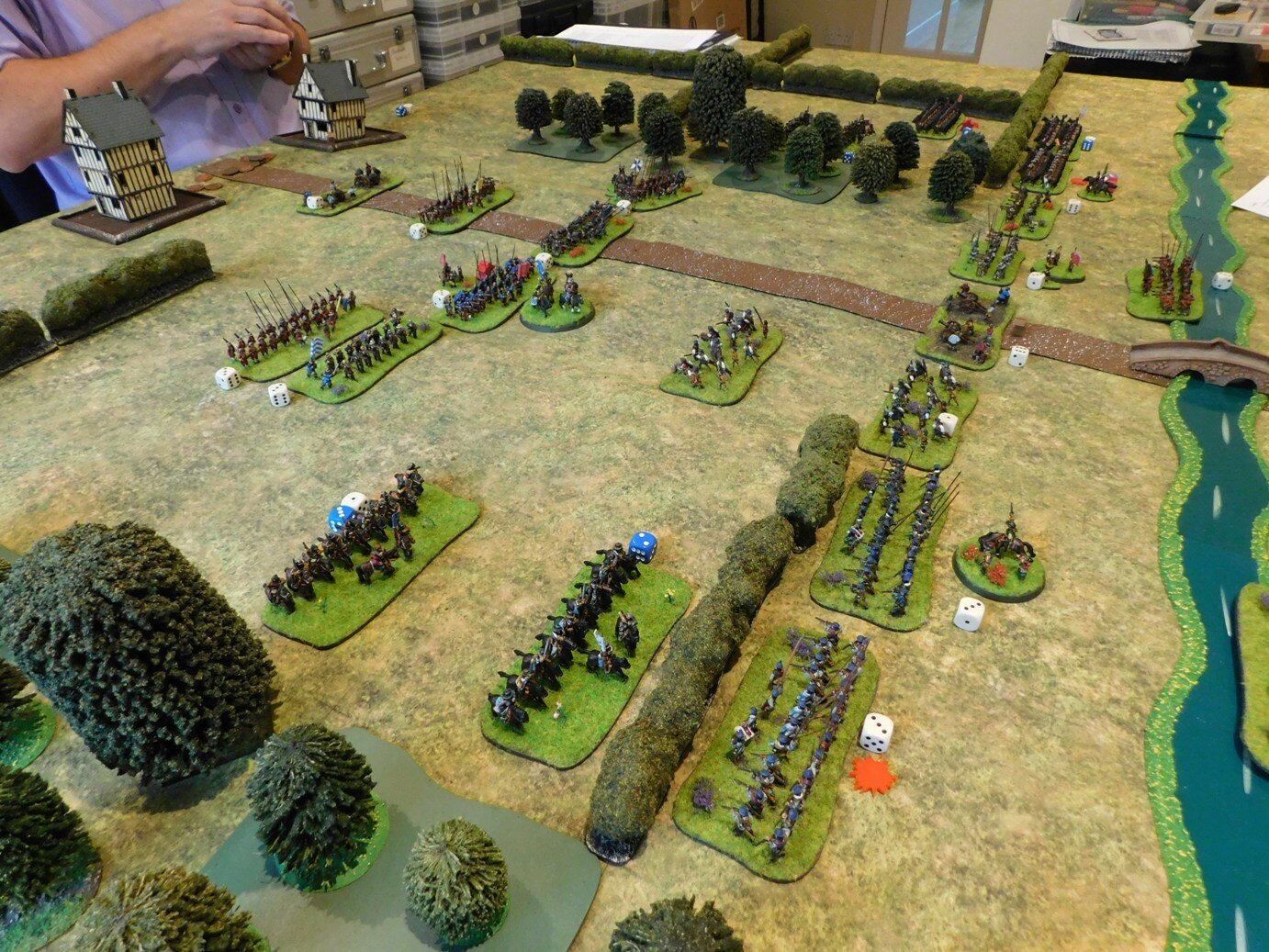
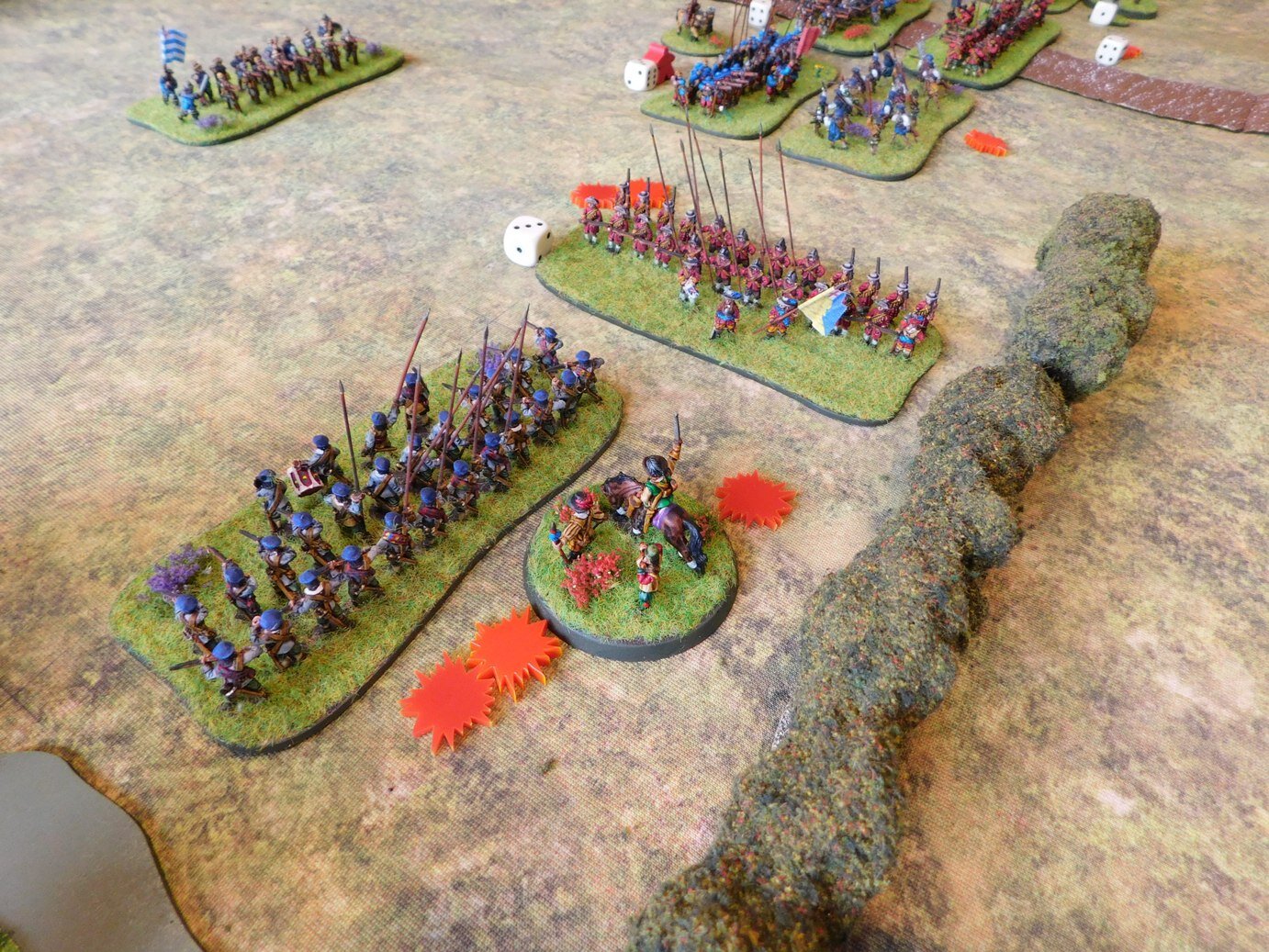
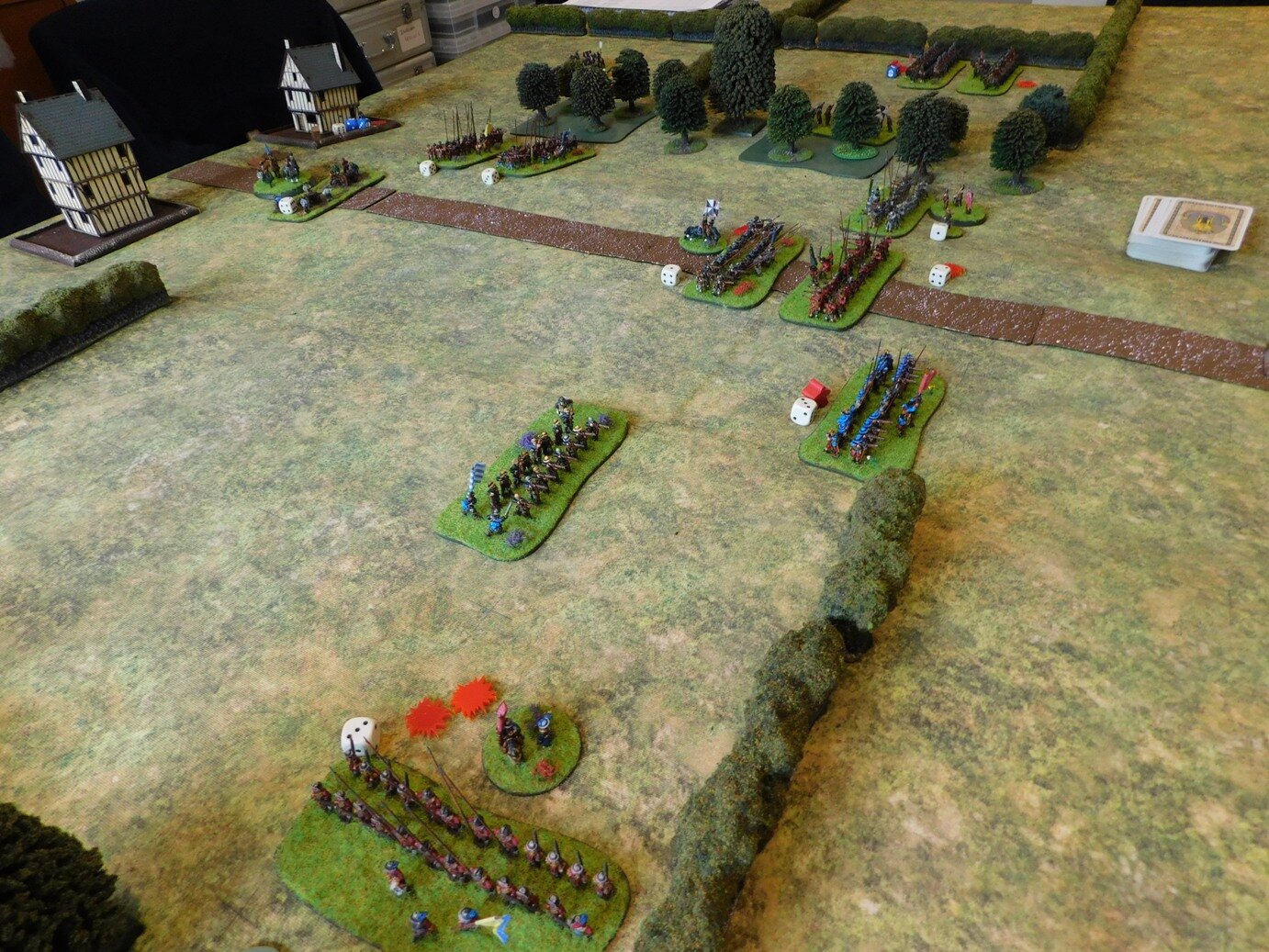
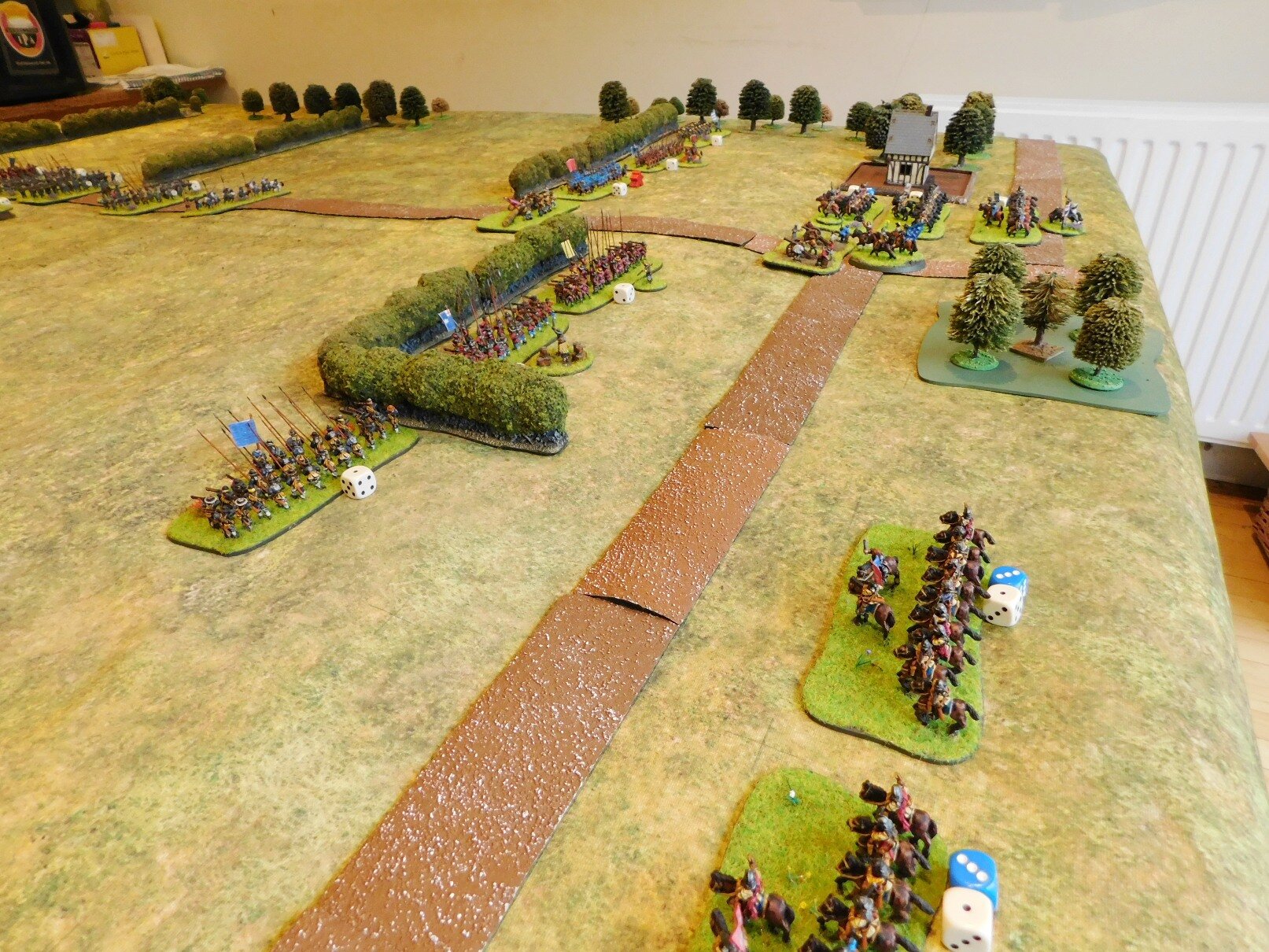
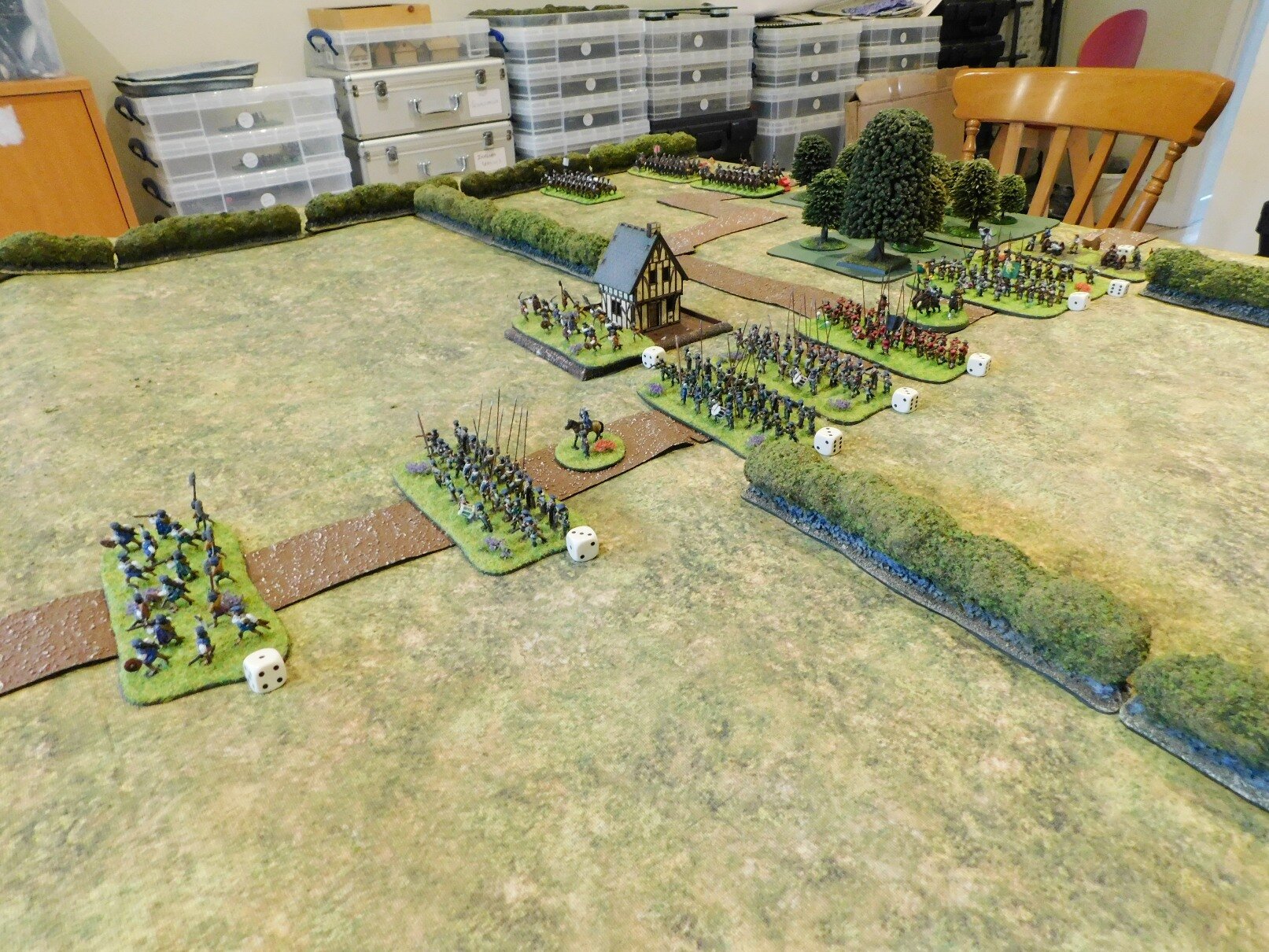
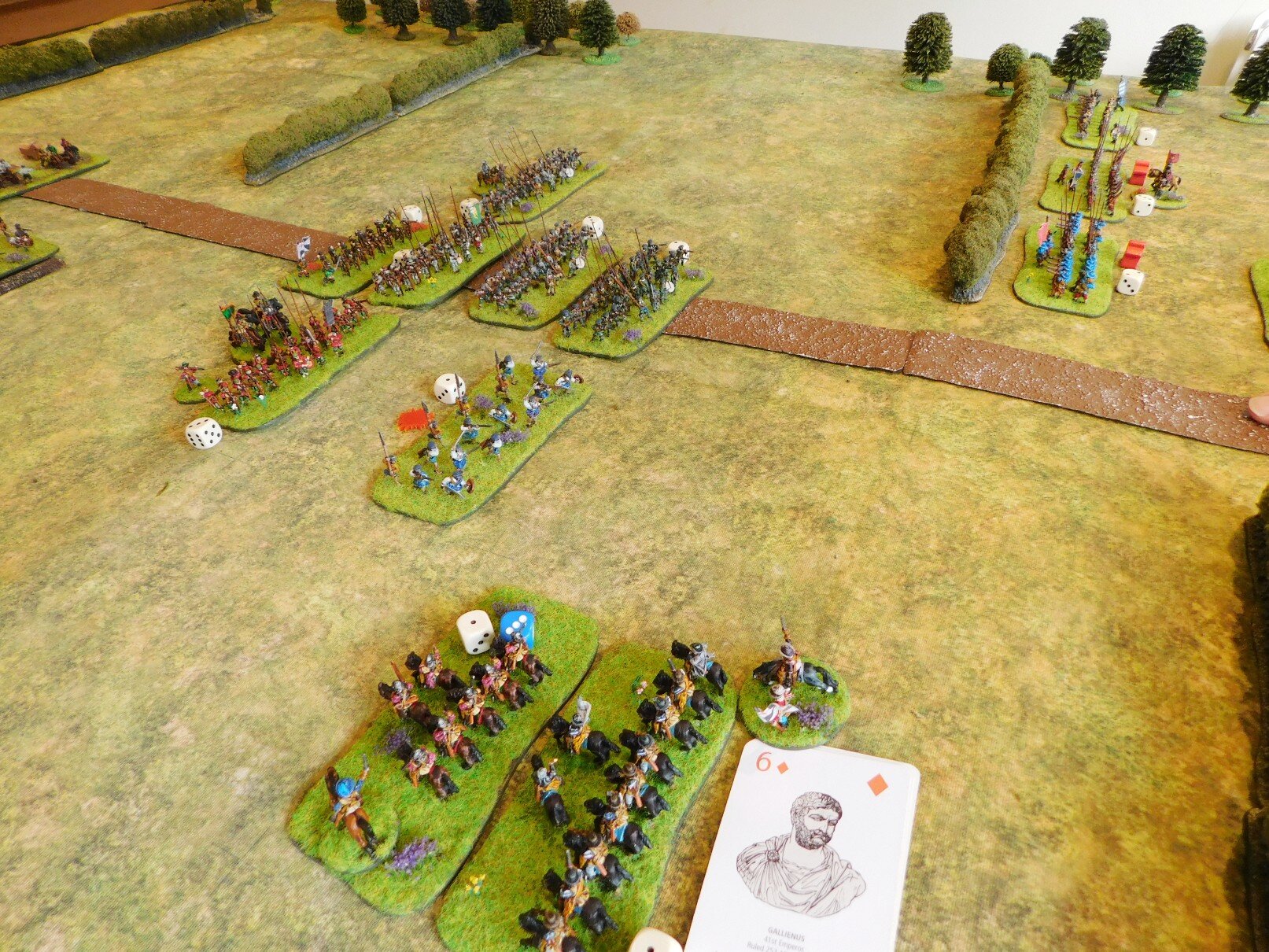
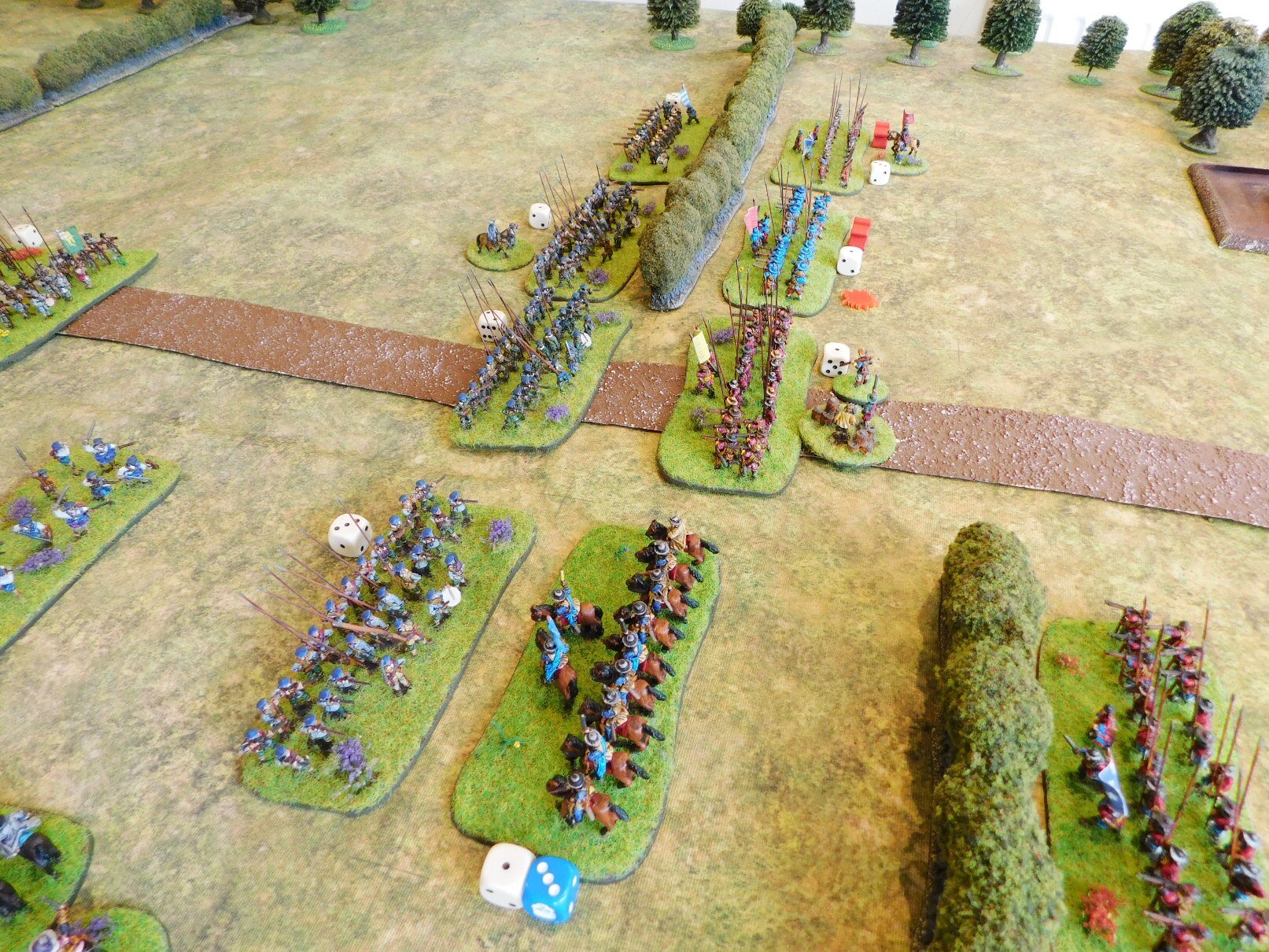
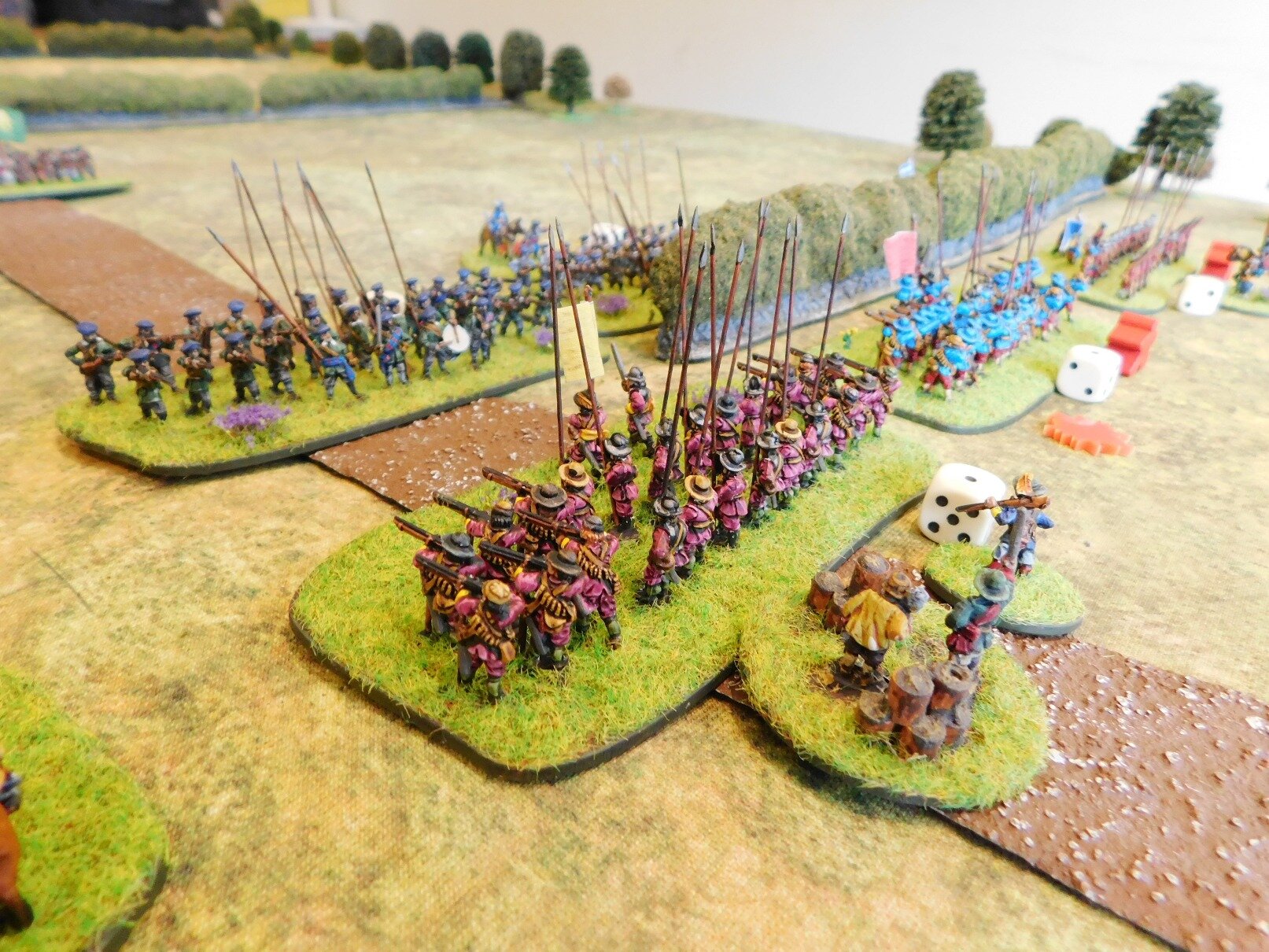
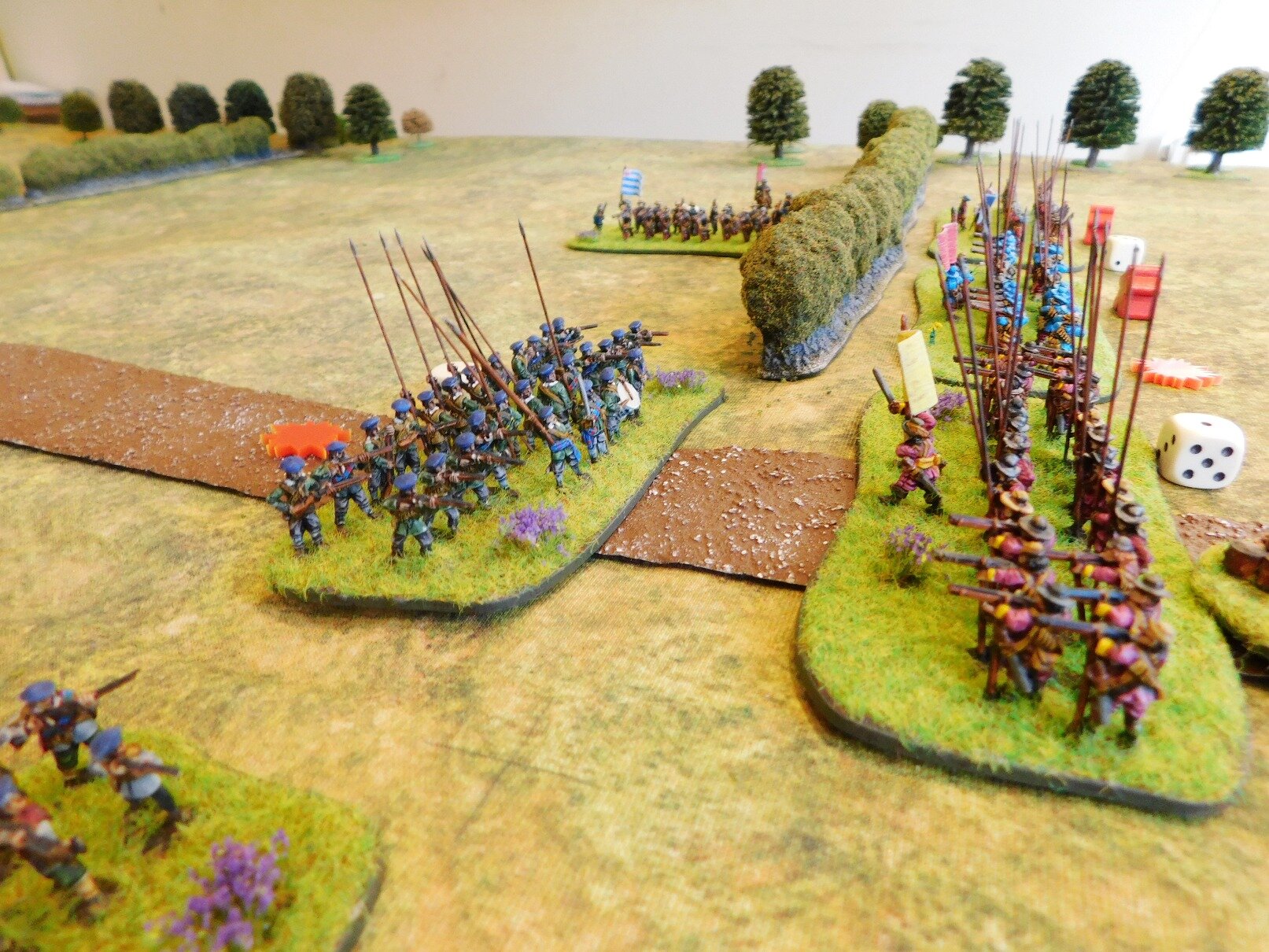
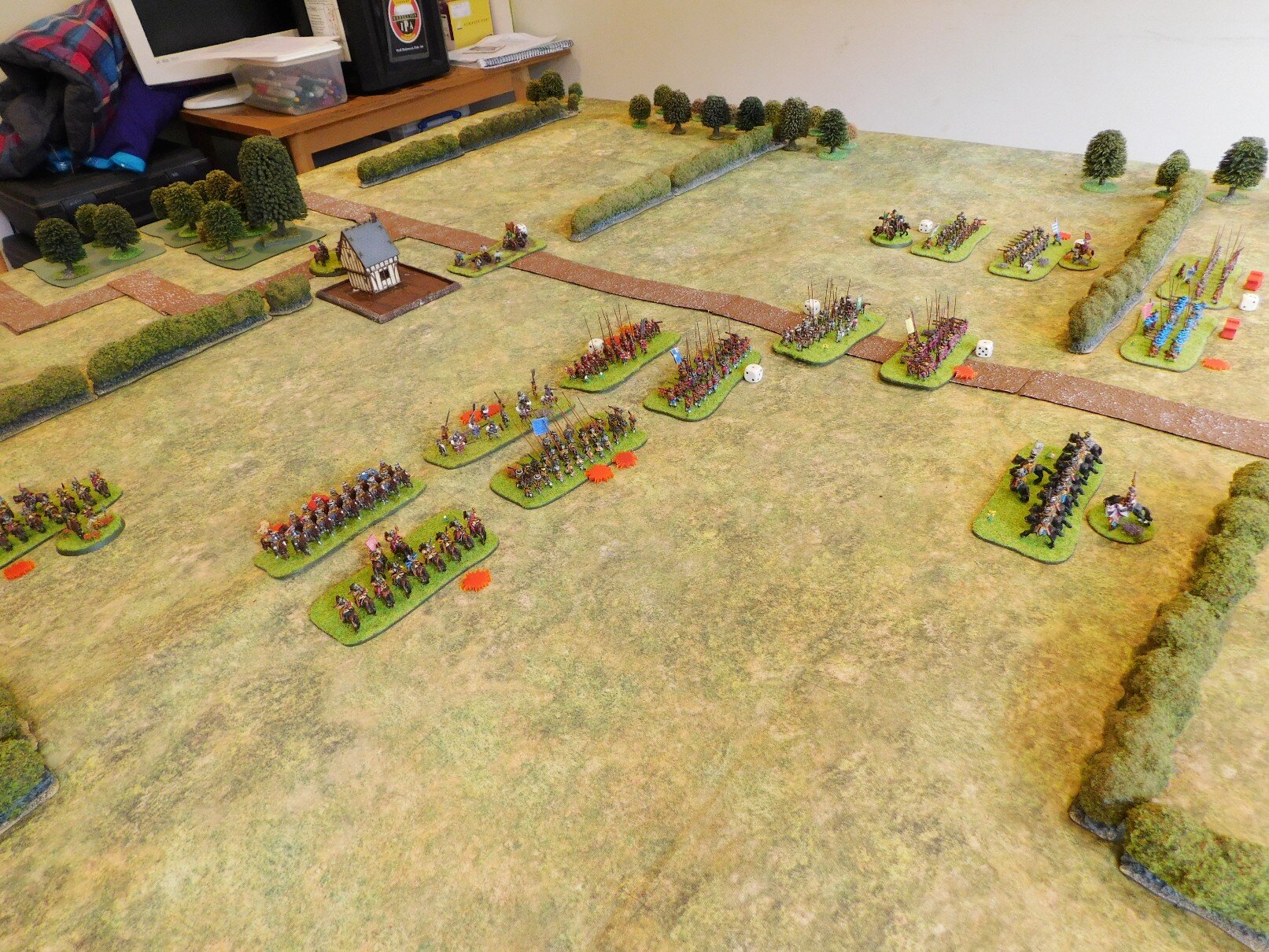
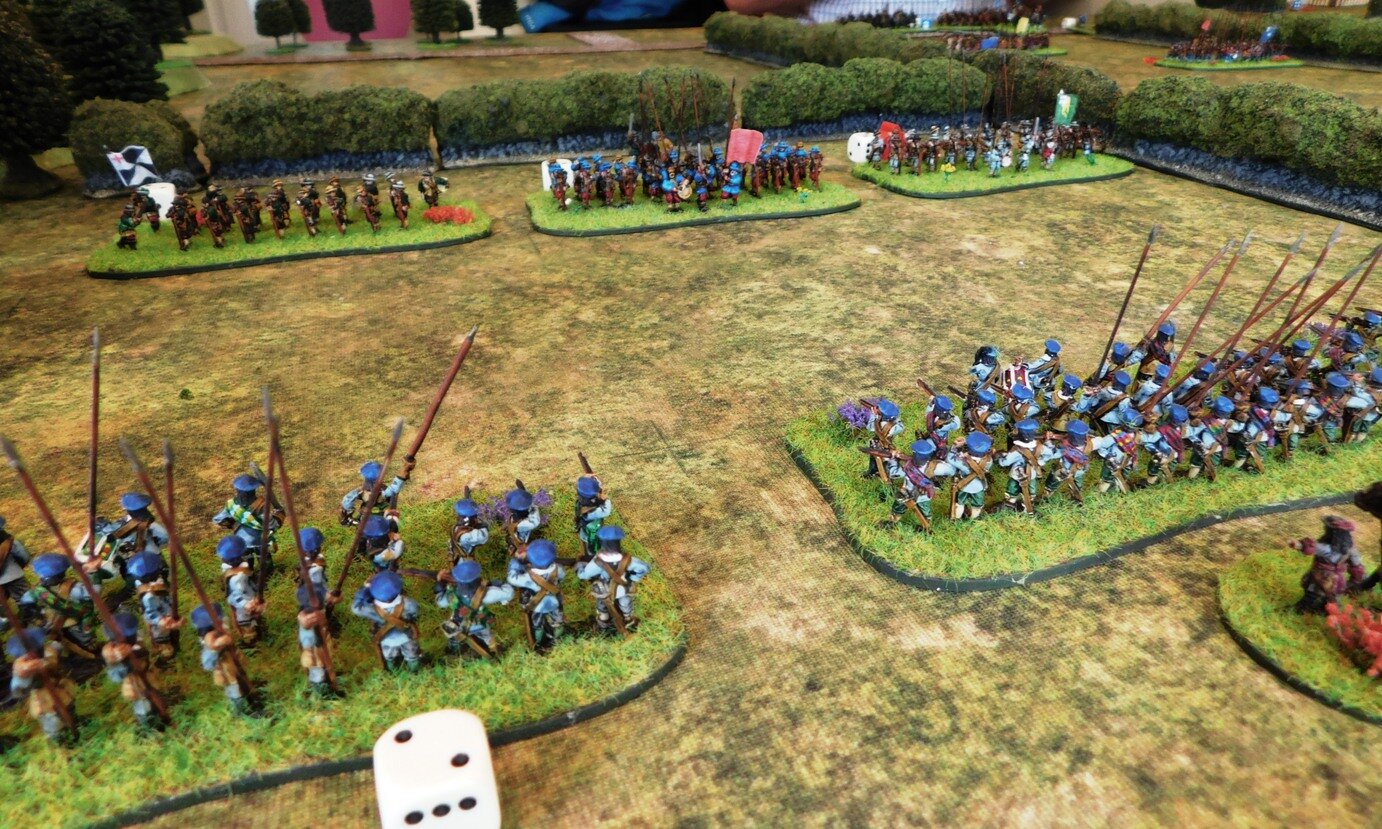
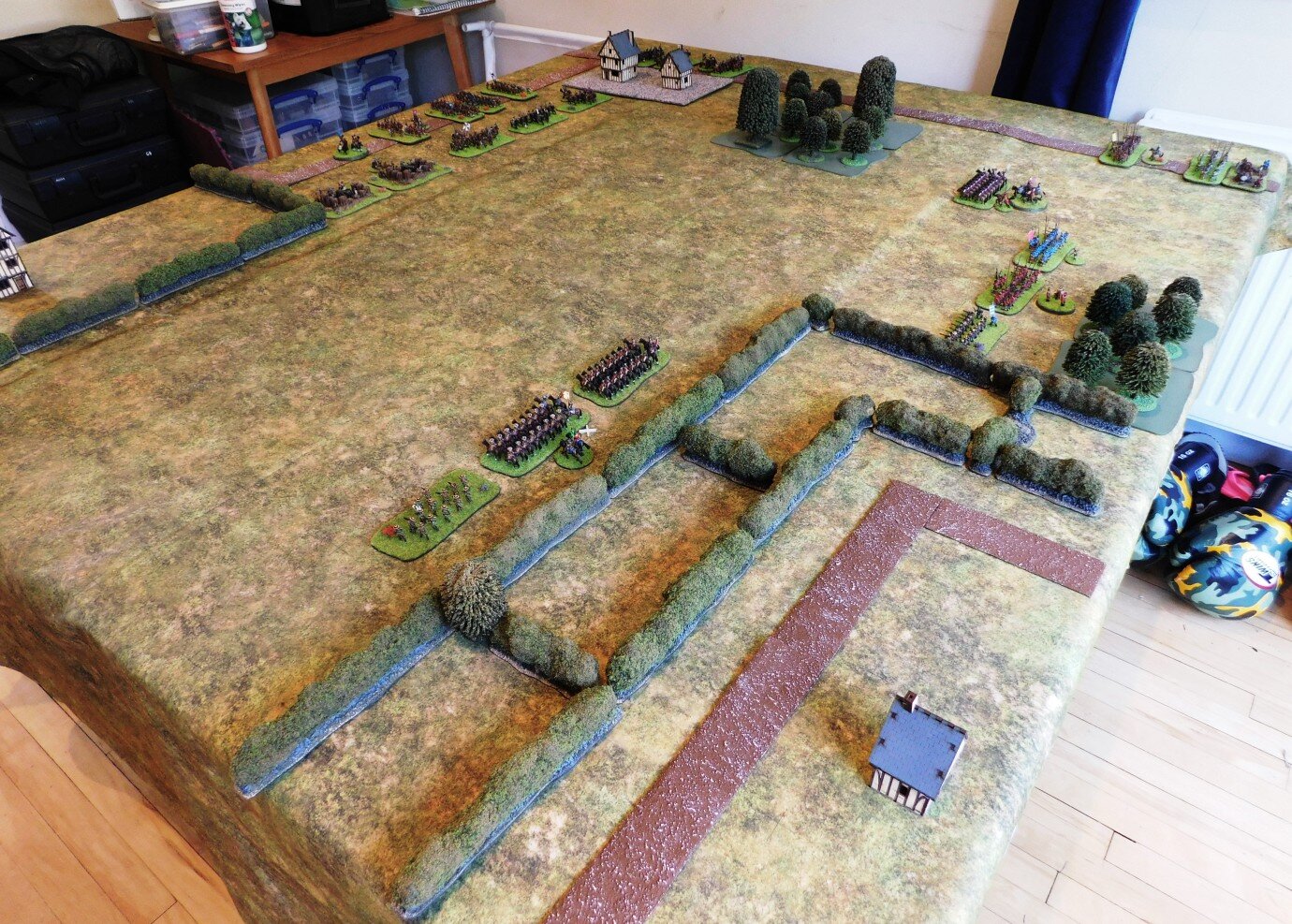
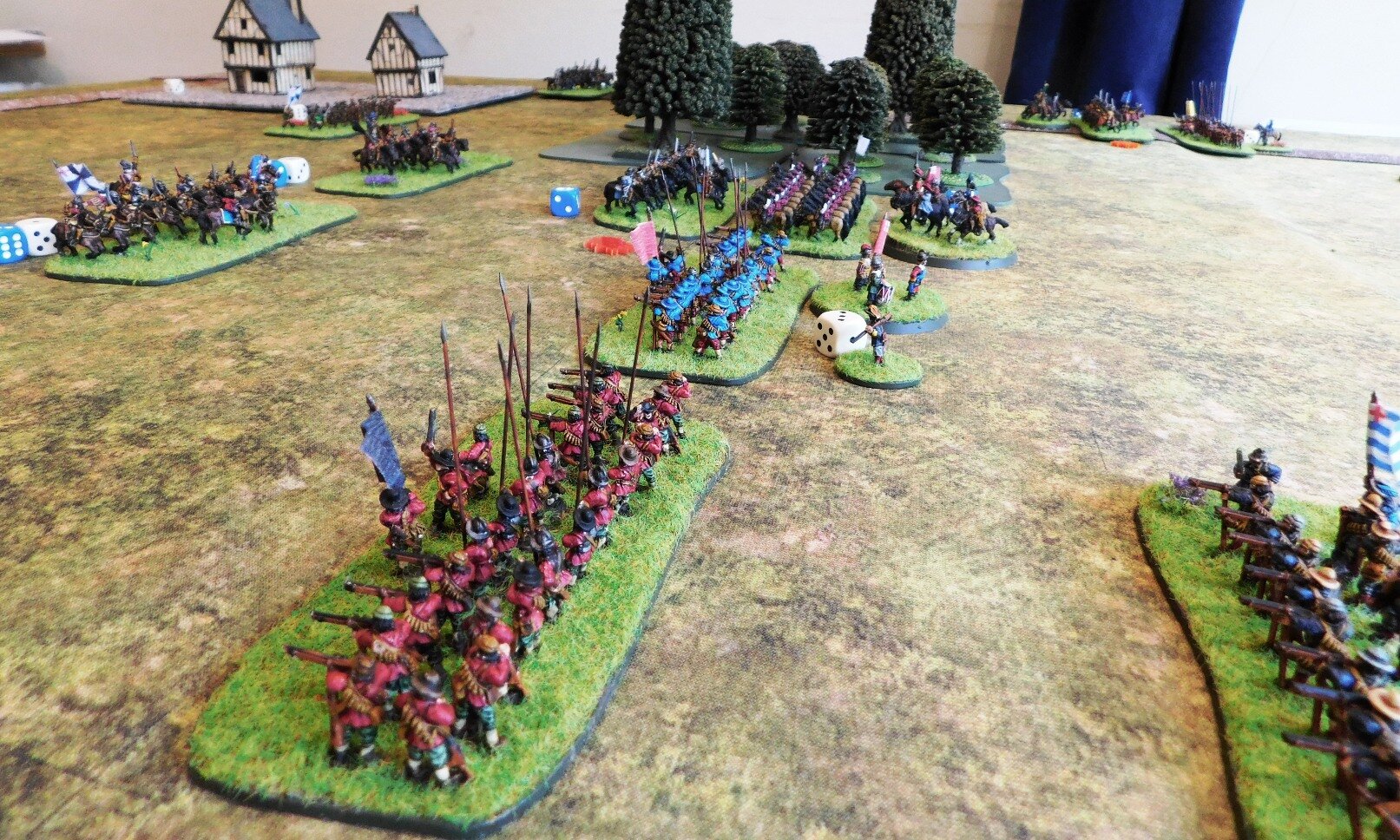
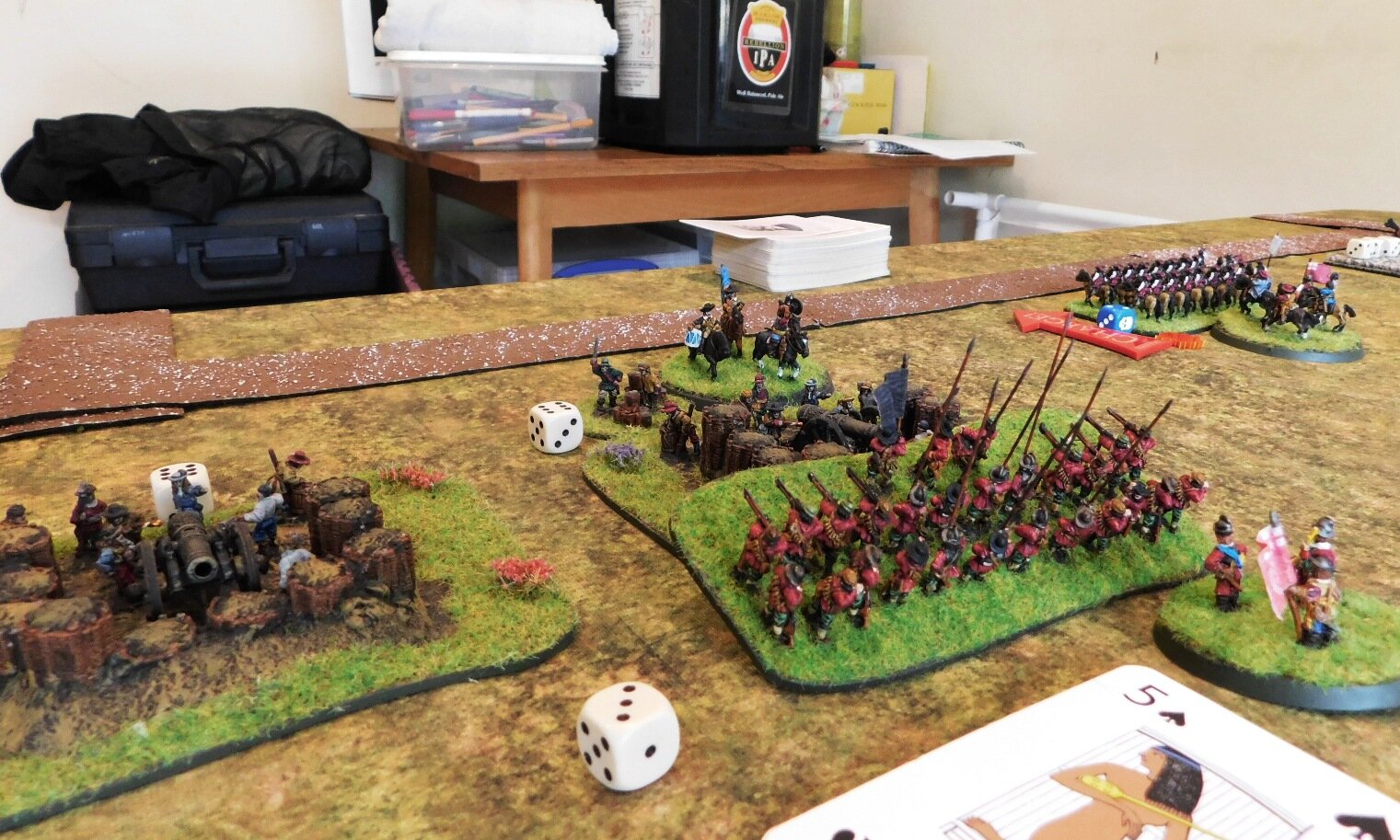
This is the situation (below) a few minutes later: the enemy unit of pikemen dressed in red in the centre of the photo have swept in from the left and destroyed two of my pike units.

My unit dressed in blue managed to get onto their flank, but the cards didn’t fall for me, and the Royalists would go on to destroy the Highlanders as well. That was nine Victory Medals gone in one fell swoop!

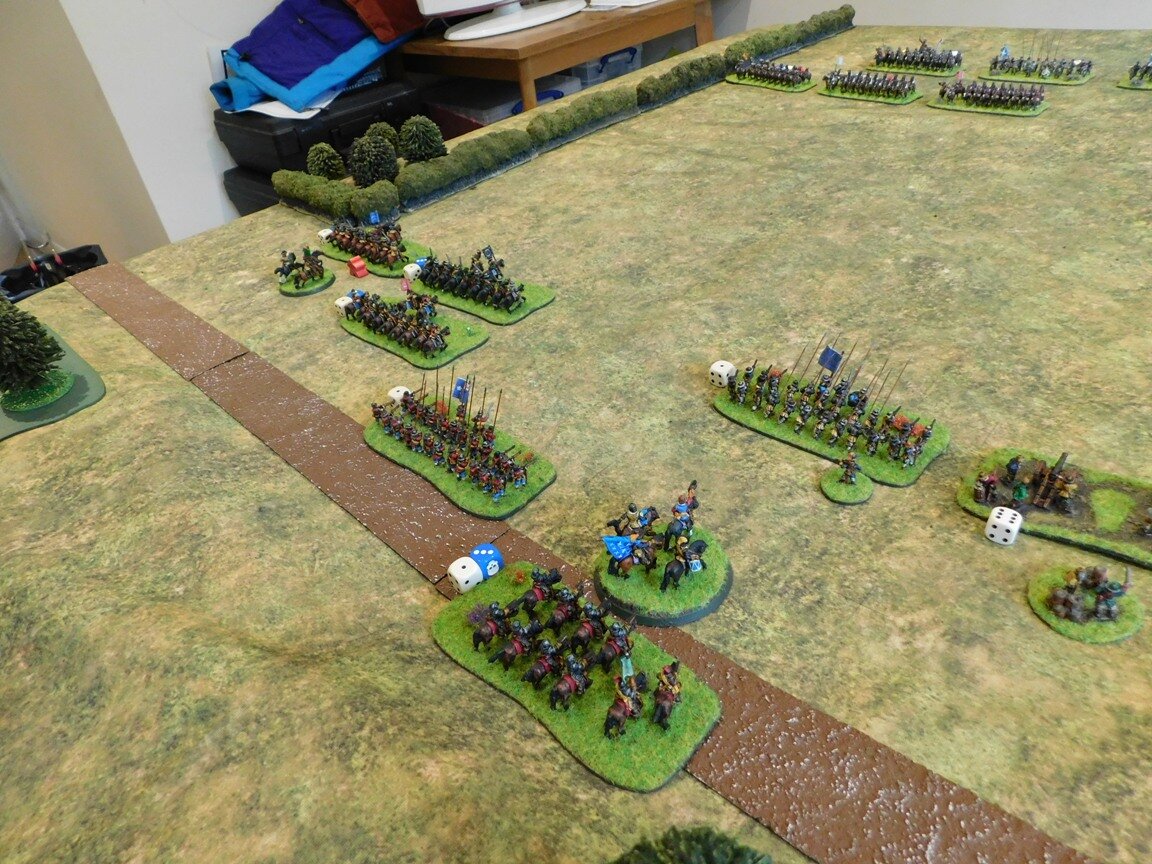
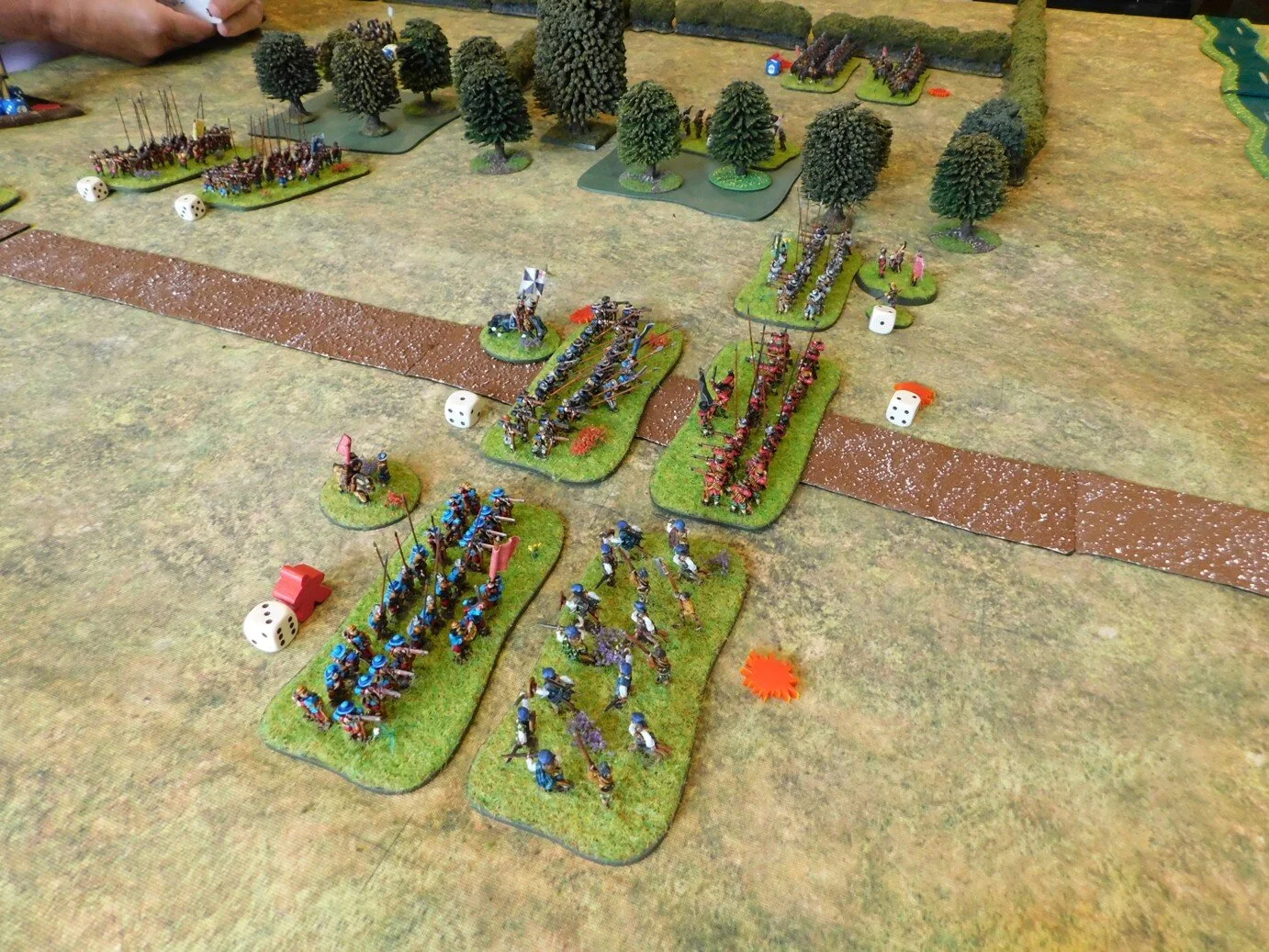
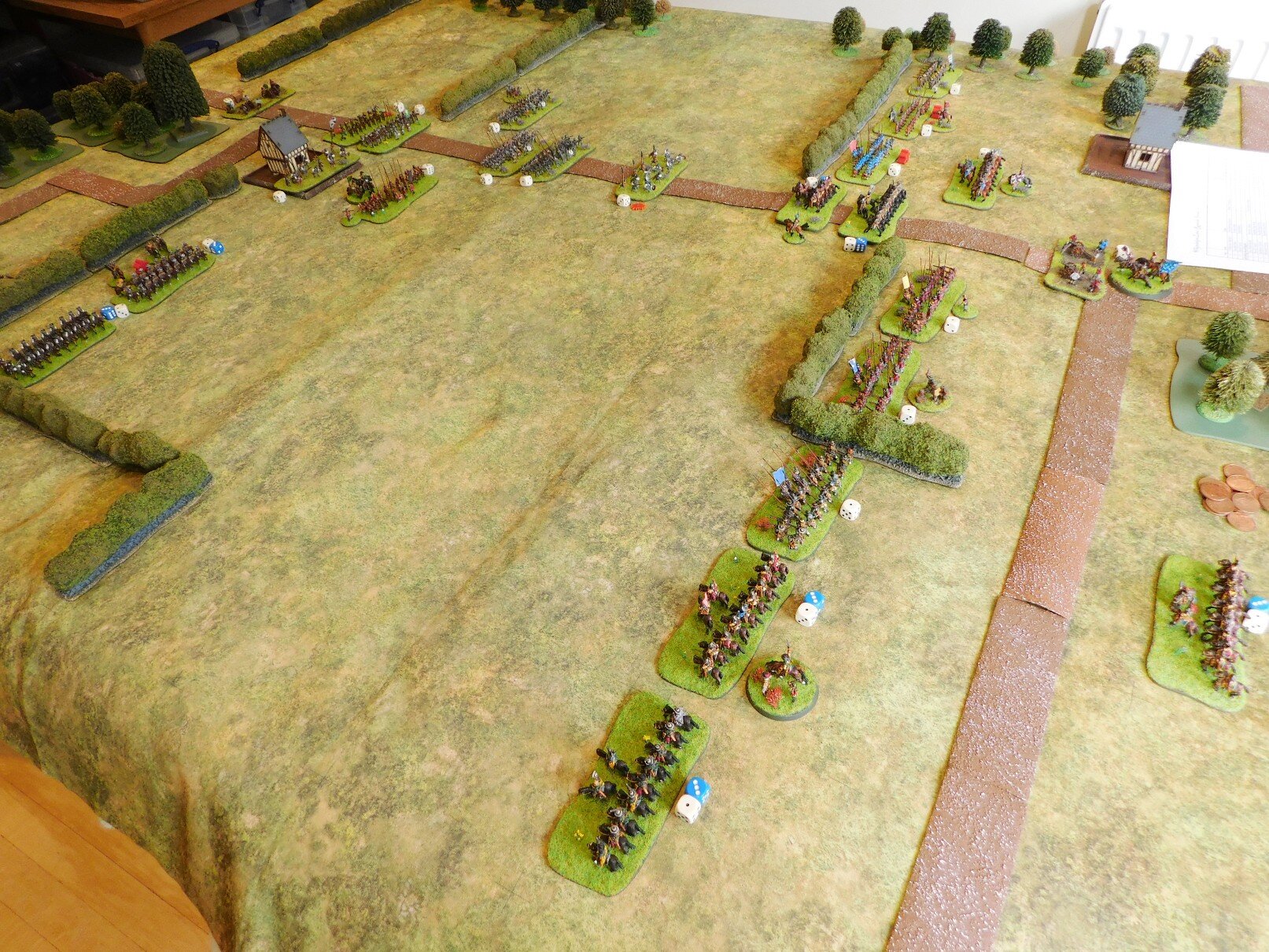
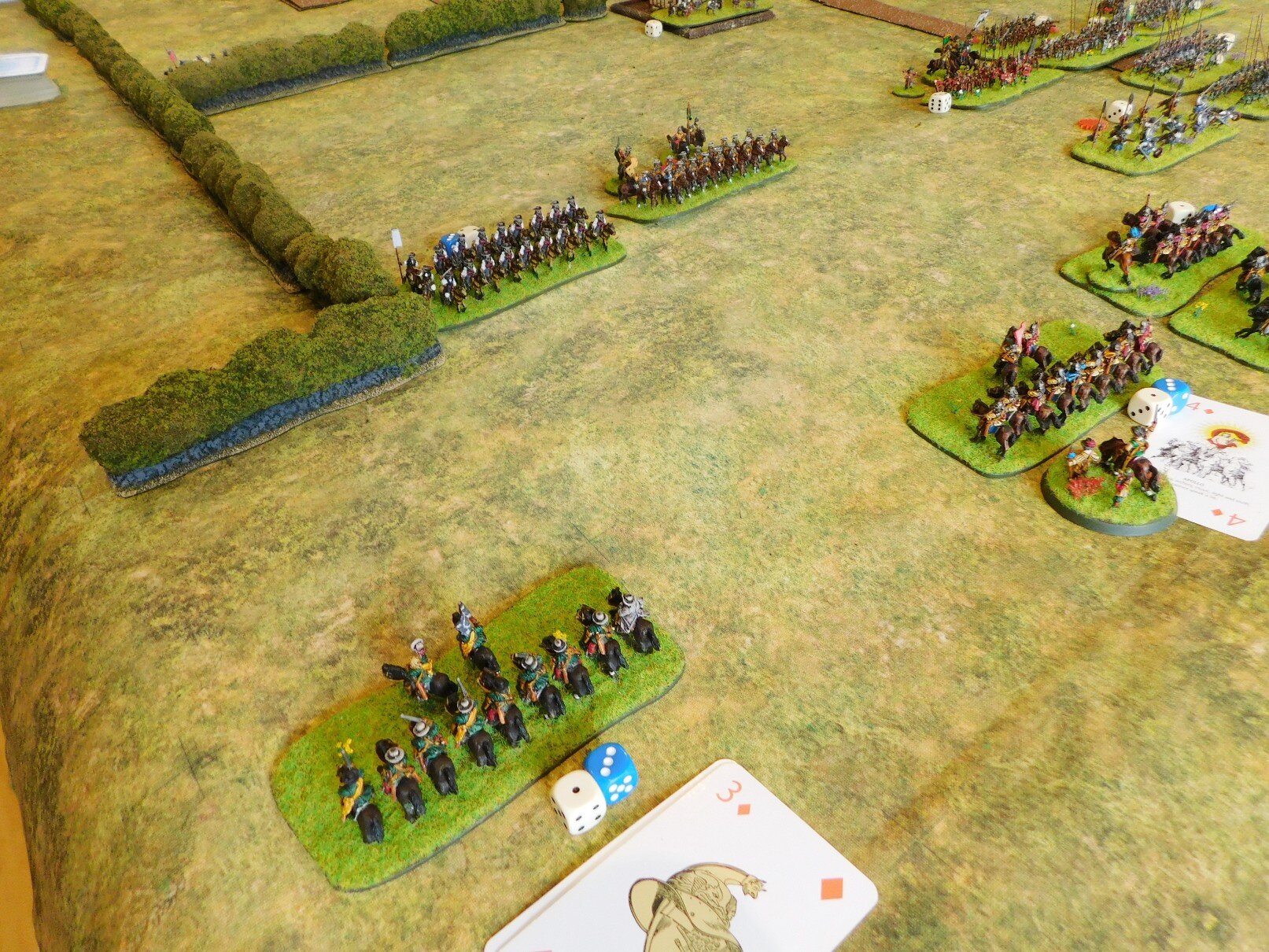
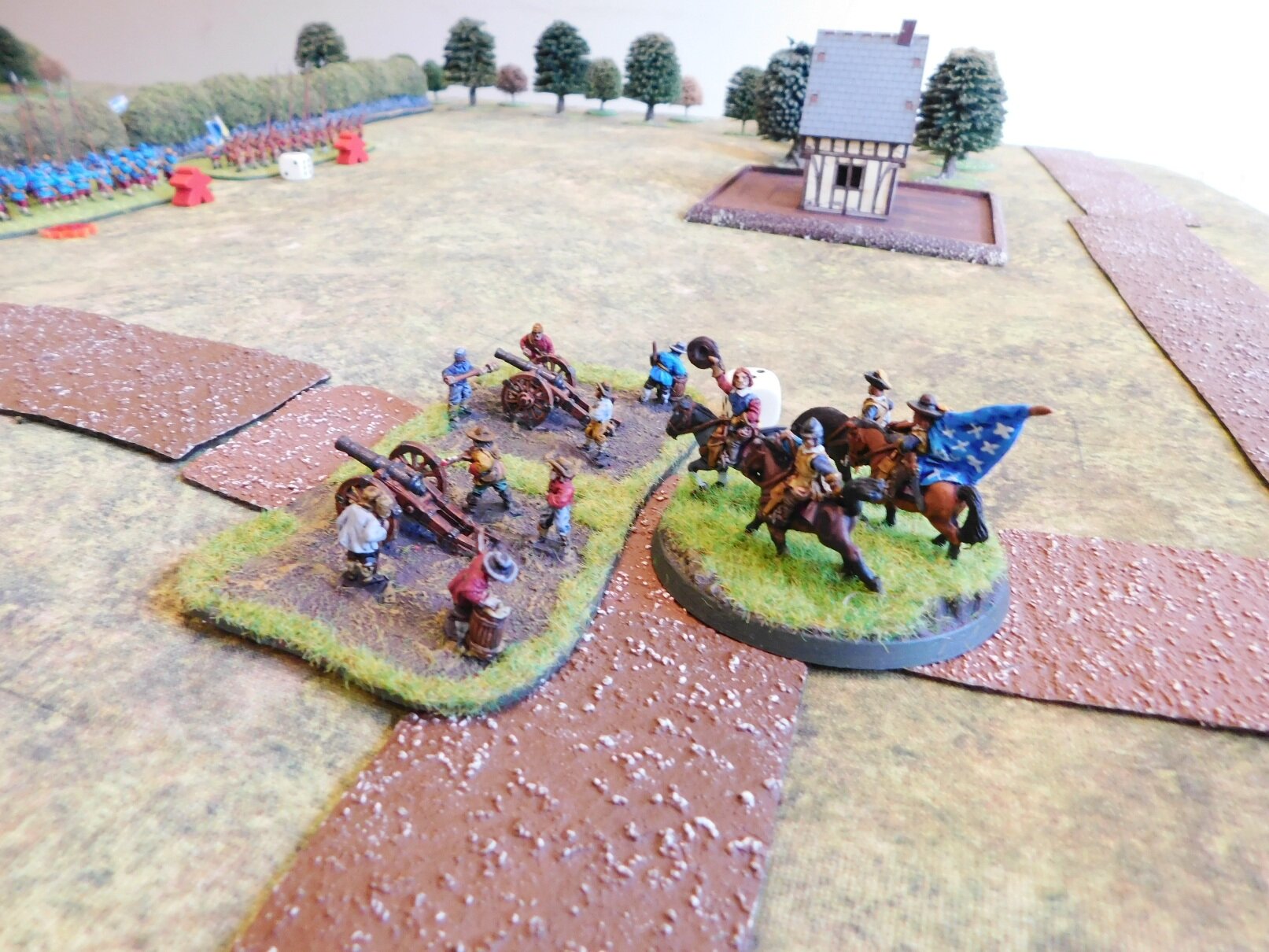
To add insult to injury, on the other side of the field my Dutch horse had now been forced into engaging two battalia of enemy pike: not something that horse enjoy doing! The game continued for another couple of turns, but the writing was on the wall. I eventually had no choice except to order a retreat.

Afterword

I came close this time, so I think when I replay this scenario again I will try pulling back my column and forming on the hedge line behind the first couple of battalia.

Whatever the result, another great game of FK&P: I shall just have to get my revenge at Cookham Moor this afternoon!

More Scottish Pike/Warbases Deliver!

Here’s another unit for my 15mm ECW Scots Covenanter army: a second pike-only battalia.

The fine-looking pikemen are from the Hallmark range via Magister Militum; and the command figures are Peter Pig. These are painted mainly with GW Contrast Paints, with just the metalwork being normal acrylics.

As regards everything else, the flag is a custom order from Maverick, the pikes are from Northstar, the heather is from Boontown (see yesterday’s post for more) , the base is from Warbases (see below for more), and the flock is from Hobby Round.

Warbases Deliver!

The story so far: a load of lockdown loot ordered from eight different manufacturers/suppliers last Sunday. On Wednesday, Boontown won the race to be the first to deliver, and yesterday the ever-reliable Warbases came in second with my order of vehicle bases (which I use for 15mm elements such as the pike, above) and a packet of command bases.

So far, therefore, we have:

  1. Boontown (3 days)

  2. Warbases (4 days)

Pretty impressive stuff!

Scottish Lancers

I’ve finally had a chance to finish a unit that’s been sitting on the painting table for almost a week: a unit of Scottish Lancers for my ECW Covenantor army.

The main body figures are from Khurasan’s ECW Scots & Irish range, painted mainly with GW Contrast Paints. The two command figures are Peter Pig. The flag is a custom design from Maverick. As I didn’t have a command figure holding a flag, and wrapping it around one of the lancers looked weird, I decided to have the chap on the left waving a cut-down version!
The unit is based for For King & Parliament on a Warbases vehicle base. The purple heather is from Boontown.

I also managed to paint up a Colonel’s command base for the troops: a couple of figures from Peter Pig:

These were painted in the same way as the Lancers, above.

FK&P AAR: Cock Marsh

After the battle for Cookham Moor, the Parliamentarians have retreated in some disarray: falling back to a position where their rear and one flank is protected by the river Thames.

This protection, however, forms two sides of a potential cage, so the Royalists have hurried forward to do battle again, knowing that if the Roundheads break, there is nowhere, at least on two sides, for them to run.

Could this finally be the decisive battle that both sides have been seeking?

The Field of Battle

The action takes place on Cock Marsh: a bleak, wind-swept area of open ground between Winter Hill and the Thames. The lower slope of Winter Hill borders the south side of the battlefield. The north and part of the east side of the battlefield are bordered by the Thames i.e. impassable terrain. Any unit that is forced off-table into the Thames is lost.

The main part of the tabletop consists of moorland separated by hedgerows and the odd patch of trees. All hedgerows count as linear rough terrain. All wooded squares count as rough terrain. There are two Iron Age burial mounds on the Parliamentarian side of the field.

The Game

Postscript

I’d like to say that my (extremely heavy) defeat was all my fault, but that would be to underplay John’s skill at exploiting my errors.

I am now writing out one hundred times "Do not throw away your cavalry on a frontal charge against even or worse odds” whilst Sit Christopher and his surviving men drag themselves out of the water on the far side of the river!
A great game of For King & Parliament despite my defeat: 150 points a side played out in just over 90 minutes.

Robert Avery

More Dutch Horse

This weekend I finally had the chance to get back to the painting table and polish off another unit of “Dutch” horse for my 15mm ECW collection.

The figures are Hallmark from Magister Militum, painted with GW Contrast Paints.

As with all my ECW figures, I mounted them as a For King & Parliament element on a Warbases Vehicle Base. They are lovely and chunky to move around the tabletop, but I am somewhat terrified of dropping one!
Whilst I was waiting for the paint to dry between colours on the above, I also managed to paint a command base for my Scots Covenantor force. Here I used the Peter Pig special Scots pack of ensign, preacher and dog and a Hallmark gentleman command figure.

I must remember to brush off the spider’s web before photographing!

These came out quite well, and I do love the preacher. One thing I must remember to do, however, is to brush off the bits of errant spider’s web that the varnish picks up when I’m spraying in the garage before photographing the figures. It comes off easily, but you can barely see it in normal light…or at least that’s my excuse.

Onto some pike-only units now.

FK&P AAR: Cookham Moor

After the encounter at Whyteladyes Lane, the Royalists retreated to the small hamlet of Cookham. The Parliamentarians, however, rather than withdrawing to regroup, have followed them.

Cookham, a pleasant place mostly home to farm labourers, is split by the Moor: an open piece of land crossed one way by a small stream, Strand Water, and the other way by Dean Lane, now more of a road.

Unwilling to surrender the Moor, “Little John” Boulters leads his men forwards to the eastern edge of the open ground only to see Sir Christopher and his men just arriving on the other side. The stage is set for another epic For King & Parliament clash!

And that’s where I ran out of coins!

Snatching Defeat…

Well that was a game that was really going my way when a sudden paralysis amongst my troops caused by the loss of my Colonel of Cavalerie and Sir Kavan’s defection (I can see no other explanation as to why Aces suddenly appeared all over his brigade!) meant that the Roylaists were given a chance to rally, catch their breath, and then move forward and concenrate their numbers with devastating effect.

It didn’t help that my CinC, Sir Christopher, led a sorely-needed Scots mercenary battalia on a complete Jeb Stuart-like perambulation up the wrong side of the left hand wood, effectively taking them out of the battle at the moment of decision. That was deffo my fault though!

A great game that saw John keeping his nerve as I scored early successes, pulling back and then seeing an opportunity and taking full advantage. Just to emphasise the point: at one stage of the game (after the early clashes) I was something like eight coins in front!

Time for the Parliamentarians to retreat and regroup!

Robert Avery

Scots Covenantor Artillery

Another unit for my ECW Scots Covenantor army: this time it’s the artillery.

These are figures from Khurasan Miniatures’ 15mm Scots & Irish range, with one man per crew coming from Peter Pig.

They are painted with GW Contrast Paints, and mounted on a vehicle base from Warbases. The “heather” comes from Boontown.

DSCN1999.JPG

FK&P AAR: Whyteladyes Lane

Time for the next encounter in my North Wessex For King & Parliament English Civil War campaign.

After the battle just north of Bisham Abbey, Sir Christopher Grey has led his Parliamentarian army (reinforced with more Scots mercenaries) east in an attempt to loop around the Royalists whom, he believes, are regrouping before moving north on their existing axis of attack.

The Roundheads get as far as Cookham Dean before they realise that the Cavaliers have been tipped off and have managed to get a blocking force across the Parliamentarian line of advance.

Battle will once more be joined!

At this point the Parliamentarians finally ran out of coins and I was forced to admit defeat: a fairly crushing defeat!

Aftermath

It had been a great game, even if I had lost!

The truth was that I never really got the Parliamentary battle line properly sorted, which allowed the Royalists to defeat my brigades piecemeal. Annoying, as before the battle I’d specifically told John that I needed to avoid that happening!

Robert Avery

More Scots

A very productive weekend with another two units of Scots for my ECW collection rolling off the production line. All the below are 15mm figures from Khurasan’s Scots & Irish for the ECW range, painted with GW Contrast Paints and mounted on Warbases vehicle bases to give a nice chunky element for For King & Parliament.

First up was the third unit of Highlanders:

High2.JPG

Following the Highlanders was a suitably manky unit of mounted Scottish Pistoliers. In FK&P , Scottish horse are nearly always downgraded due to the poor quality of their steeds.

FK&P AAR: Bisham Abbey

Time for another go at For King & Parliament, and the fifth scenario in my North Wessex campaign: Bisham Abbey.

After the last clash at Burchett’s Green, both sides have withdrawn to regroup and reform.

With “Little John” Boulters remaining in command whilst his father still recovers from wounds received at Widbrooke Common, the Royalists are bolstered by the return of the troops from Maidenhythe, hitherto sequestered by the King in Oxford. The Roundheads also receive reinforcements in the shape of a brigade of mercenary Scots troops under Colonel Macintosh MacLeod, and Sir Christopher (overall commander) is finally persuaded to lead from the back rather than the front!

The Royalists are ready to move first: marching north towards Marlowe. The Parliamentarians are ready for them, however, blocking their path just north of Bisham Abbey, a monastery-turned-manor-house that sits on the banks of the Thames.

The table from the Parliamentarian side

The Sides

The Royalist army, ably commanded by my friend John, consisted of four brigades. On the right was Col. Stafferton’s brigade of horse (two units of Swedish horse); to their left was Col. Spencer’s brigade of foot (the Cookham Militia, three battalia); to their left was Col. Sir William Ray’s brigade of foot (two standard battalia - the Maidenhythe Foot - and the Oxford Musketeers, a commanded shot battalia); and finally, on the far left, was Gen. Derrick’s brigade of horse (three units of Swedish horse).

The Royalist commander ponders his plans

The Royalist commander ponders his plans

The Parliamentarians, with Yours Truly in command, consisted of only three brigades. The Cavalerie, on the right, were led by Col. Hurst, and consisted of three squadrons of Dutch horse. Next to them, in the centre, were Gen. Nelson’s three battalia of infantry supported by the guns of Littler’s Battery. Finally, on the left, were the three battalia of mercenary pike under Col. MacLeod. A Forlorn Hope was positioned in the small hamlet of Bisham, mid-way between the battle lines.

MacLeod’s Scots in the dawn light. Well, we started at 9am, which is pretty dawn-like for a Sunday!

MacLeod’s Scots in the dawn light. Well, we started at 9am, which is pretty dawn-like for a Sunday!

The Best Laid Plans…

My plan was to pivot on the mercenary Scots, sending my horse forward as quickly as possible to smash through his lighter Swedish-types and then curl around the rear of the Royalist army. I would give up the distant hedge on the left, but take the nearer hedge in the centre.

As this was only John’s second game of FK&P, his plan was to advance generally across his entire front and see what happened when the enemy was encountered!

The Game

The End

The Parliamentarian coup de grace was administered by Sunnybank’s commanded shot and the Scottish mercenaries. Between them they utterly destroyed the Royalist 2nd Foot Brigade (the Maidenhythe Foot and Oxford Musketeers) which, added to the coins lost when the Royalist horse and artillery evaporated under the tender ministrations of Grey’s Cavalerie, finally emptied the King’s coffers!

In the end, my plan had worked, albeit with several road bumps on the way. I lost three of my command stands, and would have been gradually overwhelmed if it hadn’t been for the extraordinary fight shown by the 3rd Grey’s Cavalerie (the only non-veteran unit in the brigade, obviously). They turned the tide of the battle, with the Scots then digging in their heels and refusing to be broken.

All in all, another great game of FK&P!

My name is Connor MacLeod of the Clan MacCleod...

Now that the three battalia of Scottish pikemen are done, it’s time to start adding the Highlanders

These are, again, 15mm Khurasan Miniatures mostly painted with GW Contrast paints and mounted on my chosen element bases from Warbases.

I used 16 figures to represent the Highlander unit equivalent of a pike ‘n’ shot battalia. That might be a little light, but with the dynamic poses you can see in the pic above, any more would have had them on top of each other. It looks about right on the tabletop though.

Note that the chaps with the polearms and yellow shirts are “humblies”: called that because they are the poorer sort of Highlander!

Scottish Pikes

Here’s another battalia of lowland Scottish pikemen for my English Civil War collection:

The figures are from Khurasan’s Irish/Scottish ECW range. They are 15mm and size nicely with the Peter Pig and Hallmark (from Magister Militum) ranges that I am already using. They are very cleanly sculpted and an absolute pleasure to paint. Those of you in the UK might be interested to note that they arrived with me only five days after ordering them from the US: the GZG teleport device is obviously now working in both directions!

They are painted mainly with GW Contrast paints and are mounted on a Warbases vehicle base, giving a very nicely sized element for use with the For King & Parliament ruleset. The flowers/heather is from Boontown.

I’ve taken a pragmatic approach to painting tartan. Rather than spend hours and hours trying to actually reproduce a genuine tartan pattern, I’ve made do with something that doesn’t take too long and looks good at a wargames distance of three feet or so. In effect, all I did was add stripes of a different colour to a heavily shaded sash. This worked for these guys, but the highlanders that I’m currently painting need a little more work as they have a lot more tartan, but more on that in a later post.

Another Scots Battalia

Enthused by how the first Scots battalia came out, I leapt into painting the second one and polished it off in no time at all.

As a reminder, these are Khurasan Miniatures’ 15mm English Civil War Scots infantry: a mixture of their pikemen, musketeers and infantry command packs. They were painted using GW Contrast Paints, and mounted on a Warbases Vehicle base. The purple heather is from Boontown.

When I first started the Scots, I was a bit worried about painting tartan, but I seem to have found a way of getting the various sashes looking at least tartan-esque, certainly from usual wargaming distance. To be honest, all I did was paint each sash a basecoat red, then drew lines of various different colours (mainly green) against the grain of the sash. I think they have come out quite well, but the real test will be when I move on to the Highlanders!

DSCN1858.JPG

There will now be a short interval whilst I paint the one remaining legionary unit I need to actually field the Marian Romans…

The First of the ECW Scots

I still needed some more foot for my ECW armies, but was a little bored of painting up another straight pike and shot battalia (I have seven units of about 26 figures each, or 182 foot figures) so decided I’d add a Scots element.

Most of my ECW figures so far have been Peter Pig or Hallmark (via Magister Militum), so I decided to look elsewhere for the Scots: two changes presumably being as good as two rests!

The figures I settled on in the end were Khurasan’s fairly new range of ECW Scots and Irish. I must admit I was strongly influenced by how good the painted up examples on the website looked (other manufacturers take note!) and the fact that I could send a message via FB to check if the pikemen were open handed (they are) and get a response within a couple of hours.

Even more impressive was that after I’d ordered my usual fairly large amount (three foot battalia, three horse units, two units of Highlanders, and a couple of artillery pieces) the figures arrived from the US only five days later. Five days!

This meant they headed straight to the front of the painting queue, so here’s the first battalia finished:

What I like about these figures is the obvious contrast with the English battalia: all dressed very plainly as compared to the bright colours down South…but with several of the figures having tartan sashes just to liven things up a little.

These paint up very easily (as usual, I mostly used Contrast Paints) and are highly recommended.

A Few Odds & Ends from the Painting Table

Very busy at work this last week, so only time to complete a few odds and ends for the two projects I’m currently working on: English Civil War and Marian Romans.

I always find that having two projects on the go at any one time is better than having just one. If, like I do, you only collect in one scale (15mm for me) I also find that it’s best to use different manufacturers as well: alleviates the boredom factor.

First up, a couple of command stands for my English Civil War armies. Here I’ve used a couple of gentleman officers from Hallmark (via Magister Militum) as a random Colonel-type, and then a couple of spare figures from Peter Pig - one command, one artilleryman - as a Colonel of artillery. The mini-gabions are Hama beads filled with basing material!

The Hallmark figures are really exquisite and, if you use Contrast Paints like I do, really easy to paint.

On top of the above, I’ve now painted up the five Hero figures I need for my Marian Roman army. Representing Heroes is always difficult, as you need a figure that stands out a bit and yet is not being used for the rest of the army.

What I chose to do was to add a set of Peter Pig Centurion figures to my Baueda Marian Roman army.

One of the great things about Peter Pig (in addition to the huge range and lovely, very paintable sculpts that they do) is that you can ask them to give you a custom built pack of just one sculpt. So here I looked at one of their mixed command packs, chose one figure, and had a pack of eight of just that figure sent to me. Very handy indeed.

FK&P AAR: Burchett's Green

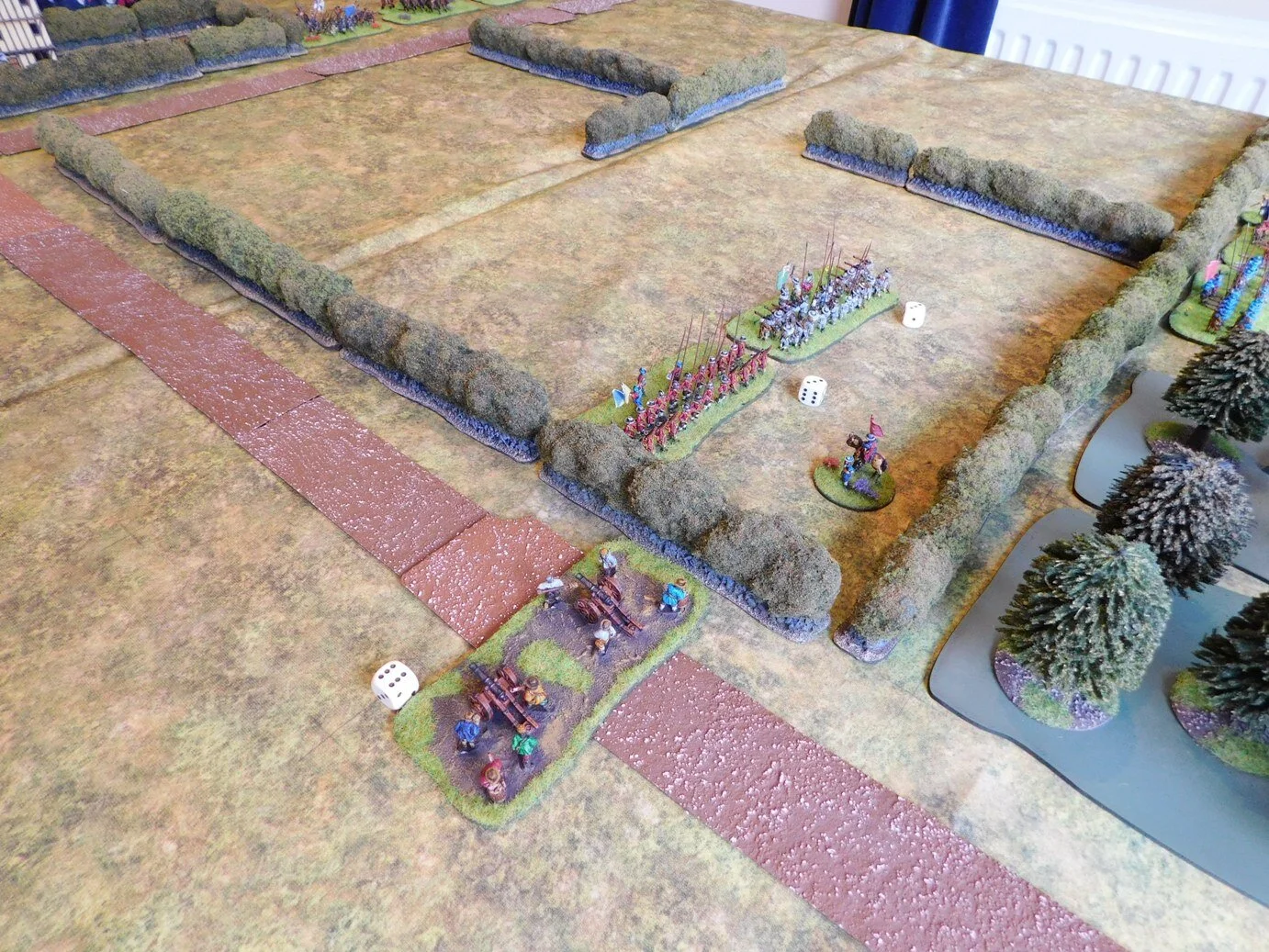
I had a chance to get my new English Civil War siege gun bases onto the tabletop as I played out the latest scenario in my North Wessex campaign using the For King & Parliament campaign.

Both sides have withdrawn from the field of their last encounter at Pinkney’s Court, with the Royalists now looping round to try and outflank the Parliamentarians. As a desperate excuse to justify the use of siege artillery, the Royalists receive a couple of huge cannon as a gift from the King. Keen to try them out, they set them up across open fields and prepare to fire off a coupe of shots. As they do so, the Roundheads appear on the other side of the field and battle is joined.

Here’s what happened:

This was a tricky battle for the Royalists as they start the game in a very awkward position. In addition, their siege guns just couldn’t hit anything and, when they did, my units saved time and time again.

A workmanlike Parliamentarian victory.

FK&P AAR: Pinkney's Court Again

I’ve now had a chance to play the Pinkney’s Court scenario another three times.

The first game, versus Bevan, was a complete disaster. The more nimble Swedish-style Royalist cavalry sliced and diced their Parliamentarian opponents, destroying all three units for the loss of only one of their own. That meant that I had to divert troops to shore up the position, leaving me short of infantry (and victory coins!) for the clash on the other flank. A crushing defeat!

The other two games, against Kavan, however, went much better. The first was a close run thing, but I eventually prevailed. The second was a glorious, overwhelming victory caused, I hasten to add, by the most amazing run of luck at the cards. In each of the initial three clashes, I hit three times out of five: not bad when you’re needing an 8+ on a 1-10 evens chance. Much like my men in the game described above, Kavan’s troops never really recovered.

Here are some pictures of the game I lost:

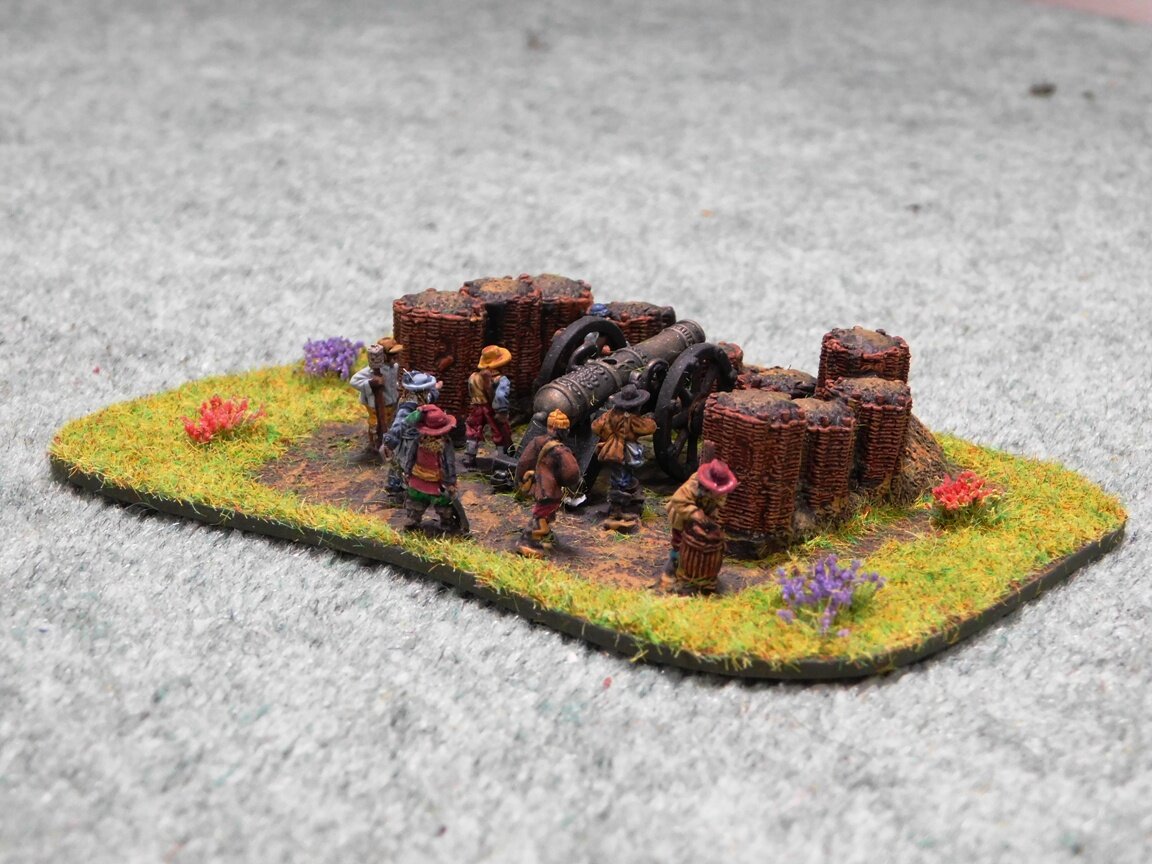
Siege Guns

Having equipped my ECW armies with light guns and field artillery, it was time to add the big boys: a couple of Siege Gun elements.

The guns themselves were no problem: many years ago I was at an English Heritage site (or similar) and came across a tub of artillery models that have, over the years, proved ideal for siege gun-sized artillery pieces. I still have a handful left, so two of them would form the centrepiece of the elements.

I wanted the siege gun elements to look immobile, so rather than having the guns “naked” on a base, I bought a couple of resin gabion pieces from Peter Pig to serve as dressing. This also meant I didn’t have to have any sort of limber and team in the vicinity: they always take ages to do!

The crews initially came from Peter Pig, who do six different poses. Six men per gun didn’t seem enough, however, so I added a couple of Hallmark officer/sergeant types to each to bulk things out. Hallmark (available through Magister Militum) and Peter Pig size very well together.

I then discovered that the guns, gabions and crews didn’t really fit depth-wise on the standard element bases I’m using for my ECW troops. My standard bases are Warbases Vehicle Bases that fit up to about thirty foot or half as many horse figures without difficulty, and sit very nicely on my FK&P grided battlemat…but the combination of crew, gun and gabion stuck out over the end. Fortunately Warbases were able to supply customised “double depth” vehicle bases that exactly did the trick. I can even use the spares I ordered for TTS camps.

So that’s two siege gun elements now completed. More Romans on the way…

FK&P AAR: The Battle for Pinkney's Court

With Sir John Boulters seriously wounded as he led his Cuirassier bodyguard in a desperate, but ultimately futile, attempt to shore up his left flank at the battle of Widbrooke Common, his son, “Little John” Boulters, has taken command of Royalist forces around Maidenhythe.

This is not a moment too soon, as the Parliamentarians seek to take advantage of Sir John’s injury by striking for Pinkney’s Court, the manor house that sits on the edge of Pinkney’s Green, north-east of the town itself. Taking the manor will give them a fitting place from which to plan and direct the rest of their campaign.

The two sides will therefore fight it out at the Battle for Pinkney’s Court.

The Royalists (on the far side of the field, above) have positioned themselves around the court: infantry and gun in the centre and on the left, and most of their cavalry on the right.

The Roundheads have placed their strong Dutch horse contingent on the left, aiming to sweep across the open ground of the Green. Their infantry are on the right, and will need to cross fields in order to get at the opposition.

Both sides must defend their building. The Royalists lose three victory coins if the Court falls; the Parliamentarians have their train in the yards of the Golden Ball tavern, so will also lose three victory coins if the building top right is taken by the enemy.

Opening Moves

The action began with the cavalry on the Parliamentarian left wing. As the Roundhead Horse swept forward, one Squadron of Royalist horse headed left thinking to move up the road and take the enemy guns.

The Royalist commander (me!) had, however, misjudged things, and the right-hand unit of enemy Horse managed to get forward and charge them in the rear, smashing the Cavaliers from the field.

This success drove the Roundhead cavalry into a frenzy and, without thinking, they charged after the retreating Royalists, heading straight for the hedge behind which one of the Cookham Militia battalia waited.

This proved a foolish thing to do, and they were sent crashing backwards, and would spend the rest of the game lurking in the woods trying desperately to rally.

In the meantime, the rest of the Royalist horse would take advantage of their superior number of units and defeat the rest of the Parliamentarian cavalry. This wasn’t enough to break the whole Roundhead army so, as the Royalist horse promptly disappeared off table in pursuit, the game would be decided by the infantry.

The Other Side of the Field

The Roundheads advanced smartly up the field, but let one of their battalia get too far forward and become an isolated target for what little Royalist cavalry had been put on this flank.

I was sure that my two units of horse could take the Parliamentarian battalia: one to pin from the front, the other to hit if from the side.

Unfortunately, the rebels were made of stronger stuff than I had expected, and I ended up losing both units of horse to fire and melee. In particular, the Roundhead Gallant Gentleman (in blue on the front of the pike unit’s base) intervened at a crucial moment: the extra hit being just enough to finish me off.

Not a good start!

The main lines then clashed, but it was going to take something fairly miraculous to save the day now: I was outnumbered five battalia to two!

Miracles were in short supply on the Royalist side, so although my lone pike block lasted far longer than anyone expected, the Oxfordshire commanded shot were soon sent flying backwards, which was enough to finish the game in the Roundhead’s favour.

Aftermath

This was the narrowest of defeats. For about two turns, whoever lost the next unit would lose the game: my outnumbered infantry balanced by the lost Roundhead cavalry.

Another great game of For King & Parliament

Robert Avery